
Cal to kcal: convert calories to kilocalories
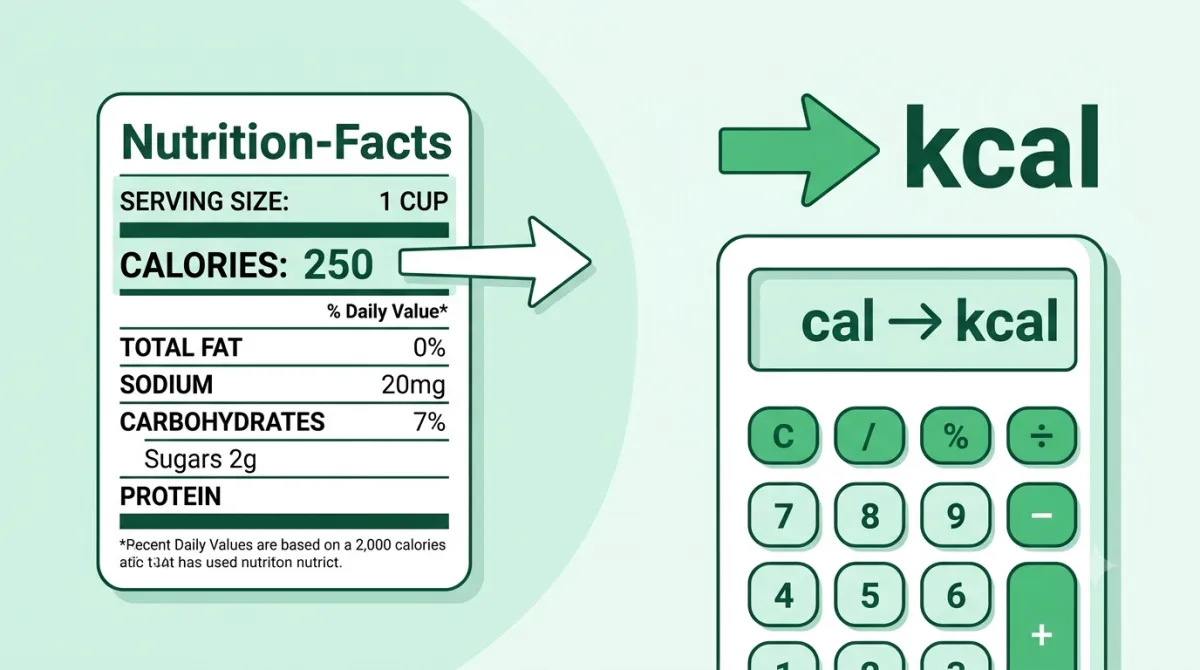
1 kcal = 1,000 cal. To convert cal to kcal, divide the number of calories by 1,000; to convert kcal to cal, multiply by 1,000. On food labels a "Calorie" with a capital C is actually a kilocalorie, so 1 Cal = 1 kcal — the value you see on packaging is already in kcal.
Cal ↔ kcal converter
Calories to kilocalories conversion table
| Calories (cal) | Kilocalories (kcal) |
|---|---|
| 100 cal | 0.1 kcal |
| 500 cal | 0.5 kcal |
| 1,000 cal | 1 kcal |
| 2,000 cal | 2 kcal |
| 1,000,000 cal | 1,000 kcal |
How to convert calories to kilocalories
- Small calories → kilocalories: divide by 1,000. Example: 750 ÷ 1,000 = 0.75 kcal.
- Kilocalories → small calories: multiply by 1,000. Example: 3 × 1,000 = 3,000.
- Food labels: a "Calorie" with a capital C already equals 1 kcal, so no maths is needed — 500 Calories = 500 kcal.
The only time you truly divide by 1,000 is when a source uses the scientific lowercase "calorie." Diet plans, food labels and fitness apps almost always already use kcal, so the numbers match.
Cal vs kcal — what's the difference?
A calorie (cal) is the energy needed to raise 1 gram of water by 1°C. A kilocalorie (kcal) is 1,000 of those calories. Because the small calorie is tiny, nutrition uses the kilocalorie instead — and writes it as "Calorie" with a capital C. So one food Calorie = one kcal = 1,000 cal.
Why food labels use kcal (or "Calories")
When a label says a meal has 600 calories, it means 600 kcal. Europe usually prints "kcal"; the US and UK often print "Calories." They're the same number — so you never need to convert label Calories to kcal, only the scientific lowercase "cal" (divide by 1,000).
Kilocalories and kilojoules (kJ)
Outside the US, many labels also show energy in kilojoules (kJ). One kilocalorie equals about 4.184 kJ: to go from kcal to kJ multiply by 4.184, and from kJ to kcal divide by 4.184. For example, 250 kcal ≈ 1,046 kJ. The energy you track for weight loss is still measured in kcal — kJ is simply a second unit printed on the same label.
Does the unit matter for weight loss?
For everyday tracking it rarely does, because the target in any diet plan or app is already in kcal. A daily goal of "2,000 calories" means 2,000 kcal, and a 500-kcal deficit is the same as a 500-Calorie deficit. Staying consistent matters far more than the label on the unit. BodyPal logs every meal in kcal automatically, so you never convert anything to know where you stand.
Quick reference
- 1 kilocalorie = 1,000 small calories = 1 food Calorie
- 1 kilocalorie ≈ 4.184 kilojoules
- To get kilocalories from small calories, divide by 1,000
- Label "Calories" need no conversion — they are already kcal
Stop converting by hand — snap a photo and BodyPal logs the kcal and macros for you.


Frequently asked questions
How many cal are in a kcal?
There are 1,000 cal in 1 kcal. To go from the small unit to the large one, divide by 1,000; to reverse it, multiply by 1,000.
Is cal the same as kcal on food labels?
On food labels, a "Calorie" with a capital C is actually a kilocalorie, so 1 Cal = 1 kcal. A food listed as 200 calories means 200 kcal.
How do I convert 2000 calories to kcal?
Divide by 1,000: 2,000 cal = 2 kcal. But 2,000 food Calories already equal 2,000 kcal, because a food Calorie is a kilocalorie.
Why are kcal and Calories used interchangeably?
In nutrition, the food "Calorie" is defined as one kilocalorie, so "Calories" and "kcal" mean the same energy. The lowercase "calorie" is the smaller scientific unit, 1/1,000 of a kcal.
Medical disclaimer: BodyPal provides general nutrition information, not medical advice. Talk to your doctor or a registered dietitian before making major dietary changes.