Cheese soup calories come to 231 for 1 cup (251 g) of canned soup prepared with milk, or 92 per 100 g. Fat supplies 56% of those calories, but sodium is the number to notice: one cup carries 1,019 mg, 44% of the daily value. Make it with water instead and the cup drops to 156.
231kcal
1 cup · 251 g, canned, prepared with milk
16%protein
9.5 gProtein
16 gCarbs
14.6 gFat
How to burn off 231 kcal
—Walking, brisk
—Jogging
—Cycling, moderate
—Swimming
Skip the math. BodyPal counts these calories from your steps and workouts automatically.
Nutrition facts
Canned, prepared with milk · per 251 g
Calories
231 kcal
Protein
9.5 g
Carbohydrate
16.2 g
Fat
14.6 g
Saturated fat
9.1 g
Cholesterol
48 mg
Sodium
1019 mg
Potassium
341 mg
Iron
0.8 mg
Source: USDA FoodData Central
🛡️
Verified nutrition data
Numbers on this page come from USDA FoodData Central, the U.S. Department of Agriculture’s food composition database, and from manufacturer labels where a branded product is named. Last verified October 2026. How we verify our data →
Cheese soup: calories, protein and sodium by serving
Percent of daily value uses the FDA reference of 2,000 kcal a day.
Serving
kcal
Protein
Carbs
Fat
Sodium
% DV kcal
1 cup (251 g)
231
9.5 g
16.2 g
14.6 g
1,019 mg
12%
Made with water (247 g)
156
5.4 g
10.5 g
10.5 g
958 mg
8%
1 can, prepared (609 g)
560
23 g
39.4 g
35.3 g
2,473 mg
28%
100 g
92
3.8 g
6.5 g
5.8 g
406 mg
5%
3 × 1 cup (251 g)
693
28.4 g
3,057 mg
5 × 1 cup (251 g)
1,155
47.3 g
5,095 mg
Milk or water decides the calorie count
Condensed cheese soup is half the recipe. The other half is whatever you pour in, and that choice moves the total more than any brand difference. A cup made with milk lands at 231 calories with 9.5 g of protein. The same soup made with water comes to 156 calories in a 247 g serving, with 5.4 g of protein.
So milk adds calories, but it also adds protein, and the fat stays meaningful either way: 14.6 g per cup with milk, 10.5 g with water. If you want the lighter bowl, water is the easy swap. If you want the soup to act more like a meal, milk earns its extra calories through that higher protein line.
Sodium barely moves between the two versions. The milk cup has 1,019 mg and the water cup has 958 mg, 44% and 42% of the daily value. Whichever liquid you choose, the salt comes from the can.
One can is a 560-calorie pot
Labels count a can as several servings, but a prepared can of 609 g often ends up split between two people or eaten by one. Eaten alone, the whole can comes to 560 calories, 23 g of protein, 35.3 g of fat and 2,473 mg of sodium. That sodium figure is 108% of the daily value in a single sitting.
Refills add up fast. Two cups total 462 calories and 2,038 mg of sodium. Three cups reach 693 calories and 3,057 mg. A big batch of five cups, about 1,255 g, holds 1,155 calories and 5,095 mg of sodium, which is why a ladle size matters more here than with a broth-based soup.
The practical move is to measure the first bowl once. A standard 1 cup serving is 251 g, and seeing what that looks like in your own bowl keeps the second helping honest. BodyPal can also log the bowl from a photo if you skip the measuring cup.
Fat is more than half the calories
Per 100 g, cheese soup made with milk has 5.8 g of fat, 6.5 g of carbs and 3.8 g of protein. Translated into calories, fat supplies 56%, carbs 28% and protein 16%. This is a creamy soup in the full sense: the cheese and milk drive the energy, not starch or vegetables.
Saturated fat accounts for 3.6 g of the 5.8 g of fat per 100 g, against a daily value of 20 g. Cholesterol is 19 mg per 100 g, a small number next to the 300 mg daily value.
Fiber is close to absent at 0.4 g per 100 g and about 1 g per cup. That matters for fullness. A cup gives you 19% of the daily value for protein, which is respectable, but with little fiber and liquid volume it can leave you hungry sooner than the calories suggest.
Build the meal around the bowl
A cup at 231 calories is 12% of a 2,000-calorie day, so cheese soup works better as a side or a starter than as the whole meal. What it lacks is fiber and bulk. Pairing it with a plain salad or roasted vegetables adds both without adding much sodium.
Watch the usual partners. Grilled cheese, crackers and bread bowls stack more cheese and salt on a soup that already brings 44% of the sodium daily value per cup. If you watch sodium, keep the rest of the meal low in salt and stop at one cup.
If protein is the goal, make the soup with milk and add a lean protein on the side. That keeps the bowl at its milk-based 9.5 g of protein and turns a creamy starter into a meal that holds you longer.
How does cheese soup compare?
Here is how cheese soup stacks up against three other creamy or hearty soups, per 100 g and per usual serving.
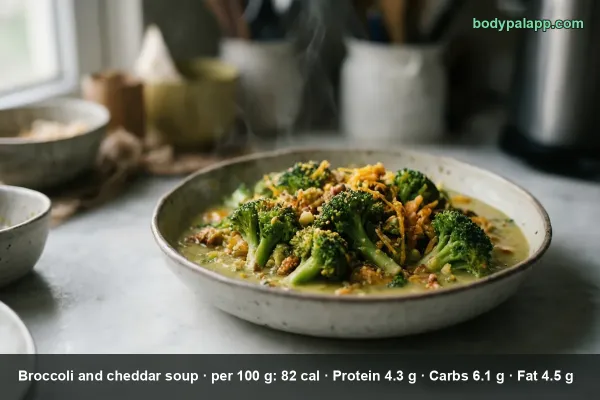
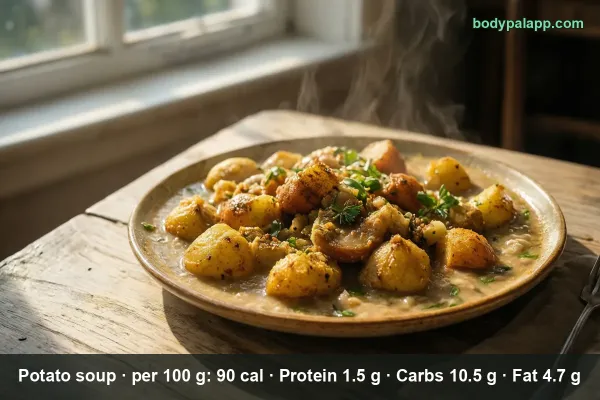
Verdict: For weight loss, broccoli and cheddar soup is the better pick at 82 calories and 329 mg of sodium per 100 g, against 92 calories and 406 mg for cheese soup. If sodium is your main concern, potato soup wins at 240 mg per 100 g, while cheese soup keeps a protein edge over it at 3.8 g versus 1.5 g.
Most popular cheese soup brands in the United States
Ranked by popularity in the BodyPal database
# Productkcal / 100 g
1Campbell's Potato Broccoli Cheese Soup1 cup · 240 ml71 kcal
6Progresso Broccoli Cheese Soup1 cup · 238 g71 kcal
7Jason's Deli Broccoli Cheese Soup1 cup · 245 g106 kcal
8Taste Broccoli Cheese Soup1 cup · 227 g53 kcal
Most labeled products are broccoli cheese soups, and condensed cans are labeled before adding milk or water, so their numbers differ from the milk-prepared soup above. Source: manufacturer labels / USDA FoodData Central.
Cheese soup FAQs
How many calories are in a cup of cheese soup?
About 231 calories per cup (251 g) when made with milk, or 156 calories per cup (247 g) when made with water.
Is cheese soup good for weight loss?
A cup made with milk has 231 calories and 14.6 g of fat. Made with water, the same cup has 156 calories and 10.5 g of fat.
Cheese soup vs potato soup: which has fewer calories?
They are close: cheese soup made with milk has 92 calories per 100 g and potato soup has 90. Made with water, cheese soup drops to 63 calories per 100 g.
How much protein is in cheese soup?
A cup made with milk has 9.5 g of protein, along with 16.2 g of carbs and 14.6 g of fat.
How many calories are in broccoli cheese soup?
Broccoli and cheddar soup has 82 calories per 100 g, a little under plain cheese soup at 92. It also carries 4.3 g of protein and 4.5 g of fat per 100 g, so it is slightly leaner.
How many carbs are in broccoli cheese soup?
Broccoli and cheddar soup has 6.1 g of carbs per 100 g. Plain cheese soup made with milk is close at 6.5 g per 100 g, or 16.2 g in a 251 g cup.
How many calories are in cheese soup made with water?
A 247 g serving of canned cheese soup made with water has 156 calories, compared with 231 for a cup made with milk. Protein falls too, from 9.5 g to 5.4 g.
How much sodium is in a can of cheese soup?
A whole can, prepared to 609 g, holds 2,473 mg of sodium, 108% of the 2300 mg daily value. One cup has 1,019 mg, which is 44%.
Is broccoli cheese soup lower in calories than cheese soup?
Yes, slightly. Broccoli and cheddar soup has 82 calories per 100 g versus 92 for cheese soup, and less sodium at 329 mg versus 406 mg.