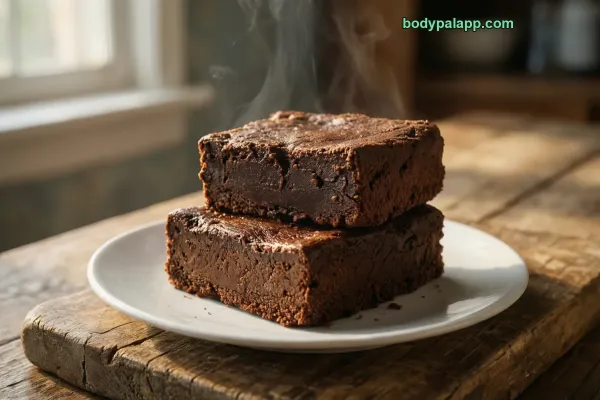
Chocolate mousse calories come to 455 for a half cup (202 g) and 225 per 100 g of mousse prepared from recipe. Fat is the story: it supplies 64% of the calories, with 9.2 g of saturated fat in every 100 g. Portion size matters more than usual, because a half cup is a generous scoop.
455kcal
1 half cup · 202 g, prepared from recipe
7%protein
8.4 gProtein
32 gCarbs
32 gFat
How to burn off 455 kcal
—Walking, brisk
—Jogging
—Cycling, moderate
—Swimming
Skip the math. BodyPal counts these calories from your steps and workouts automatically.
Nutrition facts
Prepared from recipe · per 202 g
Calories
455 kcal
Protein
8.4 g
Carbohydrate
32 g
Fat
32 g
Saturated fat
18.5 g
Cholesterol
283 mg
Sodium
77 mg
Potassium
289 mg
Iron
1.1 mg
Source: USDA FoodData Central
🛡️
Verified nutrition data
Numbers on this page come from USDA FoodData Central, the U.S. Department of Agriculture’s food composition database, and from manufacturer labels where a branded product is named. Last verified September 2026. How we verify our data →
Chocolate mousse: calories, protein and sodium by serving
Percent of daily value uses the FDA reference of 2,000 kcal a day.
Serving
kcal
Protein
Carbs
Fat
Sodium
% DV kcal
1/2 cup (202 g)
455
8.4 g
32.5 g
32.3 g
77 mg
23%
100 g
225
4.1 g
16.1 g
16 g
38 mg
11%
4 oz portion (113 g)
254
4.7 g
18.2 g
18.1 g
43 mg
13%
Pie slice (95 g)
247
3.3 g
28.1 g
14.6 g
437 mg
12%
3 × 1/2 cup (202 g)
1,364
25.1 g
230 mg
5 × 1/2 cup (202 g)
2,273
41.8 g
384 mg
A half cup is a 455-calorie dessert
The standard half cup weighs 202 g and carries 455 calories, about 23% of the daily value for calories. That is a light meal's worth of energy served in a dessert glass. A smaller 4 oz portion (113 g) drops the total to 254 calories, or 13% of the daily value, and still looks like a proper serving in a ramekin.
Mousse is easy to overeat because it is airy, sweet and gone in a few spoonfuls. Two half cups weigh 404 g and reach 909 calories. Three come to 1,364. A party batch of five half cups, 1,010 g in total, adds up to 2,273 calories, so going back to the bowl for seconds counts for more than it feels like it should.
Mousse pie behaves differently. A 95 g pie slice lists 247 calories, close to the 4 oz cup, but its sodium jumps to 437 mg, 19% of the daily value. If you order mousse as a slice rather than a cup, the calories look similar while the salt does not.
Fat supplies nearly two thirds of the calories
Per 100 g, chocolate mousse has 16 g of fat, 16.1 g of carbohydrate and 4.1 g of protein. On paper fat and carbs look evenly matched. The calorie split tells the real story: 64% of the calories come from fat, 29% from carbs and just 7% from protein. This is a rich, cream-and-egg dessert, and the numbers show it.
In a half cup that means 32.3 g of fat, 32.5 g of carbs and 8.4 g of protein. The protein looks respectable at 17% of the daily value, but it arrives with 455 calories, so mousse is not a protein food in any useful sense. Fiber is a footnote at 1.2 g per half cup.
Nearly all of the carbohydrate is sugar: 14.8 g of the 16.1 g per 100 g, and 29.9 g in a half cup. There is little starch and almost no fiber to slow things down. Sweetness and richness are the whole package, which is exactly why it tastes the way it does.
Saturated fat and cholesterol are the rows to watch
Of the 16 g of fat in 100 g of mousse, 9.2 g is saturated. Set that against a daily value of 20 g and a modest portion already takes a large bite out of it. A half cup weighs about twice as much as that 100 g reference, so the saturated fat in a standard serving is the single most notable number on this page.
Cholesterol is just as striking: 140 mg per 100 g, against a daily value of 300 mg. A recipe mousse is built on eggs and cream, and that shows up here. If you track either saturated fat or cholesterol, the 4 oz portion is the sensible ceiling for a regular treat.
Sodium, by contrast, is not a concern for the cup version. A half cup has 77 mg, only 3% of the daily value, and 100 g has 38 mg. If you watch sodium, the pie slice at 437 mg is the one to check, not the mousse itself. Potassium sits at 143 mg per 100 g.
Smaller cups make mousse easy to fit in
If you want mousse without it taking over the day, portion it before it reaches the table. The 4 oz portion at 254 calories delivers the same texture and flavor as the half cup for a little over half the calories. Small ramekins or espresso cups do the measuring for you, and nobody feels short-changed.
Pair it with something that adds volume rather than more fat. Fresh berries, orange segments or a few raspberries on top bring color, freshness and some of the fiber that mousse lacks at 0.6 g per 100 g. Skip the extra whipped cream if you are counting, since the dessert is already 64% fat by calories.
Plan around it on the days you have it. A lighter dinner leaves room for a 455-calorie half cup, and sharing one serving between two people is the simplest trick of all. BodyPal can log your mousse from a photo, so the portion you actually ate is the one that gets counted.
How does chocolate mousse compare?
Here is how chocolate mousse stacks up against chocolate pudding, chocolate cupcake and chocolate fudge, per 100 g and per usual serving.
Verdict: For the lightest chocolate fix pick chocolate pudding: 142 calories per 100 g and 153 per snack cup, with only 4.6 g of fat per 100 g. Fudge and cupcakes are denser at 410 and 355 calories per 100 g, but a 70-calorie piece of fudge beats any mousse portion if you only want a taste.
Most popular chocolate mousse brands in the United States
5Private Selection Belgian Dark Chocolate Mousse1 unit · 57 g368 kcal
6Private Selection Strawberry White Chocolate Mousse1 unit · 57 g316 kcal
Most packaged chocolate mousse items are mousse-filled candies, cones or cakes rather than spooned mousse, so their per-100-g numbers run above the 225 of the recipe version. Source: manufacturer labels / USDA FoodData Central.
Chocolate mousse FAQs
How many calories are in chocolate mousse?
Half a cup of chocolate mousse prepared from a recipe (202 g) is about 455 calories, and 100 g is 225 calories.
Is chocolate mousse good for weight loss?
It is calorie-dense: 100 g carries 225 calories, 16 g of fat and 4.1 g of protein, so a half-cup serving reaches 455 calories. A 100 g portion keeps it to 225.
Chocolate mousse vs chocolate pudding: which is lighter?
Chocolate pudding has 142 calories per 100 g against 225 for chocolate mousse, mainly because mousse carries 16 g of fat per 100 g.
How much sugar is in chocolate mousse?
Per 100 g there are 14.8 g of sugars and 16.1 g of carbs in total. A half-cup serving (202 g) comes to 29.9 g of sugars.
How many carbs are in chocolate mousse?
A half cup of chocolate mousse has 32.5 g of carbs, and 100 g has 16.1 g. Most of that is sugar, 29.9 g per half cup, while fiber is just 1.2 g.
Is chocolate mousse high in calories?
Yes, at 225 calories per 100 g it is a dense dessert. A half cup reaches 455 calories, 23% of the daily value. It is lighter than fudge at 410 per 100 g but heavier than pudding at 142.
How many calories are in one cup of chocolate mousse?
One cup, or two half cups weighing 404 g, comes to 909 calories. That cup also carries 16.7 g of protein and 154 mg of sodium, so the calories rise far faster than anything else.
How many calories are in a slice of chocolate mousse pie?
A 95 g pie slice has 247 calories, with 14.6 g of fat and 28.1 g of carbs. Its sodium is much higher than plain mousse at 437 mg, 19% of the daily value.
How much fat is in chocolate mousse?
A half cup of chocolate mousse has 32.3 g of fat, and 100 g has 16 g, of which 9.2 g is saturated. Fat supplies 64% of the calories, making it the dominant macro.