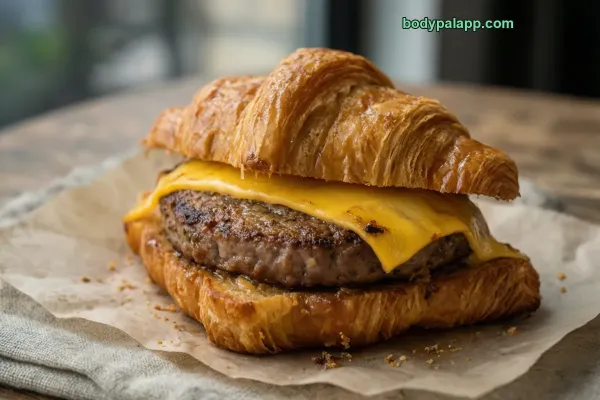
Tim Hortons croissant calories come to 272 for one large 67 g croissant and 406 per 100 g. Fat supplies 47% of those calories and carbs 45%, while protein covers just 8%. That makes it a rich, buttery pastry that will not keep you full for long. Size matters too: a small croissant comes in at 171.
272kcal
1 large croissant · 67 g, butter croissant, bakery style
8%protein
5.5 gProtein
31 gCarbs
14.1 gFat
How to burn off 272 kcal
—Walking, brisk
—Jogging
—Cycling, moderate
—Swimming
Skip the math. BodyPal counts these calories from your steps and workouts automatically.
Nutrition facts
Butter croissant, bakery style · per 67 g
Calories
272 kcal
Protein
5.5 g
Carbohydrate
31 g
Fat
14.1 g
Saturated fat
7.8 g
Cholesterol
45 mg
Sodium
257 mg
Potassium
79 mg
Iron
1.4 mg
Source: USDA FoodData Central
🛡️
Verified nutrition data
Numbers on this page come from USDA FoodData Central, the U.S. Department of Agriculture’s food composition database, and from manufacturer labels where a branded product is named. Last verified September 2026. How we verify our data →
Tim hortons croissant: calories, protein and sodium by serving
Percent of daily value uses the FDA reference of 2,000 kcal a day.
Serving
kcal
Protein
Carbs
Fat
Sodium
% DV kcal
Large (67 g)
272
5.5 g
30.7 g
14.1 g
257 mg
14%
Medium (57 g)
231
4.7 g
26.1 g
12 g
219 mg
12%
Small (42 g)
171
3.4 g
19.2 g
8.8 g
161 mg
9%
100 g
406
8.2 g
45.8 g
21 g
384 mg
20%
3 × Large (67 g)
816
16.5 g
772 mg
5 × Large (67 g)
1,360
27.5 g
1,286 mg
One large croissant is a 272-calorie snack
The figures here are USDA values for a bakery-style butter croissant, not numbers published by Tim Hortons. A large 67 g croissant comes to 272 calories, which is 14% of a 2,000-calorie daily value. A medium 57 g croissant drops to 231 calories, or 12%, and a small 42 g croissant is 171 calories, or 9%. If you can't tell which size you have, the large figure is the safe one to log.
Totals climb fast once you have more than one. Two large croissants add up to 544 calories and 515 mg of sodium. Three come to 816 calories, and a box of five reaches 1,360 calories with 1,286 mg of sodium. That last number is more than half of the 2,300 mg daily value, which is easy to miss when the croissants are shared at a meeting and you keep reaching for another.
Protein barely moves as you add more. Two large croissants give 11 g of protein and five give 27.5 g. You would have to eat 1,360 calories of pastry to get there. If portion control is the goal, the small size is the cleanest win: you still get the full flaky texture and save about a hundred calories compared with the large.
Butter supplies almost half of every bite
The calorie split is almost even between fat at 47% and carbs at 45%, with protein trailing at 8%. Per 100 g, that works out to 21 g of fat, 45.8 g of carbs and 8.2 g of protein. A croissant is basically refined flour folded around layers of butter, and the numbers show it.
In a large croissant you get 14.1 g of fat, 30.7 g of carbs and 5.5 g of protein. The protein covers 11% of the daily value, which sounds respectable until you notice that the calories cover 14%. Fiber is low at 1.7 g, and sugars sit at 7.5 g. Little in that mix slows digestion, so the energy arrives quickly and fades quickly.
None of this makes the croissant a bad choice. It just tells you what kind of food it is. Treat it as a treat with a real calorie cost, not as a light pastry. The flaky texture makes it look airy, but by weight it is denser in calories than any of the croissant sandwiches it is compared with below.
Saturated fat is the row to watch
Per 100 g, the croissant carries 11.7 g of saturated fat. The daily value used on this page is 20 g, so 100 g of croissant uses up more than half of it. A large croissant weighs a bit less than 100 g, but it still takes a large share of the day's saturated fat. That comes almost entirely from the butter layers that make it flaky.
Sodium is moderate rather than alarming. A large croissant has 257 mg, or 11% of the 2,300 mg daily value, and a small one has 161 mg, or 7%. Cholesterol comes to 67 mg per 100 g against a daily value of 300 mg. On its own, one croissant fits comfortably into most days on both counts.
The picture changes when the croissant is only part of the order. Add bacon, sausage or cheese and both sodium and saturated fat go up quickly. If you track either one, log the plain croissant and the fillings separately so you can see where the numbers really come from.
Pair it with protein so it lasts until lunch
With just 5.5 g of protein in a large croissant, the pastry rarely holds you until lunch on its own. Pairing it with a protein-rich side does more for fullness than skipping butter or jam. Eggs, plain yogurt or a milk-based coffee all add protein without much extra fat.
If calories are tight, choose the small 171-calorie croissant and leave room for the drink. Sweetened coffee drinks can add as much as the pastry, so look at the cup as well as the bag. A croissant with black coffee or tea is the leanest version of this breakfast.
Spreads count too. Butter, cream cheese or jam on a croissant that is already 47% fat calories adds up quickly, so log what goes on it. If you'd rather skip typing, BodyPal can log the croissant from a photo, and you can then pick the size that matches what you were served.
How does tim hortons croissant compare?
Here is how the Tim Hortons croissant stacks up against the Starbucks butter croissant and two croissant breakfast sandwiches, per 100 g and per usual serving.
Verdict: For the fewest calories pick a plain croissant: at 272 calories it matches the Starbucks butter croissant, while the Burger King sausage croissant reaches 527. For staying full, the croissant breakfast sandwich is the better buy at 370 calories with 12.9 g of protein per 100 g, though its sodium climbs to 602 mg per 100 g.
Tim hortons croissant FAQs
How many calories are in a Tim Hortons croissant?
A large butter croissant (67 g) has about 272 calories, and a medium one (57 g) has 231.
Is a Tim Hortons croissant good for weight loss?
One large croissant has 272 calories with 14.1 g of fat and 5.5 g of protein. Per 100 g it has 406 calories.
Tim Hortons croissant vs Starbucks croissant: which has more calories?
Both are butter croissants at 406 calories per 100 g, so the difference comes from size: 272 calories for a 67 g croissant, 231 for a 57 g one.
How many carbs are in a Tim Hortons croissant?
A large croissant (67 g) has about 30.7 g of carbs, including 7.5 g of sugars. Per 100 g it has 45.8 g of carbs.
How many calories are in two Tim Hortons croissants?
Two large croissants come to 544 calories. They also bring 515 mg of sodium and 11 g of protein, so the calories double while the pastry still adds little protein.
How much fat is in a Tim Hortons croissant?
A large croissant has 14.1 g of fat, and a medium one has 12 g. Fat supplies 47% of its calories, and saturated fat comes to 11.7 g per 100 g, almost all of it from butter.
How much sodium is in a Tim Hortons croissant?
A large croissant has 257 mg of sodium, which is 11% of the 2,300 mg daily value. A small one has 161 mg, or 7%. Fillings like bacon or sausage push that number much higher.
How much protein does a Tim Hortons croissant have?
A large croissant has 5.5 g of protein, or 11% of the daily value. Protein supplies just 8% of its calories, so pair it with eggs or yogurt if you want it to keep you full.
How much sugar is in a Tim Hortons croissant?
A large croissant has 7.5 g of sugars, and a small one has 4.7 g. Per 100 g, that comes to 11.3 g, so a croissant is less sweet than most pastries but not sugar-free.