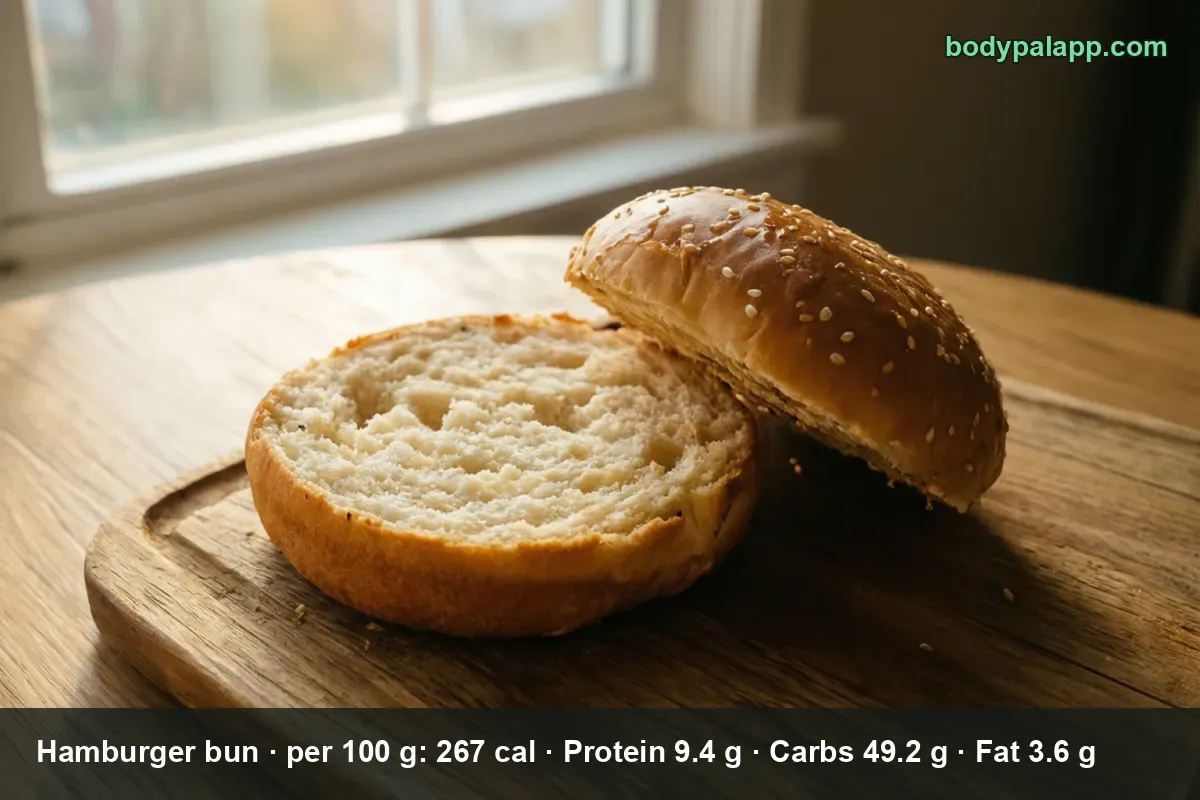
Hamburger bun calories come to 139 for one 52 g plain white bun and 267 per 100 g. Carbs supply 74% of those calories, and the bun alone carries 234 mg of sodium, 10% of the daily value, before the patty, cheese or ketchup go anywhere near it.
139kcal
1 bun · 52 g, white, plain
14%protein
4.9 gProtein
26 gCarbs
1.9 gFat
How to burn off 139 kcal
—Walking, brisk
—Jogging
—Cycling, moderate
—Swimming
Skip the math. BodyPal counts these calories from your steps and workouts automatically.
Nutrition facts
White, plain · per 52 g
Calories
139 kcal
Protein
4.9 g
Carbohydrate
26 g
Fat
1.9 g
Saturated fat
0.4 g
Cholesterol
0 mg
Sodium
234 mg
Potassium
61 mg
Iron
1.7 mg
Source: USDA FoodData Central
🛡️
Verified nutrition data
Numbers on this page come from USDA FoodData Central, the U.S. Department of Agriculture’s food composition database, and from manufacturer labels where a branded product is named. Last verified September 2026. How we verify our data →
Hamburger bun: calories, protein and sodium by serving
Percent of daily value uses the FDA reference of 2,000 kcal a day.
Serving
kcal
Protein
Carbs
Fat
Sodium
% DV kcal
1 bun (52 g)
139
4.9 g
25.6 g
1.9 g
234 mg
7%
Small bun (28 g)
75
2.6 g
13.8 g
1 g
126 mg
4%
Whole wheat (52 g)
140
6.4 g
23.4 g
2.3 g
248 mg
7%
100 g
267
9.4 g
49.2 g
3.6 g
450 mg
13%
3 × 1 bun (52 g)
417
14.7 g
702 mg
5 × 1 bun (52 g)
694
24.5 g
1,170 mg
One bun is 139 calories, a small one 75
A standard white hamburger bun weighs 52 g and lands at 139 calories, which is 7% of the daily value for energy. A small slider-style bun of 28 g comes in at 75 calories. A whole wheat bun of the same 52 g sits at 140, so the grain type barely moves the number.
Buns add up faster than people expect at a cookout. Two buns come to 278 calories, three reach 417, and five land at 694. If you double up on burgers or go back for a second one, the bread alone turns into a full snack's worth of energy before anything goes inside.
Size is the lever that works. Going from a regular bun to a small one cuts the bun's calories nearly in half, while swapping white for whole wheat changes almost nothing. An open-faced burger on just the bottom half is another simple way to shrink the total without changing what you eat.
Nearly three quarters of the calories are carbs
Carbohydrate supplies 74% of the calories in a hamburger bun, protein 14% and fat 12%. Per 100 g that works out to 49.2 g of carbs, 9.4 g of protein and 3.6 g of fat. In a single 52 g bun you get 25.6 g of carbs, 4.9 g of protein and 1.9 g of fat.
Sugar is modest for a soft white roll: 2.8 g per bun, or 5.3 g per 100 g. Fiber is low at 1.2 g per bun. Saturated fat is just 0.8 g per 100 g and cholesterol is 0, so the fat side of the label is not where the story is.
The protein looks respectable at 10% of the daily value per bun, but the bun is a carrier, not the main event. Think of it as a carb serving and let the filling supply most of the protein in the meal. That framing makes it easier to judge whether a second bun is worth it.
Sodium is the row to watch
One plain bun holds 234 mg of sodium, 10% of the 2300 mg daily value. Per 100 g the figure is 450 mg, or 20%. Bread rarely tastes salty, which is exactly why this row slips past people. Most readers check the calorie line and stop there.
Multiply it and the bun becomes a real share of the day. Two buns carry 468 mg, three carry 702 mg, and five reach 1,170 mg, just over half the daily value before any meat, cheese, pickles or sauce. A whole wheat bun runs slightly higher at 248 mg, 11% of the daily value.
If you watch sodium, the small 28 g bun is the easiest win at 126 mg, or 5% of the daily value. Treat the bun as a fixed cost and spend the rest of your sodium budget on toppings you actually care about. Salty add-ons stack on top of the bread, not instead of it.
Whole wheat buys fiber, not fewer calories
A 52 g whole wheat bun has 140 calories against 139 for white, a tie in practice. The difference shows up elsewhere: 3.2 g of fiber instead of 1.2 g, and 6.4 g of protein instead of 4.9 g, which lifts protein to 13% of the daily value from 10%. Carbs dip slightly, to 23.4 g from 25.6 g.
Store shelves offer more variety than this plain white roll covers. Brioche buns such as Whole Foods Market Brioche Hamburger Buns, potato buns from Meijer and pretzel buns from Aunt Millie's all sit in the bread aisle, and richer doughs can read quite differently on the label, so check the package for the one you buy.
Because the bun is mostly carbs, it pairs well with a lean patty, plenty of lettuce, tomato and onion, and a side of vegetables instead of a second starch like fries. If you track meals, BodyPal can log the bun from a photo, so the bread does not quietly vanish from your daily count.
How does hamburger bun compare?
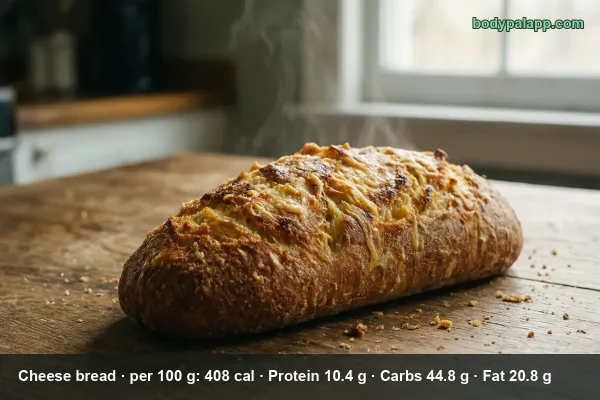
Here is how a plain hamburger bun stacks up against a Hawaiian roll and cheese bread, per 100 g and per usual serving.
Verdict: For the fewest calories per gram, the hamburger bun wins at 267 per 100 g, while cheese bread runs about 1.5 times higher at 408 with 20.8 g of fat. If you want a sweet roll anyway, one Hawaiian roll at 96 calories is a smaller hit than a full bun, even though it is denser at 321 per 100 g.
Most popular hamburger bun brands in the United States
Label buns run from 39 g to 74 g, so one packaged bun can land well above or below the 52 g portion used above. Source: manufacturer labels / USDA FoodData Central.
Hamburger bun FAQs
How many calories are in one hamburger bun?
A standard white hamburger bun weighs 52 g and has 139 calories. A miniature 28 g bun is 75 calories.
Are hamburger buns good for weight loss?
One white bun adds 139 calories to a burger. A whole wheat bun of the same 52 g size is 140 calories but carries 6.1 g fiber per 100 g instead of 2.3 g.
Hamburger bun or Hawaiian roll: which has more calories?
Per 100 g a hamburger bun is 267 calories and a Hawaiian roll is 321 calories.
How many carbs are in a hamburger bun?
One 52 g bun has about 25.6 g carbs, 4.9 g protein and 1.9 g fat, with 2.8 g sugars.
How many calories are in a small hamburger bun?
A small 28 g hamburger bun has 75 calories, about 4% of the daily value. It also carries 13.8 g of carbs, 2.6 g of protein and 126 mg of sodium, making it the lightest way to keep a bun on your burger.
How many calories are in a plain white bun per 100 g?
Plain white hamburger bun has 267 calories per 100 g, with 49.2 g of carbs, 9.4 g of protein and 3.6 g of fat. That 100 g is close to two standard buns, which together total 278 calories.
How many calories are in two or three hamburger buns?
Two standard 52 g buns have 278 calories and three have 417. Sodium climbs alongside, to 468 mg for two buns and 702 mg for three, so doubles and seconds add up on more than one line of the label.
Does a whole wheat hamburger bun have fewer calories?
No. A 52 g whole wheat bun has 140 calories, one more than the 139 in a white bun. You do get more fiber, 3.2 g versus 1.2 g, and more protein, 6.4 g versus 4.9 g.
How many carbs are in a small hamburger bun?
A small 28 g hamburger bun has 13.8 g of carbs, including 1.5 g of sugars and 0.6 g of fiber. A standard 52 g bun has 25.6 g, so the small size cuts carbs nearly in half.