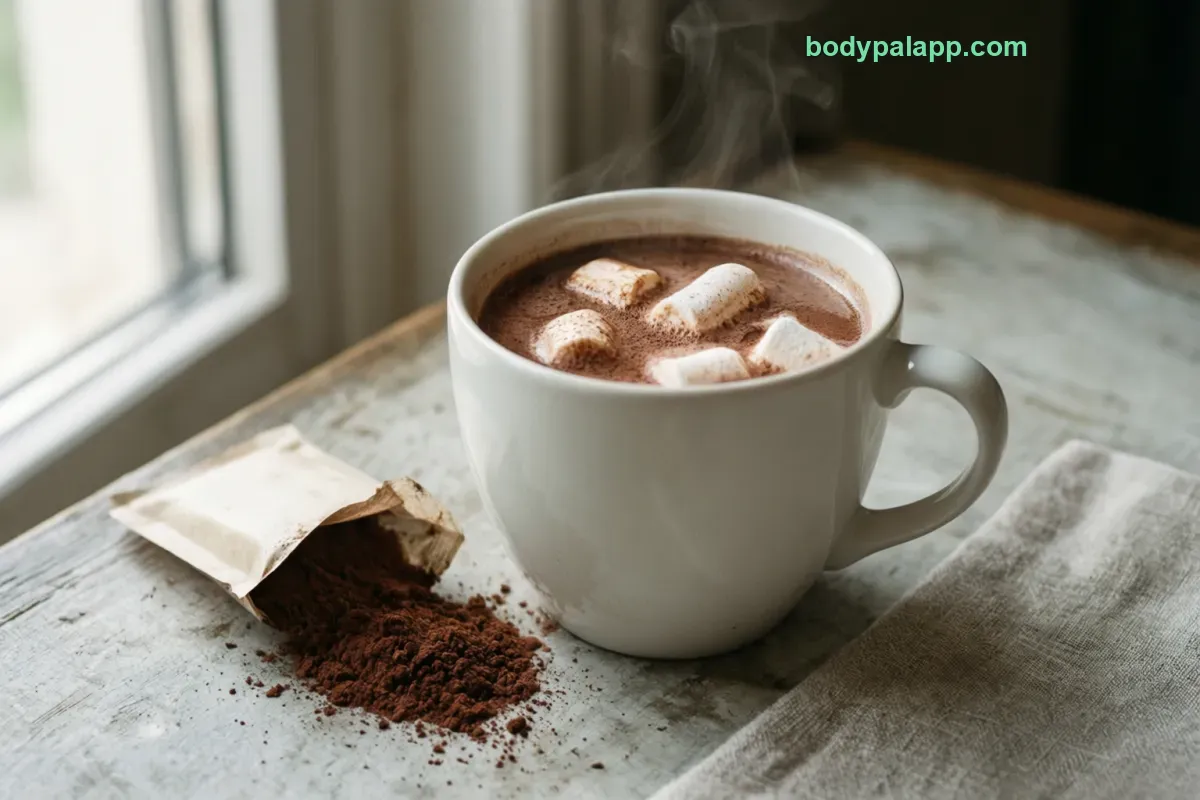
Hot chocolate packet calories come to 134 for one packet made with water (248 g), or 54 per 100 g. The thing to notice is where they come from: carbs supply 84% of the calories, with 21.9 g of sugars per packet against only 2.2 g of protein. The reduced-sugar version drops the mug to 77.
134kcal
1 packet made with water · 248 g, dry mix, made with water
7%protein
2.2 gProtein
28 gCarbs
1.3 gFat
How to burn off 134 kcal
—Walking, brisk
—Jogging
—Cycling, moderate
—Swimming
Skip the math. BodyPal counts these calories from your steps and workouts automatically.
Nutrition facts
Dry mix, made with water · per 248 g
Calories
134 kcal
Protein
2.2 g
Carbohydrate
28 g
Fat
1.3 g
Saturated fat
0.8 g
Cholesterol
0 mg
Sodium
176 mg
Potassium
238 mg
Iron
0.4 mg
Source: USDA FoodData Central
🛡️
Verified nutrition data
Numbers on this page come from USDA FoodData Central, the U.S. Department of Agriculture’s food composition database, and from manufacturer labels where a branded product is named. Last verified September 2026. How we verify our data →
Hot chocolate packet: calories, protein and sodium by serving
Percent of daily value uses the FDA reference of 2,000 kcal a day.
Serving
kcal
Protein
Carbs
Fat
Sodium
% DV kcal
1 packet (248 g)
134
2.2 g
27.9 g
1.3 g
176 mg
7%
Reduced sugar (248 g)
77
3.1 g
14.6 g
0.6 g
186 mg
4%
With non-dairy milk (248 g)
201
4.7 g
34.5 g
4.8 g
278 mg
10%
100 g
54
0.9 g
11.3 g
0.5 g
71 mg
3%
3 × 1 packet (248 g)
402
6.7 g
528 mg
5 × 1 packet (248 g)
670
11.2 g
880 mg
A second packet takes the mug to 268 calories
One packet stirred into water makes a 248 g mug with 134 calories, about 7% of a daily value. That is a modest number for a sweet drink, and it is why a single packet rarely causes trouble on its own. The problem is that hot chocolate is easy to repeat.
Use two packets in a large mug, or have a second cup later, and the total reaches 268 calories with 352 mg of sodium. Three packets over a cold afternoon add up to 402 calories. Five across a weekend of sledding or game nights land at 670 calories and 880 mg of sodium, yet only 11.2 g of protein. The calories climb in a straight line while the drink never gets more filling.
If you like a stronger, richer cup, the honest trade is clear: doubling the powder doubles the calories. Using less water with one packet changes the taste, not the count, since the powder carries nearly all of it. Count packets, not mugs, and the log stays accurate.
Sugar does nearly all the work
The calorie split is lopsided: 84% from carbs, 9% from fat and 7% from protein. Per 100 g, the made-up drink has 11.3 g of carbs, and 8.8 g of those are sugars. Fat sits at 0.5 g with 0.3 g saturated, and cholesterol is 0. This is a sweetened drink first and a chocolate drink second.
Per packet, that works out to 27.9 g of carbs and 21.9 g of sugars. Fiber is 1.2 g, a small contribution from the cocoa. Protein is 2.2 g, only 4% of a daily value, because water adds nothing and the mix itself is mostly sugar and cocoa.
That profile explains how the drink behaves. It warms you up and tastes rich, but with so little protein or fat it does little to keep you full. Treat it as a sweet treat that happens to be hot, not as a snack that replaces food.
Reduced sugar cuts it to 77, non-dairy milk lifts it to 201
The same 248 g mug swings widely depending on the packet and the liquid. Reduced-sugar mix made with water comes to 77 calories, with 14.6 g of carbs and 7.6 g of sugars. It also has slightly more protein, 3.1 g, and fiber of 1.5 g. If you drink hot chocolate often, this is the easiest switch on the page.
Swapping water for non-dairy milk goes the other way. That mug reaches 201 calories, 10% of a daily value, with 34.5 g of carbs, 26.2 g of sugars and 4.8 g of fat. Protein rises to 4.7 g, which is better than water, but you pay for it in sugar and calories.
Sodium follows the same pattern. The standard packet with water has 176 mg, 8% of a daily value, and the reduced-sugar mug has 186 mg, also 8%. The non-dairy milk version climbs to 278 mg, or 12%. None of these is high for one cup, but it matters if you have several.
One mug fits easily; the extras are the real cost
At 134 calories, a single packet with water fits into most days without much planning. It works best as a deliberate treat: an evening mug, or something warm after time outside. Where it goes wrong is as a habit stacked on top of cookies, marshmallows or a second refill.
Because the drink brings only 2.2 g of protein, pair it with something that has more staying power if it is part of a snack. A handful of nuts, a piece of cheese or a yogurt balances the sugar-heavy mug far better than a pastry. If you are watching sugar, the reduced-sugar packet at 7.6 g per mug is the cleaner base.
Brands such as Monbana Organic Hot Chocolate Original, Lake Champlain Chocolates Hot Chocolate or Franzese Hot Chocolate may differ from the USDA values here, so check the label on your box. BodyPal can log the mug from a photo, which makes it simple to see how a second packet changes your day.
How does hot chocolate packet compare?
Here is how a hot chocolate packet made with water stacks up against similar chocolate drinks, per 100 g and per usual serving.
Verdict: For the fewest calories in a chocolate drink, the packet made with water at 134 and chocolate almond milk at 120 per cup are close to even, while the chocolate shake at 357 is about 2.2 times the packet. Pick the shake only if you want more protein, 3.1 g per 100 g against 0.9 g, and can spare the calories.
Most popular hot chocolate packet brands in the United States
Ranked by popularity in the BodyPal database
# Productkcal / 100 g
1Sillycow Farms Hot Chocolate2 tsp · 21 g381 kcal
2Franzese Hot Chocolate1 packet · 25 g342 kcal
3Lake Champlain Chocolates Hot Chocolate2 Tbsp · 28 g357 kcal
4Monbana Organic Hot Chocolate Original2 tsp · 20 g340 kcal
Label numbers are for the dry mix per 100 g, while the page's main number is for the drink after the packet is prepared with water. Source: manufacturer labels / USDA FoodData Central.
Hot chocolate packet FAQs
How many calories are in one hot chocolate packet?
About 134 calories for one packet mixed with water (248 g). Mixed with non-dairy milk it comes to about 201.
Is a hot chocolate packet good for weight loss?
One packet made with water has 134 calories and 1.3 g of fat. The reduced sugar version is 77 calories per packet.
Hot chocolate packet vs chocolate shake: which has fewer calories?
Hot chocolate from a packet made with water has 54 calories per 100 g. A chocolate shake has 119 calories per 100 g.
How much sugar is in a hot chocolate packet?
About 21.9 g of sugar and 28.0 g of carbs per packet made with water. A reduced sugar packet has about 7.6 g of sugar.
How many calories are in reduced-sugar hot chocolate?
A reduced-sugar hot chocolate made with water has 77 calories per 248 g mug, compared with 134 for the regular packet. It also has 7.6 g of sugars instead of 21.9 g.
Does making hot chocolate with non-dairy milk add calories?
Yes. Made with non-dairy milk, a 248 g mug comes to 201 calories versus 134 with water. Sugars rise to 26.2 g and fat to 4.8 g, though protein improves to 4.7 g.
How much sodium is in a hot chocolate packet?
One packet made with water has 176 mg of sodium, about 8% of the daily value. Two packets bring it to 352 mg, and the non-dairy milk version has 278 mg per mug.
How many calories are in two packets of hot chocolate?
Two packets made with water total 268 calories across 496 g of drink. Three packets reach 402 calories, so doubling up in a big mug adds up quickly.
How much protein is in a hot chocolate packet?
A packet made with water has just 2.2 g of protein, about 4% of the daily value. Protein supplies only 7% of its calories, so it does little to keep you full.