Mango green tea calories come to 60 for 1 cup (240 g) and 25 per 100 g. Every one of those calories comes from carbohydrate, and the 16 g of carbs in a cup are all sugar. There is no protein and no fat, so the nutrition label on this drink works mostly as a sugar count.
60kcal
1 cup · 240 g, packaged, per label
0%protein
0 gProtein
16 gCarbs
0 gFat
How to burn off 60 kcal
—Walking, brisk
—Jogging
—Cycling, moderate
—Swimming
Skip the math. BodyPal counts these calories from your steps and workouts automatically.
Nutrition facts
Packaged, per label · per 240 g
Calories
60 kcal
Protein
0 g
Carbohydrate
16 g
Fat
0 g
Sodium
19 mg
Source: USDA FoodData Central
🛡️
Verified nutrition data
Numbers on this page come from USDA FoodData Central, the U.S. Department of Agriculture’s food composition database, and from manufacturer labels where a branded product is named. Last verified September 2026. How we verify our data →
Mango green tea: calories, protein and sodium by serving
Percent of daily value uses the FDA reference of 2,000 kcal a day.
Serving
kcal
Protein
Carbs
Fat
Sodium
% DV kcal
1 cup (240 g)
60
0 g
16 g
0 g
19 mg
3%
100 g
25
0 g
6.7 g
0 g
8 mg
1%
3 × 1 cup (240 g)
180
0 g
58 mg
5 × 1 cup (240 g)
300
0 g
96 mg
One cup is 60 calories, but few people stop at one
A single 1 cup (240 g) glass of packaged mango green tea lands at 60 calories, about 3% of a 2000-calorie daily value. On its own that is a small number. The catch is that a sweet, cold drink goes down fast, and a large bottle or a refilled pitcher rarely holds just one cup.
The total climbs in a straight line. Two cups (480 g) bring 120 calories. Three cups (720 g) reach 180. Five cups, or 1,200 g of tea, add up to 300 calories, which is the size of a light meal, delivered with 0 g of protein and nothing to chew.
If you track your intake, measure the drink by volume rather than by the bottle. Check how many cups the label says the container holds, then multiply. The tea itself does not change from the first sip to the last; only the pour does, and the pour decides whether this is a 60-calorie drink or a 300-calorie one.
Sugar supplies every calorie in the bottle
The calorie split is as lopsided as it gets: 100% carbohydrate, 0% protein, 0% fat. Per 100 g the tea carries 6.7 g of carbs, and the sugars line reads 6.7 g as well. In other words, all of the carbohydrate is sugar. There is no fiber or starch in the mix to slow it down.
Scale that to a cup and you get 16 g of sugar in 240 g of tea. That is the number to read on the label, because it is the only thing driving the 60 calories. Green tea brewed plain has almost nothing in it; the sweetener and the mango flavoring are what turn it into a calorie source.
This is why the label matters more than the name. A bottle called green tea sounds light, and the leaf base is. The sweetened version behaves nutritionally like any other sugary drink, just at a lower concentration than many sodas. If you are watching added sugar, a diet line such as Lipton Diet Pineapple Mango Green Tea is the obvious place to look, but read its own label for the numbers.
Sodium barely registers
Bottled drinks sometimes hide salt, but this one does not. A cup holds 19 mg of sodium, which is 1% of the 2300 mg daily value. Per 100 g it is just 8 mg. Even five cups come to only 96 mg, still a small slice of the day.
Protein sits at 0 g per cup, and fat at 0 g too, so there is no saturated fat or cholesterol to track. The only row on the panel that moves is sugar. That makes mango green tea simple to log: count the cups, read the sugar, and you have the whole picture.
The flip side is that the drink brings nothing that helps you feel full. With 0% of the daily value for protein and no fiber listed, its calories add to the day without taking the edge off hunger. That is not a flaw for a drink, but it is worth knowing if you tend to sip it between meals expecting it to tide you over.
Treat it as a sweet drink, not as plain tea
The cleanest way to fit mango green tea into a day is to count it the way you would count juice or soda. One cup at 60 calories is easy to absorb. Several cups across an afternoon are not free, and 180 calories from three glasses can outweigh a snack you were careful about.
Because the drink has no protein, it pairs best with food that does: eggs, yogurt, chicken, beans or a sandwich with real filling. That way the tea is the flavor and the meal does the work of keeping you full. Drinking it alongside food also tends to slow the pace, so one cup is more likely to stay one cup.
Brands on the shelf vary, from Peace Tea Mango Green Tea to Turkey Hill Mango Green Tea and Seven Teas Organic Maui Mango Green Tea, so the label on your bottle is the final word. If you would rather not type it in, BodyPal can log the drink from a photo of the bottle or glass.
How does mango green tea compare?
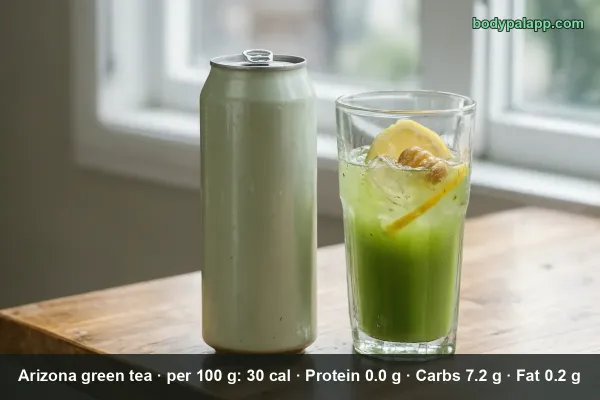
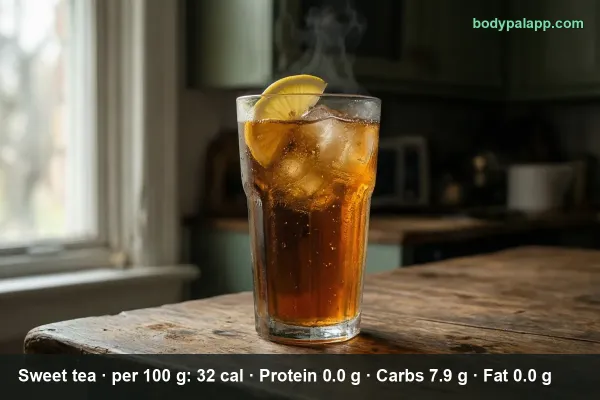
Here is how mango green tea stacks up against Arizona green tea, sweet tea and sugar tea, per 100 g and per usual serving.
Verdict: For the fewest calories pick mango green tea, at 25 per 100 g against 30 for Arizona green tea and 32 for sweet tea, so the others run about 1.2 to 1.3 times higher. None of these drinks will keep you full, since all carry 0 g of protein, so if the alternative is a 119-calorie small sugar tea, a 60-calorie cup of mango green tea is the lighter choice.
Most popular mango green tea brands in the United States
Ranked by popularity in the BodyPal database
# Productkcal / 100 g
1Peace Tea Mango Green Tea1 can · 680 ml24 kcal
2Lipton Pineapple Mango Green Tea16.9 fl oz · 500 ml8 kcal
3Seven Teas Organic Maui Mango Green Tea473 ml15 kcal
4Turkey Hill Mango Green Tea12 fl oz · 360 ml33 kcal
How many calories are in a cup of mango green tea?
About 60 calories in one 8 fl oz cup (240 g), or 25 calories per 100 g.
Is mango green tea good for weight loss?
One cup has 60 calories, all from 16 g of carbs, with 0 g of fat and protein. Diet versions such as Lipton Diet Pineapple Mango Green Tea list 1 calorie per 100 g.
Mango green tea vs Arizona green tea: which has fewer calories?
Mango green tea has 25 calories per 100 g and Arizona Green Tea has 30.
How much sugar is in mango green tea?
One cup (240 g) has 16 g of sugars, which is 6.7 g per 100 g.
How many calories are in two cups of mango green tea?
Two cups (480 g) of mango green tea contain 120 calories. All of them come from sugar, since the drink has 0 g of protein and 0 g of fat.
How many calories are in five cups of mango green tea?
Five cups, or 1,200 g, of mango green tea add up to 300 calories. That amount also carries 96 mg of sodium and 0 g of protein.
Does mango green tea have any protein or fat?
No. Mango green tea has 0 g of protein and 0 g of fat per cup. Its calorie split is 100% carbohydrate, and the 16 g of carbs in a cup are all sugar.
How much sodium is in mango green tea?
A 1 cup (240 g) serving of mango green tea has 19 mg of sodium, which is 1% of the 2300 mg daily value. Per 100 g it contains 8 mg.
How many carbs are in a cup of mango green tea?
A cup of mango green tea has 16 g of carbohydrate, and all 16 g are sugars. Per 100 g the tea has 6.7 g of carbs, also listed entirely as sugar.