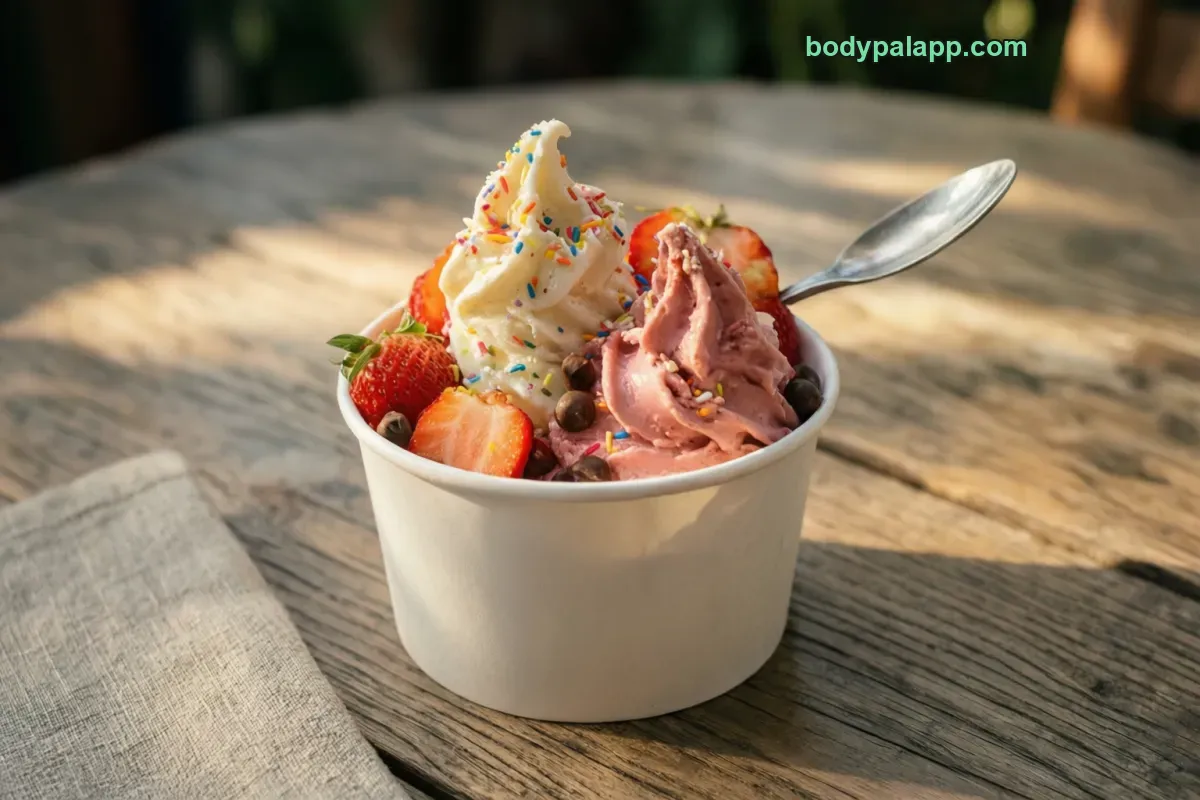
Orange Leaf frozen yogurt calories come to 278 for a 1 cup (175 g) serving of vanilla soft serve, or 159 per 100 g. Sugar is the number to notice: that cup carries 42 g of sugars, nearly all of its 42.4 g of carbs, while protein stays at just 7 g.
278kcal
1 cup · 175 g, soft serve, vanilla
10%protein
7 gProtein
42 gCarbs
9.8 gFat
How to burn off 278 kcal
—Walking, brisk
—Jogging
—Cycling, moderate
—Swimming
Skip the math. BodyPal counts these calories from your steps and workouts automatically.
Nutrition facts
Soft serve, vanilla · per 175 g
Calories
278 kcal
Protein
7 g
Carbohydrate
42 g
Fat
9.8 g
Saturated fat
6 g
Cholesterol
4 mg
Sodium
152 mg
Potassium
369 mg
Iron
0.5 mg
Source: USDA FoodData Central
🛡️
Verified nutrition data
Numbers on this page come from USDA FoodData Central, the U.S. Department of Agriculture’s food composition database, and from manufacturer labels where a branded product is named. Last verified September 2026. How we verify our data →
Orange Leaf frozen yogurt: calories, protein and sodium by serving
Percent of daily value uses the FDA reference of 2,000 kcal a day.
Serving
kcal
Protein
Carbs
Fat
Sodium
% DV kcal
1 cup (175 g)
278
7 g
42.4 g
9.8 g
152 mg
14%
Large cup (227 g)
361
9.1 g
54.9 g
12.7 g
197 mg
18%
Cone (125 g)
174
4 g
29.9 g
4.7 g
89 mg
9%
100 g
159
4 g
24.2 g
5.6 g
87 mg
8%
3 × 1 cup (175 g)
835
21 g
457 mg
5 × 1 cup (175 g)
1,391
35 g
761 mg
The cup you fill decides the total
At a self-serve shop you choose the portion yourself, so cup size is the biggest variable on this page. A 1 cup (175 g) serving of vanilla soft serve is 278 calories, about 14% of the daily value. A large cup (227 g) climbs to 361 calories, or 18% of the daily value, and that is before a single topping lands on it.
The cone (125 g) is the smallest measured option at 174 calories. Its numbers come from a separate USDA row for frozen yogurt served in a cone, so the macros shift a little: 4 g of protein, 4.7 g of fat and 24.2 g of sugars. If you want a fixed, modest portion, the cone does the measuring for you.
Second trips add up quickly. Two 1 cup servings (350 g) reach 557 calories, three (525 g) reach 835, and five cups (875 g), the kind of total a shared bowl can hit, come to 1,391. The lever does not stop at a serving size. Your scale does, so weigh a typical cup once and you will know what your usual pour really costs.
Carbs supply 59% of every spoonful
Frozen yogurt reads like a dairy snack, but the calorie split says dessert. Carbs provide 59% of the calories, fat 31% and protein only 10%. Per 100 g that works out to 24.2 g of carbs, 5.6 g of fat and 4 g of protein, with 0 g of fiber to slow anything down.
Almost all of those carbs are sugar: 24 g of the 24.2 g per 100 g. That is the trade you make for the creamy, sweet base. Fat is the second engine, and more than half of it is saturated, with 3.4 g of the 5.6 g per 100 g. It is lighter than premium ice cream territory, but it is not a fat-free treat either.
Protein is a modest bonus rather than a reason to order it. A 1 cup serving gives 7 g, which covers 14% of the daily value, and the large cup reaches 9.1 g. That helps a little with fullness. It will not turn a cup of froyo into a protein snack, so treat any protein here as a side effect.
Sugar is the row to watch, not sodium
The sugar line grows fastest as the cup gets bigger. A 1 cup (175 g) serving holds 42 g of sugars, and the large cup (227 g) holds 54.5 g. Even the cone carries 24.2 g. If you track added sweetness closely, this is the number that deserves your attention before calories do.
Sodium, by contrast, is a non-issue. A cup has 152 mg, just 7% of the daily value, and the large cup has 197 mg, or 9%. Cholesterol is minimal at 2 mg per 100 g. Potassium shows up at 211 mg per 100 g, a small contribution from the milk base.
So the honest read is simple. This is a sweet dessert with a low salt load and a little protein. Plan it the way you would plan any sugary treat, and let the portion, not the yogurt label, set your expectations.
Toppings and refills matter more than the flavor
The base is only half the story at a topping bar. Candy, cookie pieces and syrups pile calories and sugar onto a cup that already sits at 278 calories, while fresh fruit adds volume for far less. If you want the cup to feel bigger without the total jumping, fruit is the smart layer.
Timing helps too. Because a cup has 0 g of fiber and only 7 g of protein, it will not hold you for long on its own. Eating it after a meal with protein and vegetables usually feels more satisfying than having it as a stand-alone afternoon snack. Sharing a large cup is another easy way to keep the 361 calories in check.
Logging is the step most people skip with self-serve desserts, and it is where the numbers drift. Weigh the cup when you can, or snap a photo and let BodyPal log it for you. Either way, record the toppings separately so you can see which part of the bowl is doing the damage.
How does Orange Leaf frozen yogurt compare?
Here is how Orange Leaf froyo stacks up against three other sweet snacks, per 100 g and per usual serving.
Verdict: For the lightest pick, chocolate pudding wins at 142 calories per 100 g and 153 per snack cup, while brownie bites run 405 per 100 g, about 2.5 times the froyo. Skip the chocolate cupcake at 320 calories if you want volume, because a cup of froyo gives you far more to eat.
Orange Leaf frozen yogurt FAQs
How many calories are in a cup of Orange Leaf frozen yogurt?
A 175 g cup of vanilla soft serve frozen yogurt is about 278 calories. That works out to 159 calories per 100 g.
Is frozen yogurt good for weight loss?
A 175 g cup is 278 calories and 42 g of sugar, and a large 8 oz cup is 361 calories. A 125 g cone comes to 174 calories.
Does soft serve frozen yogurt have more calories than hard frozen yogurt?
Yes. Soft serve is 159 calories per 100 g against 127 for hard-packed frozen yogurt, so the same 175 g cup is 278 calories instead of 222.
How much protein is in Orange Leaf frozen yogurt?
Vanilla soft serve frozen yogurt has 4 g of protein per 100 g, so a 175 g cup gives about 7 g. The same cup carries 42 g of carbs.
How many calories are in 8 oz of frozen yogurt?
An 8 oz cup of vanilla soft serve frozen yogurt, the 227 g large cup on this page, has 361 calories. It also carries 54.5 g of sugars, 9.1 g of protein and 12.7 g of fat.
What are the nutrition facts for Orange Leaf froyo?
Per 100 g, vanilla soft serve has 159 calories, 4 g of protein, 24.2 g of carbs, 24 g of sugars, 5.6 g of fat and 87 mg of sodium. Fiber is 0 g.
How many calories are in a large Orange Leaf cup?
A large cup (227 g) of vanilla soft serve has 361 calories, about 18% of the daily value. Toppings are extra, so add them separately when you log the cup.
How much sugar is in a cup of Orange Leaf froyo?
A 1 cup (175 g) serving has 42 g of sugars out of 42.4 g of carbs. The large cup (227 g) rises to 54.5 g, so sugar grows quickly with portion size.
How many calories are in a frozen yogurt cone?
A frozen yogurt cone (125 g) has 174 calories, with 4 g of protein, 4.7 g of fat and 24.2 g of sugars. It is the smallest fixed portion on this page.