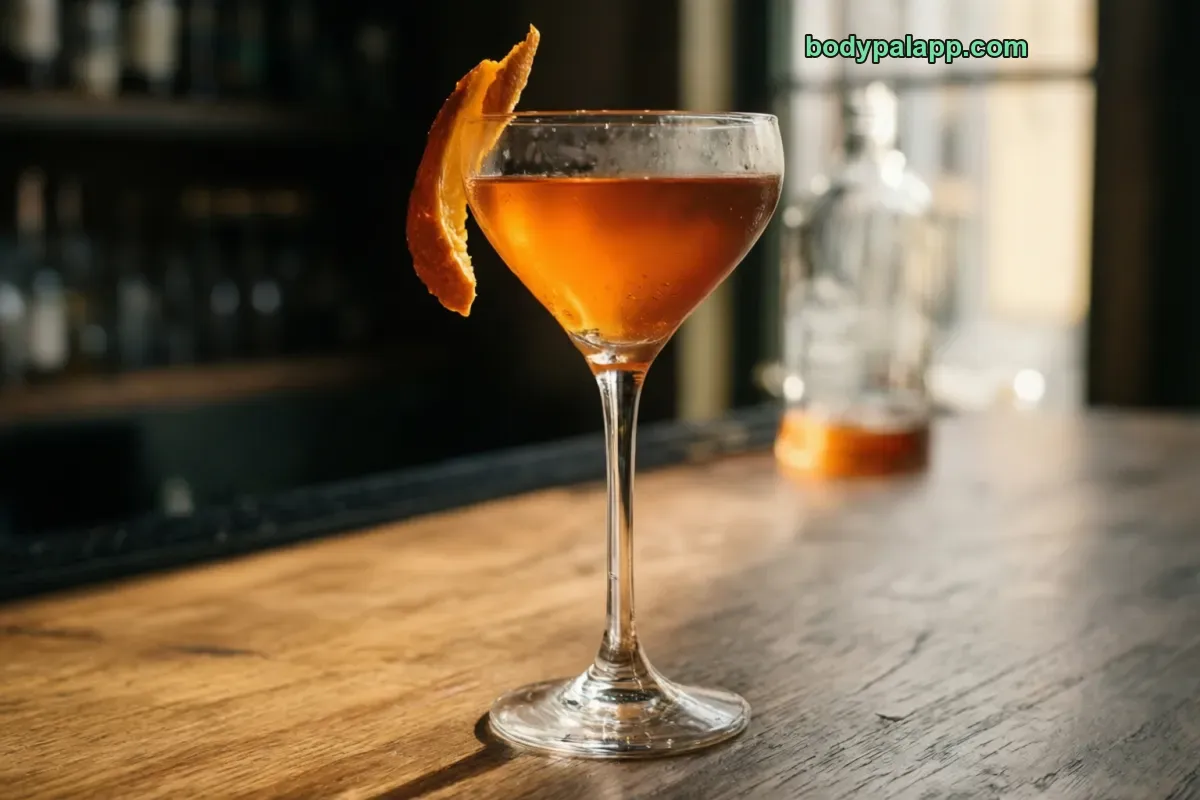
Orange liqueur calories come to 126 for a 45 g shot and 279 per 100 g. The thing to notice is what that energy brings with it: 15 g of sugar per shot, no protein and almost no fat. Pour size moves the total far more than anything else on the label.
126kcal
1 shot · 45 g, orange variety
0%protein
0 gProtein
15 gCarbs
0 gFat
How to burn off 126 kcal
—Walking, brisk
—Jogging
—Cycling, moderate
—Swimming
Skip the math. BodyPal counts these calories from your steps and workouts automatically.
Nutrition facts
Orange variety · per 45 g
Calories
126 kcal
Protein
0 g
Carbohydrate
14.9 g
Fat
0 g
Saturated fat
0 g
Cholesterol
0 mg
Sodium
0 mg
Potassium
1 mg
Iron
0 mg
Source: USDA FoodData Central
🛡️
Verified nutrition data
Numbers on this page come from USDA FoodData Central, the U.S. Department of Agriculture’s food composition database, and from manufacturer labels where a branded product is named. Last verified September 2026. How we verify our data →
Orange liqueur: calories, protein and sodium by serving
Percent of daily value uses the FDA reference of 2,000 kcal a day.
Serving
kcal
Protein
Carbs
Fat
Sodium
% DV kcal
1 shot (45 g)
126
0 g
14.9 g
0 g
0 mg
6%
1 fl oz (30 g)
84
0 g
10 g
0 g
0 mg
4%
1 drink (68 g)
190
0 g
22.6 g
0.1 g
1 mg
9%
100 g
279
0 g
33.2 g
0.1 g
1 mg
14%
3 × 1 shot (45 g)
377
0 g
1 mg
5 × 1 shot (45 g)
628
0 g
2 mg
One shot is 126 calories, and repeat pours add up fast
A standard 45 g shot of orange liqueur lands at 126 calories, about 6% of the daily value for calories. The smaller 1 fl oz pour, 30 g, is 84 calories, or 4% of the daily value. A 68 g drink portion climbs to 190 calories, which is 9% of the daily value in a single glass.
Repeat pours are where the number gets real. Two shots (90 g) come to 251 calories, three shots (135 g) reach 377, and five shots (225 g) hit 628. That last figure is a full meal's worth of energy with zero protein attached to it.
The gap between the 30 g fluid ounce and the 68 g drink is more than a hundred calories. So the pour matters more than the bottle. If you mix at home, measure once with a jigger, note the weight, and reuse that number every time you make the same drink. Free-pouring is how a 126-calorie shot quietly turns into a 190-calorie glass.
Sugar is the only macro that shows up
Per 100 g, orange liqueur carries 33.2 g of carbs, 0.1 g of fat and 0 g of protein. In the calorie split, carbs account for 99% and fat for 1%. Protein contributes nothing at all.
Those carbs are essentially all sugar: 33.3 g of sugars per 100 g and 0 g of fiber. The sugar figure sits a hair above total carbs, a quirk of how the lab values are reported, but the takeaway is the same. The macros explain only part of the 279 calories per 100 g. The alcohol itself supplies the rest, which is why the total runs higher than the carbs alone would suggest.
The practical read is simple. Nothing in this bottle helps you stay full: no protein, no fiber, almost no fat. It is energy you spend on flavor. That can be a perfectly fair trade in a cocktail you enjoy, as long as it gets counted instead of treated as a free splash.
Sugar is the row to watch, sodium is not
A 45 g shot holds 15 g of sugar. The 1 fl oz pour has 10 g, and the 68 g drink carries 22.6 g. In a mixed drink, that sugar sits on top of whatever the juice, syrup or soda adds, so the glass can be much sweeter than the liqueur alone.
The rest of the label barely registers. Sodium is 1 mg per 100 g and 0 mg in a single shot, which is 0% of the daily value. Potassium is just 2 mg per 100 g, cholesterol is 0 mg and saturated fat is 0 g. Put plainly, orange liqueur is a two-line story: sugar and alcohol.
If you track sugar, log the liqueur as its own line instead of folding it into the cocktail. A splash in a margarita or a sidecar is easy to forget, and each 1 fl oz of it brings 10 g of sugar and 84 calories. Over a few rounds, those small splashes become the biggest sugar entry of the evening.
Mixers and pour size decide what the cocktail costs
Orange liqueur is rarely sipped on its own. It usually shares a glass with a base spirit, citrus juice and sometimes syrup, and each of those adds its own calories. Within that recipe, the liqueur is often the sweetest ingredient.
If you want a lighter drink, trim the liqueur before you trim anything else. Shifting part of the pour toward a plain spirit cuts sugar, since scotch and Tito's vodka both list 0 g of carbs per 100 g. Topping the glass with soda water stretches it without adding sugar, and fresh citrus keeps the orange note bright with less liqueur.
Food matters too. Drinks with no protein or fiber pair better with a meal that has both than with a bowl of chips. Logging is simpler than it looks: measure once, then reuse the number. BodyPal can log the drink from a photo, but the pour size is still the detail worth double-checking.
How does orange liqueur compare?
Here is orange liqueur next to coffee liqueur, scotch and Tito's vodka, compared per 100 g and per usual serving.
Verdict: If calories are the priority, scotch or Tito's vodka at 97 per shot beats orange liqueur at 126 and coffee liqueur at 175. If you want a sweet liqueur anyway, orange is the lighter pick, with 279 calories per 100 g against 336 for coffee liqueur.
Orange liqueur FAQs
How many calories are in a shot of orange liqueur?
A shot (45 g) is about 126 calories. A smaller 1 fl oz pour comes to 84 calories.
Is orange liqueur good for weight loss?
One 45 g shot adds 126 calories and 15 g of sugar, with no protein and only 0.1 g of fat per 100 g.
Orange liqueur vs coffee liqueur: which has more calories?
Coffee liqueur is higher at 336 calories per 100 g versus 279 for plain liqueur, so 151 calories per 45 g shot against 126.
How much sugar is in orange liqueur?
About 33.3 g per 100 g, which works out to roughly 15 g in a 45 g shot and 10 g in a 1 fl oz pour.
How many calories are in 1 fl oz of orange liqueur?
One fluid ounce (30 g) of orange liqueur has 84 calories, with 10 g of carbs and 10 g of sugar. That is 4% of the daily value for calories, with no protein and no fat.
How many calories are in an orange liqueur drink?
A 68 g drink portion of orange liqueur comes to 190 calories, about 9% of the daily value. It carries 22.6 g of sugar and 0.1 g of fat, and any mixers add calories on top.
Does orange liqueur have any protein or fat?
Orange liqueur has 0 g of protein and only 0.1 g of fat per 100 g. Carbs make up 99% of its calorie split, and nearly all of those carbs are sugar.
Does orange liqueur have more calories than vodka?
Yes. Orange liqueur has 279 calories per 100 g versus 231 for Tito's vodka. Per usual shot it is 126 calories against 97, and the vodka has 0 g of carbs while the liqueur has 33.2 g.
How much sodium is in orange liqueur?
Orange liqueur has just 1 mg of sodium per 100 g, and a 45 g shot comes to 0 mg, or 0% of the daily value. Sodium is not a concern here; sugar is the number to track.