
Calories in a Brownie: Homemade Beats Shop-Bought, Upwards
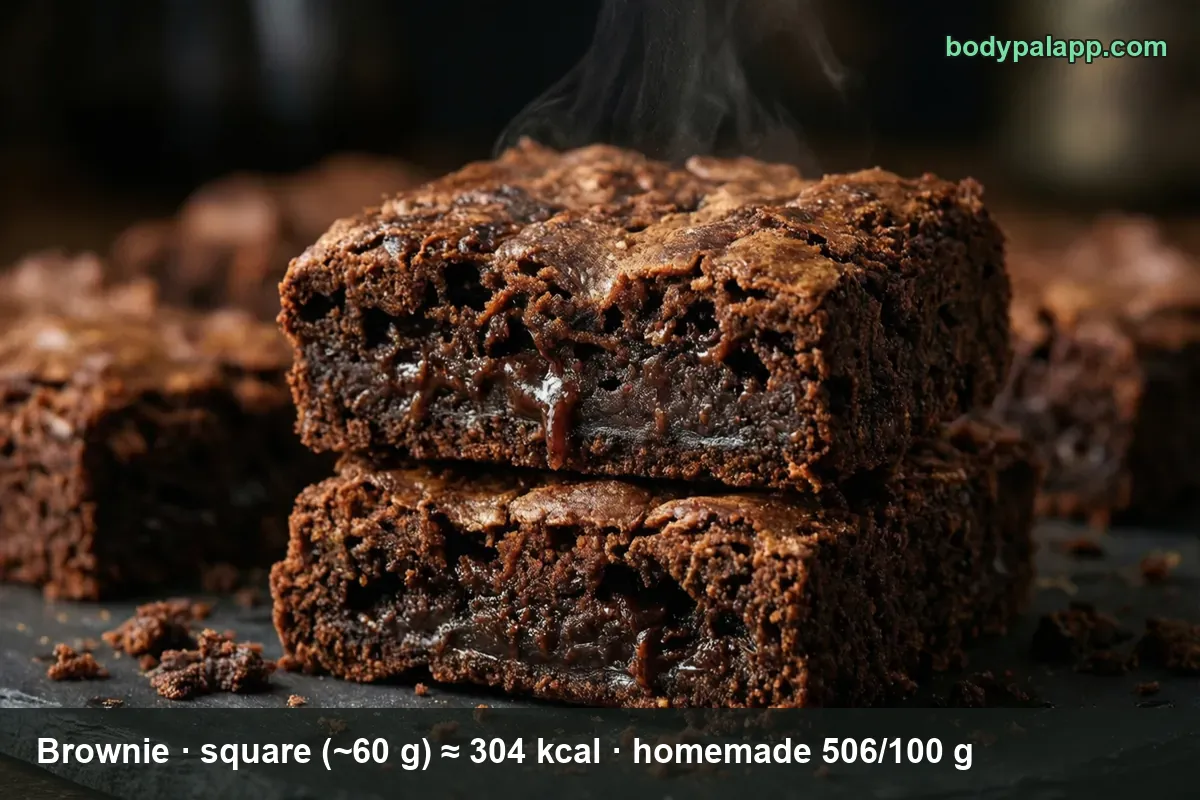
Homemade wins, and not in the direction you would hope. The calories in a brownie come to about 304 for a 60 g homemade square, with the CoFID figure at 506 per 100 g, while the average shop-bought brownie sits lower at 469. The difference is butter, and plenty of it.
On this page
- Brownie nutrition at a glance
- Squares, slabs and the tray
- Homemade against shop-bought
- Where the calories come from
- How does a brownie compare?
- Most popular brownie brands
- FAQ
Brownie nutrition at a glance
| Nutrient | Per 100 g (homemade) | Per square (~60 g) | %RI* per square |
|---|---|---|---|
| Energy | 506 kcal / 2,117 kJ | 304 kcal / 1,272 kJ | 15% |
| Protein | 6.2 g | 3.7 g | 7% |
| Carbohydrate | 54.3 g | 32.6 g | 13% |
| of which sugars | 46.1 g | 27.7 g | 31% |
| Fat | 30.8 g | 18.5 g | 26% |
| of which saturates | 16.4 g | 9.8 g | 49% |
| Fibre | – | – | – |
| Salt | 0.47 g | 0.28 g | 5% |
*%RI = percentage of the reference intake for an average adult (2,000 kcal; 70 g fat, 20 g saturates, 260 g carbohydrate, 90 g sugars, 50 g protein, 6 g salt). CoFID does not publish a fibre figure for homemade brownies.
Verified nutrition data
Numbers on this page come from CoFID, the UK government’s Composition of Foods Integrated Dataset, and from manufacturer labels where a branded product is named. Last verified August 2026. How we verify our data →
The saturates line is the loud one: 9.8 g in a single square, half the daily reference intake. That is the butter and the chocolate working together, and it is exactly why a brownie tastes the way a scone does not.
Sugars are close behind at 27.7 g per square, a third of the daily 90 g. A brownie is not pretending to be anything other than dessert, which by NHS sugar guidance makes it an occasional food doing an occasional food's job.
Squares, slabs and the tray
| Portion | Weight | Calories (homemade basis) |
|---|---|---|
| Modest square | ~60 g | 304 kcal |
| Cafe slab | ~90 g | 455 kcal |
| Shop-bought square | ~60 g | 281 kcal |
| "Just a sliver" off the tray | ~25 g | 127 kcal |
The tray is the trap. Nobody logs slivers, and three slivers are a square. If a batch lives on your counter, the honest method is to cut it into known squares the moment it cools, so every visit to the kitchen has a number attached.
Cafe brownies are rarely 60 g. A palm-sized slab at 90 g is 455 kcal, which is a dessert, not a snack with your coffee.
Homemade against shop-bought
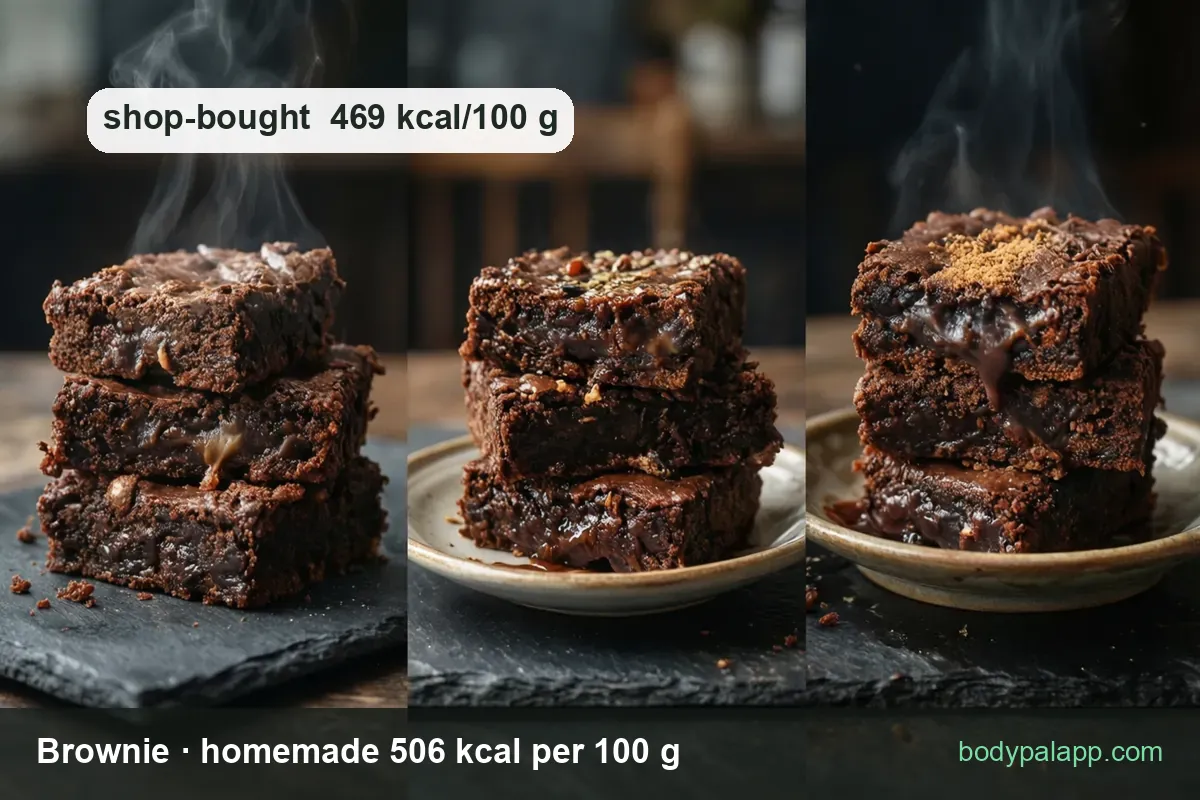
Homemade: 506 kcal per 100 g. Real butter, real chocolate, dense crumb. This is the CoFID lab average for homemade recipes, and it is the highest number on this page for a reason.
Shop-bought: about 469 kcal per 100 g. Averaged across hundreds of packaged UK brownies, the supermarket version comes in nearly 40 kcal per 100 g lighter. Commercial recipes stretch the expensive fat with cheaper ingredients and more air, and it shows up on the label as a saving you never asked for.
The gap flips the usual assumption. With most bakes the shop version is the heavier one; with brownies, the better the brownie, the higher the number. A dry, cakey brownie is lighter than a fudgy one because fudginess is literally fat.
Where the calories come from
A brownie is roughly a third sugar and a third fat by weight, and the arithmetic follows: 46.1 g of sugars and 30.8 g of fat per 100 g account for nearly all of the 506. The cocoa itself is a rounding error. Swapping honey for sugar or oil for butter reshuffles the ingredients list without moving the total much, because the energy is in the category, not the brand of sweetness.
That is also why "healthier" brownie recipes disappoint on the label. Take out enough fat and sugar to change the number and what remains is chocolate-flavoured bread. The NHS Eatwell Guide files the whole category under foods to enjoy less often, which is a more honest frame than pretending a brownie can be improved into a health food.
How does a brownie compare?
| Sweet thing | Per item | Per 100 g |
|---|---|---|
| Brownie square (~60 g) | 304 kcal | 506 kcal |
| Jam doughnut (~75 g) | 241 kcal | 321 kcal |
| Scone, medium (~65 g) | 229 kcal | 352 kcal |
| Milk chocolate (CoFID) | – | 519 kcal |
The verdict: per 100 g the brownie sits just under plain milk chocolate, which is the truthful way to think about it: a brownie is chocolate with structure. Against the doughnut and the scone it costs 60-75 kcal more per item and delivers more richness per bite. If you want the smallest number with your tea, the scone wins; if you are having dessert anyway, the brownie at a controlled 60 g is at least a number you chose.
Most popular brownie brands in the United Kingdom
Ranked by how widely each product appears among foods sold in the United Kingdom, from the BodyPal food database of over 3.3 million products. Calories are the figures printed on each label.
| Product | Calories (per 100 g) |
|---|---|
| Milka Choco Brownie | 468 kcal |
| Rhythm 108 Choco Walnut Brownie | 435 kcal |
| Fibre One Chocolate Fudge Brownie | 363 kcal |
Brand popularity: BodyPal food database. Nutrition: manufacturer labels.
How long does it take to burn off a brownie?
A 60 g homemade square is 304 kcal. Enter your weight and the amount you ate to see how long it takes you to burn that off:
lb
| Activity | Time to burn 304 kcal |
|---|---|
| Walking, brisk | 1 hr 1 min |
| Cycling, moderate | 38 min |
| Swimming, moderate | 43 min |
| Jogging | 36 min |
| Weight training, moderate | 1 hr 8 min |
Times are for a 154 lb (11 st) adult at a steady pace; change the weight to see yours. The amount is set to the portion in the text (60 g); change it to what you actually ate. BodyPal works this out from your steps automatically.
Want the bigger picture? Calculate your daily calorie needs — your maintenance figure, a target for losing or gaining, and the date you get there.
Frequently asked questions
How many calories are in a brownie?
About 304 kcal for a 60 g homemade square, from the CoFID figure of 506 kcal per 100 g. Shop-bought brownies average 469 per 100 g, so 281 for the same square. Cafe slabs run bigger, often 90 g and around 455 kcal.
Are homemade brownies more calorific than shop-bought?
Yes, by about 37 kcal per 100 g: 506 against 469. Homemade recipes use more butter and chocolate per gram, while commercial bakes stretch the fat. It is one of the few bakes where the supermarket version is reliably the lighter one.
How much sugar is in a brownie?
46.1 g per 100 g homemade, so a 60 g square carries about 27.7 g, roughly a third of the 90 g daily reference intake. Sugar and fat together make up most of a brownie's weight, which is why the calorie figure is what it is.
How many calories in a cafe brownie?
Around 455 kcal for a typical 90 g slab on the homemade basis, and cafe recipes lean homemade-rich. Sizes vary more than recipes, so weight is the thing to judge: every 10 g is roughly another 50 kcal.
Is a brownie worse than a doughnut?
Per item, yes: a 60 g brownie square is 304 kcal against 241 for a jam doughnut, and per 100 g the gap is wider, 506 against 321. The brownie is denser in both fat and sugar. The doughnut is the lighter sweet fix; the brownie is the richer one.
Why are brownies so high in saturated fat?
Butter and chocolate are both mostly saturated fat, and a fudgy texture needs a lot of both. One square carries 9.8 g of saturates, about half the 20 g daily reference intake, which is the single most striking line on the label.
Can I fit a brownie into a calorie deficit?
A planned 60 g square at 304 kcal fits the way any dessert fits: logged, and traded against the rest of the day. The failure mode is the tray sliver pattern, where three unlogged slivers quietly equal a square. Cut and count, then enjoy it.
Do nuts change a brownie's calories much?
Walnut or pecan versions add nut weight that is itself dense in fat, so per 100 g the figure stays in the same region or edges higher. The practical difference is small next to portion size, which remains the lever that actually matters.
Similar foods
- Chocolate chip cookie — 52 kcal small biscuit
- Cupcake — 470 kcal per 100 g frosted
- Krispy Kreme — 225 kcal an Original Glazed
- Flapjack — 260 kcal a slice
- Doughnut — 413 kcal per 100 g iced ring
- Greggs Yum Yum — 310 kcal each
Count it while the tray cools
BodyPal logs a brownie square from one photo, fudgy or cakey, so the tray maths stops being guesswork.

