
Calories in a Teaspoon of Honey
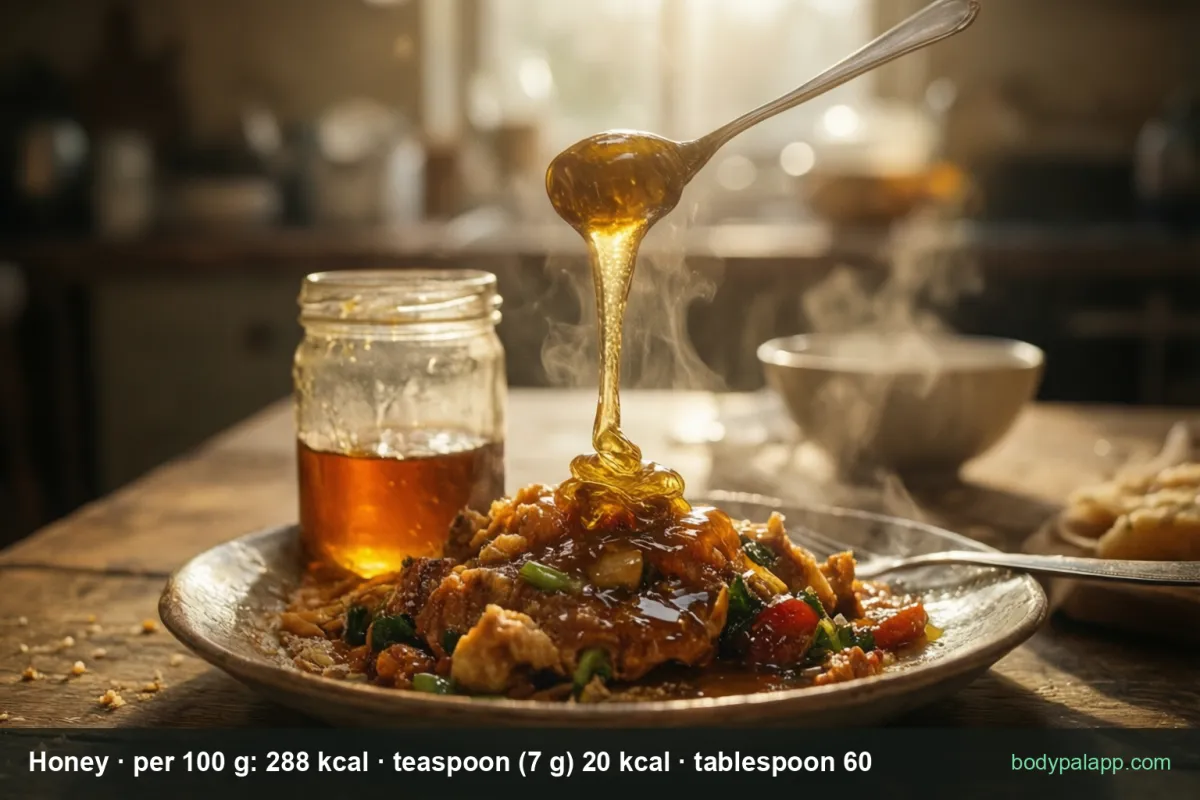
There are 20 calories in a teaspoon of honey (7 g), 60 kcal in a tablespoon (21 g) and 288 kcal per 100 g. Honey is 76.4 g sugar per 100 g, with almost no protein and no fat at all, so the calorie count moves with the size of the drizzle and nothing else.
On this page
- Honey nutrition at a glance
- UK portions and what they weigh
- Honey in tea
- Honey on porridge and crumpets
- Honey and lemon
- How does honey compare?
- The myth that honey is the lighter sweetener
- Most popular honey brands
- Honey calories FAQ
- Similar foods
Honey nutrition at a glance
| Nutrient | Per 100 g | Per teaspoon (7 g) | %RI per 100 g |
|---|---|---|---|
| Energy | 1,205 kJ / 288 kcal | 84 kJ / 20 kcal | 14% |
| Fat | 0 g | 0 g | 0% |
| of which saturates | 0 g | 0 g | 0% |
| Carbohydrate | 76.4 g | 5.3 g | 29% |
| of which sugars | 76.4 g | 5.3 g | 85% |
| Fibre | 0 g | 0 g | – |
| Protein | 0.4 g | 0.03 g | <1% |
| Salt | 0.028 g | 0.002 g | <1% |
RI = Reference Intake for an average adult (8,400 kJ / 2,000 kcal). Fibre has no RI figure in the standard UK label set.
Two things stand out in that column of numbers. Every gram of carbohydrate in honey is sugar, and 100 g of it covers 85% of an adult's daily reference intake for sugars. The salt figure, by contrast, is a rounding error: 0.028 g per 100 g means a teaspoon carries 0.002 g, which is nothing you would ever need to budget for.
Verified nutrition data
Numbers on this page come from CoFID, the UK government’s Composition of Foods Integrated Dataset, and from manufacturer labels where a branded product is named. Last verified August 2026. How we verify our data →
Honey is also one of the few foods where the label and the spoon disagree in a way that matters. Nobody eats 100 g of honey. The number you actually want is the teaspoon.
The protein figure is worth a moment too. At 0.4 g per 100 g, honey rounds to zero protein in any realistic serving, so it does nothing for how full you feel. Combined with zero fibre, that makes honey a fast, purely carbohydrate addition to whatever it goes on. Anything holding you to lunch is coming from the porridge, the toast or the yoghurt underneath, never from the drizzle.
UK portions and what they weigh
| UK portion | Weight | Calories | kJ |
|---|---|---|---|
| Teaspoon, level | 7 g | 20 kcal | 84 kJ |
| Tablespoon | 21 g | 60 kcal | 251 kJ |
| Squeeze over porridge | 10 g | 29 kcal | 121 kJ |
A teaspoon of honey weighs 7 g, not the 4 g you get from a teaspoon of granulated sugar. Honey is denser and it clings to the spoon, so the same piece of cutlery delivers nearly twice the weight. That single fact explains most of the confusion about honey calories, and we come back to it below.
The squeeze from a plastic bottle is the least predictable portion of the three. A quick count of one, two on a bowl of porridge lands around 10 g if you are careful and closer to 20 g if you are not, which is the difference between 29 kcal and roughly 58 kcal on the same breakfast. If you log honey by eye, log it generously.
A heaped teaspoon is not the same portion as a level one, and honey punishes the difference more than most foods because it holds its shape on the spoon. Where a level teaspoon is 7 g and 20 kcal, a properly heaped one sits nearer 10 g and 29 kcal. Over a jar, that gap is the entire reason two people eating "a teaspoon of honey a day" can log totals 40% apart.
There is a simple way to settle it once. Put the jar on kitchen scales, take your normal spoonful, and read the drop in weight. Whatever number comes back is your teaspoon, and you can stop guessing for good. Most people find theirs sits between 7 g and 12 g, which is 20 to 35 kcal.
Honey in tea
A teaspoon of honey adds 20 kcal to a cup of tea. That is the whole story for black tea, since tea itself contributes almost nothing before you add anything to it.
Two mugs a day, sweetened with a teaspoon each, comes to 40 kcal. Four mugs, 80 kcal. It is a small number that behaves like a large one because it repeats: honey in tea is a habit, not a meal, and habits compound across a week in a way that a single dessert does not.
If you take milk as well, add the milk separately. Honey does not change what the milk contributes.
One practical note for tea drinkers: honey dissolves into hot liquid and leaves nothing behind, so there is no residue in the bottom of the mug to discount. What goes in on the spoon is what you drink. That makes tea the easiest honey portion of all to log accurately, as long as you measure the spoon rather than the mug.
Honey on porridge and crumpets
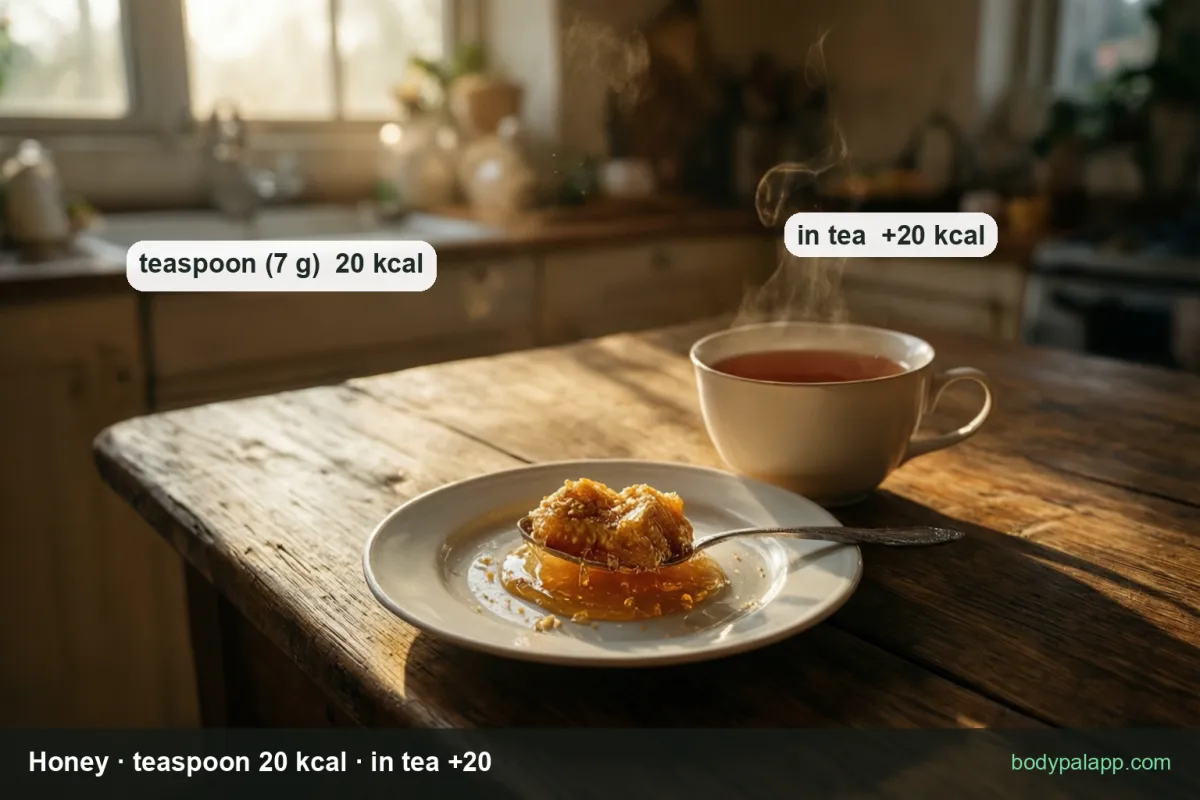
A 10 g drizzle over porridge adds 29 kcal on top of whatever the oats and milk already cost. Porridge is where honey portions quietly inflate, because the bowl is wide, the honey disappears into the surface and there is no visual cue telling you when to stop.
On a crumpet, the toppings compete rather than stack. A teaspoon of honey at 20 kcal is one of the lighter things you can put on a hot crumpet, and unlike butter it brings no fat with it. Two crumpets with a teaspoon of honey each is a 40 kcal topping bill.
Honey is one of the most-logged toppings in BodyPal, and it is almost always logged as an extra rather than as a food in its own right. That is the right instinct. Treat it as a modifier on breakfast and it stays visible.
Toast and white bread work the same way. Honey spreads thin on a slice, so a single slice rarely takes more than a teaspoon before it starts running off the edges, which caps the topping at around 20 kcal by accident. Porridge has no such limit, and that is the difference between a breakfast that lands where you expected and one that quietly gains 30 kcal.
Honey and lemon
A honey and lemon hot drink comes in at around 25 kcal, which reflects a slightly heavier pour of honey than the standard teaspoon plus a squeeze of lemon juice.
Made as a nightly drink it costs about as much as a plain digestive-sized snack across a week. Nothing more.
The reason the figure drifts is the pour. Honey for a hot drink usually goes in straight from the jar with a proper spoonful rather than a measured one, and lemon juice adds so little that the honey is doing all the work in the total. If you want the drink at exactly 20 kcal, level the spoon.
How does honey compare?
| Sweetener | Typical UK portion | Calories per portion | Calories per 100 g | Protein / Carbs / Fat per 100 g |
|---|---|---|---|---|
| Honey | 1 tsp (7 g) | 20 kcal | 288 kcal | 0.4 / 76.4 / 0 g |
| Table sugar | 1 tsp (4 g) | 16 kcal | 394 kcal | 0 / 105 / 0 |
| Jam | 1 heaped tsp (15 g) | 39 kcal | 261 kcal | 0.6 / 69.0 / 0 |
Read that table twice, because it runs against what most people expect. Per 100 g sugar is the heavier ingredient at 394 kcal against honey's 288, but per spoonful honey wins on calories: 20 kcal to sugar's 16, because a teaspoon holds 7 g of honey and only 4 g of sugar.
The verdict: if you are cutting calories, a teaspoon of sugar in your tea is the smaller number, and swapping to honey to "save calories" moves you in the wrong direction. If you are choosing what goes on toast or porridge, honey at 20 kcal a teaspoon beats a heaped teaspoon of jam at 39 kcal, and it beats butter comfortably on fat.
Both differences are small enough that they only matter at volume. Four sweetened teas a day is 80 kcal of honey against 64 kcal of sugar, a gap of 16 kcal that will never decide anything. Swap the jam on your morning toast for honey every day for a week and you save around 133 kcal, which is closer to meaningful but still not the lever most people are looking for.
The myth that honey is the lighter sweetener
Honey has a reputation as the sensible swap. The calorie arithmetic does not support it, and neither does the sugar column: honey is 76.4% sugar, and the NHS counts honey among free sugars alongside table sugar, syrups and fruit juice. The WHO guideline on sugars intake treats it the same way.
Where honey earns something back is sweetness per gram. It tastes sweeter than the same weight of sugar, so people who switch often reach for less over time, especially in tea and on yoghurt. That is a real effect, but it is a behavioural one, not a nutritional discount, and it only pays off if the pour actually gets smaller.
The honest summary: honey and sugar are close enough that the choice belongs to taste rather than to your calorie budget. If you want the number to drop, the lever is the size of the spoon, not the contents of the jar. General guidance on cutting back sits in the NHS advice on eating a balanced diet.
Most popular honey brands in the United Kingdom
Ranked by how widely each product appears among foods sold in the United Kingdom, from the BodyPal food database of over 3.3 million products. Calories are the figures printed on each label.
| Product | Calories (per 100 g) |
|---|---|
| Rowse Honey | 329 kcal |
| Duerr’s Pure Clear Honey | 329 kcal |
| Tesco Clear Honey | 327 kcal |
| Hilltop Blossom Honey | 307 kcal |
Brand popularity: BodyPal food database. Nutrition: manufacturer labels.
Honey calories FAQ
How many calories are in a teaspoon of honey?
A level teaspoon of honey is 20 kcal (84 kJ), based on 7 g of honey at 288 kcal per 100 g. That teaspoon carries 5.3 g of sugar, no fat and effectively no protein. A generous, dripping teaspoon can be closer to 10 g, which puts it nearer 29 kcal.
How many calories are in a tablespoon of honey?
A tablespoon of honey is 60 kcal (251 kJ) at 21 g, with 16 g of sugar. That is three times a teaspoon, so it is worth measuring rather than estimating when honey goes into baking, marinades or a big bowl of yoghurt where the spoon size creeps up unnoticed.
Is honey better than sugar for weight loss?
No, not on calories: a teaspoon of honey is 20 kcal against 16 kcal for a teaspoon of sugar, because honey is denser and a spoon holds 7 g of it against 4 g of sugar. Honey does taste sweeter per gram, so some people use less of it. The size of the portion decides the outcome, not the choice of sweetener.
How much sugar is in honey?
Honey is 76.4 g of sugar per 100 g, which is every gram of its carbohydrate. A teaspoon holds 5.3 g of sugar and a tablespoon 16 g. For reference, 100 g of honey covers 85% of the adult daily reference intake for sugars, so honey counts fully towards your free sugars for the day.
How many calories does honey add to a cup of tea?
One teaspoon of honey adds 20 kcal to a cup of tea. Tea itself brings almost nothing, so the honey is the entire calorie cost unless you also take milk. Three sweetened mugs a day works out at 60 kcal, which is where a small habit starts to show up in a weekly total.
Is honey fattening?
Honey contains no fat at all and 20 kcal per teaspoon, so it is a small addition on its own. It becomes significant through repetition rather than through any single serving: five teaspoons across a day is 100 kcal. Logging it as an extra on top of the meal keeps it visible.
How many calories are in honey and lemon?
A honey and lemon hot drink is around 25 kcal, which allows for a slightly heavier pour of honey than a level teaspoon plus lemon juice. Made with a level 7 g teaspoon instead, it comes down to 20 kcal. The lemon contributes very little either way.
How many calories are in 100 g of honey?
100 g of honey is 288 kcal (1,205 kJ), with 76.4 g carbohydrate, 0.4 g protein, no fat and no fibre. Very few people eat honey in 100 g quantities, so the per-100 g figure is most useful for recipes and for comparing honey against other sweeteners on the shelf.
How many calories does honey add to porridge?
A 10 g squeeze of honey over porridge adds 29 kcal on top of the oats and milk. Free-pouring from a bottle easily doubles that to around 58 kcal without looking like more, so a measured teaspoon at 20 kcal is the safer habit if the breakfast total matters to you.
Does honey have any protein or fat?
Honey has 0.4 g of protein per 100 g and no fat, which works out at 0.03 g of protein in a teaspoon. In practical terms it is a pure carbohydrate food: 76.4 g of sugar per 100 g, no fibre, and a salt content of 0.028 g per 100 g that is too small to count.
Similar foods
- Maple syrup — 54 kcal per tablespoon
- Hummus — 92 kcal per 30 g
- Mozzarella — 159 kcal per half ball
- Feta — 75 kcal per 30 g portion
- Brie — 103 kcal per 30 g wedge
- Caster sugar — 16 kcal per level teaspoon
Count it without the maths
BodyPal logs honey, the porridge under it and the tea beside it from one photo, so the teaspoons stop being a guess.


One food is easy to picture; a whole day is harder. See how many calories you need a day and what a deficit actually looks like.