
How Many Calories in Brie?
A 30 g wedge of brie is 103 calories, and 100 g is 343. That describes French-style brie. A British brie out of the same chiller runs closer to 280, which turns the identical wedge into 83 kcal. One thing does not vary: brie holds no carbohydrate worth counting.
On this page
- Brie quick facts
- The same wedge is 83 or 106 calories
- Why brie has no carbohydrate at all
- The rind, and the myth about cutting it off
- A cheeseboard, added up
- Brie, camembert and cheddar
- Brands on the UK shelf
- FAQ
Brie quick facts
The 30 g column is the portion printed on nearly every British pack — Tesco says 32 g, Morrisons 28.5 g, everyone else 30 g. It is a wedge about a finger wide.
| Nutrient | Per 100 g | 30 g wedge | RI%* |
|---|---|---|---|
| Energy | 343 kcal / 1,435 kJ | 103 kcal / 431 kJ | 5% |
| Protein | 20.3 g | 6.1 g | 12% |
| Carbohydrates | Trace (<0.1 g) | Trace | – |
| – of which sugars | Trace | Trace | – |
| Fat | 29.1 g | 8.7 g | 12% |
| – of which saturates | 18.2 g | 5.5 g | 27% |
| Fibre | 0 g | 0 g | – |
| Salt | 1.39 g | 0.42 g | 7% |
Verified nutrition data
Numbers on this page come from CoFID, the UK government’s Composition of Foods Integrated Dataset, and from manufacturer labels where a branded product is named. Last verified September 2026. How we verify our data →
*RI% = one 30 g wedge's share of an adult's daily reference intake, based on 2,000 kcal.
The saturates row is doing something the calorie row is not. A wedge costs 5% of the day's energy and 27% of the day's saturated fat, a ratio of more than five to one. Half a pack — 100 g — reaches 91% of the 20 g reference, which is why NHS advice on eating less saturated fat singles out cheese by name.
The same wedge is 83 or 106 calories
British supermarkets sell two quite different cheeses under one word, and the panels prove it.
| Brie | Per 100 g | 30 g wedge |
|---|---|---|
| Tesco Cornish Brie | 276 kcal | 83 kcal |
| Lidl Deluxe Brie de Meaux | 275 kcal | 83 kcal |
| Sainsbury's Somerset Brie | 291 kcal | 87 kcal |
| Tesco Rich & Creamy British | 299 kcal | 90 kcal |
| Président | 347 kcal | 104 kcal |
| Sainsbury's French Mild Brie | 352 kcal | 106 kcal |
| Waitrose Essential French Brie | 358 kcal | 107 kcal |
| Asda Brie | 371 kcal | 111 kcal |
| Castello Double Cream Brie | 410 kcal | 123 kcal |
British and Cornish bries cluster at 275 to 299 per 100 g. French ones cluster at 345 to 371, and the double-cream outlier goes to 410. Same shape, same rind, same shelf — a 28% gap between the two ends of the ordinary range.
The government's reference figure of 343 sits with the French cheeses, which is where most calorie charts stop. If the pack in your fridge says Cornish or Somerset on the front, the chart is overstating your wedge by about twenty calories.
Why brie has no carbohydrate at all
The dataset records brie's carbohydrate as "Tr", meaning a trace: measurably present, below 0.1 g per 100 g. Not rounded down, not left out — genuinely almost none.
The reason is ripening. Lactose is milk sugar, and brie is left long enough for its cultures to ferment that sugar away. What remains is fat, protein and water.
The energy check closes on itself. Fat contributes 29.1 g × 9 = 262 kcal. Protein contributes 20.3 g × 4 = 81 kcal. Together that is 343 kcal, exactly the declared energy, leaving no room for a carbohydrate to hide in. That is a stronger answer to the keto question than any label claim, because the arithmetic has nowhere to go.
So a 30 g wedge contributes zero to a carbohydrate target, and a whole 200 g pack still contributes zero. What it does contribute is 686 kcal and 36.4 g of saturated fat.
The rind, and the myth about cutting it off
People trim the white rind for taste, then tell themselves it saved something. It did not.
Measured separately, brie rind is 304 kcal per 100 g against 343 for the paste inside. The rind is the leaner part of the cheese, so removing it lifts the average density of what is left on your knife. Cut off 5 g of rind from a 30 g wedge and you have saved about fifteen calories while throwing away protein.
| Portion | Calories | Saturates | Salt |
|---|---|---|---|
| 25 g, thin slice | 86 kcal | 4.6 g | 0.35 g |
| 30 g, standard wedge | 103 kcal | 5.5 g | 0.42 g |
| 40 g, generous wedge | 137 kcal | 7.3 g | 0.56 g |
| 100 g, half a pack | 343 kcal | 18.2 g | 1.39 g |
| 200 g, whole French pack | 686 kcal | 36.4 g | 2.78 g |
One note that has nothing to do with calories: mould-ripened soft cheeses with a white rind are on the NHS list of foods to avoid in pregnancy unless they have been cooked until steaming hot.
A cheeseboard, added up
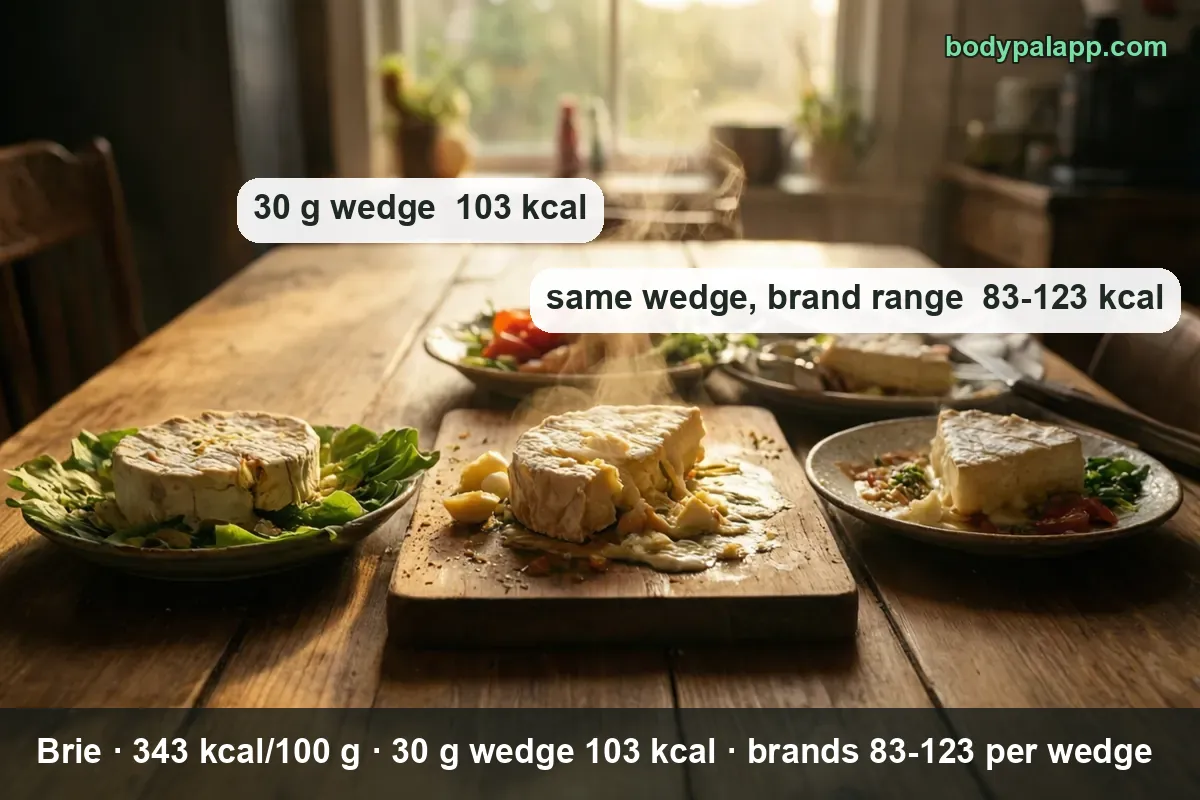
Brie rarely arrives alone, and the things around it are where the evening's calories actually accumulate.
| Item | Amount | Calories |
|---|---|---|
| Brie | 30 g wedge | 103 kcal |
| Cream crackers | three, about 21 g | 93 kcal |
| Grapes | 80 g handful | 52 kcal |
| Butter | 5 g scrape | 37 kcal |
| Total | 285 kcal |
The cheese is 36% of that plate. Three crackers and a scrape of butter together come to 130 kcal, more than the brie itself, and they arrive without anyone counting them. Salt totals 0.71 g, of which the brie supplies 0.42 g and the crackers 0.20 g.
The sandwich version behaves the same way. Two slices of white bread at 85 kcal each plus a 30 g wedge is 273 kcal, and the bread is the larger half. Cheese gets the blame; bread does the damage. The NHS's overview of milk and dairy foods makes the point about portion size rather than exclusion, which is the right frame for a cheese eaten 30 g at a time.
Brie, camembert and cheddar
| Cheese | Per 100 g | 30 g piece | Saturates per 100 g |
|---|---|---|---|
| Brie | 343 kcal | 103 kcal | 18.2 g |
| Camembert | 290 kcal | 87 kcal | 14.2 g |
| Cheddar | 416 kcal | 125 kcal | 21.7 g |
| Mozzarella | 257 kcal | 77 kcal | 13.8 g |
| Port Salut | 333 kcal | 100 kcal | 18.1 g |
| Stilton | 410 kcal | 123 kcal | 23.0 g |
Camembert is the interesting row. It is 15% lighter than brie while carrying slightly more protein — 21.5 g against 20.3 — because it holds more water, not because it is a leaner cheese by nature. Swap one for the other on a board and you save sixteen calories a wedge.
Our take: against cheddar, brie is the better wedge on both counts that matter here — 103 kcal against 125, and 16% less saturated fat per gram — though it gives up about a fifth of the protein. Against mozzarella, brie loses outright on calories and salt, and mozzarella is the swap to make if the cheese is going into a meal rather than onto a board. And if the wedge is coming off a board either way, buy the British brie: 83 calories instead of 106 for a piece nobody will be able to tell apart.
Popular brie brands in the BodyPal food database
Ranked by how widely each product appears among foods sold in the United Kingdom, from the BodyPal food database of over 3.3 million products. Calories are the figures printed on each label. Every one of these is a French brie, which is why they all sit above the CoFID average on this page.
| Product | Calories (per 100 g) |
|---|---|
| Chêne d’Argent Brie | 356 kcal |
| Ile de France Brie | 367 kcal |
| Brie (Lidl) | 356 kcal |
| Le Rustique Brie | 351 kcal |
| French Brie (Aldi) | 352 kcal |
Brand popularity: BodyPal food database. Nutrition: manufacturer labels.
Brie FAQs
How many calories are in brie?
343 kcal per 100 g, so a 30 g wedge is 103 kcal and a whole 200 g pack is 686. That figure matches French brie. British and Cornish bries are lighter at 275 to 299 per 100 g, which brings the same wedge down to 83 to 90 kcal.
How many calories in 30 g of brie?
103 kcal, with 6.1 g of protein, 8.7 g of fat and 0.42 g of salt. Thirty grams is the portion printed on most UK packs. It uses 5% of a day's calories and 27% of a day's saturated fat, which is the ratio worth remembering.
How many calories in a slice of brie?
A thin 25 g slice is 86 kcal and a generous 40 g wedge is 137. UK packs are usually 160 to 200 g, so a slice is between a sixth and an eighth of the pack. Cutting from a British brie rather than a French one takes roughly 20% off each figure.
Does brie have carbs?
Effectively none. The UK dataset records brie's carbohydrate as a trace, below 0.1 g per 100 g, because ripening ferments the milk sugar away. The arithmetic confirms it: 29.1 g of fat and 20.3 g of protein account for all 343 calories with nothing left over.
Is brie keto friendly?
On carbohydrate, yes — a trace per 100 g, so a wedge contributes nothing to a daily limit. What it does contribute is 5.5 g of saturated fat per 30 g, and 18.2 g per 100 g, which is 91% of the daily reference for saturates in half a pack.
Brie or camembert — which has fewer calories?
Camembert, by 15%: 290 kcal per 100 g against 343, or 87 kcal against 103 for a 30 g wedge. Camembert also edges the protein at 21.5 g per 100 g against 20.3. The difference is water content rather than richness of recipe.
Brie or cheddar for fewer calories?
Brie, comfortably. A 30 g wedge is 103 kcal against 125 for the same weight of English cheddar, and brie carries 16% less saturated fat per gram. Cheddar wins on protein, 25.4 g per 100 g against 20.3, and on salt at 1.81 g against 1.39.
How many calories in baked brie?
Baking changes nothing on its own, so a whole 200 g French brie baked in its box is 686 kcal before anything is dipped into it. Add two slices of white bread at 85 kcal each and one shared starter passes 850. The bread and honey do the arithmetic, not the oven.
Similar foods
- Hummus — 92 kcal per 30 g
- Caster sugar — 16 kcal per level teaspoon
- Granulated sugar — 16 kcal per level teaspoon
- Tablespoon of sugar — 50 kcal per level tablespoon
- Honey — 20 kcal a teaspoon
- Cheddar cheese — 125 kcal per 30 g piece
Count it without the maths
Point the camera at the board and BodyPal counts the wedge, the crackers and the butter together, which is the part most people leave out.


How long does it take to burn off brie?
A 30 g wedge is 103 kcal. Enter your weight and the amount you ate to see how long it takes you to burn that off:
lb
| Activity | Time to burn 103 kcal |
|---|---|
| Walking, brisk | 21 min |
| Cycling, moderate | 13 min |
| Swimming, moderate | 15 min |
| Jogging | 12 min |
| Weight training, moderate | 23 min |
Times are for a 154 lb (11 st) adult at a steady pace; change the weight to see yours. The amount is set to the portion in the text (30 g); change it to what you actually ate. BodyPal works this out from your steps automatically.
One food is easy to picture; a whole day is harder. See how many calories you need a day and what a deficit actually looks like.