
How Many Calories in Hummus?
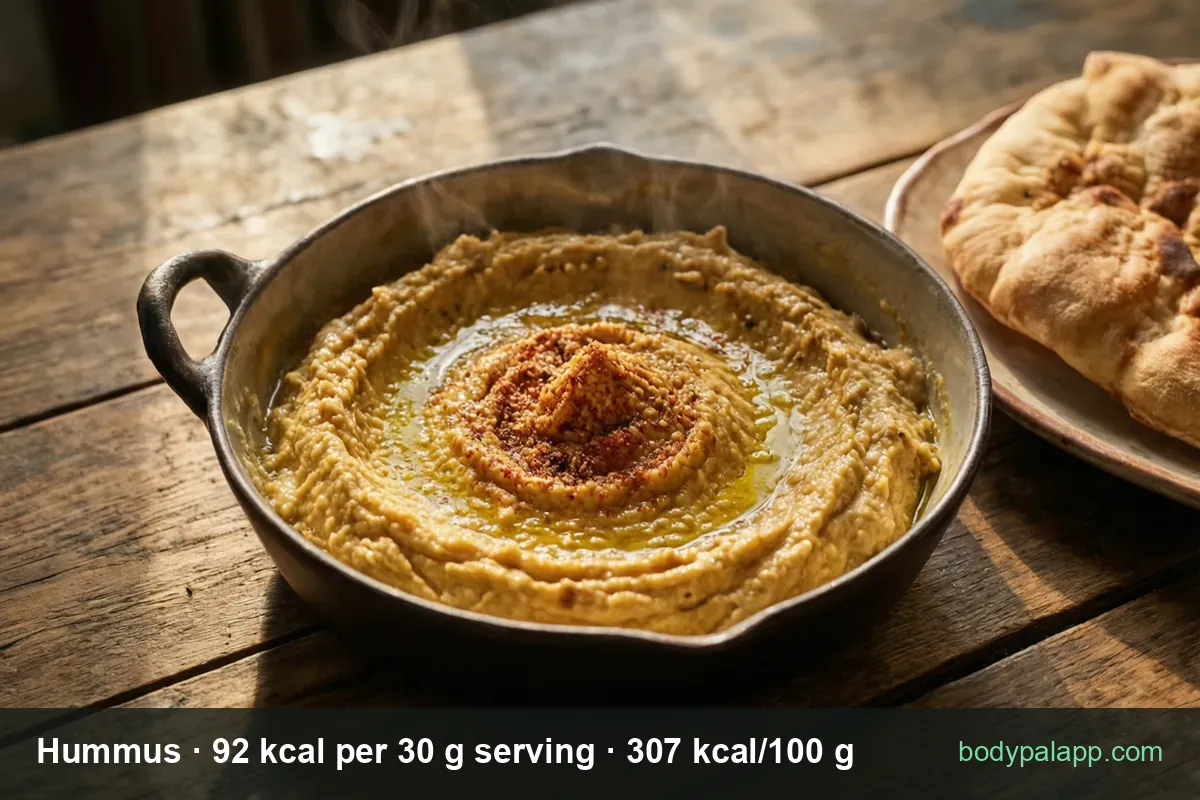
Hummus is a health food with the calorie density of a dessert: 307 kcal per 100 g, 92 in a 30 g deli-counter scoop. The chickpea isn't the problem — the tahini and oil are, at 26.7 g of fat per 100 g. Half a standard 200 g tub is 307 calories on its own.
On this page
- Quick facts
- What a serving actually weighs
- Reduced-fat hummus
- How does hummus compare?
- The health-halo problem
- Most popular hummus brands
- FAQ
Quick facts
Standard houmous (that's how the UK database spells it), per 100 g:
| Per 100 g | Amount | % RI |
|---|---|---|
| Energy | 307 kcal (1,284 kJ) | 15% |
| Protein | 6.8 g | 14% |
| Carbohydrates | 10.5 g | 4% |
| Fat | 26.7 g | 38% |
| Fibre | 4.9 g | —* |
| Sugar | 0.6 g | 1% |
| Salt | 1.02 g | 17% |
RI = reference intake for an average adult (2,000 kcal). *No UK reference intake exists for fibre; the NHS suggests 30 g a day. Note the salt: a sixth of your daily 6 g hides in every 100 g of dip.
Verified nutrition data
Numbers on this page come from CoFID, the UK government’s Composition of Foods Integrated Dataset, and from manufacturer labels where a branded product is named. Last verified August 2026. How we verify our data →
What a serving actually weighs
A level tablespoon is about 15 g — 46 calories. The 30 g serving printed on supermarket tubs is 92. That's the honest unit for hummus: spoon-sized, not tub-sized.
Add 80 g of carrot sticks for 27 calories and the whole snack is 119 — and the carrots count towards your 5 a day. Swap the carrots for pitta and crisps and the same bowl of dip becomes the smallest number on the plate.
Hummus also works as a spread, and there it looks positively frugal: a thin 10 g scrape across bread is about 31 calories, less than half the 69 that the same layer of mayonnaise costs. The dip that overwhelms a tub behaves itself on a sandwich.
Reduced-fat hummus
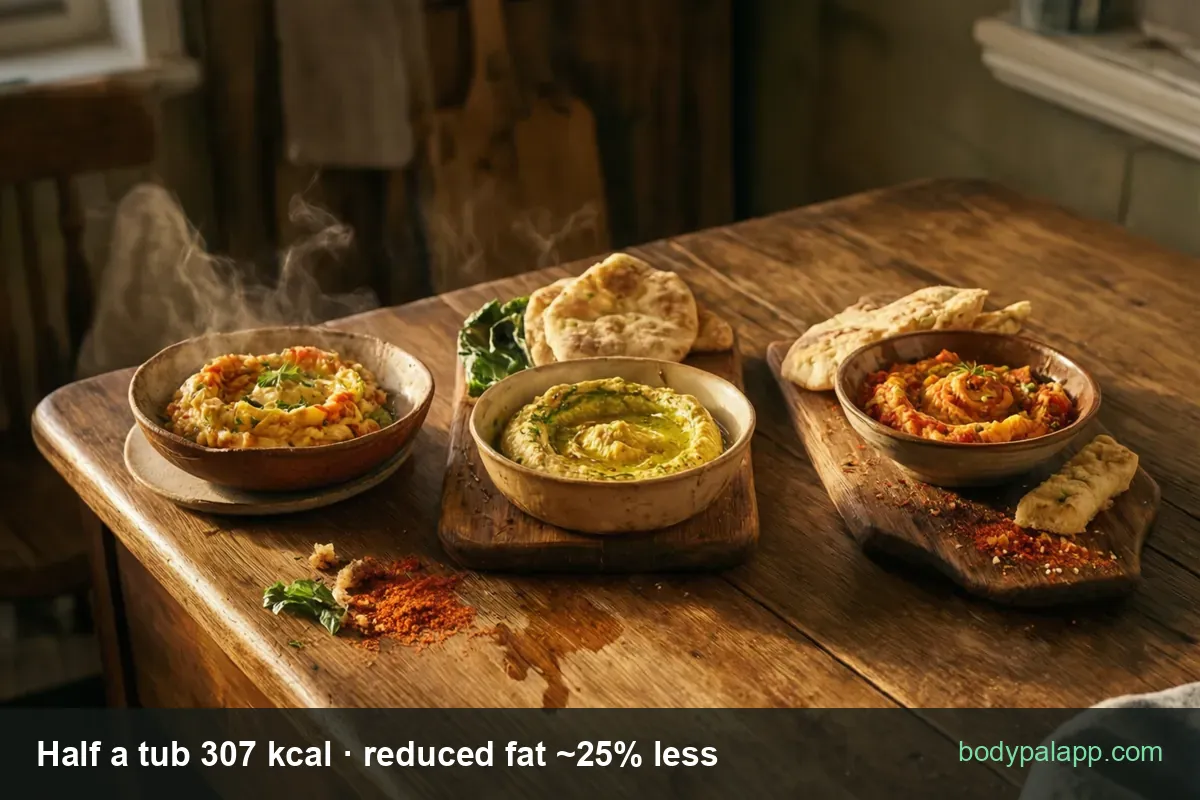
Reduced-fat tubs typically label at around 230–250 kcal per 100 g — roughly a quarter lighter than the standard 307. That's a real saving, unlike most "light" claims, because the makers genuinely pull back the tahini and oil.
It still isn't a low-calorie food. A quarter off a dense number leaves a dense number. Portion control does more here than the recipe on the lid.
How does hummus compare?
| Food | Per 100 g | Calories |
|---|---|---|
| Olives | 100 g, drained | 103 |
| Avocado | 100 g | 171 |
| Hummus | 100 g | 307 |
| Peanut butter | 100 g | 607 |
| Mayonnaise | 100 g | 686 |
As a sandwich spread, hummus is the smart swap: less than half the calories of mayonnaise, gram for gram, with fibre and protein that mayo doesn't have. Against olives or avocado it's the heavier dip — pick those when volume is the point.
The health-halo problem
Hummus earns its good reputation — the fat comes from tahini and olive oil, and it carries 4.9 g of fibre per 100 g. What it doesn't earn is a free pass on quantity. Healthy and light are different words.
Half a tub is 307 calories: chocolate-bar territory, eaten with a spoon and a clean conscience. Hold the spoon, not the tub.
The other quiet number is salt — 1.02 g per 100 g, a sixth of the NHS 6 g daily limit in every half tub. A 30 g serving keeps that to a modest 0.3 g, with about 1.5 g of fibre alongside. The serving size fixes almost every complaint you can raise against hummus.
Most popular hummus brands in the United Kingdom
Ranked by how widely each product appears among foods sold in the United Kingdom, from the BodyPal food database of over 3.3 million products. Calories are the figures printed on each label.
| Product | Calories (per 100 g) |
|---|---|
| Tesco Houmous | 303 kcal |
| The Deli Houmous (Aldi) | 302 kcal |
| Meadow Fresh Reduced Fat Houmous | 256 kcal |
Brand popularity: BodyPal food database. Nutrition: manufacturer labels.
FAQ
How many calories in a tablespoon of hummus?
46 calories for a level tablespoon (about 15 g). A heaped one is closer to the 30 g supermarket serving — 92 calories. Nobody stops at level, which is how a "light lunch" of hummus and pitta quietly climbs into the hundreds.
How many calories in hummus and carrot sticks?
119 calories — 92 for a 30 g serving of hummus plus 27 for 80 g of carrot sticks. It's one of the better snack trades going: the carrots are nearly free, and the fat in the dip is what makes them feel like actual food.
How many calories in half a tub of hummus?
307 calories — half a standard 200 g tub is 100 g, and hummus runs 307 kcal per 100 g. That's a chocolate bar's worth of energy from something that reads as a salad accessory. The 30 g serving at 92 is the saner unit.
Is reduced-fat hummus worth it?
Around 230–250 calories per 100 g on most labels — roughly 25% below the standard 307, and unlike most "light" products the cut is real. It's still calorie-dense, though. Measuring the serving saves more than switching the tub.
Is hummus good for weight loss?
At 92 calories per 30 g serving, hummus fits a deficit easily — with fibre and fat that make vegetables worth eating. The risk is the tub: 100 g eaten absent-mindedly is 307. If you're cutting, portion it onto the plate and put the tub back.
How much protein is in hummus?
6.8 g per 100 g — but a realistic 30 g serving delivers only about 2 g. Hummus has a protein reputation it doesn't quite earn at real portion sizes; it's better understood as a fat-and-fibre dip than a protein source.
Hummus or mayonnaise — which is lighter?
Hummus, by a wide margin: 307 calories per 100 g against mayonnaise at 686. Spread for spread, swapping mayo for hummus in a sandwich cuts the condiment calories by more than half and adds fibre mayo can't offer.
Is houmous the same as hummus?
Yes — same dip, same 307 calories per 100 g. UK supermarkets and the government's food database favour "houmous", while "hummus" dominates everywhere else. Spelling changes nothing on the label.
Why is hummus so high in calories?
Because of the 26.7 g of fat per 100 g — that's 38% of an adult's daily reference intake, and it comes from the tahini and olive oil, not the chickpeas. The NHS guide to fats explains why fat carries more calories per gram than anything else you eat.
Similar foods
- Honey — 20 kcal a teaspoon
- Brie — 103 kcal per 30 g wedge
- Maple syrup — 54 kcal per tablespoon
- Mozzarella — 159 kcal per half ball
- Feta — 75 kcal per 30 g portion
- Caster sugar — 16 kcal per level teaspoon
Dip logged, no maths
Photograph the plate and BodyPal counts the hummus, the carrots and everything else on it — calories and macros in one shot.


How long does it take to burn off hummus?
100 g is 307 kcal. Enter your weight and the amount you ate to see how long it takes you to burn that off:
lb
| Activity | Time to burn 307 kcal |
|---|---|
| Walking, brisk | 1 hr 1 min |
| Cycling, moderate | 38 min |
| Swimming, moderate | 44 min |
| Jogging | 36 min |
| Weight training, moderate | 1 hr 8 min |
Times are for a 154 lb (11 st) adult at a steady pace; change the weight to see yours. The amount is set to the portion in the text (100 g); change it to what you actually ate. BodyPal works this out from your steps automatically.
One food is easy to picture; a whole day is harder. See how many calories you need a day and what a deficit actually looks like.