
How Many Calories in Olives?
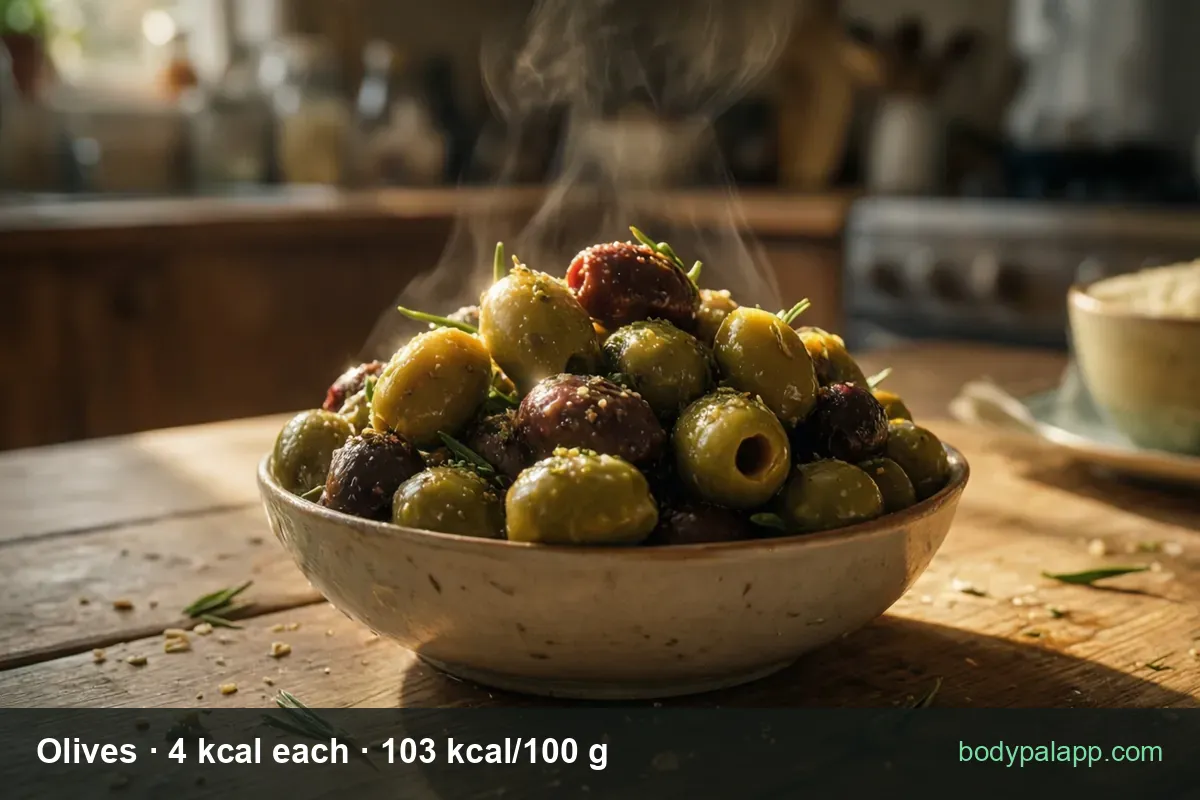
How many calories in olives barely moves the needle: about 4 kcal per olive, 31 kcal for a 30 g bowl, and 103 kcal per 100 g for green olives in brine, drained. The figure that deserves your attention sits elsewhere on the label. It is the salt: 3.33 g per 100 g.
On this page
- Quick facts
- From one olive to the whole bowl
- Green, black, stoned and marinated
- How do olives compare?
- The fattening myth and the real catch
- Most popular olive brands
- Olive FAQs
Quick facts
Figures are for green olives in brine, drained, flesh and skin, per 100 g.
| Per 100 g | Amount | % RI* |
|---|---|---|
| Energy | 103 kcal (431 kJ) | 5% |
| Protein | 0.9 g | 2% |
| Carbohydrate | trace | 0% |
| Fat | 11.0 g | 16% |
| – of which saturates | 1.7 g | 9% |
| Fibre | no verified figure | – |
| Sugar | trace | 0% |
| Salt | 3.33 g | 56% |
*RI = reference intake of an average adult (2,000 kcal).
Verified nutrition data
Numbers on this page come from CoFID, the UK government’s Composition of Foods Integrated Dataset, and from manufacturer labels where a branded product is named. Last verified August 2026. How we verify our data →
An unusual profile: essentially no carbohydrate, no sugar, hardly any protein. Olives are fat delivered in 4-calorie instalments, and only 1.7 g of that 11 g is saturated; the rest is the kind the NHS guide to fat types suggests swapping towards. Then there is the salt row, quietly claiming 56% of a day's limit per 100 g. Hold that thought.
From one olive to the whole bowl
- One olive (~4 g): ~4 kcal
- Small bowl or garnish (30 g): ~31 kcal
- Weighed with stones: 82 kcal per 100 g, since the stone is weight you never eat
The 4-kcal figure is what makes olives such a forgiving nibble. Ten of them cost you about 41 kcal, less than most single crisps' worth of anything else on the party table. If you are logging from a jar, note whether your weight includes stones: 100 g of unpitted olives carries about a fifth fewer calories than 100 g of pitted flesh, purely because of the stones on the scale.
On the plate, olives do their best work as the thing that stops you reaching for heavier snacks. A 31-kcal bowl alongside a drink occupies the picking hand for a fraction of what cheese or crisps would charge for the same job.
Green, black, stoned and marinated
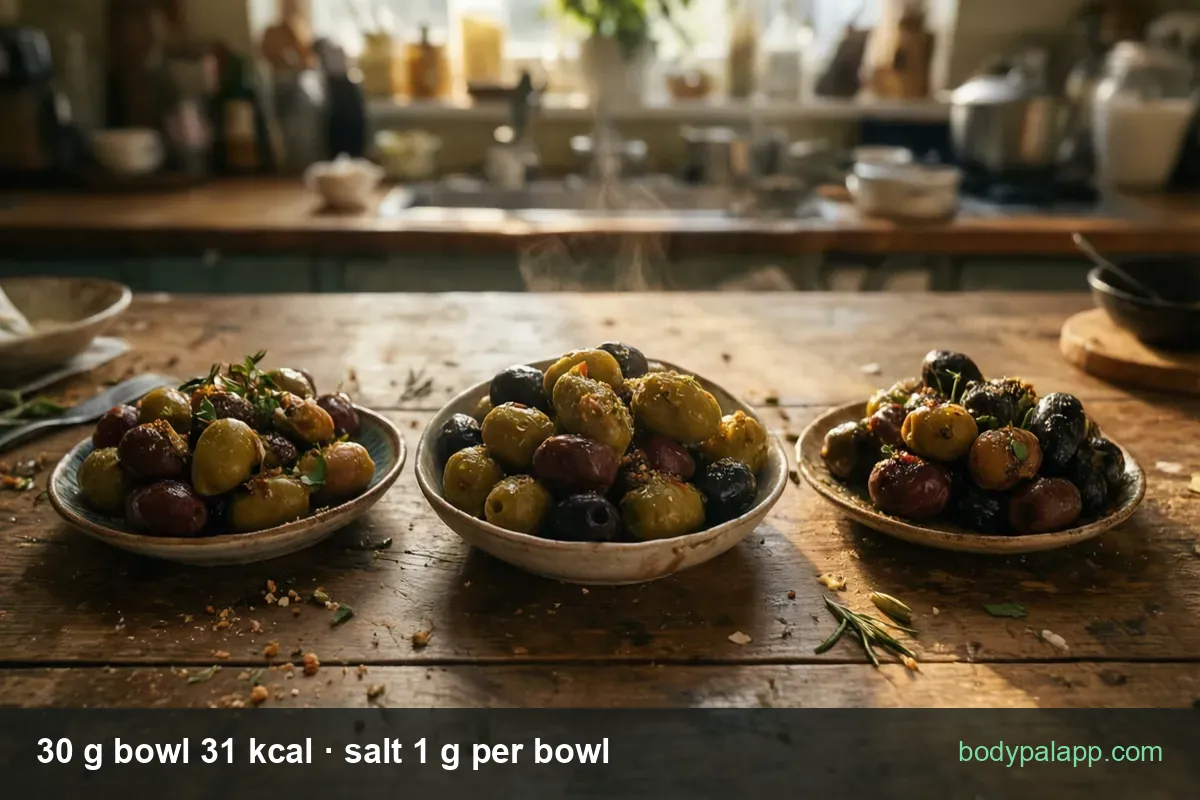
The verified UK figure on this page is for green olives in brine. Black olives have no equivalent verified row, but they are the same fruit picked riper, and the sensible expectation is a broadly similar count, not a different league. Pitted versus unpitted changes only what the scale says, not what an olive costs you.
Marinated olives are the variant that genuinely moves. Those glistening deli-counter tubs are dressed in oil, and olive oil runs 124 kcal per tablespoon, more than a whole 30 g bowl of the olives it coats. Drain them well and the difference shrinks; spoon the marinade onto bread and you have eaten the calories anyway, just in a tastier disguise.
Stuffed olives depend entirely on the stuffing. Pimento adds next to nothing; cheese and anchovy versions borrow from their fillings, so read the deli label rather than assuming.
How do olives compare?
The natural rivals are the other picky bits on a sharing board:
| Food | Typical serving | Calories |
|---|---|---|
| Olives | 30 g bowl | 31 kcal |
| Hummus | 30 g serving | 92 kcal |
| Cheese | 30 g piece | 125 kcal |
| Avocado | half | 128 kcal |
| Olive oil | 1 tbsp | 124 kcal |
Gram for gram, olives are the lightest thing on the board by a factor of three or four: the same 30 g of cheese charges four times as much. If calories are the criterion, fill the olive bowl and go easy on everything else. The one column this table hides is salt, where olives lead the board just as decisively in the wrong direction.
The fattening myth and the real catch
"Olives are fattening" survives because they are visibly oily, but the arithmetic laughs at it: at 4 kcal each you would need to empty several jars to trouble anyone's day. As fat sources go, this is one of the most portion-controlled formats food comes in.
The real catch is the brine. At 3.33 g of salt per 100 g, olives carry more than twice the salt of crisps gram for gram (crisps: 1.51 g per 100 g), and a single 30 g bowl delivers about 1 g, a sixth of the 6 g daily maximum in the NHS salt guidance. If you are watching blood-pressure-friendly numbers, a rinse under the tap before serving washes a little of it away, and the calories stay exactly where they were.
Most popular olive brands in the United Kingdom
Ranked by how widely each product appears among foods sold in the United Kingdom, from the BodyPal food database of over 3.3 million products. Calories are the figures printed on each label. Oil-marinated jars sit above the plain brine figure of 103.
| Product | Calories (per 100 g) |
|---|---|
| Baresa Pitted Green Olives (Lidl) | 172 kcal |
| Gaea Pitted Green Olives | 133 kcal |
Brand popularity: BodyPal food database. Nutrition: manufacturer labels.
Olive FAQs
How many calories in 10 olives?
About 41 kcal, taking a typical 4 g olive at roughly 4 kcal each (103 kcal per 100 g of drained green olives). Even a generous double handful stays under 100 kcal, which is why olives are one of the safest things to graze on absent-mindedly.
Do green and black olives have different calories?
Green olives in brine measure 103 kcal per 100 g; black olives have no separate verified UK figure but are the same fruit at fuller ripeness, so expect a broadly similar number rather than a meaningful gap. The marinade or stuffing changes the count far more than the colour does.
Are olives fattening?
At about 4 kcal per olive and 31 kcal per 30 g bowl, no realistic serving is. Their 11 g of fat per 100 g is mostly unsaturated, with only 1.7 g saturated. The format polices itself: olives are eaten one by one, not by the slab, and the calories follow suit.
How much salt is in olives?
3.33 g per 100 g, which is 56% of the 6 g daily reference intake, courtesy of the brine. A 30 g bowl carries about 1 g of salt, a sixth of the NHS daily maximum. If you are watching salt, drain well or rinse before serving; the calories are unaffected.
Do olives have carbs?
Only a trace, and effectively no sugar either. Practically all of an olive's 103 kcal per 100 g comes from its 11 g of fat, which makes olives a rare savoury snack with next to no carbohydrate on the label at all.
How many calories in olives with stones?
82 kcal per 100 g weighed with the stones in, versus 103 kcal per 100 g for drained flesh alone. The stone is inedible weight on the scale, so unpitted olives look about 20% lighter on paper while costing exactly the same per olive eaten.
Are marinated olives in oil more calorific?
Yes, and the oil is the reason: a single tablespoon of olive oil is 124 kcal, more than four times a 30 g bowl of the olives themselves. Well-drained marinated olives land close to the plain figure; the ones swimming in their dressing do not.
Are olives saltier than crisps?
Yes, comfortably: 3.33 g of salt per 100 g against 1.51 g for crisps, more than double gram for gram. The difference is that a 30 g bowl of olives costs 31 kcal where crisps charge far more energy for the same weight, so each snack fails a different test.
Similar foods
- Quinoa — ~111 kcal per 100 g cooked
- Baked beans — 168 kcal per half tin
- Rice — 236 kcal per cooked portion
- Tofu — 102 kcal per 70 g quarter block
- Pasta — 304 kcal per cooked portion
- Gravy — 21 kcal a pour
Count it without the maths
Snap the sharing board and BodyPal logs the olives, the cheese and the dips in one photo, calories and macros sorted.


Want the bigger picture? Calculate your daily calorie needs — your maintenance figure, a target for losing or gaining, and the date you get there.