
Calories in Quinoa: Why the Packet Says 309 and Your Bowl Says 111
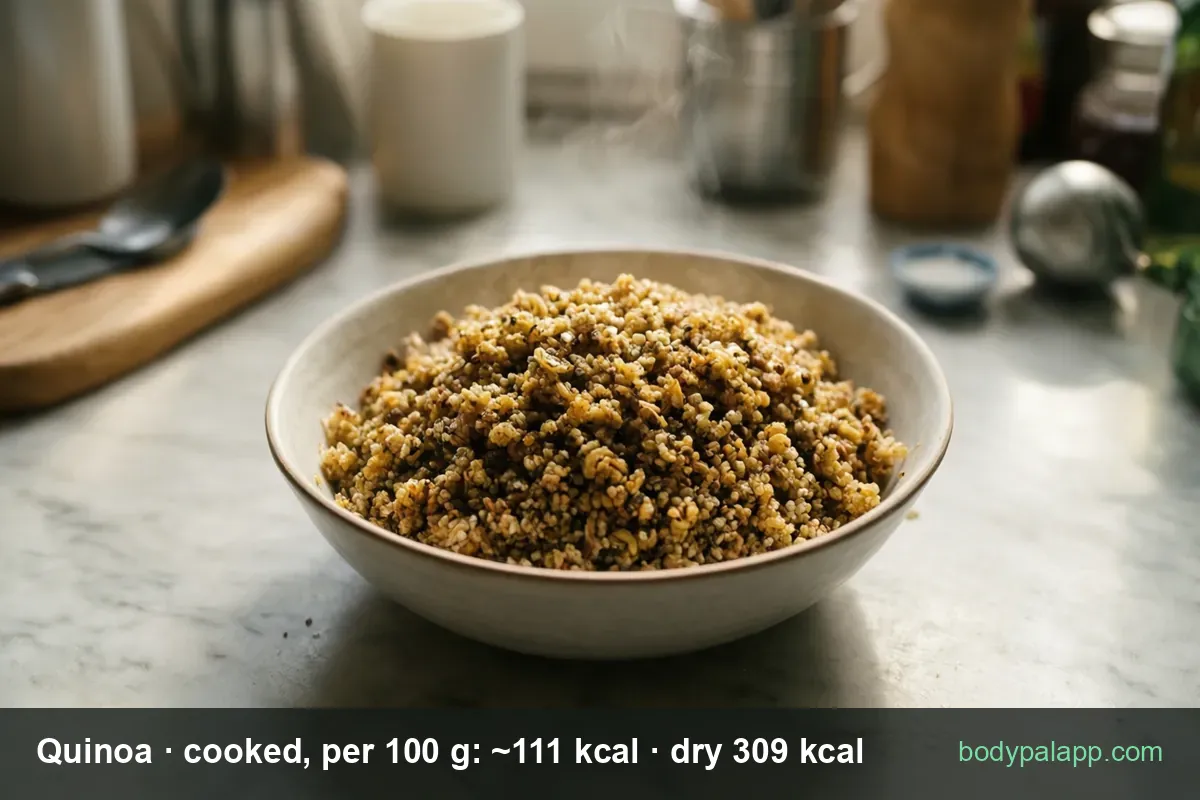
The calories in quinoa depend entirely on which quinoa you mean: a 125 g cooked side is 139 kcal, which works out at about 111 kcal per 100 g, while the packet label reads 309. Both are right. The label describes the dry grain, and the grain roughly triples in weight as it absorbs water in the pan.
On this page
- Quinoa nutrition at a glance
- Dry weight against cooked weight
- UK portions, from a side to a salad bowl
- White, red and black quinoa
- How does quinoa compare with rice?
- The myth worth correcting
- Most popular quinoa brands
- FAQ
Quinoa nutrition at a glance
| Nutrient | Per 100 g dry | Per 100 g cooked | Per 125 g cooked side | %RI* per side |
|---|---|---|---|---|
| Energy | 309 kcal / 1,293 kJ | ~111 kcal / 464 kJ | 139 kcal / 582 kJ | 7% |
| Protein | 13.8 g | ~5.0 g | 6.3 g | 13% |
| Carbohydrate | 55.7 g | ~20.1 g | 25.1 g | 10% |
| of which sugars | 6.1 g | ~2.2 g | 2.7 g | 3% |
| Fat | 5.0 g | ~1.8 g | 2.3 g | 3% |
| Fibre | 7.0 g | ~2.5 g | 3.1 g | – |
| Salt | 0.15 g | ~0.05 g | 0.07 g | 1% |
*%RI = percentage of the reference intake for an average adult (2,000 kcal; 70 g fat, 260 g carbohydrate, 90 g sugars, 50 g protein, 6 g salt). Cooked figures are recalculated from the CoFID dry values using a yield factor of 0.36.
Verified nutrition data
Numbers on this page come from CoFID, the UK government’s Composition of Foods Integrated Dataset, and from manufacturer labels where a branded product is named. Last verified August 2026. How we verify our data →
The line that separates quinoa from every other grain on the shelf is protein: 13.8 g per 100 g dry, which survives cooking as roughly 5 g per 100 g in the bowl. A cooked side carries 6.3 g, close to what a boiled egg offers, from something that behaves like rice on the plate.
Fibre is the quieter strength. That 3.1 g per side is a tenth of the 30 g a day the NHS suggests adults aim for, from a food most people file under "diet carb" and forget to credit.
Dry weight against cooked weight
Every calorie confusion about quinoa comes from one place. Nutrition labels describe the product in the bag, and the product in the bag is dry. Cook 100 g of dry quinoa and you get roughly 280 g of cooked quinoa; the 309 calories have not changed, they are simply spread across nearly three times the weight.
That is why this page uses a conversion factor of 0.36, and says so openly: cooked values here are the CoFID dry figures multiplied by 0.36, giving about 111 kcal per 100 g in the bowl. If you weigh your food, decide once whether you weigh it dry or cooked and stay consistent. Logging 100 g of cooked quinoa against the dry label nearly triples the calories on paper, which is the most common quinoa logging error there is.
UK portions, from a side to a salad bowl
| Portion | Weight | Calories |
|---|---|---|
| Standard portion, weighed dry | 75 g dry | 232 kcal |
| Side portion, cooked | ~125 g | 139 kcal |
| Large salad bowl, cooked | ~185 g | 205 kcal |
The 75 g dry portion is the honest anchor, because that is how most people actually measure it, straight from the bag before the pan. It lands at 232 kcal and cooks up to a generous plateful with around 10 g of protein.
A supermarket ready-to-eat pouch usually holds 250 g, which on these figures is roughly 278 kcal if you eat the whole thing. Half a pouch beside some chicken is a 139 kcal side. The pouch never feels like two portions, which is exactly why it is worth knowing that it is.
White, red and black quinoa
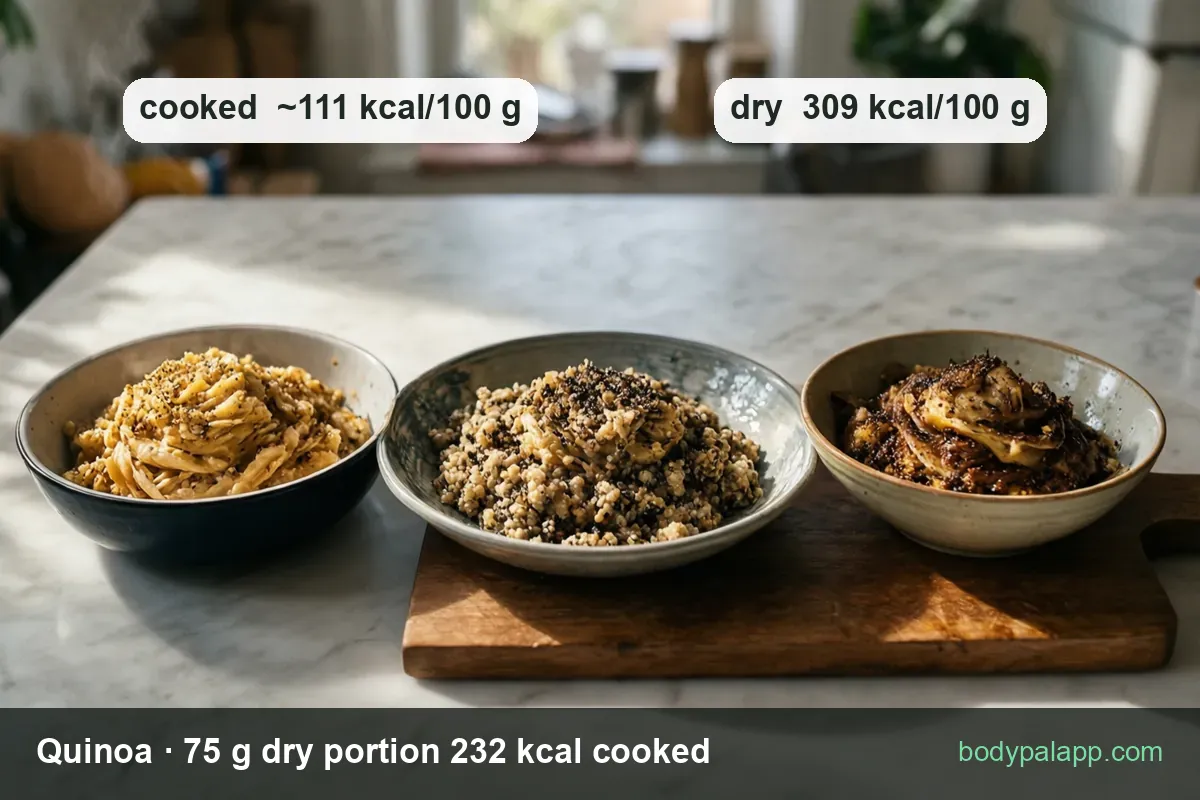
The colour on the shelf changes the price more than the nutrition. CoFID carries a single row for raw quinoa, and the white, red and black grains are close enough that UK retail labels print near-identical numbers across all three. Red and black hold their bite slightly better in salads; white cooks fluffier and faster.
Flaked and puffed quinoa are different products with different water content, so their labels differ from the raw grain. Read those per 100 g as sold and trust the packet rather than a generic figure.
How does quinoa compare with rice?
All figures below are cooked-to-cooked, which is the only fair way to run this table.
| Food, cooked | Per 100 g | Protein | Fibre |
|---|---|---|---|
| Quinoa | ~111 kcal | 5.0 g | 2.5 g |
| Basmati rice | 117 kcal | 2.8 g | 0.6 g |
| White long grain rice | 131 kcal | 2.8 g | 0.5 g |
| Brown rice | 131 kcal | 3.3 g | 1.2 g |
The verdict: for a calorie deficit, quinoa quietly wins, sitting 20 kcal per 100 g under standard white rice with nearly double the protein and four times the fibre. For a neutral base under a curry, basmati at 117 is close enough on calories that flavour should decide. The full head-to-head lives in our quinoa vs rice comparison.
Against other starchy sides the pattern holds: quinoa is mid-table on calories and top of the table on what comes with them. A jacket potato remains the bulkier, more filling plate per calorie; quinoa brings the protein. The NHS Eatwell Guide puts both in the starchy carbohydrate group it recommends building meals around.
The myth worth correcting
"Quinoa is a protein food, not a carb." It is a carb. At roughly 20 g of carbohydrate against 5 g of protein per 100 g cooked, quinoa sits firmly with rice and couscous as a starchy staple, one that happens to carry an unusually good protein bonus. Treat it as the base of the plate, not the protein on top of it, and its numbers make sense. The British Dietetic Association's food fact sheets make the same distinction between a complete protein source and a protein-rich grain.
Most popular quinoa brands in the United Kingdom
Ranked by how widely each product appears among foods sold in the United Kingdom, from the BodyPal food database of over 3.3 million products. Calories are the figures printed on each label. Both are ready-cooked pouches, so they sit between the dry figure of 309 and the plain-boiled ~111.
| Product | Calories (per 100 g) |
|---|---|
| Merchant Gourmet Red & White Quinoa (cooked pouch) | 184 kcal |
| Tilda Brown Basmati & Quinoa (cooked pouch) | 130 kcal |
Brand popularity: BodyPal food database. Nutrition: manufacturer labels.
How long does it take to burn off quinoa?
100 g cooked is 111 kcal. Enter your weight and the amount you ate to see how long it takes you to burn that off:
lb
| Activity | Time to burn 111 kcal |
|---|---|
| Walking, brisk | 22 min |
| Cycling, moderate | 14 min |
| Swimming, moderate | 16 min |
| Jogging | 13 min |
| Weight training, moderate | 25 min |
Times are for a 154 lb (11 st) adult at a steady pace; change the weight to see yours. The amount is set to the portion in the text (100 g); change it to what you actually ate. BodyPal works this out from your steps automatically.
Burning it off is one side of it. The other is knowing your number: work out how many calories you need a day, with macros and a goal date.
Frequently asked questions
How many calories are in 100g of cooked quinoa?
About 111 kcal per 100 g cooked, recalculated from the CoFID dry figure of 309 kcal using a 0.36 yield factor. The grain roughly triples in weight as it cooks, so the packet number and the bowl number describe the same calories at different weights.
How many calories are in a portion of quinoa?
A 125 g cooked side is 139 kcal, and a large 185 g salad bowl is 205 kcal. Measured the other way, the standard 75 g dry portion comes to 232 kcal once cooked. Pick one measuring habit, dry or cooked, and log it the same way every time.
Why does the packet say quinoa is over 300 calories?
Because 309 kcal per 100 g describes the dry grain, and nobody eats it dry. After cooking, those calories are spread across nearly three times the weight, which lands at about 111 kcal per 100 g in the bowl. The label is accurate; it just measures a different moment.
Is quinoa lower in calories than rice?
Yes, cooked against cooked. Quinoa sits at about 111 kcal per 100 g, white long grain rice at 131 and basmati at 117. The 20 kcal gap over standard white rice is modest; the bigger difference is quinoa's 5 g of protein against rice's 2.8 g.
Is quinoa good for weight loss?
A 139 kcal side with 6.3 g of protein and 3.1 g of fibre is a strong base for a deficit, since the protein and fibre do the staying-full work. The trap is the pouch: 250 g of ready-cooked quinoa is around 278 kcal, double the side portion most plans assume.
How much protein is in quinoa?
About 5 g per 100 g cooked, or 6.3 g in a 125 g side, from 13.8 g per 100 g dry. That is roughly double what white rice offers for slightly fewer calories. It is a genuine bonus, though a cooked side still carries less protein than a single chicken thigh.
Is quinoa a carb?
Yes. Cooked quinoa carries about 20.1 g of carbohydrate per 100 g against 5 g of protein, which makes it a starchy staple, not a protein food. It belongs in the same slot on the plate as rice or potatoes, with a better protein and fibre profile than either.
How much dry quinoa do I need per person?
75 g dry per person is the standard portion, which is 232 kcal and swells to roughly 210 g once cooked. For a lighter side, 50 g dry lands at about 155 kcal. Rinse it first; the maths stays the same but the flavour improves considerably.
Does quinoa have much fibre?
7 g per 100 g dry, which survives as roughly 2.5 g per 100 g cooked, or 3.1 g in a side portion. That is around a tenth of the 30 g daily intake the NHS suggests, and about four times what the same weight of white rice provides.
Similar foods
- Olives — 4 kcal each
- Rice — 236 kcal per cooked portion
- Baked beans — 168 kcal per half tin
- Tofu — 102 kcal per 70 g quarter block
- Pasta — 304 kcal per cooked portion
- Couscous — 267 kcal per 150 g cooked side
Count it without the maths
BodyPal logs the bowl in front of you from one photo, cooked weight and all, so the dry-versus-cooked arithmetic stops being your problem.

