
How Many Calories in Couscous?
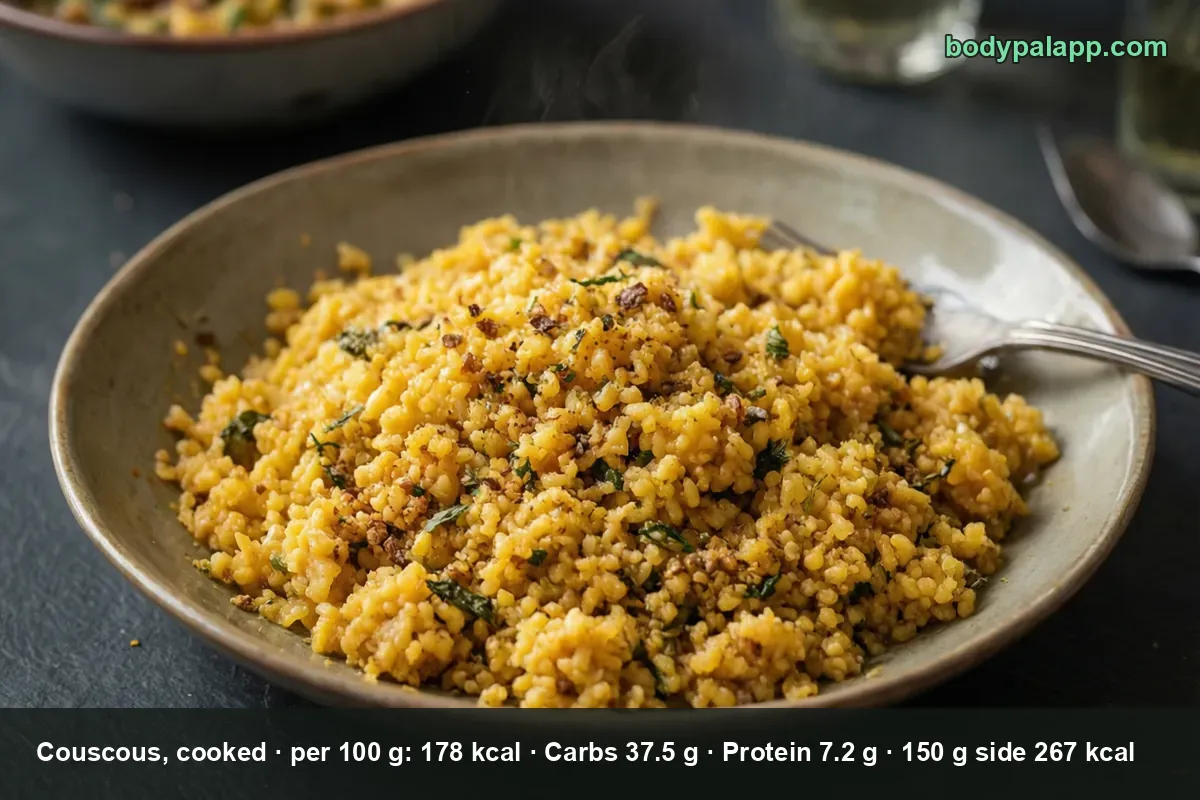
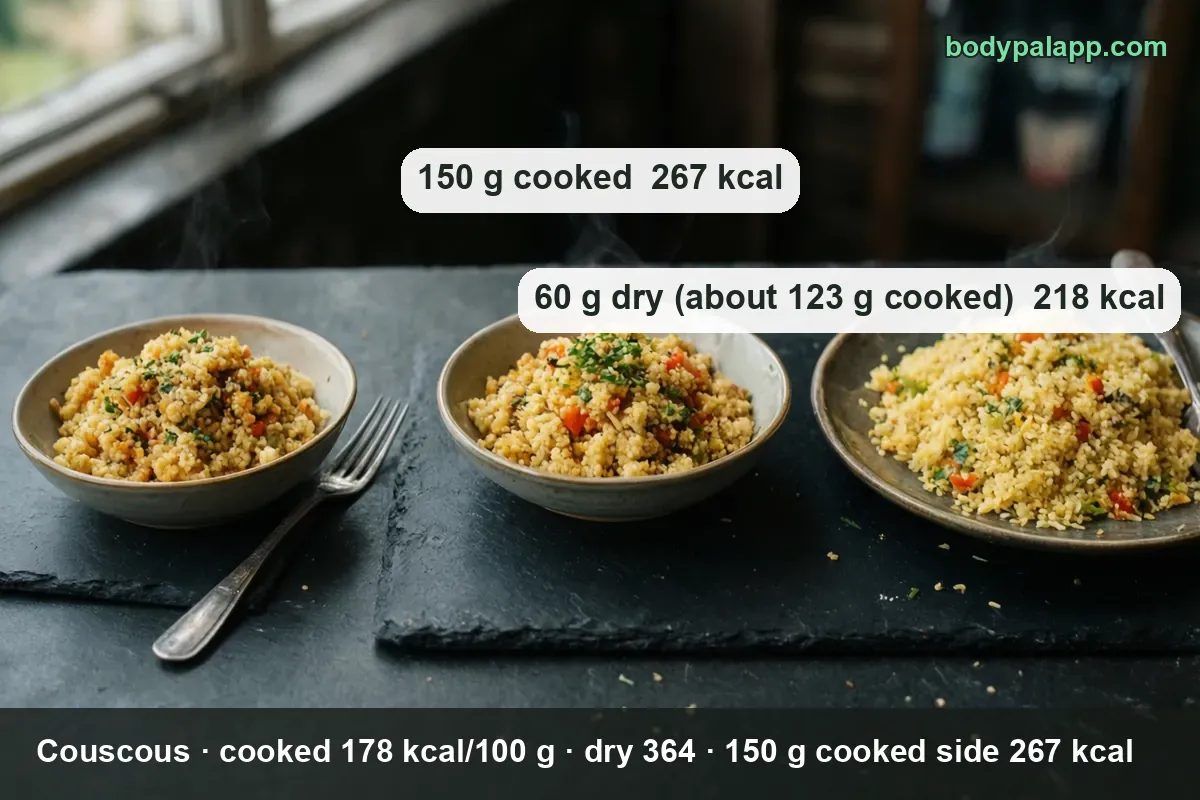
Cooked couscous is 178 calories per 100 g, so a 150 g side on the plate is 267 kcal. The 364 printed on the packet is dry couscous, and dry couscous roughly doubles in weight the moment hot water hits it. The usual UK serving of 60 g dry finishes as 218 kcal.
On this page
- Couscous quick facts
- The 364 on the packet is not the 364 in your bowl
- How much dry couscous per person
- Wholewheat, giant and the flavoured sachets
- Couscous, rice, pasta and potatoes
- Brands on the UK shelf
- FAQ
Couscous quick facts
Plain couscous, cooked in water, nothing stirred through it. The right-hand column is a 150 g side — the amount that sits next to a tagine or under a piece of fish.
| Nutrient | Per 100 g cooked | 150 g side | RI%* |
|---|---|---|---|
| Energy | 178 kcal / 745 kJ | 267 kcal / 1,117 kJ | 13% |
| Protein | 7.2 g | 10.8 g | 22% |
| Carbohydrates | 37.5 g | 56.3 g | 22% |
| – of which sugars | 1.0 g | 1.5 g | 2% |
| Fat | 1.0 g | 1.5 g | 2% |
| – of which saturates | 0.18 g | 0.27 g | 1% |
| Fibre | 2.2 g | 3.3 g | – |
| Salt | 0.01 g | 0.02 g | <1% |
*RI% = one side portion's share of an adult's daily reference intake, based on 2,000 kcal.
Verified nutrition data
Numbers on this page come from CoFID, the UK government’s Composition of Foods Integrated Dataset, and from manufacturer labels where a branded product is named. Last verified September 2026. How we verify our data →
Two rows are worth pausing on. Fat is 1.5 g in a whole side portion — semolina is almost fat-free until something is stirred into it. Salt is 0.02 g, which is close enough to nothing that it does not register on the day.
The 364 on the packet is not the 364 in your bowl
Pick up a box of couscous and the panel says something in the low 350s or 360s per 100 g. Lidl's is 349, the Co-op's 352, Ainsley Harriott's 364. Every one of those numbers describes dry grains, because that is what is inside the box.
Cooked, the same grains read 178.
The gap is water, and it is close to exactly double. Dry couscous is 364 kcal per 100 g; cooked couscous is 178. Divide one by the other and you get 2.045 — one gram of dry couscous becomes a little over two grams of cooked couscous, carrying the same energy across a doubled weight.
That single figure is where most couscous logging goes wrong. Weigh 200 g of fluffed couscous out of the pan, multiply by the packet's 364, and you have logged 728 kcal for something that holds 356. The error is not small and it always runs the same way: too high, by a factor of two.
Run it backwards and it becomes useful. A 150 g cooked portion started life as 73 g of dry couscous. A 200 g bowl started as 98 g. If you weigh before the kettle goes on, use the packet number; if you weigh after, use 178.
How much dry couscous per person
British packets are unusually consistent about this. Lidl says 60 g dry, the Co-op and Aldi say 50 g, Marks & Spencer says 50 g, Sainsbury's says 80 g, Morrisons says 35 g. The middle of that range — 50 to 60 g dry per person — is the honest answer, and it lands on a plate as roughly a mugful.
| Portion | Calories | Protein |
|---|---|---|
| 50 g dry (≈102 g cooked) | 182 kcal | 6.0 g |
| 60 g dry (≈123 g cooked) | 218 kcal | 7.2 g |
| 80 g dry (≈164 g cooked) | 291 kcal | 9.6 g |
| 150 g cooked, side portion | 267 kcal | 10.8 g |
| 180 g cooked | 320 kcal | 13.0 g |
| 200 g cooked, large bowl | 356 kcal | 14.4 g |
The two bases agree, which is reassuring when a single sachet quotes both. Ainsley Harriott's Moroccan Medley gives a dry portion of 50 g at 364 kcal per 100 g, which is 182 kcal. The same brand's prepared figures give a 130 g serving at 140.8 kcal per 100 g, which is 183. One calorie apart, from two different directions.
Couscous belongs in the starchy third of the plate that the NHS describes under starchy foods and carbohydrates, and at 267 kcal a side it is a normal-sized member of that group rather than a light one.
Wholewheat, giant and the flavoured sachets
| Version | Basis | Calories |
|---|---|---|
| Plain, dry | per 100 g dry | 364 kcal |
| Plain, cooked | per 100 g cooked | 178 kcal |
| Wholewheat (M&S, prepared) | per 100 g cooked | 142 kcal |
| Wholewheat (Sainsbury's, prepared) | per 100 g cooked | 147 kcal |
| Roasted vegetable sachet, made up | per 100 g cooked | 140.8 kcal |
| Roasted vegetable sachet, one serving | 130 g cooked | 183 kcal |
Wholewheat couscous reads lower per 100 g cooked than white — 142 to 147 against 178 — but read that carefully before celebrating. Wholewheat grains hold more water, so a portion of them weighs more for the same amount of grain. The real upgrade is the fibre, not the calorie count, and white couscous starts from a modest 2.2 g per 100 g cooked. The NHS target is 30 g of fibre a day, which most adults miss; the page on getting more fibre into your diet is blunt about swapping white grains for wholegrain ones where the swap costs nothing. Here it costs nothing.
Giant couscous — the pearl-sized version Sainsbury's sells in 300 g bags — is the same durum semolina rolled larger, and its label portions come out smaller: 35 g or 37.5 g dry.
The flavoured sachets are a different proposition, and not because of calories. A made-up sachet lands at 140 to 142 kcal per 100 g, lighter than plain couscous because the added vegetables are mostly water. What comes with them is salt: 0.44 to 0.78 g per 100 g of prepared couscous, so a 130 g serving carries 0.6 to 1.0 g of salt. That is up to 17% of the 6 g daily maximum the NHS sets out in its guidance on salt in your diet, from a side dish. Plain couscous carries 0.02 g in the same portion. The seasoning is the sodium, not the grain.
Couscous, rice, pasta and potatoes
| Side | Per 100 g cooked | Typical portion | Calories |
|---|---|---|---|
| Couscous | 178 kcal | 150 g | 267 kcal |
| Pasta | 169 kcal | cooked portion | 304 kcal |
| Rice | 131 kcal | cooked portion | 236 kcal |
| Quinoa | 111 kcal | 100 g cooked | 111 kcal |
| Boiled potatoes | 74 kcal | boiled serving | 130 kcal |
| Jacket potato | 97 kcal | medium | 277 kcal |
Couscous looks like the heavy one per 100 g, and that reputation is undeserved. Dry, every grain on this list sits near 350 kcal per 100 g — wheat is wheat. What separates them once cooked is how much water each absorbs, and couscous absorbs less than rice does. It is denser on the plate, not richer in the packet.
Our take: for the lowest calories per forkful, boiled potatoes win outright at 74 kcal per 100 g and nothing else is close. For protein, couscous is the pick of the grains — 7.2 g per 100 g cooked works out at 4.0 g of protein per 100 calories, against 3.3 for pasta and 2.1 for white rice. That is not a superfood claim; it is durum wheat with less water in it than boiled rice.
Popular couscous brands in the BodyPal food database
Ranked by how widely each product appears among foods sold in the United Kingdom, from the BodyPal food database of over 3.3 million products. Calories are the figures printed on each label. These are dry-weight figures, the way the packet states them — the cooked figure on this page is roughly half.
| Product | Calories (per 100 g dry) |
|---|---|
| Tipiak Couscous | 361 kcal |
| Tipiak Wholewheat Couscous | 354 kcal |
| Tipiak Express Couscous | 366 kcal |
| 1001 Delights Couscous (Lidl) | 346 kcal |
| Osem Israeli Couscous | 360 kcal |
Brand popularity: BodyPal food database. Nutrition: manufacturer labels.
Couscous FAQs
How many calories are in couscous?
Cooked couscous is 178 kcal per 100 g, so a 150 g side portion is 267 kcal. Dry couscous is 364 kcal per 100 g, which is the number printed on the packet. A standard 60 g dry serving comes to 218 kcal once made up.
How many calories in 100 g of couscous?
178 kcal if the 100 g is cooked, 364 kcal if it is dry. The two describe the same grains at different water contents, and the ratio between them is 2.045. Weighing after cooking and using the packet figure doubles the number by mistake.
How much dry couscous per person?
UK packets say 50 to 60 g of dry couscous per person, which is 182 to 218 kcal. Sainsbury's is the outlier at 80 g, or 291 kcal. Fifty grams of dry couscous makes about 102 g on the plate, so it looks a lot bigger than it did in the jug.
Is couscous healthier than rice?
Couscous carries more protein and more fibre than white rice — 7.2 g and 2.2 g per 100 g cooked, against 2.8 g and 0.5 g. Rice is lighter, at 131 kcal per 100 g against 178. Neither is a clear winner; couscous does more per calorie, rice gives more volume per calorie.
How much protein is in couscous?
7.2 g per 100 g cooked, or 10.8 g in a 150 g side — 22% of an adult's daily reference intake. Measured per calorie it is 4.0 g of protein per 100 kcal, better than pasta at 3.3 and nearly double white rice at 2.1. Dry couscous holds 12.0 g per 100 g.
How many calories in wholewheat couscous?
UK wholewheat labels give 142 to 147 kcal per 100 g prepared, against 178 for white. Part of that gap is extra water rather than less energy. The real reason to switch is fibre, since white couscous only offers 2.2 g per 100 g cooked.
How many calories in an Ainsley Harriott couscous sachet?
A made-up serving of 130 g is about 183 kcal, from a prepared figure of 140.8 kcal per 100 g. The calories are ordinary. The salt is the part worth noticing: flavoured sachets run 0.44 to 0.78 g per 100 g prepared, so a serving carries 0.6 to 1.0 g.
Is couscous good for losing weight?
It works if you weigh it dry. A 50 g dry portion is 182 kcal with 6.0 g of protein and almost no fat, and it fills a side plate. The trap is the 2.045 expansion: cooked couscous is easy to serve generously, and a 200 g bowl is 356 kcal before anything is stirred through it.
Similar foods
- Pasta — 304 kcal per cooked portion
- Tofu — 102 kcal per 70 g quarter block
- Rice — 236 kcal per cooked portion
- Quinoa — ~111 kcal per 100 g cooked
- Feta — 75 kcal per 30 g portion
- Olives — 4 kcal each
Count it without the maths
Point the camera at the bowl and BodyPal works out whether it is looking at 150 g or 250 g, so the dry-versus-cooked question never comes up.


How long does it take to burn off couscous?
100 g cooked is 178 kcal. Enter your weight and the amount you ate to see how long it takes you to burn that off:
lb
| Activity | Time to burn 178 kcal |
|---|---|
| Walking, brisk | 36 min |
| Cycling, moderate | 22 min |
| Swimming, moderate | 25 min |
| Jogging | 21 min |
| Weight training, moderate | 40 min |
Times are for a 154 lb (11 st) adult at a steady pace; change the weight to see yours. The amount is set to the portion in the text (100 g); change it to what you actually ate. BodyPal works this out from your steps automatically.
Burning it off is one side of it. The other is knowing your number: work out how many calories you need a day, with macros and a goal date.