
Calories in Potatoes: From 74 Boiled to 161 Roasted (per 100 g)
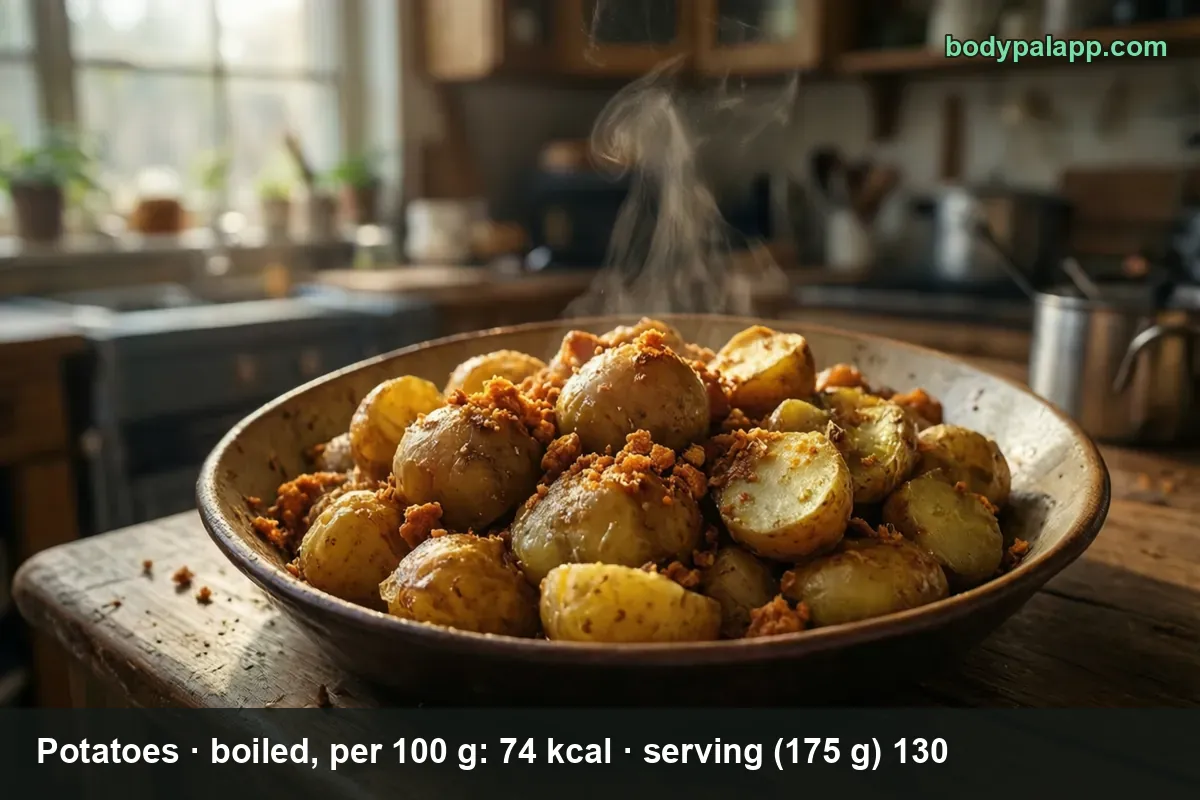
A typical serving of boiled potatoes (175 g) has 130 calories, with boiled potato flesh at 74 kcal per 100 g. That's the baseline — and almost nobody eats the baseline. The calories in potatoes are decided in the pan: mash made with butter runs 102 kcal per 100 g, and roast potatoes hit 161.
On this page
- Quick facts
- Portion sizes
- Boiled, mash or roast: what changes
- How does it compare?
- The potato isn't the problem
- Most popular potato product brands
- FAQ
Quick facts
These figures are for old potatoes, boiled in unsalted water, flesh only — the plainest version, and the anchor for everything else on this page. RI percentages are for the 175 g serving.
| Nutrient | Per 100 g (boiled) | Per serving (175 g) | % RI (serving) |
|---|---|---|---|
| Energy | 74 kcal / 310 kJ | 130 kcal / 544 kJ | 7% |
| Protein | 1.8 g | 3.2 g | 6% |
| Carbohydrates | 17.5 g | 30.6 g | 12% |
| Fat | 0.1 g | 0.2 g | <1% |
| Fibre | 1.6 g | 2.8 g | — |
| Sugars | 0.8 g | 1.4 g | 2% |
| Salt | 0.003 g | 0.005 g | <1% |
Verified nutrition data
Numbers on this page come from CoFID, the UK government’s Composition of Foods Integrated Dataset, and from manufacturer labels where a branded product is named. Last verified August 2026. How we verify our data →
RI = reference intake for an average adult: 2,000 kcal, 70 g fat, 260 g carbohydrate, 90 g sugars, 50 g protein, 6 g salt. Fibre has no RI on UK labels.
Read that fat row again: 0.1 g per 100 g. A boiled potato is essentially fat-free, low in sugar and, cooked in unsalted water, close to salt-free. Whatever reputation potatoes carry, the vegetable itself didn't earn it.
The carbohydrate is the real cargo — 30.6 g in a serving, 12% of the day's reference. That's what a starchy staple is for. The Eatwell Guide builds meals around exactly this kind of food.
Portion sizes
Three servings, three cooking methods, three very different numbers on your plate.
| Portion | Weight | Calories |
|---|---|---|
| Boiled potatoes, typical serving | 175 g | 130 kcal |
| Mash with butter, serving | 180 g | 184 kcal |
| Roast potatoes, serving | 130 g | 209 kcal |
Notice the trap in the third row. The roast serving is the smallest of the three at 130 g, yet it costs the most at 209 kcal — more than a boiled serving half again its size. Oil-dense food punishes eyeball estimates, because the plate looks modest while the energy isn't.
Mash sits in between. A 180 g scoop made with butter reaches 184 kcal, and that's home-style mash; restaurant versions lean harder on butter and cream, so treat 184 as the friendly end of the range.
If you weigh nothing else, weigh roast potatoes once. Seeing what 130 g actually looks like recalibrates every Sunday lunch that follows.
Boiled, mash or roast: what changes
Same vegetable, three preparations, and the spread between them is wider than the spread between potatoes and most other starches.
| Per 100 g | kcal | kJ | Fat | Sugars | Salt |
|---|---|---|---|---|---|
| Boiled in unsalted water (flesh only) | 74 | 310 | 0.1 g | 0.8 g | 0.003 g |
| Mashed with butter | 102 | 427 | 3.9 g | 1.0 g | 0.09 g |
| Roasted in corn oil | 161 | 674 | 5.7 g | 1.2 g | 0.007 g |
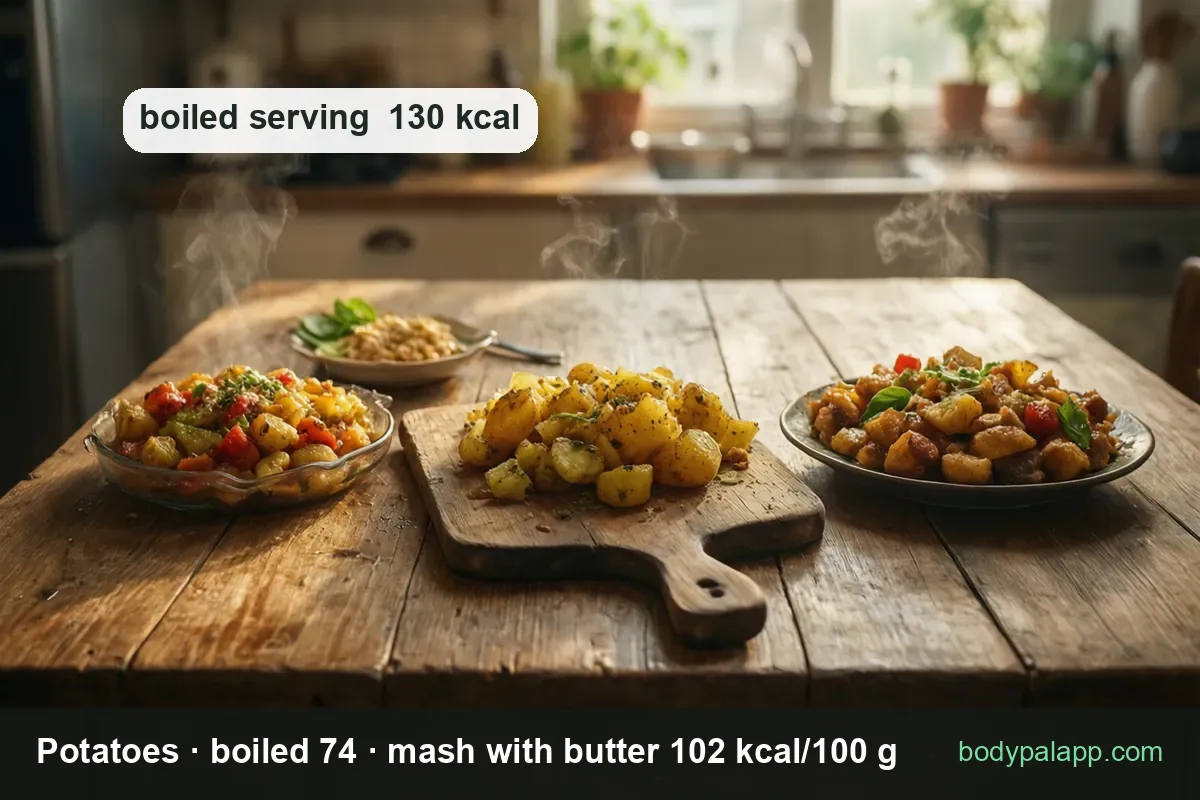
The mechanism is simple and worth internalising. Boiling adds water and nothing else. Mashing folds in butter: fat jumps from 0.1 g to 3.9 g per 100 g and salt rises to 0.09 g. Roasting does two things at once — the potato loses water in the oven, concentrating its starch, and it drinks oil, taking fat to 5.7 g per 100 g. Result: 161 kcal, well over double the boiled figure.
So the practical rule for anyone counting: log potatoes by cooking method, never as "potato". The gap between a careless log and reality can be a hundred calories on one plate. Fibre, for what it's worth, favours the roast at 2.7 g per 100 g against 1.6 g boiled — the one consolation of the crispy option.
If you're watching salt, note that none of these preparations is inherently salty; it's the shake at the table and the goose fat seasoned with flakes that move the needle. The NHS salt guidance puts the daily line at 6 g, and plain potatoes barely register against it.
How does it compare?
Per 100 g cooked, here's the starchy-side league table.
| Food | kcal per 100 g |
|---|---|
| Boiled potatoes | 74 |
| Jacket potato | 97 |
| Rice | 131 |
| Pasta | 169 |
Boiled potatoes are the lightest mainstream starch on the British plate, and it isn't close — pasta carries more than double the calories gram for gram. If you're trying to eat bigger portions for fewer calories, swapping the base of the meal to boiled or jacket potato is one of the easiest wins available.
The potato isn't the problem
"Potatoes are fattening" survives on the strength of chips, crisps and roasties — potatoes carrying someone else's fat. The plain numbers say otherwise: 74 kcal per 100 g, 0.1 g fat, 0.8 g sugar. Few filling foods are this cheap.
One genuine catch: potatoes don't count towards your 5-a-day. The NHS classes them as a starchy food, alongside bread and rice, so the veg box needs filling from elsewhere. That's a labelling rule, not a verdict on the potato — it just means your roasties can't moonlight as salad.
Most popular potato product brands in the United Kingdom
Ranked by how widely each product appears among foods sold in the United Kingdom, from the BodyPal food database of over 3.3 million products. Calories are the figures printed on each label. These are prepared products; plain boiled potatoes stay at 74 kcal per 100 g.
| Product | Calories (per 100 g) |
|---|---|
| McCain Country Potatoes | 135 kcal |
| Harvest Basket Potato Wedges (Lidl) | 134 kcal |
| Harvest Basket Instant Mashed Potato (Lidl) | 63 kcal |
Brand popularity: BodyPal food database. Nutrition: manufacturer labels.
FAQ
How many calories are in potatoes?
Boiled potatoes have 74 kcal per 100 g, so a typical 175 g serving is 130 calories. Mash with butter comes to 102 kcal per 100 g and roast potatoes 161, which is why the same potato can land very differently on your plate depending on the pan.
How many calories are in potatoes per 100 g?
From 74 kcal per 100 g for boiled potatoes to 102 for mash made with butter and 161 for potatoes roasted in oil. A jacket potato sits at 97 kcal per 100 g. Water content falls and fat rises as you move along that list, and the calories follow.
How many calories are in potato chips?
Fast-food fine-cut chips run about 290 kcal per 100 g in CoFID — nearly four times boiled potatoes at 74. The oil does most of it, exactly as roasting already showed at 161, and chippy portion sizes then do the rest of the damage.
How many calories are in potato salad?
Plain boiled potatoes are 74 kcal per 100 g; what a potato salad adds on top depends almost entirely on the mayonnaise, so no single figure is honest. If you make it at home, weigh the mayo separately — the dressing will usually out-calorie the potato underneath it.
Is potato a vegetable?
Botanically yes, but with 17.5 g of carbohydrate per 100 g boiled, the NHS classes potatoes as a starchy food, like bread or rice — so they don't count towards your 5-a-day. Sweet potatoes and other root veg do count. Potatoes belong in the starchy-carbs section of the Eatwell Guide.
Is potato a carb?
With 17.5 g of carbohydrate per 100 g boiled — against 1.8 g of protein and 0.1 g of fat — potatoes are firmly a carbohydrate food. That isn't a strike against them: at 74 kcal per 100 g, boiled potatoes are one of the least calorie-dense starches you can put on a plate.
Is potato good for weight loss?
At 74 kcal per 100 g, plain boiled potatoes are the lightest mainstream starchy side, far under boiled pasta at 169. If you're managing your intake, the method matters most: the same 100 g roasted in oil is 161 kcal. Boil or bake more often than you roast, and count the fats you add.
Is potato good for dogs?
Plain cooked potato is 74 kcal per 100 g and small amounts are generally fine for dogs, but never feed raw potato or green-tinged skin, which contain solanine. Skip mash made with butter (102 kcal per 100 g) and seasoned roasties too. When in doubt, ask your vet.
Similar foods
- Prawns — 77 kcal per 100 g raw king prawns
- Jacket potato — 277 kcal per medium potato
- Cottage pie — ~444 kcal a portion
- Beans on toast — 338 kcal a plate
- Miso soup — 60 kcal per 250 ml bowl
- Pasta carbonara — 124 kcal per 100 g the finished plate
Count it without the maths
Snap your plate — roasties, mash and all — and BodyPal logs the calories and macros from one photo.


How long does it take to burn off potatoes?
100 g boiled potato is 74 kcal. Enter your weight and the amount you ate to see how long it takes you to burn that off:
lb
| Activity | Time to burn 74 kcal |
|---|---|
| Walking, brisk | 15 min |
| Cycling, moderate | 9 min |
| Swimming, moderate | 11 min |
| Jogging | 9 min |
| Weight training, moderate | 16 min |
Times are for a 154 lb (11 st) adult at a steady pace; change the weight to see yours. The amount is set to the portion in the text (100 g); change it to what you actually ate. BodyPal works this out from your steps automatically.
Want the bigger picture? Calculate your daily calorie needs — your maintenance figure, a target for losing or gaining, and the date you get there.