
How Many Calories in Cottage Pie?
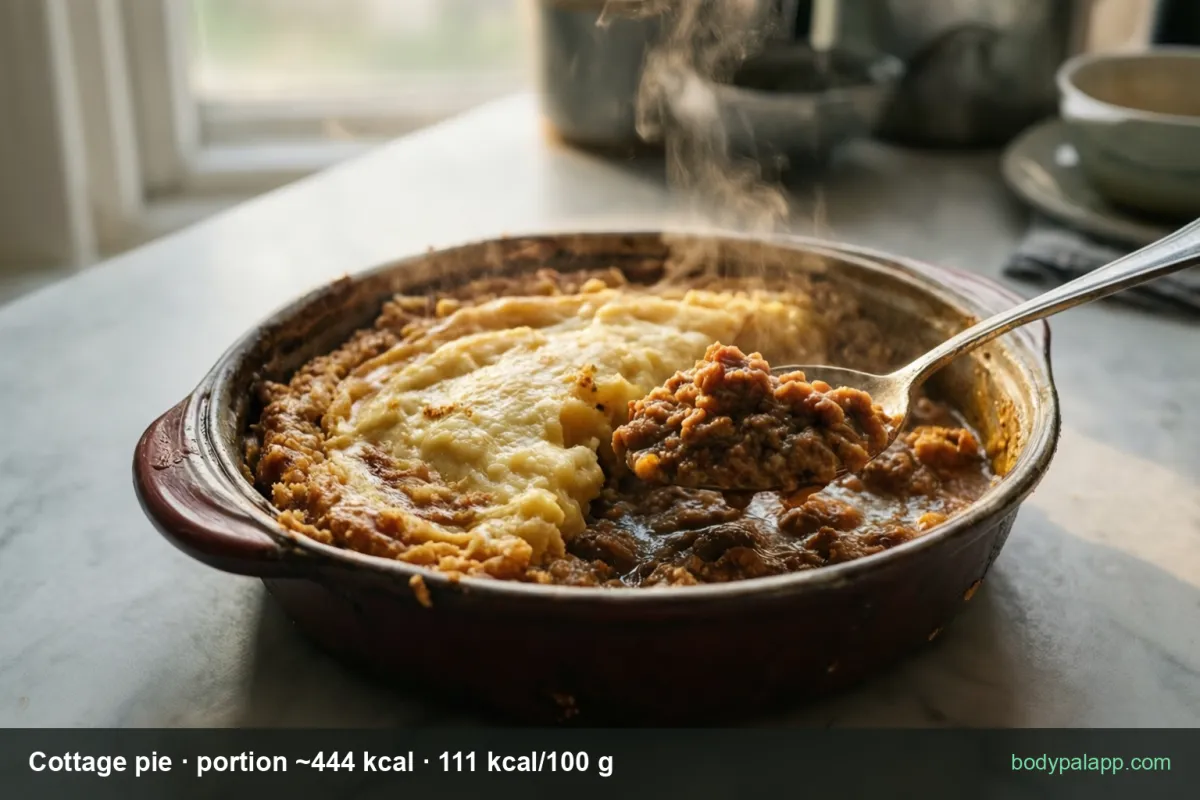
Count the calories in cottage pie and the news is good: 111 kcal per 100 g, which makes a generous 400 g helping 444 kcal and a single ready meal about 500. For a dish built on minced beef and buttery mash, that is remarkably light.
On this page
- Quick facts
- Portion sizes
- Beef, lamb and vegetable versions
- How does cottage pie compare?
- The lamb-is-lighter myth
- Most popular cottage pie brands
- Cottage pie FAQs
Quick facts
| Per 100 g | Amount | RI%* |
|---|---|---|
| Calories | 111 kcal (464 kJ) | 6% |
| Protein | 4.5 g | 9% |
| Carbohydrates | 11.9 g | 5% |
| Fat | 5.4 g | 8% |
| Fibre | 1.2 g | — |
| Sugar | 1.6 g | 2% |
| Salt | 0.3 g | 5% |
*RI = reference intake of an average adult (8,400 kJ / 2,000 kcal).
Verified nutrition data
Numbers on this page come from CoFID, the UK government’s Composition of Foods Integrated Dataset, and from manufacturer labels where a branded product is named. Last verified August 2026. How we verify our data →
Why so gentle? Because half of any cottage pie is potato mash, and mash carries a lot of water. The dish dilutes its own beef, in the nicest possible way.
The salt figure deserves a second look too: 0.3 g per 100 g is low for a savoury classic, and even a full portion stays around 1.2 g — a fifth of the 6 g daily maximum the NHS recommends. Plenty of ready meals cannot say the same.
Portion sizes
| Portion | Weight | Calories |
|---|---|---|
| Home-cooked portion | ~400 g | 444 kcal |
| Single ready meal | ~450 g | 500 kcal |
A 400 g plateful also delivers about 18 g of protein, 48 g of carbohydrate and 22 g of fat. That macro spread is honest comfort food: enough carbs to feel like dinner, enough protein to hold you, and a fat load that stays sane.
The 500 kcal ready meal is the number worth memorising for weeknights. Among chilled single-serve dinners, cottage pie sits at the light end of the cabinet — most creamy pasta or pastry-topped rivals clear it by a wide margin.
Beef, lamb and vegetable versions
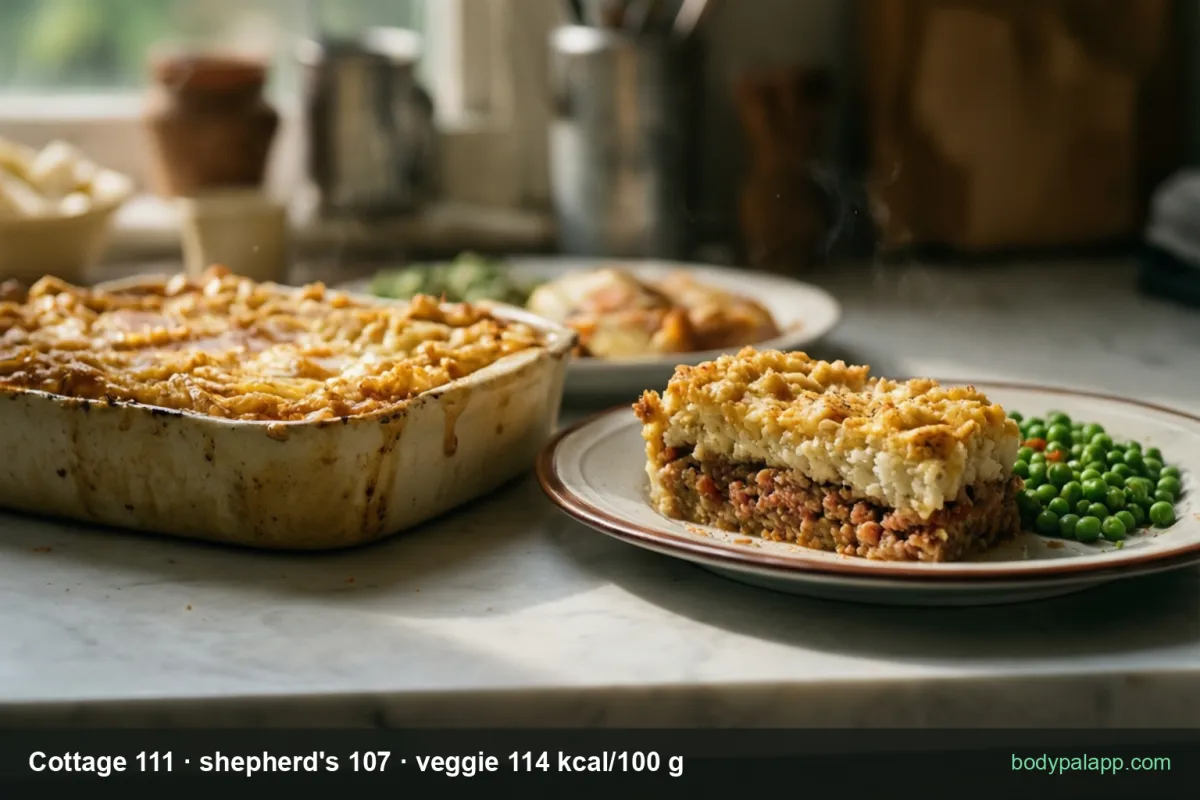
The classic split — cottage pie is beef, shepherd's pie is lamb — turns out to be a question of vocabulary, not calories.
| Version | Per 100 g |
|---|---|
| Shepherd's pie, homemade (lamb) | 107 kcal |
| Cottage pie (beef) | 111 kcal |
| Vegetable version | 114 kcal |
Seven calories per 100 g separate the whole family. Even the vegetable version lands within a rounding error, because the topping and the sauce — not the filling — set the tone. Whatever goes under the mash, the mash is half the story.
That is also where the calories hide when a recipe creeps upwards. Extra butter in the topping, a cheese crust grilled on top, oil-heavy frying of the mince: each pushes the same 400 g portion well past the baseline 444.
How does cottage pie compare?
Against the other big British dinner plates, cottage pie is quietly the diet option.
| Meal | Serving | Calories |
|---|---|---|
| Cottage pie | 400 g portion | 444 kcal |
| Lasagne | portion | ~630 kcal |
| Spaghetti bolognese | home plate | 680 kcal |
| Sunday roast | full plate | ~946 kcal |
| Fish and chips | portion | ~1,074 kcal |
The verdict: for weight loss, cottage pie is the strongest pick on this table — a proper hot dinner for 444 kcal, half of what fish and chips costs. For maximum satisfaction per calorie, it still wins: the mash-and-mince combination eats like far more than it logs.
The lamb-is-lighter myth
Some diners swap cottage pie for shepherd's on the theory that lamb is leaner, or avoid shepherd's on the theory that it is fattier. Neither move earns its logic: 107 versus 111 kcal per 100 g is a difference you could not detect over a month of dinners.
The variable that actually moves the number is the topping. A pie finished with extra butter and a thick cheese crust can out-calorie either version's baseline comfortably. Choose by taste; count by recipe.
Most popular cottage pie brands in the United Kingdom
Ranked by how widely each product appears among foods sold in the United Kingdom, from the BodyPal food database of over 3.3 million products. Calories are the figures printed on each label.
| Product | Calories (per 100 g) |
|---|---|
| Cully & Sully Cottage Pie | 120 kcal |
| Iceland Cottage Pie | 110 kcal |
| Quorn Comforting Cottage Pie | 99 kcal |
| Weight Watchers Beef Cottage Pie | 97 kcal |
Brand popularity: BodyPal food database. Nutrition: manufacturer labels.
Cottage pie FAQs
Shepherd's pie vs cottage pie — which has fewer calories?
Shepherd's pie, barely: 107 kcal per 100 g against 111 for cottage pie. The lamb-versus-beef choice changes the flavour, not the total. Pick the one you prefer and treat them identically in your food diary — a 400 g portion of either is around 430–444 kcal.
How many calories in a ready meal cottage pie?
About 500 kcal for a typical 450 g single-serve meal, at 111 kcal per 100 g. That makes it one of the lighter options in the chilled aisle. Labels vary a little by brand and topping, so the sleeve is the final word — but 500 is the right ballpark.
How many calories in homemade cottage pie?
Around 444 kcal for a 400 g serving if your recipe stays close to the standard mince-and-mash build. Homemade totals drift with the cook's hand: generous butter in the mash and fattier mince push it up, lean mince and a lighter topping keep it near the baseline.
How many calories with a cheese topping?
More than the plain 444 kcal — a grilled cheese crust is the single biggest upgrade a cottage pie can take, since hard cheese is calorie-dense and it sits on top of an already buttery mash. If you love the crust, thin it rather than skipping it: a light grating buys the flavour for far less.
Is cottage pie healthy?
At 444 kcal a portion with 18 g protein and just 1.2 g salt, it is one of the better-balanced comfort dinners. Beef, potato and vegetables map neatly onto the NHS Eatwell Guide plate. Add greens on the side and it is a genuinely solid weeknight meal.
How many carbs in cottage pie?
About 48 g in a 400 g portion (11.9 g per 100 g), almost all from the mash topping. That is under a fifth of the 260 g daily reference intake, but it does make cottage pie a poor fit for strict low-carb plans — the potato is not negotiable in this dish.
Is cottage pie good for weight loss?
Yes, as hot dinners go: 444 kcal buys a full, filling plate — roughly 40% of what fish and chips costs. If you are cutting calories, it is a rare dish that needs no modification. Watch only the extras: cheese crusts, buttered bread on the side, and second helpings.
How many calories in a vegetable cottage pie?
About 114 kcal per 100 g — fractionally more than the beef original at 111, because the topping and sauce dominate the total. A 400 g portion comes to roughly 456 kcal. Going meat-free here is a fine choice, just not a calorie-saving one.
Similar foods
- Beans on toast — 338 kcal a plate
- Pasta carbonara — 124 kcal per 100 g the finished plate
- Jacket potato — 277 kcal per medium potato
- Beef — 161 kcal per 125 g lean portion
- Instant noodles — 135 kcal per 100 g made up
- Indian takeaway — 145 kcal per 100 g chicken curry
One photo, whole plate
Dish up, snap it, done — BodyPal reads a plate of cottage pie and logs the calories and macros for your actual portion, not the textbook one.


How long does it take to burn off cottage pie?
A 400 g home-cooked portion is 444 kcal. Enter your weight and the amount you ate to see how long it takes you to burn that off:
lb
| Activity | Time to burn 444 kcal |
|---|---|
| Walking, brisk | 1 hr 29 min |
| Cycling, moderate | 56 min |
| Swimming, moderate | 1 hr 3 min |
| Jogging | 52 min |
| Weight training, moderate | 1 hr 39 min |
Times are for a 154 lb (11 st) adult at a steady pace; change the weight to see yours. The amount is set to the portion in the text (400 g); change it to what you actually ate. BodyPal works this out from your steps automatically.
Want the bigger picture? Calculate your daily calorie needs — your maintenance figure, a target for losing or gaining, and the date you get there.