
Pot Noodle Calories: What Instant Noodles Actually Cost You
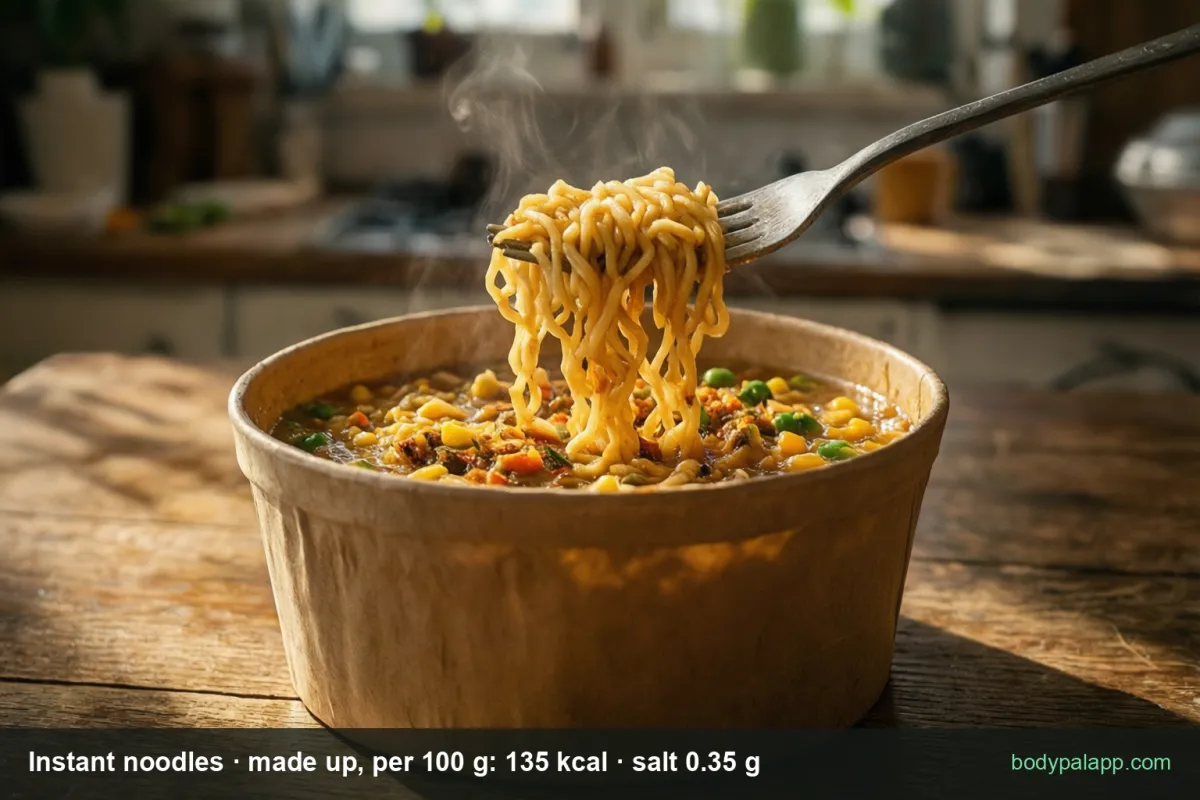
Made up with boiling water, instant noodles land at 135 kcal per 100 g (565 kJ). That is the honest way to read Pot Noodle calories, because pots come in different sizes and a "standard" and a King are not the same lunch. Instant noodles calories are modest for a hot meal. The salt is the number that deserves your attention.
On this page
- Quick facts: instant noodles per 100 g
- Portions: what you actually eat
- Pot Noodle standard vs King
- Super Noodles
- Plain egg noodles
- The salt story
- How do instant noodles compare?
- Myths worth clearing up
- Most popular instant noodle brands
- FAQ
Quick facts: instant noodles per 100 g
Values are for noodles made up with water, from the Pot Noodle Chicken & Mushroom label. Dry weight figures on a packet look far higher, which is why people think a pot is a monster meal when it isn't.
| Per 100 g (made up) | Amount | RI% |
|---|---|---|
| Energy | 135 kcal / 565 kJ | 7% |
| Protein | 3.2 g | 6% |
| Carbohydrate | 19 g | 7% |
| of which sugars | 1.3 g | 1% |
| Fat | 5.7 g | 8% |
| Fibre | 2.3 g | — |
| Salt | 0.35 g | 6% |
RI% = percentage of an adult Reference Intake based on 2,000 kcal a day. Fibre has no RI figure on UK labels; the NHS target is 30 g of fibre a day.
Verified nutrition data
Numbers on this page come from CoFID, the UK government’s Composition of Foods Integrated Dataset, and from manufacturer labels where a branded product is named. Last verified August 2026. How we verify our data →
Portions: what you actually eat
There is no single "a pot = X kcal" answer, and anyone giving you one is guessing. Pot sizes differ between the standard tub and the King, and between flavours. Read the made-up figure on the side of the pot you're holding, then match it to the weight.
- 100 g made up: 135 kcal. The clean reference point, and the one to use if you're logging by weight.
- Half a pot: exactly half of whatever the label states for the full made-up pot. Useful if you're pairing noodles with something else.
- A nest of dried egg noodles (62 g dry), boiled to roughly 180 g: about 258-299 kcal, depending on thickness. Medium egg noodles run 166 kcal per 100 g boiled, thick ones 143 kcal.
That last line surprises people. A supermarket nest of plain egg noodles is often the heavier option once it's cooked, because you eat more of it and the water content is lower.
Pot Noodle standard vs King
A standard Pot Noodle sits at 135 kcal per 100 g made up. The King version is 137 kcal per 100 g (573 kJ), which is close enough to call identical.
The difference isn't density, it's volume. A King pot holds more noodles and more water, so it delivers more of everything: more calories, more carbs, and proportionally more salt. If you're choosing between them for calorie reasons, the per-100 g number won't help you. The made-up total on the label will.
Super Noodles
Batchelors Super Noodles come out at 151 kcal per 100 g prepared (632 kJ), around 12% above a Pot Noodle on a like-for-like weight basis.
They're also a different eating experience. Super Noodles are cooked in a pan and usually served as a side or a base rather than drunk-and-eaten from a tub, so the portion tends to be larger. Same principle applies: weigh or read the pack, don't assume.
Plain egg noodles
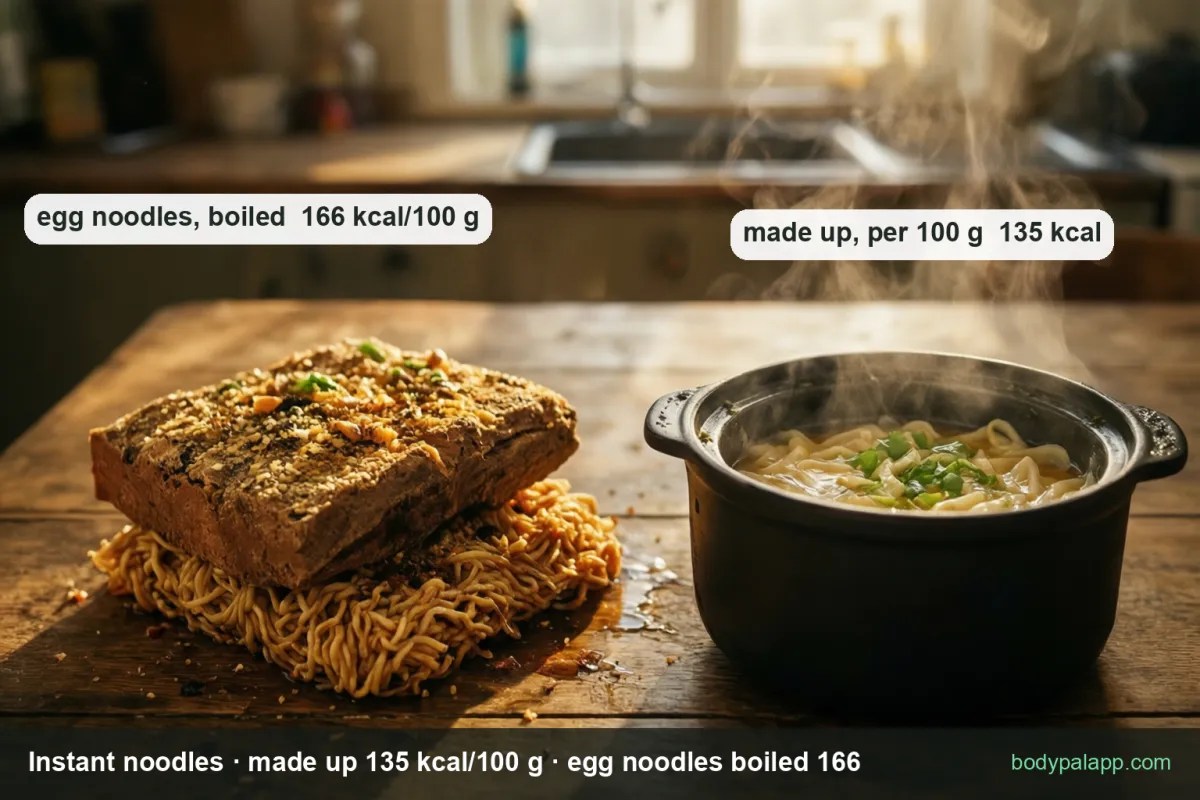
Boiled egg noodles from CoFID run 129 kcal per 100 g for fine, 143 kcal for thick, and 166 kcal for medium.
Medium egg noodles are the highest per 100 g of anything on this page, which sounds like bad news until you look at what's missing. There's no seasoning sachet, no fried noodle block, and the salt comes from whatever you add. That's the real trade: plain noodles cost you slightly more energy per gram and give you control over the fat and salt. Instant noodles cost less per gram and make those decisions for you.
The salt story
Per 100 g made up, instant noodles carry 0.35 g of salt. That's 6% of an adult's daily reference intake, and it reads like nothing.
A whole pot is the number that matters. Made up, a full pot easily reaches 1.5-2 g of salt, which is a quarter to a third of the 6 g a day the NHS sets as the adult maximum. The WHO recommends less still, under 5 g a day for adults.
So the sensible way to read a pot isn't "high calorie" or "low calorie". It's a roughly 300-400 kcal hot lunch that spends a big slice of your salt budget in one sitting. If you eat one twice a week alongside otherwise unsalted home cooking, that's a non-issue. If it's a daily desk lunch on top of bread, cheese and crisps, the salt adds up faster than the calories do.
One practical fix: don't drink the last of the liquid. A good share of the salt is dissolved in it.
How do instant noodles compare?
| Food | Per 100 g | Typical portion | P / C / F per 100 g |
|---|---|---|---|
| Instant noodles (made up) | 135 kcal | 135 kcal per 100 g | 3.2 / 19 / 5.7 |
| Egg noodles, boiled (medium) | 166 kcal | ~299 kcal per nest | 5.8 / 35.7 / 1.0 |
| Jacket potato | 97 kcal | 277 kcal (medium, 285 g) | 2.5 / 22.6 / 0.2 |
| Doner kebab | 377 kcal | varies by shop | 23.5 / 0 / 31.4 |
| Fish and chips | 224 kcal | 1,074 kcal a regular order | 8.5 / 24.8 / 10.8 |
The verdict: for weight loss, a jacket potato wins on every axis that counts, at 97 kcal per 100 g with almost no fat and no salt to speak of. For a hot lunch you want in four minutes, instant noodles at 135 kcal per 100 g are a far lighter choice than a doner kebab at 377 kcal per 100 g, as long as you treat the pot as one salted item in your day rather than a free one.
Myths worth clearing up
"Pot Noodles are 500 calories." They aren't, and this myth comes from reading the dry weight. Noodles absorb a lot of water, so a made-up pot spreads that energy across a much bigger, heavier portion. At 135 kcal per 100 g made up, you'd need a very large pot to approach 500 kcal.
"Instant noodles have no fibre." The made-up figure here is 2.3 g per 100 g, which is a reasonable contribution towards the NHS 30 g target. Not a fibre source you'd build a diet on, but not zero.
"Plain noodles are always the lighter option." Boiled medium egg noodles are 166 kcal per 100 g, above instant. The genuine advantage of plain noodles is the fat and the seasoning sachet you skip, not the calories.
Most popular instant noodle brands in the United Kingdom
Ranked by how widely each product appears among foods sold in the United Kingdom, from the BodyPal food database of over 3.3 million products. Calories are the figures printed on each label.
| Product | Calories (per 100 g made up) |
|---|---|
| Pot Noodle Chicken & Mushroom | 135 kcal |
| Batchelors Super Noodles | 134 kcal |
| Nissin Cup Noodles | 126 kcal |
Brand popularity: BodyPal food database. Nutrition: manufacturer labels.
FAQ
How many calories are in a Pot Noodle?
A made-up Pot Noodle is 135 kcal per 100 g. The total for a whole pot depends on the pot size, which varies between flavours and between the standard and King formats, so the made-up figure printed on the side of your pot is the number to log. Weighing the made-up noodles is the most reliable route.
How many calories are in a Pot Noodle King?
A King is 137 kcal per 100 g made up, essentially the same density as a standard pot at 135 kcal. The King simply holds more, so the finished pot delivers more calories, carbs and salt in proportion to its extra weight. Check the made-up total on the label rather than assuming a fixed number.
How many calories are in Super Noodles?
Batchelors Super Noodles are 151 kcal per 100 g prepared, about 12% more than instant pot noodles per gram. Because they're cooked in a pan and often served as a side, the portion on the plate is usually larger than a pot, so the finished dish can be noticeably higher in calories overall.
Are Pot Noodles bad for you?
At 135 kcal per 100 g, a pot is a modest hot meal in energy terms; the salt is the part to watch, since a full pot can reach 1.5-2 g against the NHS maximum of 6 g a day. Eaten occasionally alongside varied meals, it fits fine. Daily, the salt stacks up quickly.
How much salt is in instant noodles?
Made-up instant noodles contain 0.35 g of salt per 100 g, which is 6% of the adult reference intake. A whole pot easily lands at 1.5-2 g, a quarter to a third of the NHS 6 g daily maximum. Leaving the last of the liquid in the pot cuts a share of it.
Egg noodles or instant noodles: which is lighter?
Boiled medium egg noodles are 166 kcal per 100 g, higher than instant noodles at 135 kcal. Fine egg noodles come in lower at 129 kcal. The real difference isn't calories: plain noodles arrive without a seasoning sachet, so you decide how much fat and salt goes in.
Can I eat a Pot Noodle on a diet?
Yes. At 135 kcal per 100 g made up, a pot is one of the lighter hot convenience lunches, well under a doner kebab at 377 kcal per 100 g. The catch is satiety: 3.2 g of protein per 100 g is low, so pairing it with a boiled egg or some chicken helps it hold you.
How much protein is in instant noodles?
Instant noodles provide 3.2 g of protein per 100 g made up, which is 6% of the adult reference intake. That's low for a main meal. If you're using a pot as lunch and want it to last until dinner, adding a protein source on the side does more than switching brands.
Why does the packet say so many more calories than 135?
Because 135 kcal per 100 g is the made-up figure, while the pack also lists the dry product. Dry noodles are dense; once they absorb boiling water the same energy is spread across a much heavier portion. Always log the made-up value unless you weighed the noodles dry.
How many calories in a nest of egg noodles?
A 62 g dry nest boils up to roughly 180 g and works out at about 258-299 kcal, depending on thickness. Medium noodles at 166 kcal per 100 g put you at the top of that range, thick ones at 143 kcal per 100 g near the bottom. Sauce and oil sit on top of that.
Similar foods
- Beef — 161 kcal per 125 g lean portion
- Indian takeaway — 145 kcal per 100 g chicken curry
- Pasta carbonara — 124 kcal per 100 g the finished plate
- Chicken breast — 147 kcal per 100 g grilled
- Chicken chow mein — 588 kcal a takeaway box
- Chinese takeaway — 147 kcal per 100 g chow mein
Count it without the maths
BodyPal logs a pot of noodles, the nest of egg noodles and whatever you added on top from one photo, with the salt and fibre alongside the calories.


How long does it take to burn off 135 kcal of Pot Noodle?
100 g made up is 135 kcal. Enter your weight and the amount you ate to see how long it takes you to burn that off:
lb
| Activity | Time to burn 135 kcal |
|---|---|
| Walking, brisk | 27 min |
| Cycling, moderate | 17 min |
| Swimming, moderate | 19 min |
| Jogging | 16 min |
| Weight training, moderate | 30 min |
Times are for a 154 lb (11 st) adult at a steady pace; change the weight to see yours. The amount is set to the portion in the text (100 g); change it to what you actually ate. BodyPal works this out from your steps automatically.
One food is easy to picture; a whole day is harder. See how many calories you need a day and what a deficit actually looks like.