
Calories in a Chinese Takeaway: Every Dish, Per 100 g
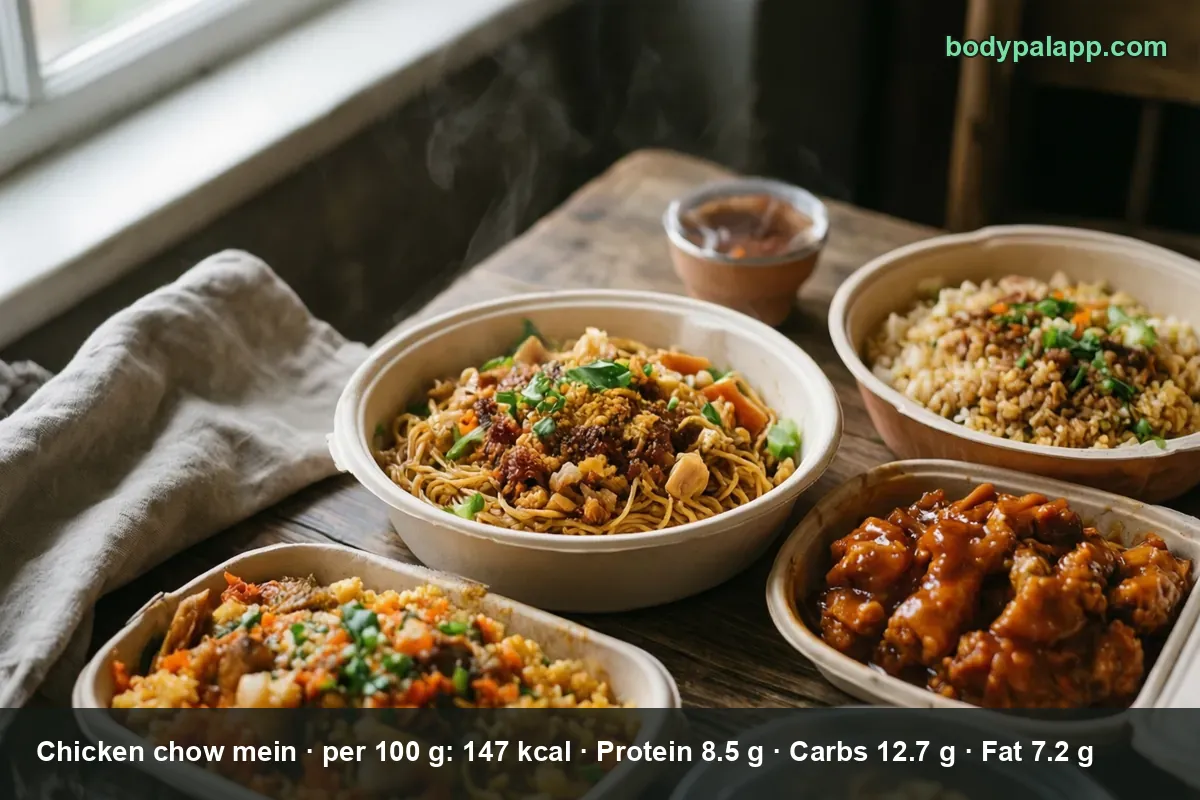
A Chinese takeaway is three decisions: a main, a rice, and something fried while you wait. Per 100 g those come to 147 kcal for chicken chow mein, 186 for egg fried rice and 242 for a meat spring roll. The calories in a Chinese takeaway are decided far less by the meat than by what has been wrapped around it.
On this page
- A standard order, per 100 g
- The whole menu, ranked
- A sevenfold spread
- Batter is the surcharge
- Salt beats calories on this menu
- Prawn crackers, honestly
- Takeaway rice against supermarket rice
- Most popular Chinese takeaway brands in the United Kingdom
- FAQ
A standard order, per 100 g
Three containers, three sets of numbers. Everything below is per 100 g, because UK takeaway boxes are not standardised and nobody serves a round number.
| Nutrient | Chicken chow mein | Egg fried rice | Meat spring roll | RI%* |
|---|---|---|---|---|
| Energy | 147 kcal / 615 kJ | 186 kcal / 778 kJ | 242 kcal / 1,013 kJ | 7% |
| Protein | 8.5 g | 4.3 g | 6.5 g | 17% |
| Carbohydrates | 12.7 g | 33.3 g | 18.2 g | 5% |
| – of which sugars | 0.3 g | trace | 1.8 g | <1% |
| Fat | 7.2 g | 4.9 g | 16.4 g | 10% |
| – of which saturates | 1.17 g | 0.62 g | 3.81 g | 6% |
| Fibre | 1.5 g | 1.1 g | 2.0 g | – |
| Salt | 1.165 g | 1.042 g | 1.212 g | 19% |
*RI% = the chow mein column's share of an adult's daily reference intake per 100 g, based on 2,000 kcal.
Verified nutrition data
Numbers on this page come from CoFID, the UK government’s Composition of Foods Integrated Dataset, and from manufacturer labels where a branded product is named. Last verified September 2026. How we verify our data →
The main is the lightest thing on that list. That surprises people who order chow mein guiltily and rice absent-mindedly, when the rice is 39 kcal per 100 g heavier and carries two and a half times the carbohydrate.
Turning this into an order total needs container weights, and British takeaway containers follow no national standard at all. Weigh one box on a kitchen scale and reuse the figure. Most shops are consistent with themselves even when they differ from each other.
The whole menu, ranked
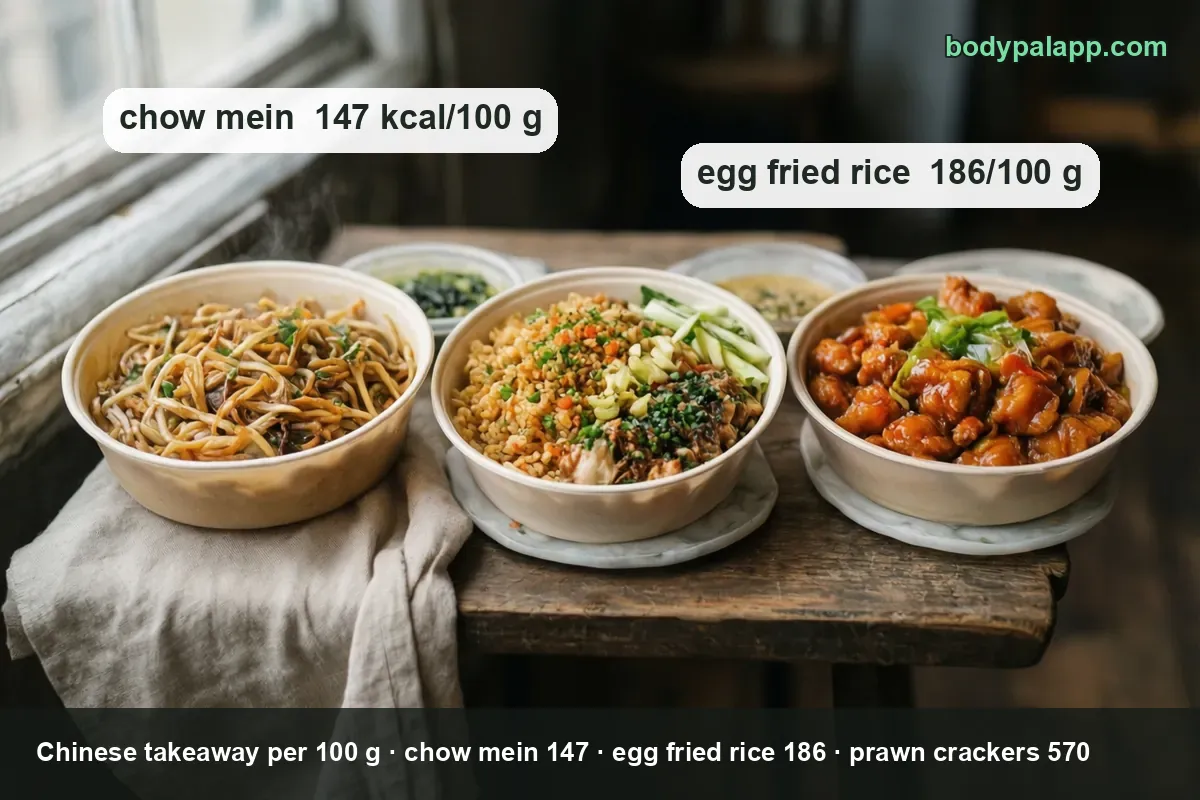
Ten items from the UK's national food composition work, all measured per 100 g, ordered from heaviest to lightest.
| Dish, per 100 g | Calories | Protein | Carbs | Fat | Salt |
|---|---|---|---|---|---|
| Prawn crackers | 570 kcal | 0.3 g | 58.2 g | 39.0 g | 1.917 g |
| Pancakes for crispy duck (pancakes only) | 305 kcal | 7.8 g | 53.3 g | 7.9 g | 0.302 g |
| Spring rolls, meat | 242 kcal | 6.5 g | 18.2 g | 16.4 g | 1.212 g |
| Sweet and sour pork, battered | 240 kcal | 7.8 g | 22.4 g | 13.9 g | 0.623 g |
| Sweet and sour chicken | 194 kcal | 7.6 g | 19.7 g | 10.0 g | 0.647 g |
| Egg fried rice, takeaway | 186 kcal | 4.3 g | 33.3 g | 4.9 g | 1.042 g |
| Egg fried rice, supermarket | 169 kcal | 3.9 g | 28.1 g | 5.3 g | 1.022 g |
| Sweet and sour sauce | 157 kcal | 0.2 g | 32.8 g | 3.4 g | 0.375 g |
| Chicken chow mein | 147 kcal | 8.5 g | 12.7 g | 7.2 g | 1.165 g |
| Szechuan prawns with vegetables | 83 kcal | 7.8 g | 2.5 g | 4.7 g | 1.34 g |
Read the table top to bottom and a rule appears. Everything above 200 kcal per 100 g has either been deep-fried or is made mostly of flour. Everything below it is a pan dish with vegetables in it. Nothing on this menu is heavy because of the meat.
A sevenfold spread
Szechuan prawns are 83 kcal per 100 g. Prawn crackers are 570. That is the widest gap you will find on any single British takeaway menu, and both are things people order without thinking.
The prawn dish is also the protein bargain of the list, buying 9.4 g of protein for every 100 kcal spent. Chow mein manages 5.8 g per 100 kcal, sweet and sour chicken 3.9 g, and prawn crackers a rounding error.
Our take: build the order around a stir-fried dish with vegetables in it, treat the rice as the calorie budget, and the starters as the luxury. That ordering is the opposite of how most tables approach the menu, where the starters arrive first and get eaten fastest.
If the goal is simply to eat less without eating differently, halving the rice does more than swapping the main. Rice is where the volume is.
Batter is the surcharge
Sweet and sour pork, battered, is 240 kcal per 100 g. Sweet and sour chicken is 194. The 46 kcal difference per 100 g is not the pig. It is the coating and the oil the coating absorbs, which is the same mechanism that makes spring rolls the third-densest thing on the list at 16.4 g of fat per 100 g.
The sauce is a separate line item and it is worth its own paragraph. Sweet and sour sauce is 157 kcal per 100 g and 32.8 g of carbohydrate, of which 27.5 g is sugar. That is 31% of an adult's daily sugars reference intake in every 100 g, from something ladled on rather than eaten.
Protein in the sauce is 0.2 g. It is sugar, vinegar and thickener, and it is doing nothing for satiety at all.
Duck pancakes deserve a word too. The pancakes alone, without the duck, hoisin or cucumber, are 305 kcal per 100 g and 53.3 g of carbohydrate. Six thin pancakes look like nothing and behave like bread.
Salt beats calories on this menu
Chinese takeaway food is salty in a way the calorie column does not reveal. Chow mein is 1.165 g of salt per 100 g, egg fried rice 1.042 g, spring rolls 1.212 g, prawn crackers 1.917 g and even the light Szechuan prawns 1.34 g.
Run the arithmetic on the main alone: 500 g of chow mein carries 5.8 g of salt against the NHS daily maximum of 6 g. That is before rice, before starters, and before anyone reaches for the soy sauce on the table.
Salt is also the one number where the light dishes give you no discount. Szechuan prawns are the lowest-calorie item on the menu and the third-saltiest per 100 g, because the seasoning is in the sauce rather than the ingredients. Eating lightly here does not mean eating less salt.
If salt is what you are managing, the practical lever is portion size and skipping the crackers, not choosing a different main.
Prawn crackers, honestly
570 kcal per 100 g. 39 g of fat. 0.3 g of protein. Prawn crackers are the most calorie-dense thing on any British takeaway menu and one of the least filling, which is a bad combination in a bowl that sits on the table for twenty minutes.
They also carry 1.917 g of salt per 100 g, the highest on the list, and 0.9 g of fibre, the lowest.
The trouble is that they weigh almost nothing, so a bag that looks trivial is not. Per 100 g they are denser than chips by a wide margin, and unlike chips nobody counts them as food. If one item on this page is worth actively skipping rather than moderating, it is this one.
Takeaway rice against supermarket rice
The same dish from a supermarket chiller is 169 kcal per 100 g against 186 from a takeaway. Seventeen calories per 100 g, or roughly 9% lighter.
| Egg fried rice, per 100 g | Calories | Protein | Carbs | Fat | Fibre | Salt |
|---|---|---|---|---|---|---|
| Takeaway | 186 kcal | 4.3 g | 33.3 g | 4.9 g | 1.1 g | 1.042 g |
| Supermarket, retail | 169 kcal | 3.9 g | 28.1 g | 5.3 g | 2.8 g | 1.022 g |
The interesting column is not the calories. It is the fibre: 2.8 g in the retail version against 1.1 g in the takeaway one, more than double. Salt is essentially identical, and the retail pack actually carries slightly more fat.
Which is to say the supermarket version is not a health food that happens to be cheaper. It is the same dish, a little less oily and a little more fibrous, and if you are eating egg fried rice twice a week the difference will show up eventually. Plain boiled rice remains lighter than both.
Most popular Chinese ready meal brands in the United Kingdom
Ranked by how widely each product appears among foods sold in the United Kingdom, from the BodyPal food database of over 3.3 million products. Calories are the figures printed on each label. Supermarket versions run lighter than the takeaway rows above them.
| Product | Calories (per 100 g) |
|---|---|
| Waitrose Egg Fried Rice | 159 kcal |
| Vitasia Vegetable Spring Rolls (Lidl) | 143 kcal |
| Aldi Sweet & Sour Chicken with Egg Fried Rice | 142 kcal |
| M&S Cantonese Sweet & Sour Chicken | 136 kcal |
| Tesco Chicken Chow Mein | 66 kcal |
Brand popularity: BodyPal food database. Nutrition: manufacturer labels.
Chinese takeaway FAQs
How many calories in a Chinese takeaway?
It depends almost entirely on the mix. Per 100 g, chicken chow mein is 147 kcal, egg fried rice 186, battered sweet and sour pork 240 and prawn crackers 570. A vegetable-led main with rice is the light end of the menu; anything deep-fried doubles the density.
How many calories in chicken chow mein?
147 kcal per 100 g, with 8.5 g of protein, 12.7 g of carbohydrate and 7.2 g of fat. It is the lightest main on the standard menu apart from the prawn and vegetable dishes. The catch is salt at 1.165 g per 100 g, close to a fifth of the daily maximum.
How many calories in egg fried rice?
186 kcal per 100 g from a takeaway and 169 kcal from a supermarket chiller pack. The takeaway version carries 33.3 g of carbohydrate and 1.042 g of salt per 100 g. Rice is usually the largest single component of an order by weight, so it decides the total more than the main does.
How many calories in sweet and sour chicken?
194 kcal per 100 g, against 240 kcal for the battered pork version. The sauce is counted separately at 157 kcal per 100 g and 27.5 g of sugar, which is 31% of the daily sugars reference intake in every 100 g. Ordering the sauce on the side is the easiest saving on the menu.
How many calories in prawn crackers?
570 kcal per 100 g, with 39 g of fat, 0.3 g of protein and 1.917 g of salt. They are the densest item on a Chinese takeaway menu and the least filling, because almost all of the weight is starch and frying oil. They weigh very little, which is exactly why they get under-counted.
What is the healthiest Chinese takeaway?
Szechuan prawns with vegetables at 83 kcal per 100 g, which buys 9.4 g of protein per 100 kcal, the best ratio on the menu. Chicken chow mein at 147 kcal is the next choice. Salt does not improve with these picks, so portion size still matters more than the dish.
How many calories in a spring roll?
Meat spring rolls are 242 kcal per 100 g, with 16.4 g of fat and 1.212 g of salt. That puts them level with battered sweet and sour pork on density. Fibre is 2.0 g per 100 g, the highest of the fried items, which is the only kind word available about them.
How many calories in a Chinese takeaway box?
Multiply the box weight by the per-100 g figure: chow mein 1.47 kcal per gram, egg fried rice 1.86, sweet and sour pork 2.40. UK containers are not standardised, so weigh one from your usual shop once and reuse that weight.
Similar foods
- Chicken breast — 147 kcal per 100 g grilled
- Chicken chow mein — 588 kcal a takeaway box
- Indian takeaway — 145 kcal per 100 g chicken curry
- Spaghetti bolognese — ~680 kcal a plate
- Turkey — 155 kcal per 100 g breast
- Chicken tikka masala — ~546 kcal the curry alone
Count the whole order at once
Photograph the table before anyone opens a lid and BodyPal totals the main, the rice and the starters together, salt included.


How long does it take to burn off a Chinese takeaway?
100 g of chicken chow mein is 147 kcal. Enter your weight and the amount you ate to see how long it takes you to burn that off:
lb
| Activity | Time to burn 147 kcal |
|---|---|
| Walking, brisk | 29 min |
| Cycling, moderate | 18 min |
| Swimming, moderate | 21 min |
| Jogging | 17 min |
| Weight training, moderate | 33 min |
Times are for a 154 lb (11 st) adult at a steady pace; change the weight to see yours. The amount is set to the portion in the text (100 g); change it to what you actually ate. BodyPal works this out from your steps automatically.
One food is easy to picture; a whole day is harder. See how many calories you need a day and what a deficit actually looks like.