
Calories in Turkey: The Leanest Meat in the Fridge
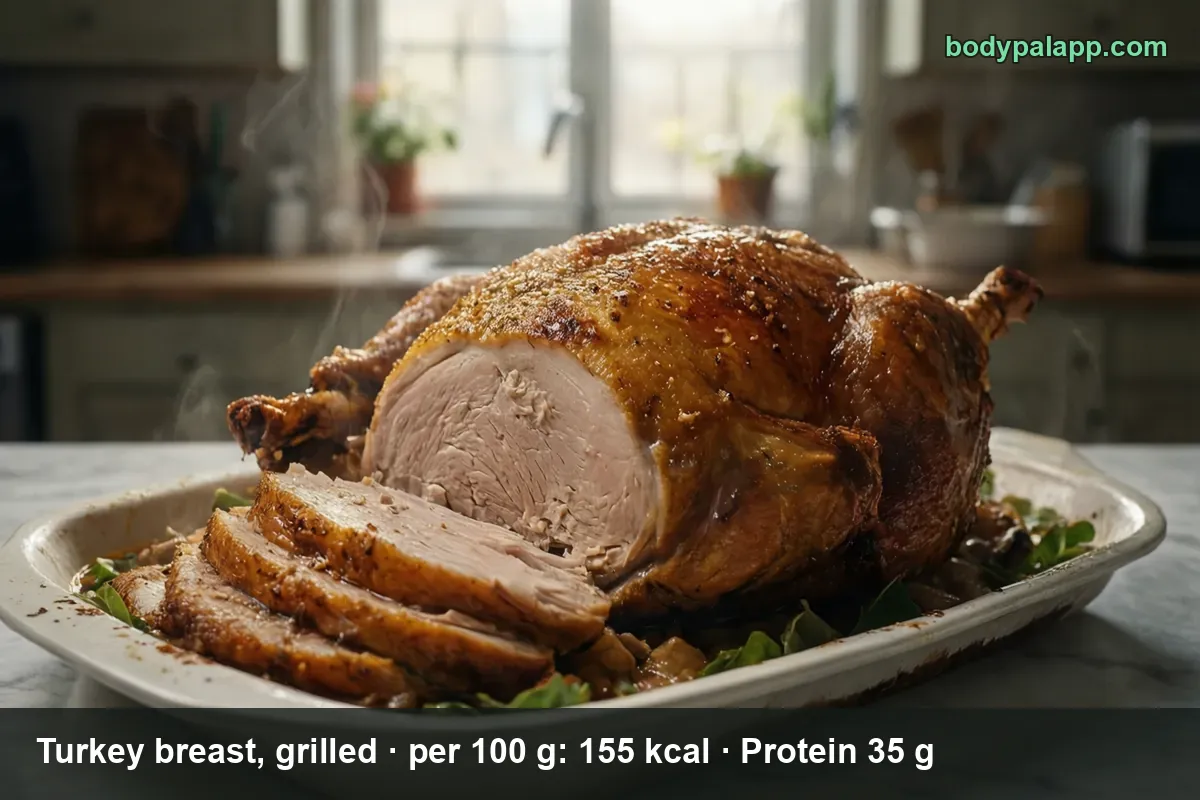
Grilled turkey breast is 155 calories per 100 g, so a ~125 g fillet comes to 194. Behind that sits the best protein deal in the meat aisle: 35 g per 100 g with only 1.7 g of fat. The calories in turkey climb only once you leave the breast for the leg.
On this page
- Turkey nutrition at a glance
- UK portions, fillet to festive plate
- Light meat, dark meat, thigh
- Raw to roasted: why the number jumps
- The Christmas plate problem
- How does turkey compare?
- Most popular turkey brands
- FAQ
Turkey nutrition at a glance
| Nutrient | Per 100 g, grilled breast | Per ~125 g fillet | %RI* per fillet |
|---|---|---|---|
| Energy | 155 kcal / 649 kJ | 194 kcal / 812 kJ | 10% |
| Protein | 35.0 g | 43.8 g | 88% |
| Carbohydrate | 0 g | 0 g | 0% |
| of which sugars | 0 g | 0 g | 0% |
| Fat | 1.7 g | 2.1 g | 3% |
| Fibre | 0 g | 0 g | – |
| Salt | 0.23 g | 0.29 g | 5% |
*%RI = percentage of the reference intake for an average adult (2,000 kcal; 70 g fat, 260 g carbohydrate, 90 g sugars, 50 g protein, 6 g salt).
Verified nutrition data
Numbers on this page come from CoFID, the UK government’s Composition of Foods Integrated Dataset, and from manufacturer labels where a branded product is named. Last verified August 2026. How we verify our data →
Read the protein row again. One fillet delivers 88% of an adult's daily reference intake, and it does so with 2.1 g of fat, of which only 0.8 g is saturated. No everyday meat packs protein tighter per calorie: 35 g for every 155 kcal.
The NHS guidance on meat points people towards lean cuts, and turkey breast is what that advice looks like on a shelf.
UK portions, fillet to festive plate
| Portion | Weight | Calories |
|---|---|---|
| Grilled breast fillet | ~125 g | 194 kcal |
| Larger breast steak | ~150 g | 233 kcal |
| Three slices of roast turkey | ~90 g | 149 kcal |
| Casseroled thigh, diced | ~100 g | 181 kcal |
Three slices of roast turkey at 149 kcal is the number worth memorising in December. The bird is rarely what sinks the day; a typical roast serving of turkey costs less than a sausage roll eaten standing up at the buffet.
For everyday cooking, the ~125 g fillet at 194 kcal behaves like a slightly heavier, slightly leaner chicken breast, and it takes the same pan, the same time and the same sauces.
Light meat, dark meat, thigh
| Cut, roasted or casseroled | kcal per 100 g | Protein | Fat |
|---|---|---|---|
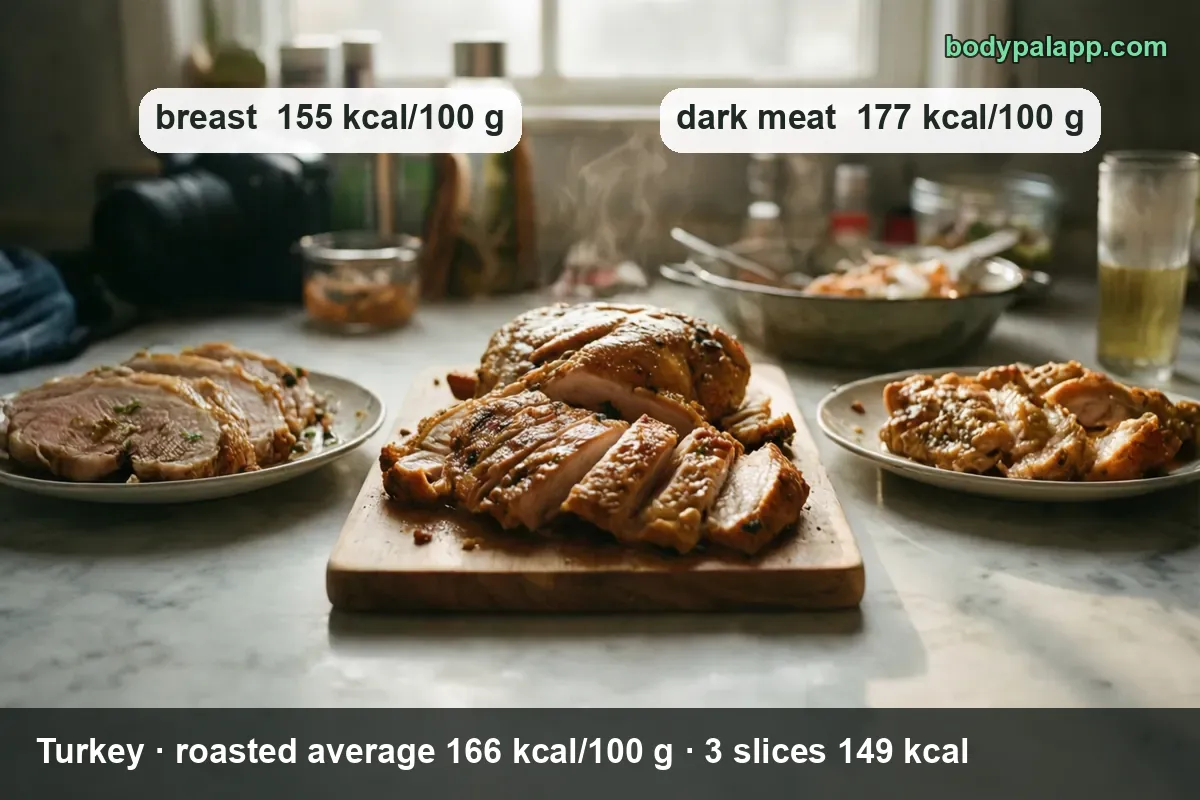
| Light meat, roasted | 153 | 33.7 g | 2.0 g |
| Grilled breast fillet | 155 | 35.0 g | 1.7 g |
| Roast meat, average | 166 | 31.2 g | 4.6 g |
| Dark meat, roasted | 177 | 29.4 g | 6.6 g |
| Thigh, diced, casseroled | 181 | 28.3 g | 7.5 g |
Turkey's breast-to-thigh gap is unusually small. From 155 to 181 is a 17% step; on a chicken the same walk, breast to casseroled thigh, is 147 to 233, a 59% step. Even the darkest turkey meat stays under 180 kcal per 100 g with skin off.
That makes turkey the rare bird where choosing the tastier cut costs almost nothing. If you prefer the leg, take the leg. The macros barely blink.
Raw to roasted: why the number jumps
Raw turkey meat averages 105 kcal per 100 g. Roasted, the average is 166. The oven adds nothing; it removes water, and the same energy ends up concentrated in fewer grams.
The rule for the diary is to pair the weight with the state. Weigh raw, log 105 per 100 g. Weigh cooked, log the roasted figure. Crossing them is the single most common way turkey gets over- or under-counted at home.
The Christmas plate problem
On the big day the turkey is usually the lightest thing touching the plate. Ninety grams of roast turkey is 149 kcal; the Yorkshire pudding beside it, the roast potatoes, the stuffing and the gravy each bring their own line to the bill.
If you are logging the festive meal, weigh or photograph the whole plate rather than agonising over the bird. The turkey earns its place: high protein, low fat, and the leftovers make the leanest sandwich filling in the fridge for a week.
How does turkey compare?
| Food | Portion | kcal per portion | kcal per 100 g | P / C / F per 100 g |
|---|---|---|---|---|
| Turkey breast, grilled | ~125 g fillet | 194 | 155 | 35.0 / 0 / 1.7 |
| Chicken breast, grilled | ~130 g fillet | 191 | 147 | 29.8 / 0 / 3.1 |
| Chicken thigh, casseroled | ~85 g | 198 | 233 | 21.5 / 0 / 16.3 |
| Boiled egg | medium, ~50 g | 72 | 143 | 14.1 / 0 / 9.6 |
The verdict: chicken breast holds a slender 8-calorie lead per 100 g, but turkey repays it with 5 g more protein and half the fat, so per calorie of protein turkey is the stronger buy. The full argument, cut by cut, is in our chicken vs turkey head-to-head. Against dark poultry cuts and eggs, turkey breast is not really competing; it is a category of its own.
Most popular turkey brands in the United Kingdom
Ranked by how widely each product appears among foods sold in the United Kingdom, from the BodyPal food database of over 3.3 million products. Calories are the figures printed on each label. These are ready-to-eat deli slices; the grilled fillet figures above are for plain meat.
| Product | Calories (per 100 g) |
|---|---|
| Bernard Matthews Turkey Breast Slices | 97 kcal |
| Glensallagh Cooked Turkey Slices (Lidl) | 104 kcal |
| Ashfield Farm Roast Turkey Breast Slices | 114 kcal |
| The Co-operative Roast Turkey Slices | 114 kcal |
Brand popularity: BodyPal food database. Nutrition: manufacturer labels.
How long does it take to burn off turkey?
100 g of grilled breast is 155 kcal. Enter your weight and the amount you ate to see how long it takes you to burn that off:
lb
| Activity | Time to burn 155 kcal |
|---|---|
| Walking, brisk | 31 min |
| Cycling, moderate | 19 min |
| Swimming, moderate | 22 min |
| Jogging | 18 min |
| Weight training, moderate | 34 min |
Times are for a 154 lb (11 st) adult at a steady pace; change the weight to see yours. The amount is set to the portion in the text (100 g); change it to what you actually ate. BodyPal works this out from your steps automatically.
One food is easy to picture; a whole day is harder. See how many calories you need a day and what a deficit actually looks like.
Frequently asked questions
How many calories are in turkey breast?
Grilled turkey breast is 155 kcal per 100 g, which makes a typical ~125 g fillet 194 kcal. It carries 35 g of protein per 100 g with 1.7 g of fat, so one fillet covers 88% of an adult's daily protein reference intake.
Is turkey leaner than chicken?
Yes. Grilled turkey breast has 1.7 g of fat per 100 g against 3.1 g for grilled chicken breast, and 35 g of protein against 29.8. Chicken keeps a small calorie lead, 147 to 155 per 100 g, because turkey packs more protein into each 100 g.
How many calories are in roast turkey slices?
Three slices of roast turkey, about 90 g, come to 149 kcal. Roast turkey meat averages 166 kcal per 100 g across light and dark meat, so a heaped Boxing Day plate of 150 g is still only around 249 kcal before the trimmings.
What is the difference between light and dark turkey meat?
Roasted light meat is 153 kcal per 100 g with 2 g of fat; roasted dark meat is 177 with 6.6 g. The gap is real but modest, far smaller than on a chicken, so choosing leg over breast costs about 24 kcal per 100 g.
How many calories are in a turkey thigh?
Diced casseroled turkey thigh is 181 kcal per 100 g, with 28.3 g of protein and 7.5 g of fat. A ~100 g serving is therefore 181 kcal, only 13 kcal above the same weight of grilled breast fillet meat.
How much protein is in turkey?
Grilled turkey breast holds 35 g of protein per 100 g, the highest of the everyday meats, and even roasted dark meat keeps 29.4 g. A single ~125 g fillet supplies 43.8 g, most of the 50 g daily reference intake for an adult.
Why does roasted turkey have more calories than raw?
Raw turkey meat averages 105 kcal per 100 g and roasted meat 166 because water evaporates in the oven while the energy stays. Match the figure to the state you weighed. Logging a cooked portion at the raw number undercounts it by about a third.
Is turkey good for weight loss?
At 155 kcal per 100 g with 35 g of protein, grilled turkey breast delivers a lot of fullness per calorie, which makes a deficit easier to hold. If you are cutting, it is the meat where the lean choice and the tasty choice are nearly the same thing.
Similar foods
- Chicken tikka masala — ~546 kcal the curry alone
- Spaghetti bolognese — ~680 kcal a plate
- Full English breakfast — about 1,093 kcal the works
- Sunday roast — ~946 kcal a typical plate
- Sushi — 148–170 kcal per 100 g
- Chicken breast — 147 kcal per 100 g grilled
Logging a roast without the arithmetic
Point your camera at the plate and BodyPal counts the slices, the sides and the gravy in one go, Christmas included.

