
How Many Calories in a Full English Breakfast? The Plate, Item by Item
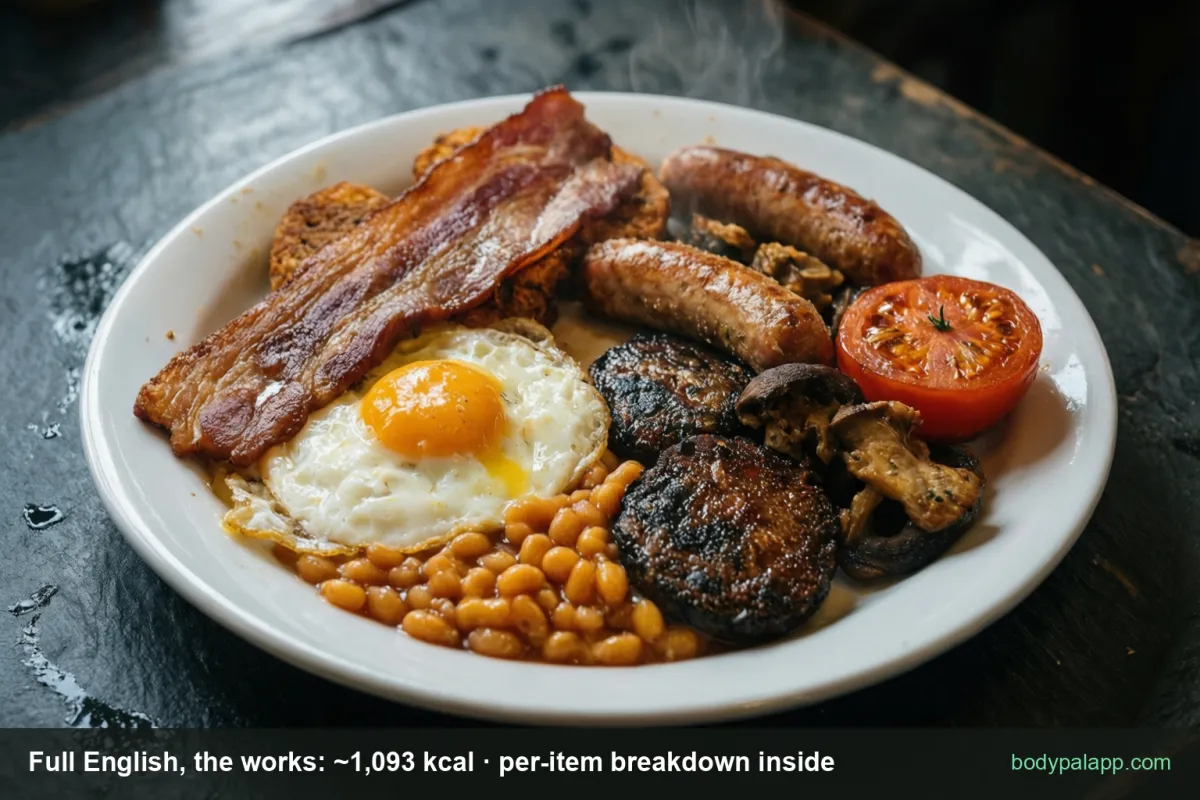
A full English breakfast with the works is 1,093 calories: two rashers of bacon, two sausages, a fried egg, half a tin of beans, a slice of black pudding, mushrooms, grilled tomato, a hash brown and buttered toast. How many calories in a full English breakfast is really a question about your plate, not about the dish. Nobody eats all nine.
On this page
- The plate at a glance
- What every item costs
- What to drop first
- The salt problem
- Small fry-up, veggie and café versions
- How does a fry-up compare?
- Two things people get wrong
- Most popular sausage brands
- FAQ
- Similar foods
The plate at a glance
| Nutrient | Amount | %RI* |
|---|---|---|
| Energy, the works | 1,093 kcal / 4,573 kJ | 55% |
| Energy, small fry-up | 515 kcal / 2,155 kJ | 26% |
| Energy, vegetarian | 625 kcal / 2,615 kJ | 31% |
| Salt, the works | 4.25 g | 71% |
| Plate weight, the works | about 680 g | |
| Energy density | about 160 kcal per 100 g |
*%RI = share of the reference intake for an average adult (2,000 kcal; 6 g salt). For the works: roughly 51 g protein, 82 g carbohydrate, 60 g fat and 15 g fibre across the plate (summed from the per-item CoFID values).
Verified nutrition data
Numbers on this page come from CoFID, the UK government’s Composition of Foods Integrated Dataset, and from manufacturer labels where a branded product is named. Last verified August 2026. How we verify our data →
Two numbers there are worth holding on to. The works is over half a day's energy before 10am. And at roughly 160 kcal per 100 g, the plate is less calorie-dense than a bare slice of white bread at 236. A fry-up is not concentrated. It is simply a lot of food.
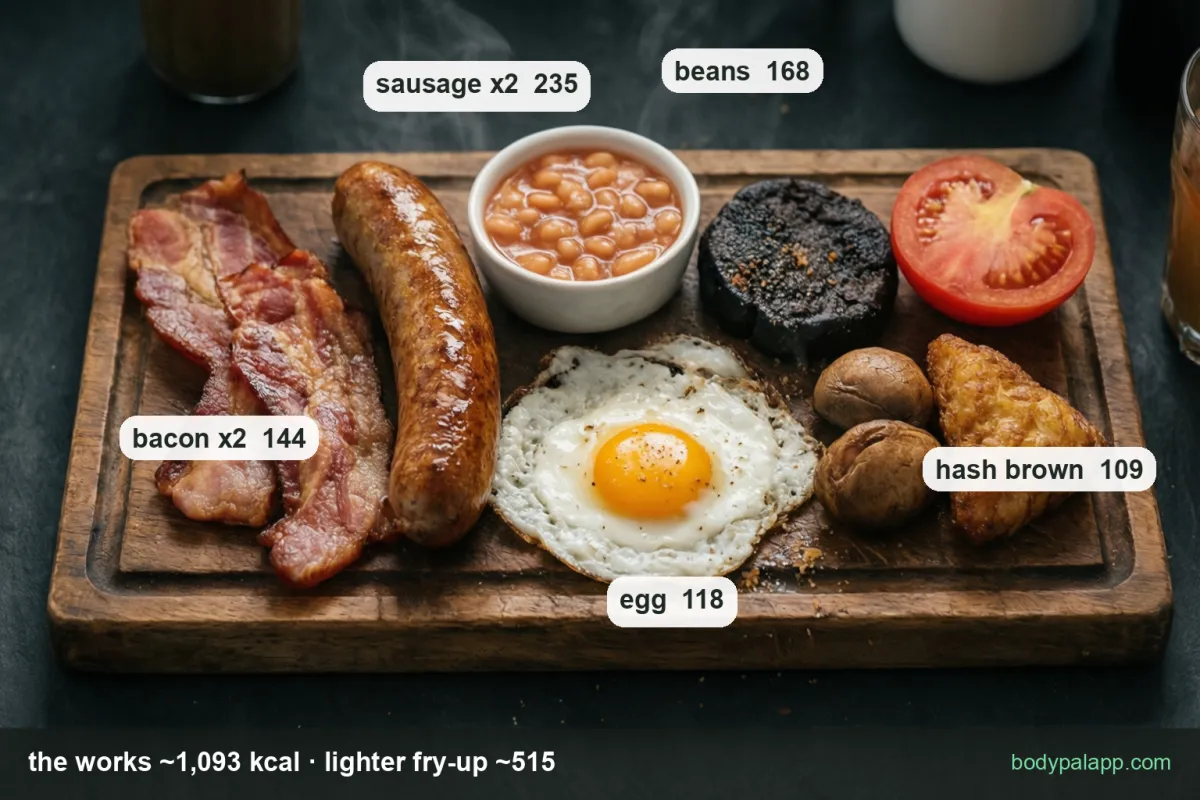
Which is why one number for the whole dish is useless, and a price list is not.
What every item costs
| Item | Per 100 g | Typical serving | Calories |
|---|---|---|---|
| Pork sausages, grilled | 294 kcal | 2 sausages, 80 g | 235 kcal |
| Baked beans | 81 kcal | half a tin, 207 g | 168 kcal |
| Toast with 10 g butter | - | 1 slice + butter | 159 kcal |
| Back bacon, grilled | 287 kcal | 2 rashers, 50 g | 144 kcal |
| Fried egg | 196 kcal | 1 egg, 60 g | 118 kcal |
| Hash brown | 217 kcal | 1 hash brown, 50 g | 109 kcal |
| Black pudding | 297 kcal | 1 slice, 30 g | 89 kcal |
| Grilled tomato | 50 kcal | 1 half, 80 g | 40 kcal |
| Mushrooms, cooked without fat | 39 kcal | 1 portion, 80 g | 31 kcal |
| All nine | about 680 g | 1,093 kcal |
Read the last column top to bottom and the plate reorganises itself. The sausages alone cost more than the mushrooms, tomato, egg and hash brown put together. The beans, which have the worst reputation of anything on there, come in under the toast.
This is one of the most-logged breakfasts in BodyPal, and the item people forget is almost always the butter.
What to drop first
Three things carry this plate: the sausages at 235, the hash brown at 109 and the 10 g of butter at 74. That is 418 calories, 38% of the total, from the fried and the spread.
Take those three off and you keep bacon, egg, beans, black pudding, mushrooms, tomato and dry toast for 675 kcal. Nothing recognisable has left the plate. You still get a cooked breakfast with meat on it.
Now the other end. Beans, mushrooms, tomato and the egg together are 357 kcal, a third of the plate across four items and most of its volume. That is the cheap half, and it is the half people cut first. Losing the tomato saves 40 calories. Losing one sausage saves 118.
The salt problem
Calories are not the only thing stacking up here.
| Item | Salt |
|---|---|
| Back bacon, 2 rashers | 1.75 g |
| Pork sausages, 2 | about 1.3 g |
| Baked beans, half a tin | 1.2 g |
| Total | 4.25 g |
That is 71% of the 6 g a day the NHS advises adults to stay under, before the toast is counted and before anyone reaches for the brown sauce. Bacon is the champion: at 3.5 g of salt per 100 g (1,390 mg sodium), two rashers carry more salt than half a tin of beans.
There is a second tally on this plate. Bacon 50 g, sausages 80 g and black pudding 30 g make 160 g of red and processed meat in one sitting, against the 70 g a day the NHS suggests for people currently eating more than 90 g. If you have a fry-up on Saturday, that is the meat side of the week doing its work in one morning.
Small fry-up, veggie and café versions
The small fry-up: 515 kcal. Bacon, a fried egg, half a tin of beans and a slice of dry toast. This is the version most people actually cook on a weekday, and at 515 it sits in the same bracket as a shop-bought lunch. It also drops the salt, because the sausages go.
The vegetarian full English: 625 kcal. Egg, beans, mushrooms, grilled tomato, hash brown and buttered toast. Note that it is not the light option by much: it lands 110 calories above the small fry-up, because the hash brown and the butter replace the meat rather than the bulk.
The café version: bigger, usually. Extra items, a second egg, fried bread and butter you did not choose push a served breakfast past the 1,093 here. Chains publish their own figures and those are the only reliable ones for a specific menu, so check the nutrition PDF on the chain's site.
How does a fry-up compare?
| Breakfast | What is on it | Calories |
|---|---|---|
| Full English, the works | all nine items | 1,093 kcal |
| Full English, no sausage, hash brown or butter | six items plus dry toast | 675 kcal |
| Vegetarian full English | six items, no meat | 625 kcal |
| Small fry-up | bacon, egg, beans, dry toast | 515 kcal |
| Beans on toast, 2 slices | half a tin, 2 slices | 338 kcal |
| Bacon sandwich, 2 rashers | 2 rashers, 2 slices | 314 kcal |
The verdict: for weight loss the small fry-up is the one worth keeping, because at 515 it costs about what a sandwich lunch does and delivers a hot meal with two protein sources. For a Saturday, eat the works, but plan dinner around it rather than after it: 1,093 is 55% of the day.
Read the component table against the NHS Eatwell Guide and the pattern holds. The two cheapest items on the plate, beans and mushrooms, are also the two doing the most for it.
Two things people get wrong
"A fry-up is calorie-dense." It is not, particularly. About 680 g of food at roughly 160 kcal per 100 g is less dense than dry toast. The total is high because the plate is enormous, and that also means it holds most people to mid-afternoon, which a 300-calorie breakfast rarely does.
"Grill it instead of frying it and you fix the number." These figures are already for grilled bacon and grilled sausages, so grilling does not touch the biggest item on the plate. The frying that costs you is the hash brown at 109, which is not where people look.
Most popular sausage brands in the United Kingdom
Ranked by how widely each product appears among foods sold in the United Kingdom, from the BodyPal food database of over 3.3 million products. Calories are the figures printed on each label. The sausage is where brands differ most on this plate.
| Product | Calories (per 100 g) |
|---|---|
| Richmond Thick Pork Sausages | 269 kcal |
| Tesco Finest Pork Sausages | 241 kcal |
| Porky Lights Lower Fat Sausages | 138 kcal |
Brand popularity: BodyPal food database. Nutrition: manufacturer labels.
How long does it take to burn off a full English breakfast?
The works, all nine items is 1,093 kcal. Enter your weight to see how long it takes you to burn that off:
lb
| Activity | Time to burn 1,093 kcal |
|---|---|
| Walking, brisk | 3 hr 39 min |
| Cycling, moderate | 2 hr 17 min |
| Swimming, moderate | 2 hr 36 min |
| Jogging | 2 hr 9 min |
| Weight training, moderate | 4 hr 3 min |
Times are for a 154 lb (11 st) adult at a steady pace; change the weight to see yours. BodyPal works this out from your steps automatically.
Burning it off is one side of it. The other is knowing your number: work out how many calories you need a day, with macros and a goal date.
Frequently asked questions
How many calories are in a full English breakfast?
A full English with all nine items is 1,093 kcal: sausages 235, beans 168, buttered toast 159, bacon 144, fried egg 118, hash brown 109, black pudding 89, tomato 40 and mushrooms 31. Most plates leave two or three of those off, which is why your own total is usually 600 to 900.
How many calories are in a fry up?
Between about 515 and 1,093 kcal, depending on how many items are on it. Bacon, egg, beans and dry toast is 515. Add two sausages, a hash brown, black pudding, mushrooms, tomato and butter and you reach 1,093. Add each item you actually ate from the table above rather than using one figure.
How many calories are in a small fry up?
A small fry-up of two rashers of bacon, one fried egg, half a tin of beans and a slice of dry toast is 515 kcal. Butter the toast and it becomes 589. This is the weekday version, and at 515 it costs about the same as a bought sandwich lunch while carrying two sources of protein.
How many calories are in a vegetarian full English?
A vegetarian cooked breakfast of fried egg, half a tin of beans, mushrooms, grilled tomato, a hash brown and buttered toast is 625 kcal. It is not the light choice by much, landing 110 calories above a small bacon-and-egg fry-up, because the hash brown at 109 and the butter at 74 stay on the plate. Drop those two and you are at 442.
How many calories are in a Wetherspoons breakfast?
Chains publish their own nutrition figures and those are the ones to use, because portion sizes and recipes differ from the generic plate. Look for the nutrition PDF on the chain's website. If it is not available, add up the items you were served using the per-item table on this page, which will get you close.
Is a full English healthy?
The works carries 4.25 g of salt, 71% of the 6 g daily maximum the NHS advises, and 160 g of red and processed meat in one sitting. As an occasional plate that is manageable. As a daily habit the salt is the part worth watching, and the fix is the same one that saves calories: fewer sausages, more beans and mushrooms.
What is the highest-calorie item in a full English?
Two grilled pork sausages at 235 kcal, from 294 kcal per 100 g. Half a tin of beans is second at 168, then buttered toast at 159 and bacon at 144. The lowest are mushrooms at 31 and grilled tomato at 40, so cutting the vegetables saves almost nothing.
How do I cut the calories in a cooked breakfast?
Remove the sausages, hash brown and butter and the plate falls from 1,093 to 675 kcal, a saving of 418. Those three are 38% of the total between them. Keeping the beans, mushrooms, tomato and egg costs only 357 kcal and is most of the volume, so the plate still looks full.
Similar foods
- Sunday roast — ~946 kcal a typical plate
- Sushi — 148–170 kcal per 100 g
- Ham sandwich — 277 kcal whole
- Chicken tikka masala — ~546 kcal the curry alone
- Turkey — 155 kcal per 100 g breast
- Chicken kebab — 166 kcal per 100 g shish
Count it without the maths
BodyPal logs every item on the plate from one photo, so the hash brown and the butter do not go missing from the total.

