
How Many Calories Are in Sushi? Counting by the Piece
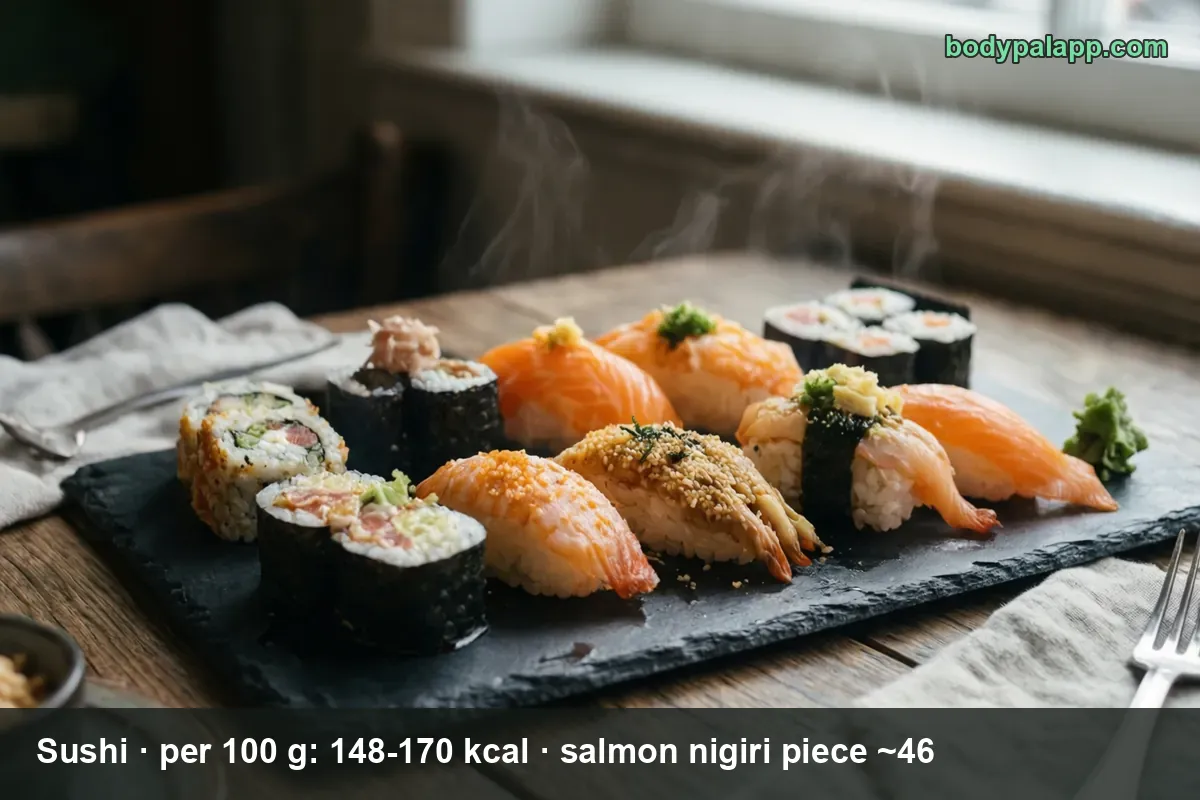
How many calories are in sushi depends on the piece: a salmon nigiri is about 46 kcal at 152 kcal per 100 g, a vegetable maki roughly 30, and a typical 200 g supermarket pack lands near 300. Light, yes. But the rice is seasoned with sugar, and the salt reads like a crisp packet.
On this page
- Sushi nutrition at a glance
- Piece by piece: the sushi ledger
- The sugar hiding in the rice
- Salt: the small print
- Salmon, tuna or vegetable?
- How does sushi compare?
- Most popular sushi brands
- FAQ
Sushi nutrition at a glance
| Nutrient | Per 100 g | Per piece (~30 g nigiri) | %RI* per piece |
|---|---|---|---|
| Energy | 152 kcal / 636 kJ | 46 kcal / 191 kJ | 2% |
| Protein | 8.7 g | 2.6 g | 5% |
| Carbohydrate | 25.2 g | 7.6 g | 3% |
| of which sugars | 3.2 g | 1.0 g | 1% |
| Fat | 2.5 g | 0.8 g | 1% |
| of which saturates | 0.5 g | 0.2 g | 1% |
| Fibre | 1.2 g | 0.4 g | – |
| Salt | 0.90 g | 0.27 g | 5% |
*%RI = percentage of the reference intake for an average adult (2,000 kcal; 70 g fat, 20 g saturates, 260 g carbohydrate, 90 g sugars, 50 g protein, 6 g salt).
Verified nutrition data
Numbers on this page come from CoFID, the UK government’s Composition of Foods Integrated Dataset, and from manufacturer labels where a branded product is named. Last verified August 2026. How we verify our data →
The reference row is CoFID's salmon nigiri. Notice what sushi actually is on paper: a carbohydrate food. Rice supplies 25.2 g per 100 g while fat sits at just 2.5 g, which is why the calories stay low and also why a pack rarely holds you past mid-afternoon on its own.
The salt line deserves a second look before the soy sauce even opens. At 0.90 g per 100 g, the seasoning is already in the rice and the fish.
Piece by piece: the sushi ledger
| Piece or pack | Weight | Calories |
|---|---|---|
| Vegetable maki piece | ~20 g | 30 kcal |
| Salmon nigiri piece | ~30 g | 46 kcal |
| Supermarket mixed pack | ~200 g | ~300 kcal |
Sushi is one of the few foods people genuinely eat by the unit, which makes the mental arithmetic honest for once. Six salmon nigiri come to about 275 kcal. A mixed pack from the meal deal shelf, at around 150 kcal per 100 g across its contents, totals close to 300, sitting comfortably in light-lunch territory.
The trap is not the pack. It is treating the pack as a side and adding a second one, plus edamame and a sweet drink, at which point the "light" lunch quietly passes 700.
The sugar hiding in the rice
Sushi rice is not plain boiled rice: it is dressed with rice vinegar and sugar, which is how it holds its shine and its shape. CoFID's vegetable sushi carries 7.0 g of sugars per 100 g, more than double the 3.2 g in salmon nigiri, because the rice-to-filling ratio is higher in a veggie roll.
For scale, plain boiled rice carries almost no sugars at all. The sweetness in sushi is a recipe decision, not a property of the grain, and it is one of the two ways this food differs from the clean image it trades on.
Salt: the small print
The other way is salt. Vegetable sushi measures 1.30 g per 100 g, so a 200 g veggie pack delivers 2.6 g, over 40% of the 6 g a day the NHS advises, before a single drop of soy sauce. Salmon nigiri is gentler at 0.90 g per 100 g.
Soy sauce then adds its own load on top with every dip, and the little fish-shaped bottle in the pack is nobody's friend here. If you are watching salt, the practical move is embarrassingly simple: dip the fish side, not the rice, or skip the sauce for half the pieces.
Salmon, tuna or vegetable?
| Type | Per 100 g | Protein per 100 g | Salt per 100 g |
|---|---|---|---|
| Vegetable sushi | 148 kcal | 3.4 g | 1.30 g |
| Salmon nigiri | 152 kcal | 8.7 g | 0.90 g |
| Tuna nigiri | 170 kcal | 8.4 g | 0.83 g |
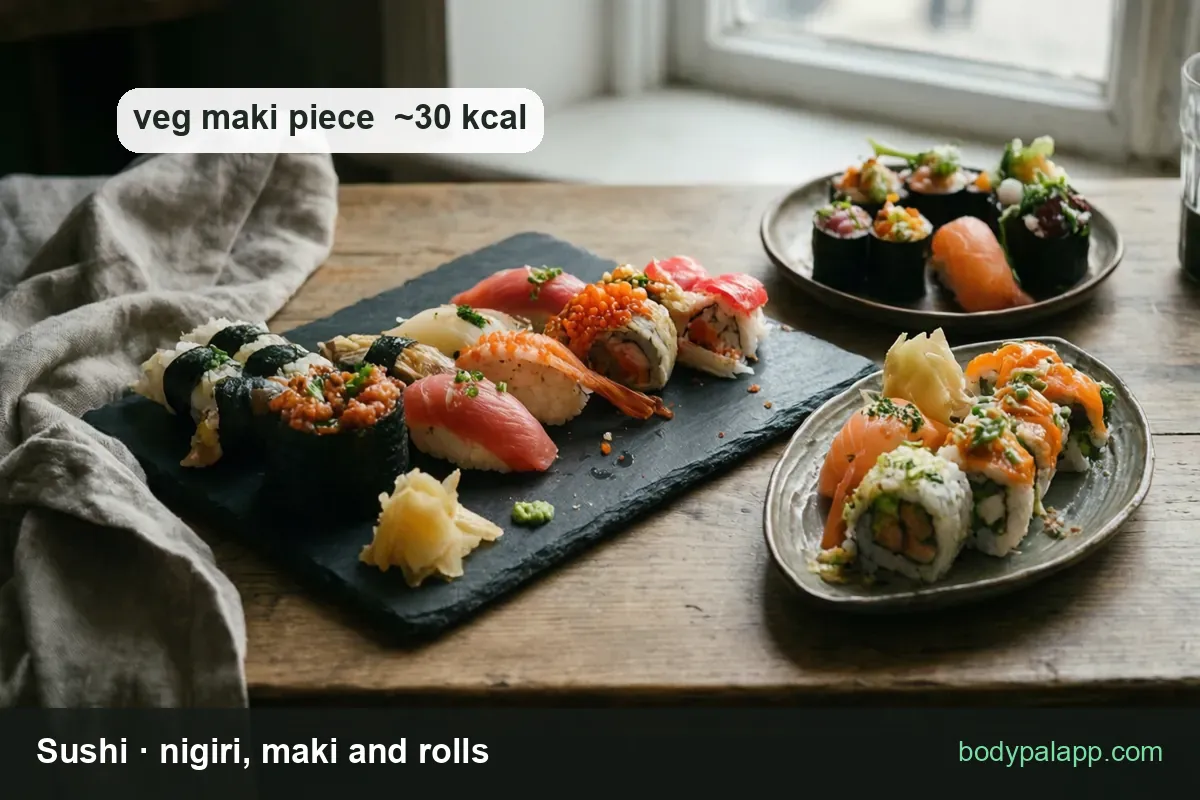
Twenty-two kilocalories per 100 g separate the lightest from the heaviest, which is to say: the choice barely moves the energy. What it moves is everything else. The fish options carry two and a half times the protein of the vegetable roll and noticeably less salt, so salmon or tuna is the better pack for the same calories. The vegetable pack is the lightest by a whisker and the saltiest by a margin.
How does sushi compare?
| Food | Per 100 g | Protein per 100 g |
|---|---|---|
| Tuna nigiri | 170 kcal | 8.4 g |
| Salmon nigiri | 152 kcal | 8.7 g |
| Boiled white rice | 131 kcal | 2.8 g |
| Cooked quinoa | ~111 kcal | ~5.0 g |
The verdict: sushi costs only a little more than its own rice base and buys three times the protein with it, which is a good trade. As a light lunch it earns the reputation; as a protein meal it needs the fish pieces, not the veggie ones, and as a low-salt choice it was never in the running.
Most popular sushi box brands in the United Kingdom
Ranked by how widely each product appears among foods sold in the United Kingdom, from the BodyPal food database of over 3.3 million products. Calories are the figures printed on each label.
| Product | Calories (per 100 g) |
|---|---|
| Sushi Box Aki (Lidl) | 131 kcal |
| Sushi Box Joto (Chef Select) | 159 kcal |
| Sushi Box Sapporo (Select&Go) | 139 kcal |
Brand popularity: BodyPal food database. Nutrition: manufacturer labels.
How long does it take to burn off sushi?
A salmon nigiri piece is 46 kcal. Enter your weight to see how long it takes you to burn that off:
lb
| Activity | Time to burn 46 kcal |
|---|---|
| Walking, brisk | 9 min |
| Cycling, moderate | 6 min |
| Swimming, moderate | 7 min |
| Jogging | 5 min |
| Weight training, moderate | 10 min |
Times are for a 154 lb (11 st) adult at a steady pace; change the weight to see yours. BodyPal works this out from your steps automatically.
One food is easy to picture; a whole day is harder. See how many calories you need a day and what a deficit actually looks like.
Frequently asked questions
How many calories are in a sushi pack?
A typical 200 g supermarket mixed pack is around 300 kcal, with the contents averaging near 150 kcal per 100 g. Piece by piece that is about 46 kcal per salmon nigiri and 30 per vegetable maki, so the maths stays easy whatever the combination in the tray.
How many calories are in salmon sushi?
Salmon nigiri is 152 kcal per 100 g, which works out at about 46 kcal per 30 g piece. Six pieces come to roughly 275 kcal, with 8.7 g of protein per 100 g. Among common sushi types it is the middle option, above vegetable rolls and below tuna.
Is sushi good for weight loss?
The calories cooperate: a 200 g pack near 300 kcal is a genuinely light lunch. The catch is staying power, since sushi is mostly rice with modest protein, so hunger returns sooner than after an equal-calorie meal built on meat or eggs. Choosing fish pieces over vegetable rolls helps.
Why does sushi contain sugar?
The rice is dressed with vinegar and sugar as part of the recipe, which is why vegetable sushi shows 7.0 g of sugars per 100 g while plain boiled rice shows almost none. Rolls with more rice and less filling carry more of it; salmon nigiri holds 3.2 g per 100 g.
How much salt is in sushi?
More than the clean image suggests: 0.90 g per 100 g in salmon nigiri and 1.30 g in vegetable sushi, so a 200 g veggie pack reaches 2.6 g before any soy sauce. That is over 40% of the NHS daily guide of 6 g, and dipping adds more with every piece.
Salmon or tuna sushi: which has fewer calories?
Salmon, narrowly: 152 kcal per 100 g against tuna's 170. Protein is near-identical at 8.7 and 8.4 g, and tuna edges the salt contest at 0.83 g per 100 g. In practice the difference across a six-piece serving is about 30 kcal, small enough to pick by taste.
How many pieces of sushi make a meal?
At 30-46 kcal a piece, a 400-500 kcal lunch is roughly nine to twelve pieces depending on the mix. A single 200 g pack at ~300 kcal sits just under that, which is why one pack feels slightly short and two overshoot. Adding a protein side beats adding a second pack.
Is vegetable sushi healthier than fish sushi?
It is the lightest at 148 kcal per 100 g, but it carries the most salt at 1.30 g and the least protein at 3.4 g per 100 g. The fish versions cost 4-22 kcal more per 100 g and deliver two and a half times the protein with less salt, so on balance they are the stronger choice.
Similar foods
- Full English breakfast — about 1,093 kcal the works
- Sunday roast — ~946 kcal a typical plate
- Ham sandwich — 277 kcal whole
- Chicken tikka masala — ~546 kcal the curry alone
- Turkey — 155 kcal per 100 g breast
- Chicken kebab — 166 kcal per 100 g shish
Count it without the maths
BodyPal counts the pieces in the tray from one photo and logs the pack, the sauce and the sides before the chopsticks split.

