
How Many Calories in a Sunday Dinner?
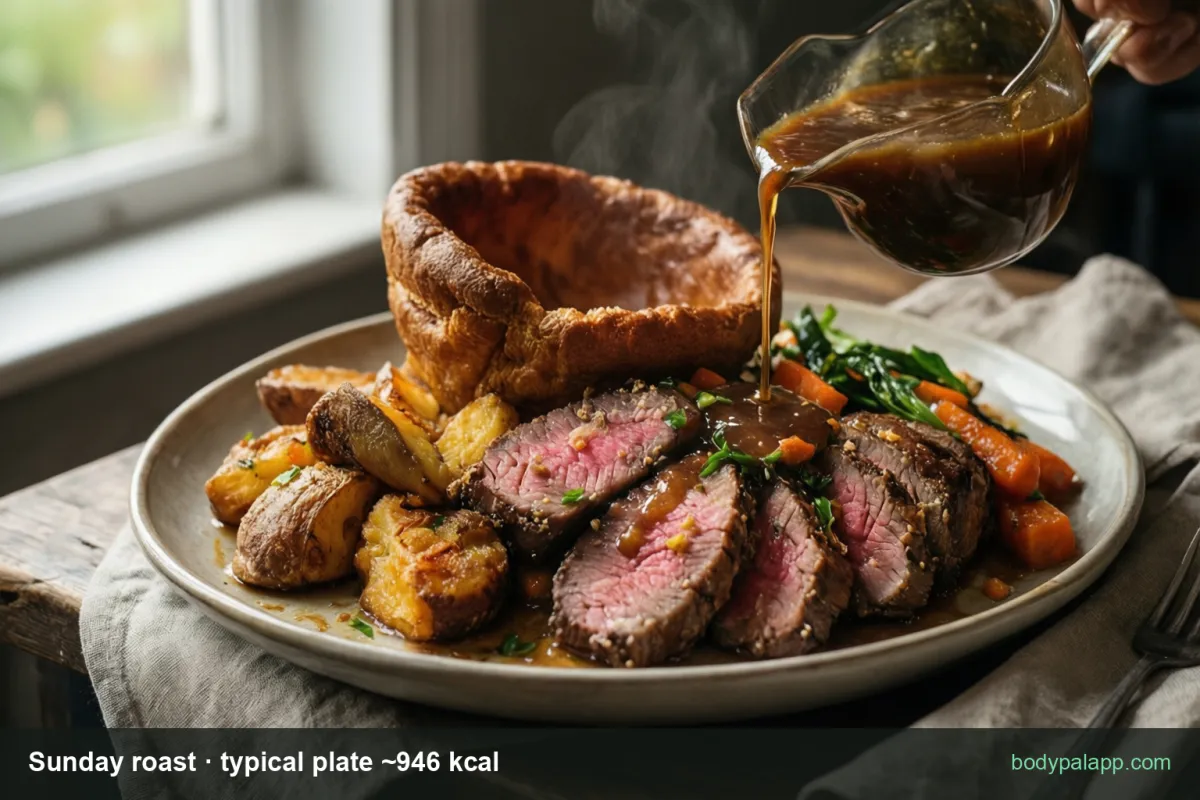
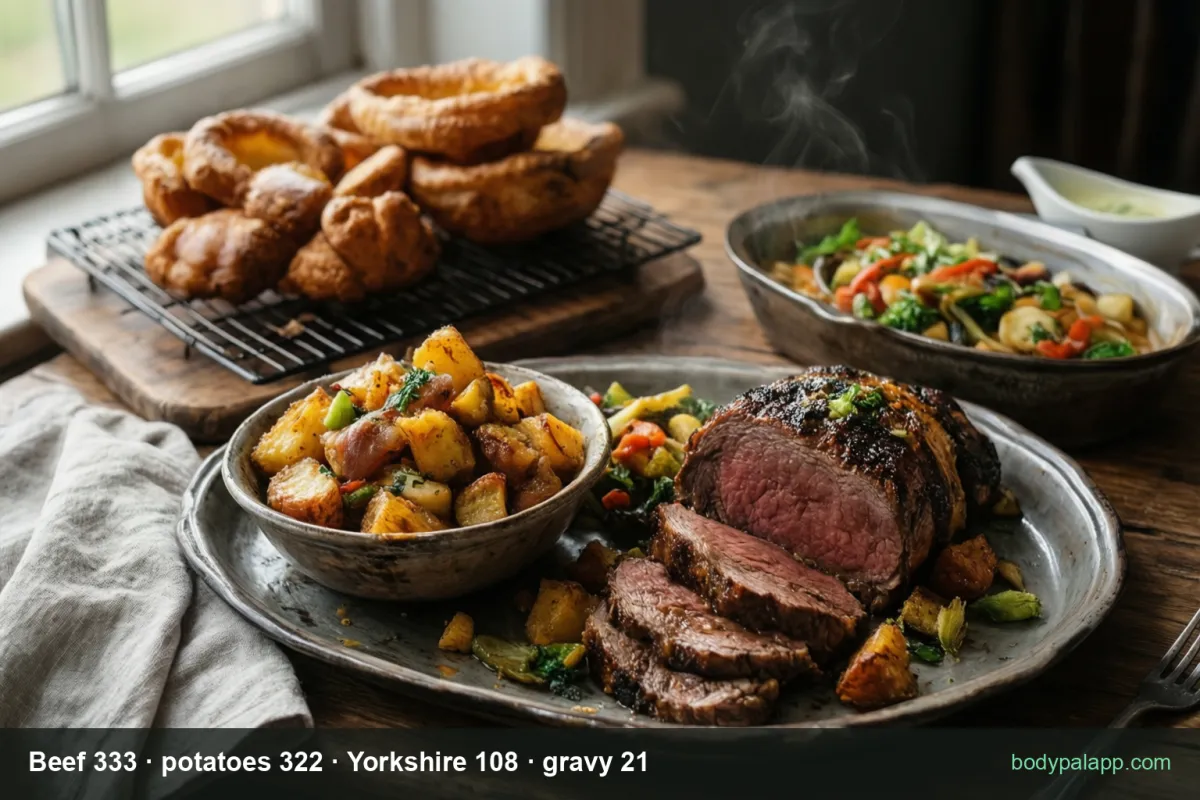
Count the calories in a Sunday dinner component by component and a typical plate lands at about 946: roast beef 333, roast potatoes 322, a Yorkshire pudding 108, stuffing 127, vegetables 35 and gravy a mere 21. Swap in chicken and skip the stuffing, and the same ritual costs roughly 700.
On this page
- The plate, component by component
- Lighter and heavier plates
- How does a Sunday roast compare?
- The gravy myth
- Most popular roast trimming brands
- Sunday roast FAQs
The plate, component by component
A roast is not one food — it is six, and they behave very differently. Here is the standard beef plate, item by item.
| Component | Portion | Calories |
|---|---|---|
| Roast beef, topside (medium-rare, lean and fat) | 150 g (222 kcal/100 g) | 333 kcal |
| Roast potatoes | 200 g (161 kcal/100 g) | 322 kcal |
| Yorkshire pudding | 1 | 108 kcal |
| Stuffing | 50 g (253 kcal/100 g) | 127 kcal |
| Boiled vegetables (carrot, cabbage, broccoli) | ~150 g | ~35 kcal |
| Gravy | ~70 ml | 21 kcal |
| Whole plate | ≈946 kcal (3,958 kJ) |
The full plate carries roughly 64 g of protein, 85 g of carbohydrate and 38 g of fat. Against a 2,000 kcal day, that is 47% of the energy, over a day's worth of the 50 g protein reference intake, a third of the carbs and just over half the fat.
Verified nutrition data
Numbers on this page come from CoFID, the UK government’s Composition of Foods Integrated Dataset, and from manufacturer labels where a branded product is named. Last verified August 2026. How we verify our data →
Now look at where the weight of the meal actually sits. The potatoes and the Yorkshire together are 430 kcal — very nearly half the plate. The beef, which feels like the main event, is barely a third at 333. And the two most feared items, gravy and veg, are a rounding error between them at 56.
That protein figure is the roast's quiet strength. A meal delivering 64 g of protein is doing what the NHS Eatwell Guide asks of a main meal several times over, and it is a large part of why nobody snacks on a Sunday afternoon.
Lighter and heavier plates
The 946 kcal plate is the middle of a wide road. The same tradition stretches from about 700 kcal to well past 1,100 depending on three decisions.
The meat. Beef topside at 222 kcal per 100 g is the benchmark. Choose roast chicken breast instead and the meat line drops substantially — that swap, plus leaving off the stuffing, is what brings the whole plate down to roughly 700 kcal without shrinking it.
The potatoes. At 161 kcal per 100 g, roast potatoes are the most expensive habit on the plate to repeat. A second scoop is another 160-plus kcal per 100 g served, and it is precisely how a 946 kcal dinner becomes an 1,100-plus one. If seconds are non-negotiable, make them veg: 150 g costs about 35.
The extras. Stuffing runs 253 kcal per 100 g — dense enough that the modest 50 g ball adds 127. Pigs in blankets, cauliflower cheese and buttered mash all push in the same direction. None is a problem alone; the plate simply keeps the receipts.
If you are trying to lighten the tradition rather than abandon it, the order of operations is clear: chicken over beef, one round of potatoes, stuffing only when it is worth it. The gravy was never the issue.
How does a Sunday roast compare?
Among the big British plates, the roast sits near the top — but not at it.
| Meal | Serving | Calories |
|---|---|---|
| Full English breakfast | full plate | ~1,093 kcal |
| Fish and chips | portion | ~1,074 kcal |
| Sunday roast | full plate | ~946 kcal |
| Chicken tikka masala with rice | plate | ~874 kcal |
| Cottage pie | 400 g portion | 444 kcal |
The verdict: of the great British blowouts, the roast is the most defensible — fewer calories than a full English or fish and chips, with far more protein and actual vegetables on the plate. For an everyday dinner, though, cottage pie does the comfort job at less than half the price.
The gravy myth
Gravy has spent decades as the guilty pour of the Sunday table, and the numbers refuse to cooperate: a generous 70 ml over the plate is 21 kcal. Two per cent of the meal. You could double it and barely notice the difference in the total.
What gravy does carry is salt — about 0.7 g per serving against the NHS daily maximum of 6 g — so a heavy hand matters there more than on the calorie line. But if something made Sunday heavy, it was the second round of roast potatoes. The boat is innocent.
Most popular roast trimming brands in the United Kingdom
Ranked by how widely each product appears among foods sold in the United Kingdom, from the BodyPal food database of over 3.3 million products. Calories are the figures printed on each label. The meat and potatoes sell unbranded — the trimmings carry the labels.
| Product | Calories (per 100 g) |
|---|---|
| Aunt Bessie's Yorkshire Puddings | 248 kcal |
| Bisto Gravy Granules (dry) | 395 kcal |
Brand popularity: BodyPal food database. Nutrition: manufacturer labels.
Sunday roast FAQs
How many calories in a roast dinner with chicken?
Roughly 700 kcal for the same plate built on roast chicken breast without stuffing — about 250 below the 946 kcal beef version. The potatoes, Yorkshire, veg and gravy stay identical; the meat swap and the missing stuffing ball do all the saving. It is the easiest "lean roast" there is.
How many calories in a roast beef dinner?
About 946 kcal for a typical plate: 150 g of topside (333 kcal), 200 g of roast potatoes (322), a Yorkshire pudding (108), stuffing (127), vegetables (35) and gravy (21). Generous carveries and second helpings push past 1,100 without difficulty.
How many calories in a Yorkshire pudding?
108 kcal for a standard pudding — less than most people guess for the plate's most theatrical item. It is batter and air. One Yorkshire is a modest spend; it is the giant carvery versions and the second one that start to count.
How many calories in roast potatoes?
322 kcal for a typical 200 g serving, at 161 kcal per 100 g. That makes them the plate's joint-biggest item alongside the beef — and unlike the beef, they invite seconds. A refill scoop is the single fastest way to add 150-plus kcal to Sunday.
How many calories in gravy?
About 21 kcal for a 70 ml pour of granule gravy — the cheapest component of the entire roast. Its real contribution is salt, at roughly 0.7 g per serving, so pour for taste and watch the shaker elsewhere in the meal instead.
How many calories in stuffing?
127 kcal for a 50 g serving — at 253 kcal per 100 g, stuffing is the densest thing on the plate bar none. It outranks the beef gram for gram. If a roast needs trimming, the stuffing ball is the highest-value single omission.
Is a Sunday roast healthy?
At 946 kcal it is a big meal, but a well-constructed one: 64 g of protein, real vegetables, and less overall than a full English or fish and chips. As a weekly ritual within an otherwise ordinary week, it fits. The watch-outs are portion creep on potatoes and the salt across gravy and stuffing.
How much protein is in a Sunday dinner?
About 64 g on a typical beef plate — more than the full 50 g daily reference intake in one sitting. The beef supplies the bulk, with the Yorkshire, stuffing and veg adding the rest. It is the most protein-rich of the classic British meals.
How do I make a roast dinner lighter?
Start from 946 kcal and work down: chicken instead of beef and no stuffing lands near 700. Keep to one serving of potatoes, let the 35 kcal of vegetables fill the gap, and pour the gravy freely — at 21 kcal it is the one indulgence that costs nothing worth counting.
Similar foods
- Full English breakfast — about 1,093 kcal the works
- Sushi — 148–170 kcal per 100 g
- Ham sandwich — 277 kcal whole
- Chicken tikka masala — ~546 kcal the curry alone
- Turkey — 155 kcal per 100 g breast
- Chicken kebab — 166 kcal per 100 g shish
Sunday, settled
One photo of the loaded plate and BodyPal logs the beef, the potatoes, the Yorkshire and the gravy as separate items — the whole roast counted before the carving knife is washed.


How long does it take to burn off a Sunday dinner?
A typical beef plate is 946 kcal. Enter your weight to see how long it takes you to burn that off:
lb
| Activity | Time to burn 946 kcal |
|---|---|
| Walking, brisk | 3 hr 9 min |
| Cycling, moderate | 1 hr 58 min |
| Swimming, moderate | 2 hr 15 min |
| Jogging | 1 hr 51 min |
| Weight training, moderate | 3 hr 30 min |
Times are for a 154 lb (11 st) adult at a steady pace; change the weight to see yours. BodyPal works this out from your steps automatically.
Want the bigger picture? Calculate your daily calorie needs — your maintenance figure, a target for losing or gaining, and the date you get there.