
How Many Calories in Gravy?
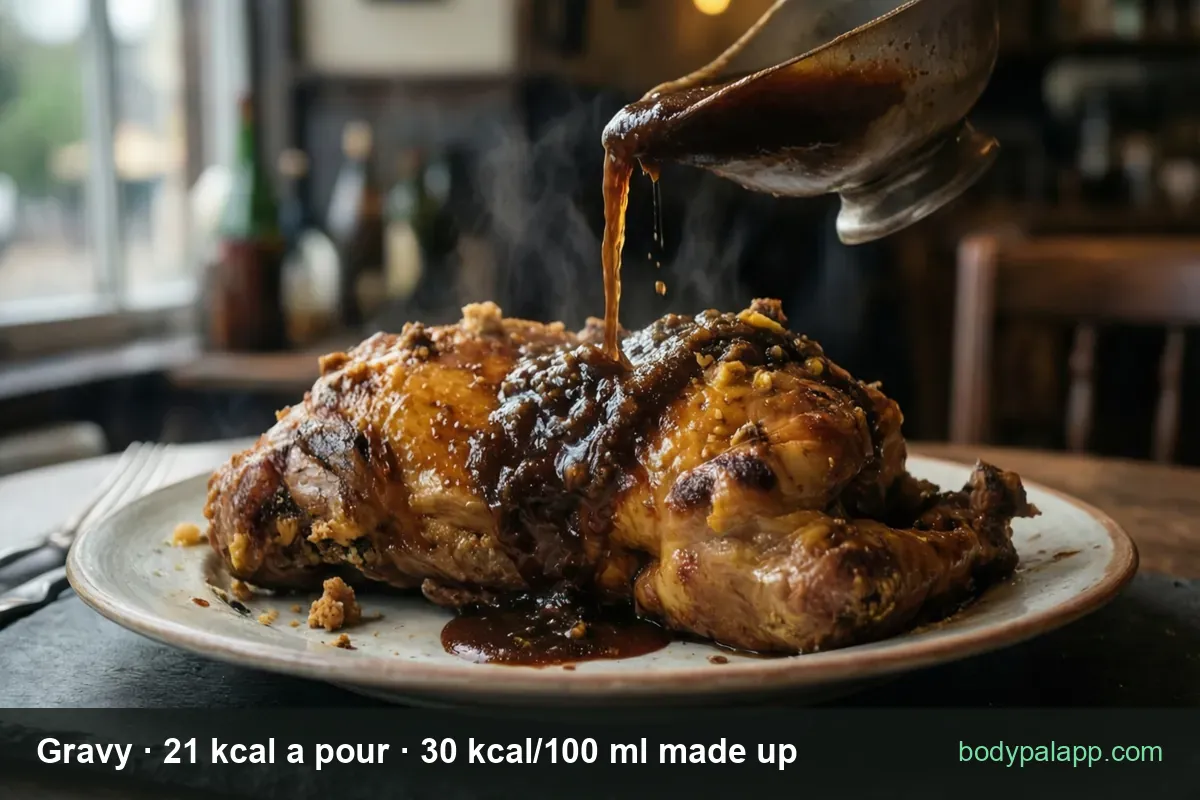
Of everything on a Sunday roast, gravy is the item least worth worrying about: a typical 70 ml pour is 21 kcal on a plate that can reach 946. Made up from granules, gravy is 30 kcal per 100 ml. Ask how many calories in gravy and the honest answer is "almost none" – the salt is another matter.
On this page
- Gravy nutrition per 100 ml
- What a pour actually adds
- Granules, dry weight and pan gravy
- How does gravy compare
- The gravy myth
- Most popular gravy brands
- FAQ
Gravy nutrition per 100 ml
Figures are for instant gravy granules made up with water, the way most British gravy is actually made.
| Nutrient | Per 100 ml | % RI* |
|---|---|---|
| Energy | 30 kcal / 126 kJ | 2% |
| Protein | 0.3 g | 1% |
| Carbohydrates | 4.7 g | 2% |
| Fat | 1.2 g | 2% |
| Saturates | 0.77 g | 4% |
| Fibre | 0.1 g | — |
| Sugar | 0.4 g | <1% |
| Salt | 0.96 g | 16% |
*Reference intake of an average adult (8,400 kJ / 2,000 kcal).
Verified nutrition data
Numbers on this page come from CoFID, the UK government’s Composition of Foods Integrated Dataset, and from manufacturer labels where a branded product is named. Last verified August 2026. How we verify our data →
Every line in that table is a rounding error except the last one. Nearly a gram of salt per 100 ml means gravy earns its place on the NHS list of foods to watch for salt, and it's why the WHO's under-5 g-a-day advice is hard to hit on a traditional roast day. Calories, though? Practically a garnish.
What a pour actually adds
| Portion | Calories | Salt |
|---|---|---|
| Typical pour on a roast (70 ml) | 21 kcal / 88 kJ | ~0.7 g |
| Generous flooding (150 ml) | 45 kcal | ~1.4 g |
A normal pour over chicken, mash or chips costs 21 kcal, about the price of a bite of Yorkshire pudding. Even drowning the plate in 150 ml only reaches 45. Cutting gravy to save calories is effort spent in exactly the wrong place.
Spend that attention on the salt column instead. If the rest of your day is already salty, the generous pour's 1.4 g is nearly a quarter of the 6 g daily maximum, and that's a real number in a way the calories aren't.
Granules, dry weight and pan gravy
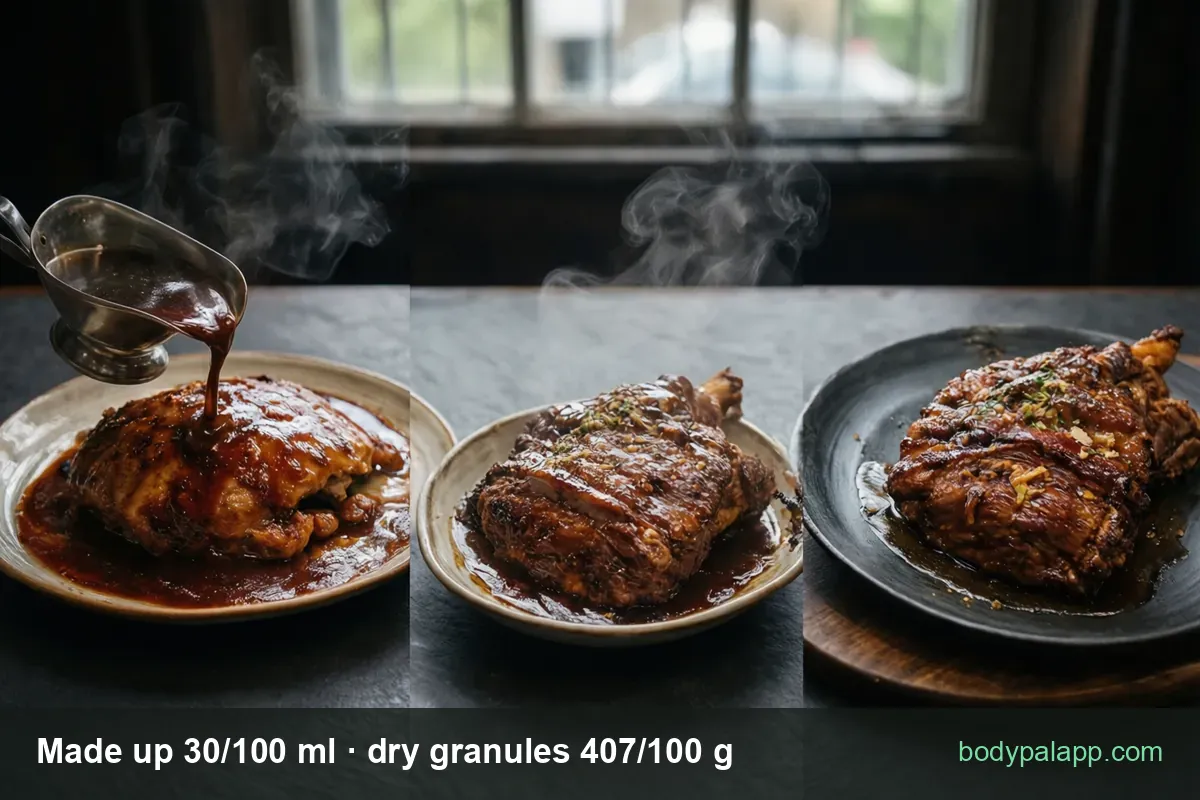
The tub says something alarming like 407 kcal per 100 g. That's the dry granules, and nobody eats gravy granules dry. Diluted to actual gravy, the figure collapses to 30 kcal per 100 ml; the scary label number is a concentrate being honest about itself.
Homemade gravy from the roasting tray is the wild card. Its calories depend almost entirely on how much fat comes along from the tin: skim the juices well and you're close to the granule figure, pour the drippings straight in and it climbs. There's no single number for pan gravy, which is precisely why the granule figure is the useful baseline.
How does gravy compare
| On the plate | Portion | Calories |
|---|---|---|
| Gravy | 70 ml pour | 21 kcal |
| Gravy | 150 ml flooding | 45 kcal |
| Mayonnaise | 1 tbsp | 103 kcal |
| Yorkshire pudding | 1 pudding | 108 kcal |
| Sunday roast | full plate | ~946 kcal |
The verdict: gravy is the cheapest indulgence in British cooking – one tablespoon of mayonnaise costs the same as five pours of gravy. If something has to leave the plate, it should never be the gravy; a single Yorkshire pudding buys back five times more.
The gravy myth
"It's the gravy that makes a roast so heavy." It isn't, and the arithmetic is blunt about it. On a typical Sunday dinner of about 946 kcal, the gravy contributes 21. The roast potatoes contribute 322, and the Yorkshire pudding another 108 – the potato-and-batter corner of the plate carries twenty times what the jug does.
Gravy gets the blame because it's poured last and looks rich. But wetting the plate is not what loaded it. If a roast needs lightening, start with the second scoop of potatoes; the gravy was never the problem.
Most popular gravy brands in the United Kingdom
Ranked by how widely each product appears among foods sold in the United Kingdom, from the BodyPal food database of over 3.3 million products. Calories are the figures printed on each label. Made up with water, a serving lands near 30 kcal per 100 ml whichever tub it starts from.
| Product | Calories (per 100 g of dry granules) |
|---|---|
| Bisto Gravy Granules | 395 kcal |
| Bisto Chicken Gravy Granules | 400 kcal |
Brand popularity: BodyPal food database. Nutrition: manufacturer labels.
Gravy FAQs
How many calories in Bisto gravy?
Granule gravy made up with water comes to about 30 kcal per 100 ml, so a typical 70 ml pour is around 21 kcal. Branded granules vary a little either side of that once diluted; check the tub for the as-prepared figure rather than the per-100 g dry number.
How many calories in gravy granules?
407 kcal per 100 g dry, but that number never reaches your plate as-is. Made up with water, gravy comes to 30 kcal per 100 ml, and a pour uses only a few grams of granules. Judge gravy by the jug, not the tub.
How many calories in gravy made with meat juices?
It varies more than any other version, because the calories ride on the fat left in the roasting tray. Skimmed well, pan gravy sits near the granule figure of 30 kcal per 100 ml; made with unskimmed drippings it can be several times that. Skimming is the whole game.
Is gravy fattening?
No, in any normal quantity. A 70 ml pour is 21 kcal and even a 150 ml flooding is 45, a fraction of a single Yorkshire pudding's 108. On a 946 kcal roast plate, gravy is about 2% of the total. The potatoes are where the plate gets heavy.
How much salt is in gravy?
0.96 g per 100 ml made up, so a typical pour adds about 0.7 g of salt and a generous one 1.4 g, against the NHS maximum of 6 g a day. Salt, not calories, is gravy's real cost; reduced-salt granules exist if roast days keep pushing you over.
How many calories does gravy add to a Sunday dinner?
About 21 kcal for a standard 70 ml pour on a plate that typically totals around 946 kcal, or 45 kcal if you flood it with 150 ml. Skipping gravy saves less than any other change you could make to a roast, so it's the wrong place to economise.
Can I have gravy while losing weight?
Yes, and at 21 kcal a pour it's one of the few sauces that needs no negotiation. Compare mayonnaise at 103 kcal per tablespoon. If you're tracking salt as well as calories, keep to one pour or choose a reduced-salt granule; the energy side takes care of itself.
Gravy or mayonnaise – which is lighter?
Gravy, by a mile. A whole 70 ml pour of gravy is 21 kcal while one tablespoon of mayonnaise is 103 – roughly five pours' worth. Water-based sauces almost always undercut emulsified ones, and gravy is mostly water with seasoning and a little fat.
Similar foods
- Baked beans — 168 kcal per half tin
- Olives — 4 kcal each
- Quinoa — ~111 kcal per 100 g cooked
- Rice — 236 kcal per cooked portion
- Tofu — 102 kcal per 70 g quarter block
- Pasta — 304 kcal per cooked portion
Log the whole plate without the maths
BodyPal logs a gravy-covered roast – every component, calories and salt – from one photo.


Burning it off is one side of it. The other is knowing your number: work out how many calories you need a day, with macros and a goal date.