
Calories in a Yorkshire Pudding (and Why It Is the Wrong Thing to Cut)
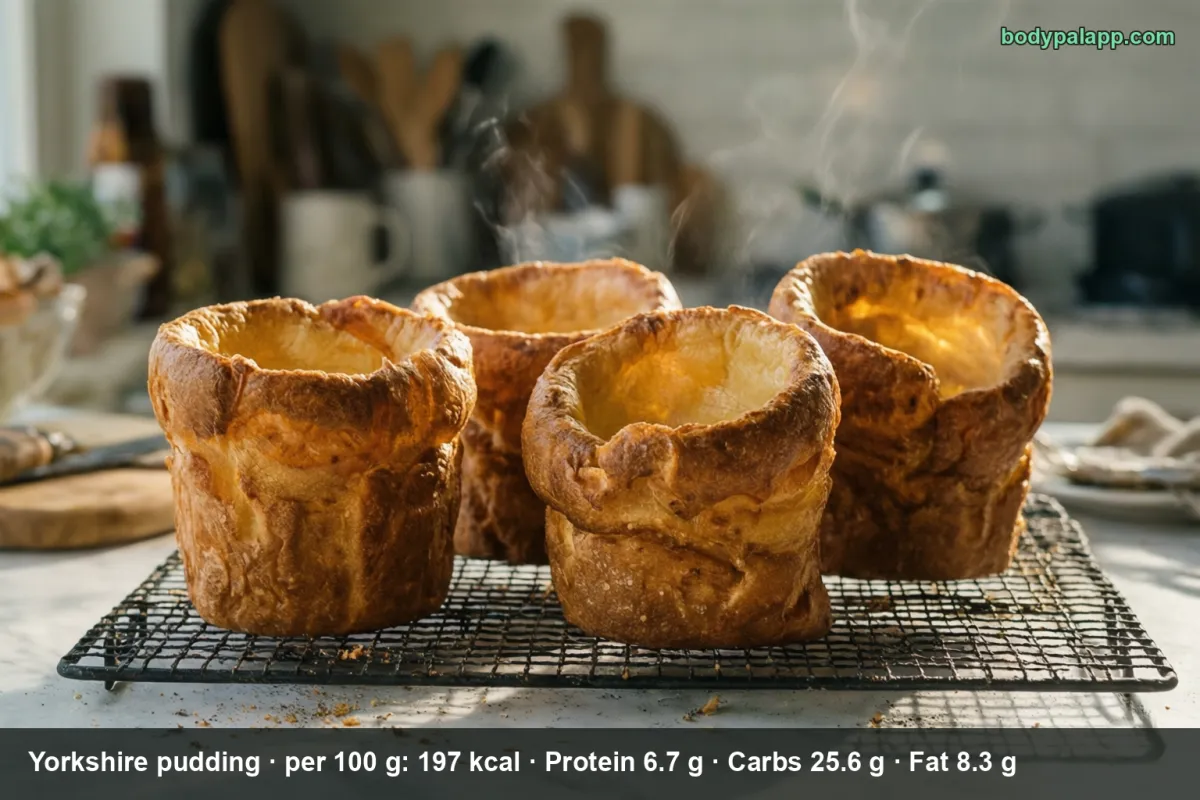
There are 108 calories in a Yorkshire pudding of the size that turns up beside a roast, around 55 g, or 197 kcal per 100 g. A small homemade one is 59. That makes it one of the lightest things on a Sunday plate, which is not remotely how it gets talked about.
On this page
- Yorkshire pudding nutrition at a glance
- Small, standard, giant: what each one costs
- Batter maths: flour, egg, milk and the tin
- The giant filled yorkshire is a different food
- How does it compare on the plate?
- Two things people get wrong
- Most popular Yorkshire pudding brands
- FAQ
- Similar foods
Yorkshire pudding nutrition at a glance
| Nutrient | Per 100 g | Per standard pudding (55 g) | %RI* per pudding |
|---|---|---|---|
| Energy | 197 kcal / 824 kJ | 108 kcal / 452 kJ | 5% |
| Protein | 6.7 g | 3.7 g | 7% |
| Carbohydrate | 25.6 g | 14.1 g | 5% |
| of which sugars | 3.5 g | 1.9 g | 2% |
| Fat | 8.3 g | 4.6 g | 7% |
| Fibre | 1.1 g | 0.6 g | 2%† |
| Salt | 0.13 g | 0.07 g | 1% |
*%RI = share of the reference intake for an average adult (2,000 kcal; 70 g fat, 260 g carbohydrate, 90 g sugars, 50 g protein, 6 g salt). †No UK reference intake exists for fibre, so this is measured against the 30 g a day the NHS suggests.
Verified nutrition data
Numbers on this page come from CoFID, the UK government’s Composition of Foods Integrated Dataset, and from manufacturer labels where a branded product is named. Last verified August 2026. How we verify our data →
The line worth staring at is the salt: 0.07 g. That is about a fifth of what sits in a single slice of white bread, and it barely registers against the 6 g a day the NHS advises adults to stay under.
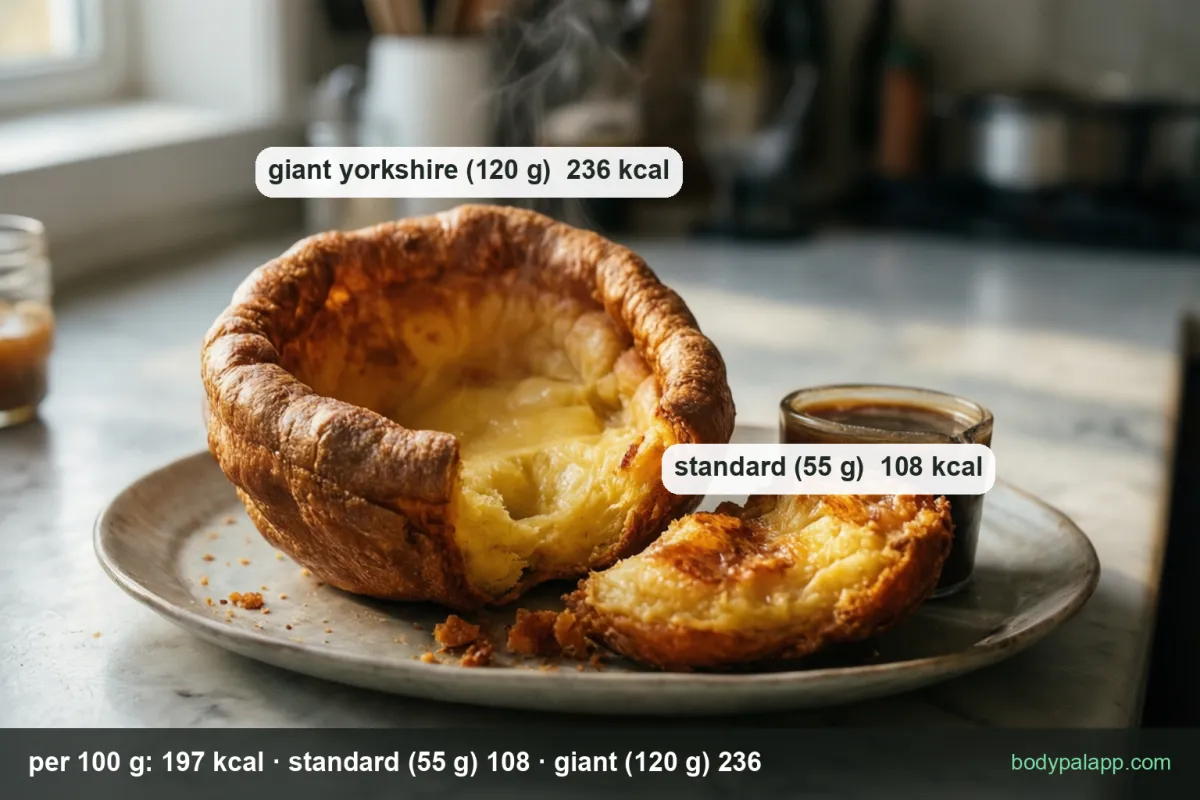
The gap between the smallest and the largest is wider than most people would guess.
Small, standard, giant: what each one costs
| Portion | Calories |
|---|---|
| Small homemade (30 g) | 59 kcal |
| Standard roast-dinner size (55 g) | 108 kcal |
| Two standard puddings | 216 kcal |
| Giant pub yorkshire (120 g) | 236 kcal |
Frozen supermarket puddings sit at the small end of that range rather than the standard one, so if you are logging a box of four from the freezer aisle, check the weight printed on the pack before you assume 108. The batter is the same food either way; only the tin has changed size.
Batter maths: flour, egg, milk and the tin
Yorkshire pudding batter is three ingredients. Flour brings the 25.6 g of carbohydrate per 100 g, egg and milk bring most of the 6.7 g of protein, and nothing in the recipe contains sugar, which is why the 3.5 g of sugars reads low and arrives with the milk rather than a bag.
Then there is fat, at 8.3 g per 100 g. That number is the one that moves. A slice of white bread carries 2.1 g per 100 g, so the difference is not the flour, it is the fat the batter is poured into. Dripping, goose fat and a generous glug of oil all end up inside the pudding, and a tin run hot with a teaspoon of oil produces a lighter pudding than one swimming in it.
Worth knowing when you compare labels: the figures here are for batter made with semi-skimmed milk. Whole milk pushes the fat up, skimmed pulls it down, and neither shift is anywhere near the size of the one the tin makes.
The giant filled yorkshire is a different food
The giant yorkshire sold as a bowl is 236 kcal at 120 g, and that is before anything goes in it. Filled with beef, potatoes, veg and gravy it stops being a side and becomes the plate, so logging it as "a Yorkshire pudding" is the single easiest way to lose several hundred calories from a day's total.
Treat the shell as a container with a price tag on it. Two standard puddings cost less than one giant, and the giant has not fed you yet.
How does it compare on the plate?
| Food | Per 100 g | Typical UK portion | Per portion |
|---|---|---|---|
| Yorkshire pudding | 197 kcal | 1 standard, 55 g | 108 kcal |
| Roast potatoes | 161 kcal | — | — |
| Crumpet | 207 kcal | 1 crumpet, 46 g | 95 kcal |
| White bread | 236 kcal | 1 medium slice, 36 g | 85 kcal |
Gram for gram the pudding sits below a crumpet and well below white bread, so it is not a calorie-dense food by any normal standard. Roast potatoes look cheaper at 161 per 100 g, and then people eat four of them.
The verdict: if you are cutting calories off a roast dinner, the yorkshire is the wrong target. Leave the 108-calorie pudding alone and take one roast potato off the plate instead, because portion size is doing far more work here than the per-100-g figures suggest.
Two things people get wrong
"Yorkshire puddings are fattening." At 108 kcal, a standard one is roughly 5% of a 2,000-calorie day, and it is almost always the smallest item on the plate it arrives with. What surrounds it, especially the gravy and the roast potatoes, decides the total.
"It is a pudding, so it must be sugary." There are 1.9 g of sugars in a standard one, against 14.1 g of carbohydrate. The name is old English usage for anything cooked in batter; the recipe has no sugar in it at all.
Most popular Yorkshire pudding brands in the United Kingdom
Ranked by how widely each product appears among foods sold in the United Kingdom, from the BodyPal food database of over 3.3 million products. Calories are the figures printed on each label.
| Product | Calories (per 100 g) |
|---|---|
| Aunt Bessie's Yorkshire Puddings | 248 kcal |
| Aunt Bessie's Bake At Home Yorkshires | 175 kcal |
| Asda Smart Price Yorkshire Puddings | 221 kcal |
Brand popularity: BodyPal food database. Nutrition: manufacturer labels.
How long does it take to burn off a Yorkshire pudding?
A standard roast-dinner pudding, 55 g is 108 kcal. Enter your weight and the amount you ate to see how long it takes you to burn that off:
lb
| Activity | Time to burn 108 kcal |
|---|---|
| Walking, brisk | 22 min |
| Cycling, moderate | 14 min |
| Swimming, moderate | 15 min |
| Jogging | 13 min |
| Weight training, moderate | 24 min |
Times are for a 154 lb (11 st) adult at a steady pace; change the weight to see yours. The amount is set to the portion in the text (55 g); change it to what you actually ate. BodyPal works this out from your steps automatically.
This table assumes you know your daily total. If you do not, the daily calorie calculator works it out from five numbers.
Frequently asked questions
How many calories are in a Yorkshire pudding?
A standard roast-dinner Yorkshire pudding of about 55 g is 108 kcal, from 197 kcal per 100 g. A small homemade one at 30 g is 59 kcal. Each standard pudding also brings 3.7 g of protein, 14.1 g of carbohydrate and 4.6 g of fat.
How many calories are in an Aunt Bessie's Yorkshire pudding?
Check the pack, because branded frozen puddings are usually smaller than the ones that come out of a home tin. A 30 g frozen pudding lands near 59 kcal at the standard 197 kcal per 100 g, but the printed weight per pudding varies between boxes and is the number that decides it.
How many calories are in a giant Yorkshire pudding?
A giant pub-sized yorkshire of around 120 g is 236 kcal empty. That is more than two standard puddings, and it is the figure before any beef, potatoes, veg or gravy goes inside. Filled, it is a main course rather than a side and should be logged as one.
Are Yorkshire puddings fattening?
One standard pudding is 108 kcal, about 5% of a 2,000-calorie day, so it only adds weight the way any food does, by pushing your daily total past what you use. On a roast dinner it is usually the lightest item present, well under what the potatoes contribute.
Yorkshire pudding vs roast potato: which has fewer calories?
Roast potatoes are lighter per 100 g at 161 kcal against 197 for the pudding, but portion size flips the answer on a real plate. One 55 g pudding is 108 kcal, and a helping of roast potatoes is rarely 55 g. Drop a potato before you drop the yorkshire.
How many calories are in toad in the hole?
It depends almost entirely on the sausages, not the batter. Sausages run about 294 kcal per 100 g against 197 for Yorkshire pudding batter, so the meat is roughly half again as dense as the thing it sits in. Weigh the sausages and the batter separately for an accurate figure.
How many calories are in 2 Yorkshire puddings?
Two standard 55 g puddings are 216 kcal. Two small homemade ones at 30 g each come to 118 kcal. Both still cost less than a single giant pub yorkshire, which is 236 kcal on its own before anything is poured into it.
Are Yorkshire puddings high in fat?
There are 8.3 g of fat per 100 g, or 4.6 g in a standard pudding, which is 7% of an adult's reference intake. Most of that comes from the fat in the tin rather than the batter itself, so how heavily you oil the tray changes the number more than the milk you use does.
Similar foods
- Pork chop — 233 kcal grilled lean
- Mac and cheese — 183 kcal per 100 g
- Chips — 535 kcal a small chippy portion
- Lasagne — ~630 kcal per portion
- Samosa — 152 kcal each
- Steak — 398 kcal per 8 oz lean rump
Count it without the maths
BodyPal logs the pudding, the potatoes and the gravy from one photo of the plate, so the parts that actually move the number do not get guessed.

