
Calories in Lasagna: the Portion Is the Number
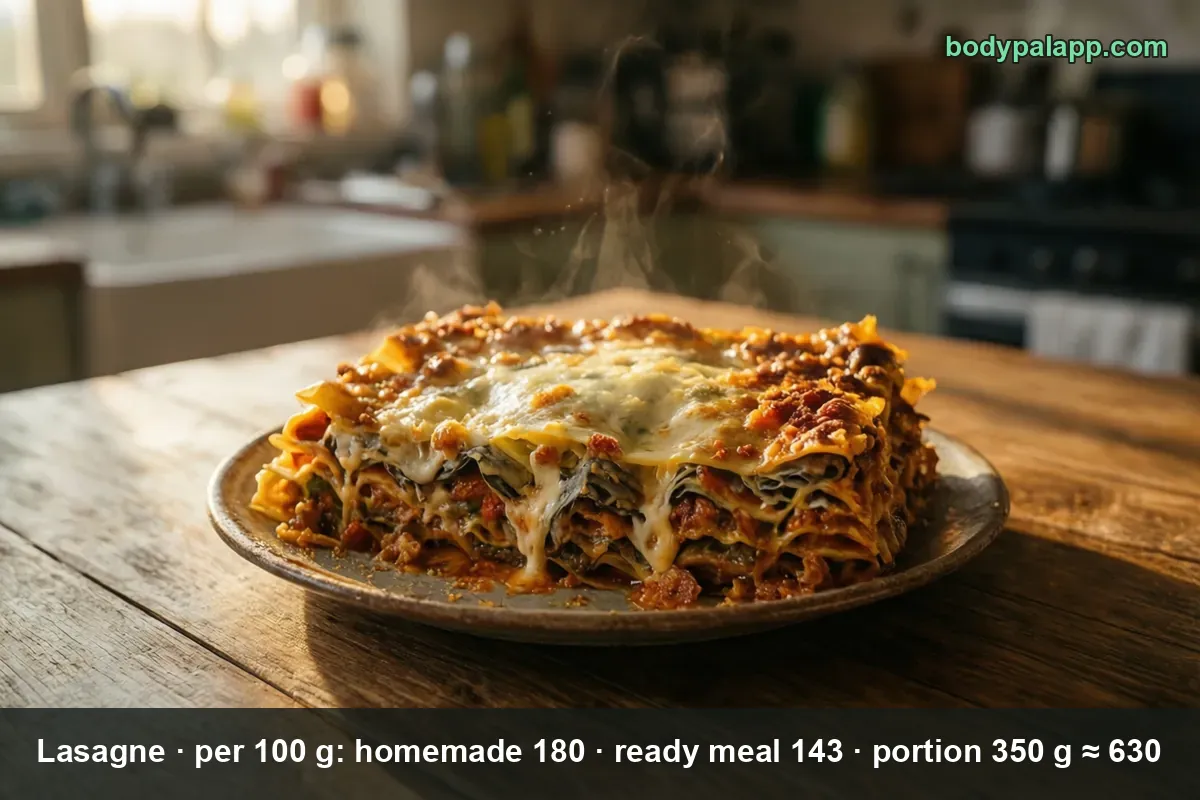
The calories in lasagna look modest on paper, at 180 kcal per 100 g homemade, until you weigh the serving. A real portion runs 350 to 400 g, which puts the plate at roughly 630 kcal, and a 400 g ready meal at 572. The 100 g figure flatters; the ladle decides.
On this page
- Lasagna nutrition at a glance
- The four lasagnes on the UK table
- Portions: where the calories actually land
- Ready meal or homemade?
- How does lasagna compare?
- Most popular lasagne brands
- FAQ
Lasagna nutrition at a glance
| Nutrient | Per 100 g | Per portion (~350 g) | %RI* per portion |
|---|---|---|---|
| Energy | 180 kcal / 753 kJ | 630 kcal / 2,636 kJ | 32% |
| Protein | 9.6 g | 33.6 g | 67% |
| Carbohydrate | 15.2 g | 53.2 g | 20% |
| of which sugars | 2.8 g | 9.8 g | 11% |
| Fat | 9.6 g | 33.6 g | 48% |
| of which saturates | 4.2 g | 14.7 g | 74% |
| Fibre | 1.0 g | 3.5 g | – |
| Salt | 0.59 g | 2.07 g | 35% |
*%RI = percentage of the reference intake for an average adult (2,000 kcal; 70 g fat, 20 g saturates, 260 g carbohydrate, 90 g sugars, 50 g protein, 6 g salt).
Verified nutrition data
Numbers on this page come from CoFID, the UK government’s Composition of Foods Integrated Dataset, and from manufacturer labels where a branded product is named. Last verified August 2026. How we verify our data →
The row is CoFID's homemade lasagne with minced beef. Read the portion column, because that is the one you eat: a third of a day's energy, two thirds of the protein reference intake, and three quarters of the saturates, mostly from the cheese sauce and the beef.
The sugars line stays honest at 9.8 g per plate, and almost all of it is the tomatoes and milk rather than anything added. Lasagne is not a sweet problem. It is a density-times-portion problem.
The four lasagnes on the UK table
| Version | Per 100 g | Protein per 100 g |
|---|---|---|
| Homemade, minced beef | 180 kcal | 9.6 g |
| Homemade, extra-lean beef | 160 kcal | 10.1 g |
| Ready meal, reheated | 143 kcal | 7.4 g |
| Vegetable, retail | 117 kcal | 4.8 g |
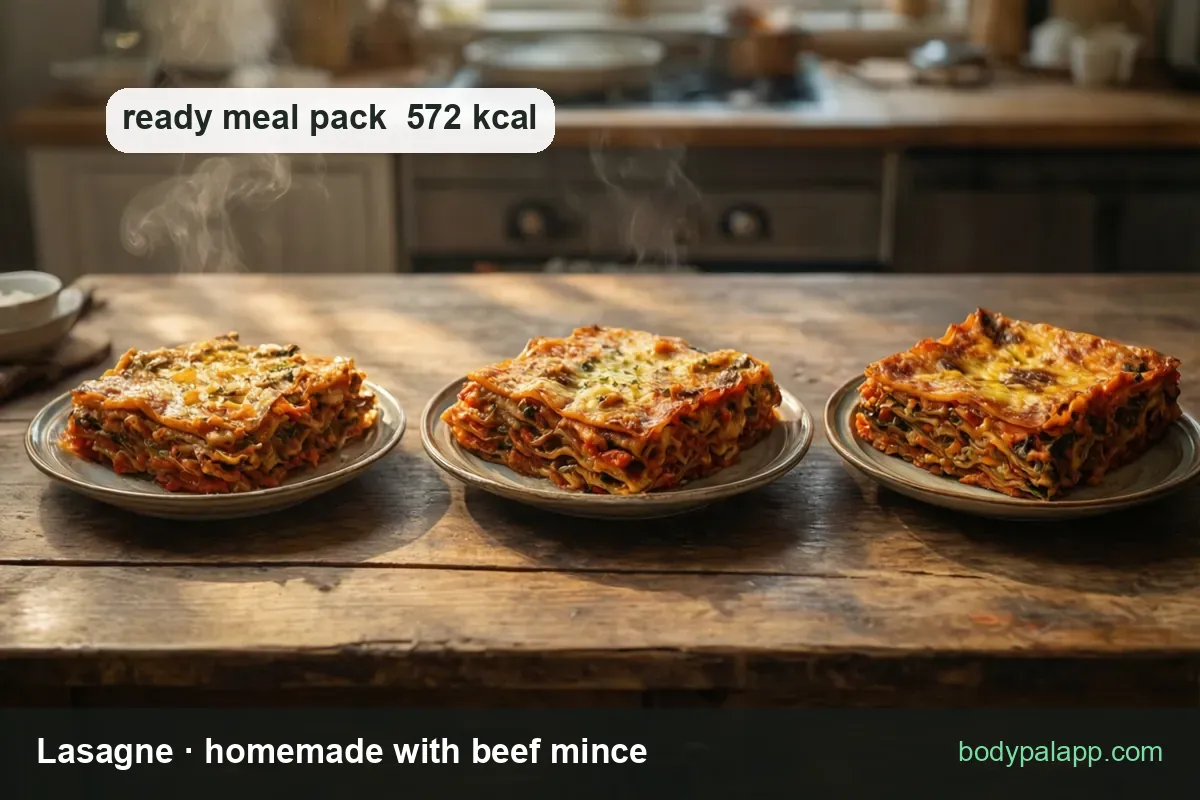
Swapping standard mince for extra-lean saves 20 kcal per 100 g, which compounds to about 70 kcal on a full portion, and the protein actually rises. It is the rare swap that costs nothing but the price difference.
The vegetable version at 117 kcal per 100 g is the lightest of the family, though not because vegetables are magic: it simply carries less protein, 4.8 g against 9.6. If the lasagne is your protein for the evening, the veggie tray needs help from a side.
Portions: where the calories actually land
| Serving | Weight | Calories |
|---|---|---|
| Modest square, homemade | ~250 g | 450 kcal |
| Typical portion, homemade | ~350 g | 630 kcal |
| Generous second-helping night | ~450 g | 810 kcal |
| Individual ready meal pack | 400 g | 572 kcal |
Nobody weighs lasagne at the table, which is exactly why the estimates drift. The difference between a modest square and a generous one is 360 kcal, the size of a separate meal, and it looks identical on the plate once the cheese browns over it.
Garlic bread is the quiet partner here. The lasagne's own carbohydrate is moderate at 53 g a portion, and the loaf beside it is where an Italian night usually doubles, the same way cheese on toast turns bread into a meal.
Ready meal or homemade?
Per 100 g the ready meal wins at 143 kcal against homemade's 180, and the whole 400 g pack comes to 572 kcal, less than a typical homemade plate. More sauce, less meat: its protein is 7.4 g per 100 g against 9.6 homemade, which is how the density falls.
Salt is the counterweight. The ready meal carries 0.53 g per 100 g, so the pack delivers 2.1 g, over a third of the NHS daily guide of 6 g, and homemade lands in the same territory at 0.59 per 100 g only if you salt the sauce with a similar hand. If you are watching salt, the win comes from your own pan, not the chiller aisle.
How does lasagna compare?
| Food | Per 100 g | Protein per 100 g |
|---|---|---|
| Burger, homemade in bun | 283 kcal | 21.9 g |
| Lasagne, homemade | 180 kcal | 9.6 g |
| Lasagne, ready meal | 143 kcal | 7.4 g |
| Chicken breast, grilled | 147 kcal | 29.8 g |
The verdict: among comfort dinners lasagne is the moderate one, at well under a burger's density, and its portion is the only thing that makes it a heavyweight. For protein per calorie nothing on this table touches plain chicken breast; for a one-dish dinner that feeds four from one tray, lasagne earns its place, extra-lean mince first.
Most popular lasagne brands in the United Kingdom
Ranked by how widely each product appears among foods sold in the United Kingdom, from the BodyPal food database of over 3.3 million products. Calories are the figures printed on each label.
| Product | Calories (per 100 g) |
|---|---|
| Chef Select Lasagne Bolognese (Lidl) | 141 kcal |
| Quorn Lasagne | 114 kcal |
| Giovanni Rana Lasagne alla Bolognese | 170 kcal |
Brand popularity: BodyPal food database. Nutrition: manufacturer labels.
How long does it take to burn off lasagna?
A typical 350 g homemade portion is 630 kcal. Enter your weight and the amount you ate to see how long it takes you to burn that off:
lb
| Activity | Time to burn 630 kcal |
|---|---|
| Walking, brisk | 2 hr 6 min |
| Cycling, moderate | 1 hr 19 min |
| Swimming, moderate | 1 hr 30 min |
| Jogging | 1 hr 14 min |
| Weight training, moderate | 2 hr 20 min |
Times are for a 154 lb (11 st) adult at a steady pace; change the weight to see yours. The amount is set to the portion in the text (350 g); change it to what you actually ate. BodyPal works this out from your steps automatically.
This table assumes you know your daily total. If you do not, the daily calorie calculator works it out from five numbers.
Frequently asked questions
How many calories are in a portion of lasagna?
A typical homemade portion of about 350 g is 630 kcal, at 180 kcal per 100 g. A modest 250 g square is 450 kcal and a generous helping can reach 810. The spread between servings is bigger than the spread between recipes, so the ladle matters more than the cookbook.
How many calories are in a lasagne ready meal?
A standard 400 g individual ready meal is 572 kcal, measured at 143 kcal per 100 g reheated. That is lighter than most homemade plates, mainly because it carries less meat, with 7.4 g of protein per 100 g against 9.6 in homemade.
How many calories are in vegetable lasagne?
Retail vegetable lasagne is 117 kcal per 100 g, so a 400 g serving is about 468 kcal. It is the lightest version of the dish, but also the lowest in protein at 4.8 g per 100 g, roughly half the beef version, so it holds you for less time.
Does extra-lean mince make lasagne much lighter?
It saves 20 kcal per 100 g, taking homemade lasagne from 180 to 160, which is about 70 kcal on a full portion. Protein rises slightly at the same time, from 9.6 to 10.1 g per 100 g. As swaps go it is invisible in the finished dish.
Is lasagne high in salt?
A full portion carries around 2.1 g of salt, over a third of the 6 g daily guide the NHS suggests, whether it is a 400 g ready meal at 0.53 g per 100 g or a similarly seasoned homemade tray at 0.59. The cheese sauce and the seasoning are the main carriers.
Is lasagne good for weight loss?
At 630 kcal a homemade portion fits a normal day if the garlic bread stays modest, and its 33 g of protein is genuinely filling. If you want the number lower, extra-lean mince and a 250 g square bring the plate to 400-450 kcal without changing the recipe.
Why does lasagne look low-calorie per 100 g?
Because it is a wet dish: pasta sheets, sauce and béchamel hold a lot of water, which dilutes the density to 143-180 kcal per 100 g. The portion compensates, since 350-400 g is a normal serving. Dry-looking foods read scarier per 100 g and lighter on the plate; lasagne is the reverse.
How much protein is in lasagna?
Homemade beef lasagne delivers 9.6 g of protein per 100 g, which is 33.6 g in a 350 g portion, two thirds of an adult's 50 g reference intake. Ready meals run leaner at 7.4 g per 100 g, and vegetable versions at 4.8 g.
Similar foods
- Mac and cheese — 183 kcal per 100 g
- Steak — 398 kcal per 8 oz lean rump
- Chicken kebab — 166 kcal per 100 g shish
- Pork chop — 233 kcal grilled lean
- Ham sandwich — 277 kcal whole
- Yorkshire pudding — 108 kcal each
Count it without the maths
BodyPal estimates the square on your plate from one photo, so the difference between a 250 g and a 450 g helping stops being a guess.

