
Cheese on Toast Calories: 336 for Two Slices
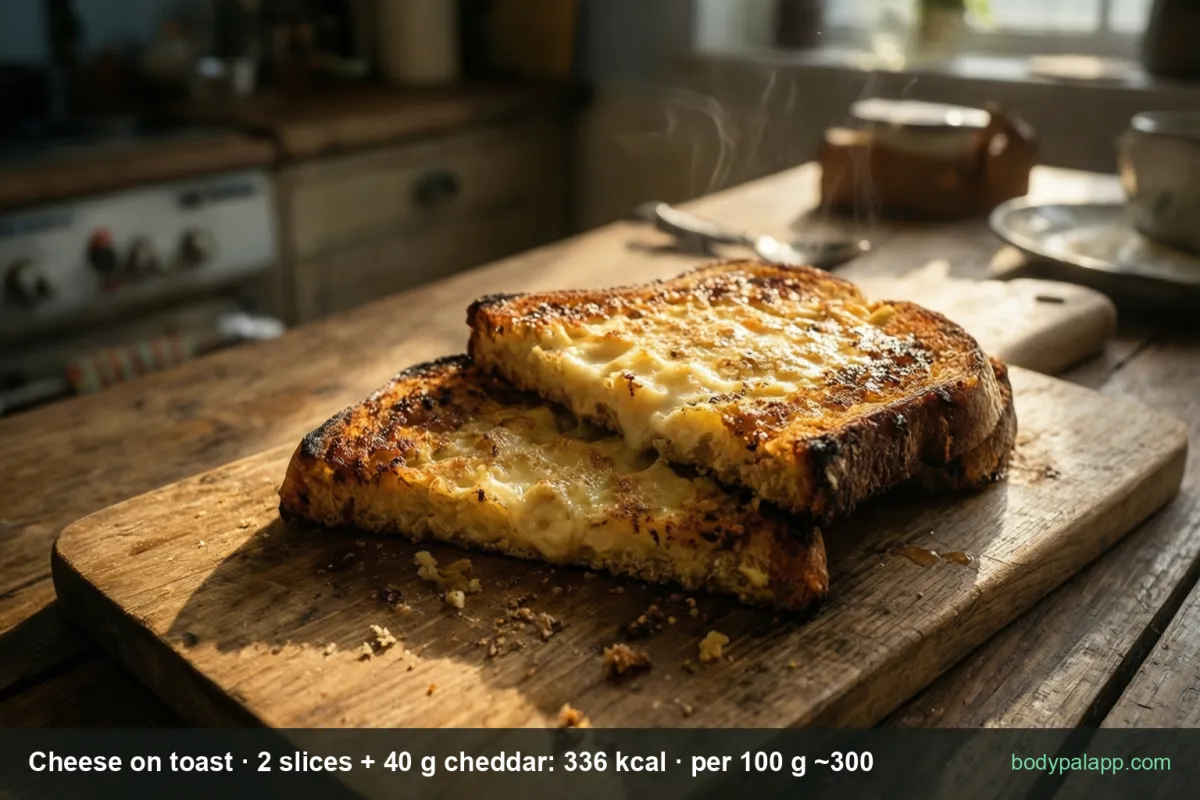
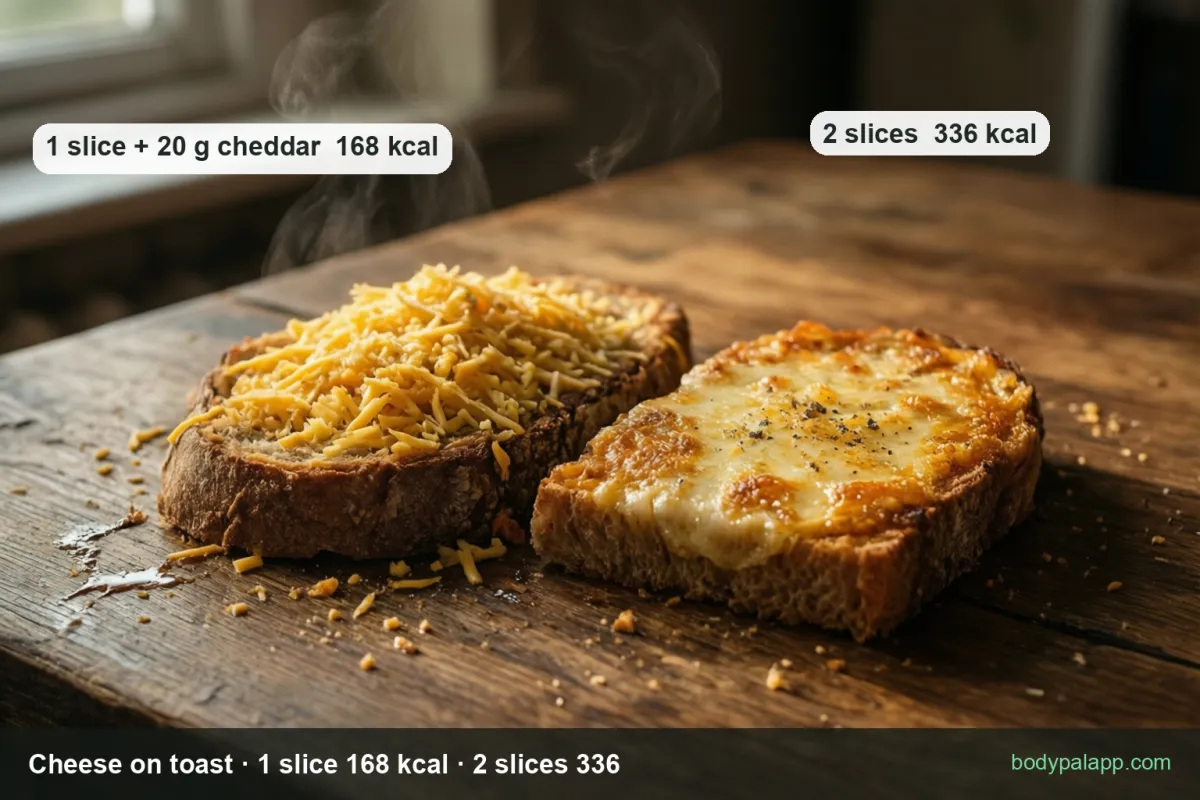
Two slices of cheese on toast come to 336 kcal, or 300 kcal per 100 g of the finished plate. That splits into 170 kcal of bread and 166 kcal of cheddar. One slice on its own is 168 kcal. Cheese on toast calories rise with the cheese, not with the bread.
On this page
- Quick facts
- UK portions
- With butter under the cheese
- With half-fat cheddar
- With Worcestershire sauce
- How much salt is in it?
- How does it compare?
- Does toasting change the calories?
- Most popular cheddar brands
- FAQ
- Similar foods
Quick facts
| Nutrient | Per 2 slices (112 g) | Per 100 g | %RI* |
|---|---|---|---|
| Energy | 1,406 kJ / 336 kcal | 1,255 kJ / 300 kcal | 17% |
| Fat | 15.1 g | 13.5 g | 22% |
| Carbohydrate | 34.7 g | 31 g | 13% |
| of which sugars | 2.2 g | 2.0 g | 2% |
| Fibre | 2.1 g | 1.9 g | — |
| Protein | 18.5 g | 16.5 g | 37% |
| Salt | 1.0 g | 1.0 g | 17% |
*Reference intake for an average adult, 2,000 kcal a day. Fibre carries no RI figure on UK labels.
Verified nutrition data
Numbers on this page come from CoFID, the UK government’s Composition of Foods Integrated Dataset, and from manufacturer labels where a branded product is named. Last verified August 2026. How we verify our data →
The protein number is the one people miss. A two-slice plate lands 18.5 g, which is 37% of the daily reference intake and more than most cereal breakfasts manage. That comes almost entirely from the 40 g of cheddar.
UK portions
Three portions cover almost every plate made in a British kitchen. Each assumes a 36 g slice of white bread and 20 g of cheddar per slice, grilled.
| Portion | Weight | Calories |
|---|---|---|
| 1 slice cheese on toast | ~56 g | 168 kcal |
| 2 slices (standard plate) | ~112 g | 336 kcal |
| 2 slices with 10 g butter | ~122 g | 410 kcal |
A two-slice plate sits in the same bracket as a filled sandwich, which makes it a reasonable lunch rather than a snack. One slice, at 168 kcal, is the version that works alongside soup. Add a tomato or a handful of salad and the plate starts to look like the Eatwell Guide intends, since bread and cheese on their own cover only two of its groups.
Weigh the cheese once and you will never need to weigh it again. Most people grate somewhere between 20 g and 40 g per slice without noticing the difference on the plate, and that gap alone is worth 83 kcal.
With butter under the cheese
Buttering the toast first adds 74 kcal for 10 g, taking the standard plate from 336 kcal to 410 kcal. That is a 22% increase for a layer nobody tastes once the cheddar has melted over it.
If you want the butter, take it out of the cheese instead: drop to 20 g of cheddar per slice and butter both slices, and you are back near the original total.
With half-fat cheddar
Half-fat cheddar runs at 273 kcal per 100 g against 416 kcal for full-fat English cheddar. Swap it into the standard plate and the total falls to about 279 kcal, a saving of 57 kcal.
It melts less willingly and browns differently under the grill. For a weekday plate that is a fair trade; for the version you actually look forward to, it usually is not.
With Worcestershire sauce
A dash of Worcestershire sauce adds roughly 2 kcal, which rounds away to nothing on a 336 kcal plate. Mustard, black pepper and a splash of vinegar behave the same way.
This is the cheapest thing you can do to the dish. Flavour that costs no calories is worth more than a low-fat cheese that costs you the enjoyment.
How much salt is in it?
A standard plate carries about 1 g of salt. The cheddar brings 0.72 g of that, from 1.8 g per 100 g, and the two slices of bread account for roughly 0.29 g.
That is a sixth of the 6 g daily maximum the NHS advises for adults. Not alarming for one meal, but worth knowing if the rest of the day includes bacon, soup or anything tinned. Cheese and bread are two of the biggest salt contributors in the British diet, and this dish is both of them at once.
Fibre is the weak spot, at 2.1 g against the 30 g a day the NHS suggests. Wholemeal bread instead of white is the fix, and it changes the calorie total very little.
How does it compare?
| Food | Typical UK portion | Calories per portion | Calories per 100 g | Protein |
|---|---|---|---|---|
| Cheese on toast | 2 slices, 112 g | 336 kcal | 300 kcal | 18.5 g |
| Beans on toast | 2 slices | 338 kcal | 121 kcal | 8.1 g |
| Bacon sandwich | 1 sandwich | 314 kcal | — | — |
| Crumpet | 1 crumpet | 95 kcal | 207 kcal | 3.2 g |
Cheese on toast and beans on toast finish two calories apart, so the choice comes down to what else you want from the meal: beans for fibre, cheddar for protein and staying power. If you are cutting calories and still want something on toast, a crumpet at 95 kcal gives you the format for a third of the cost.
Does toasting change the calories?
Toasting a slice of bread does not burn off calories. It drives off water, so the slice gets lighter, which means toast reads slightly higher per 100 g than the same bread untoasted. The slice in your hand still carries the 85 kcal it started with.
The same logic catches people out with grilled cheese. Fat that drips onto the grill pan is genuinely gone, but the amount is small and unpredictable, so it is not worth counting on.
Most popular cheddar brands in the United Kingdom
Ranked by how widely each product appears among foods sold in the United Kingdom, from the BodyPal food database of over 3.3 million products. Calories are the figures printed on each label. At 40 g on two slices, the difference between these is under 10 kcal a plate.
| Product | Calories (per 100 g) |
|---|---|
| Kerrygold Cheddar | 392 kcal |
| Cathedral City Cheddar | 416 kcal |
| Castello Cheddar | 416 kcal |
Brand popularity: BodyPal food database. Nutrition: manufacturer labels.
FAQ
How many calories are in cheese on toast?
A standard plate of two slices is 336 kcal, made up of 170 kcal of bread and 166 kcal of cheddar. Per 100 g of the finished dish that works out at 300 kcal. A single slice comes to 168 kcal, and adding 10 g of butter pushes the two-slice plate to 410 kcal.
How many calories in 2 slices of cheese on toast?
Two slices are 336 kcal, based on 36 g slices of white bread and 20 g of grated cheddar on each. That plate also gives you 18.5 g protein, 34.7 g carbohydrate and 15.1 g fat. If you grate 40 g of cheddar per slice rather than 20 g, the total climbs to roughly 500 kcal.
How much protein is in cheese on toast?
A two-slice plate has 18.5 g of protein, which is 37% of the daily reference intake and 16.5 g per 100 g. Nearly all of it comes from the cheddar, at 25.4 g protein per 100 g of cheese. That protein figure is why the dish holds off hunger better than toast with jam or honey.
Is cheese on toast healthy?
It is a reasonable 336 kcal meal with 18.5 g protein, held back by 1 g of salt and only 2.1 g of fibre. Swapping white bread for wholemeal raises the fibre without moving the calories much. Treat it as lunch rather than a snack and the numbers behave.
How much salt is in cheese on toast?
About 1 g per plate, roughly a sixth of the 6 g daily maximum the NHS advises. The cheddar supplies 0.72 g of it and the bread the remaining 0.29 g. Reducing the cheese from 40 g to 30 g across the plate takes the salt down towards 0.8 g.
Cheese on toast or beans on toast: which has fewer calories?
They are almost identical, at 336 kcal for cheese on toast and 338 kcal for beans on toast. The difference is in the make-up rather than the total: cheese gives you more protein and fat, beans give you more fibre. Neither is the obvious pick on calories alone.
How many calories in cheese on toast with butter?
410 kcal for two slices with 10 g of butter spread underneath the cheese. The butter alone is 74 kcal, a 22% increase on the 336 kcal plate. Since the butter disappears under melted cheddar, it is the easiest 74 kcal on the plate to skip.
Does half-fat cheddar make much difference?
It takes the plate from 336 kcal to about 279 kcal, a saving of 57 kcal. Half-fat cheddar is 273 kcal per 100 g compared with 416 kcal for full-fat English cheddar. The trade-off is texture, as it browns and melts less readily under the grill.
Is cheese on toast good for weight loss?
One slice at 168 kcal fits most calorie targets comfortably; two slices at 336 kcal work as a full lunch rather than a snack. The 18.5 g of protein in the two-slice plate is what makes it hold you until the evening. Butter and generous grating are what push it out of range.
Does toasting bread add calories?
No. A 36 g slice of white bread is 85 kcal before and after it goes in the toaster. Toasting removes water, so the slice weighs less and its calories per 100 g read higher, but nothing is added or removed in energy terms.
Similar foods
- Cheese and onion pasty — 436 kcal a Greggs bake
- Fries — 331 kcal per medium portion
- Burger — 288 kcal per 100 g
- Bacon sandwich — 314 kcal, 388 with butter
- Greggs Chicken Bake — 420 kcal per bake
- Pizza — 340 kcal per slice
Count it without the maths
BodyPal logs cheese on toast, the butter under it and the extra handful of cheddar from one photo, so the plate you actually made is the one that gets counted.


How long does it take to burn off 336 kcal of cheese on toast?
2 slices is 336 kcal. Enter your weight to see how long it takes you to burn that off:
lb
| Activity | Time to burn 336 kcal |
|---|---|
| Walking, brisk | 1 hr 7 min |
| Cycling, moderate | 42 min |
| Swimming, moderate | 48 min |
| Jogging | 40 min |
| Weight training, moderate | 1 hr 15 min |
Times are for a 154 lb (11 st) adult at a steady pace; change the weight to see yours. BodyPal works this out from your steps automatically.
One food is easy to picture; a whole day is harder. See how many calories you need a day and what a deficit actually looks like.