
Calories in a Cheese and Onion Pasty: Bake and Pasty Are Not the Same Thing
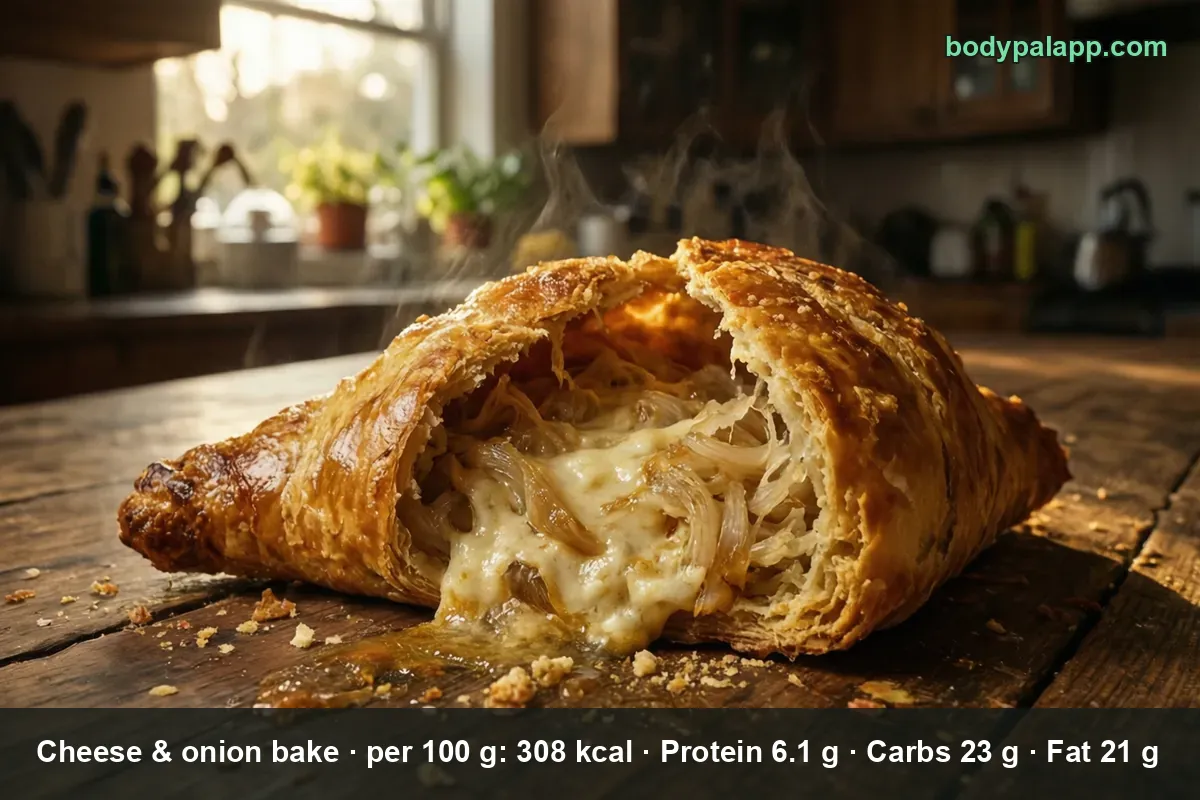
A Greggs Cheese & Onion Bake is 436 calories, or 308 per 100 g. A cheese and onion pasty of the usual 180 g shelf size works out nearer 542. Both figures get searched under the same words, and they describe different products, because Greggs does not sell a cheese and onion pasty. It sells a bake.
On this page
- Quick facts for the Greggs bake
- A bake is not a pasty
- What an actual pasty costs
- The pastry decides it, not the filling
- The rest of the Greggs counter
- Salt varies more than calories
- Most popular pasty brands in the United Kingdom
- Pasty and bake FAQs
Quick facts for the Greggs bake
Figures below are from the manufacturer's own published table, August 2026, for one Cheese & Onion Bake weighing 141.4 g.
| Nutrient | Per bake (141.4 g) | Per 100 g | RI%* |
|---|---|---|---|
| Energy | 436 kcal / 1,814 kJ | 308 kcal / 1,283 kJ | 22% |
| Protein | 8.6 g | 6.1 g | 17% |
| Carbohydrates | 33 g | 23 g | 13% |
| – of which sugars | 1.4 g | 1.0 g | 2% |
| Fat | 30 g | 21 g | 43% |
| – of which saturates | 16 g | 11 g | 80% |
| Fibre | 2.0 g | 1.4 g | – |
| Salt | 1.6 g | 1.1 g | 27% |
*Share of an average adult's daily reference intake at 2,000 kcal, for one whole bake.
Verified nutrition data
Numbers on this page come from CoFID, the UK government’s Composition of Foods Integrated Dataset, and from manufacturer labels where a branded product is named. Last verified September 2026. How we verify our data →
Eighty per cent. One bake spends four fifths of the day's saturated fat, which is the highest single figure on this page and the one that ought to shape how often you buy one. The calorie total of 436 is unremarkable for a hot lunch. The 16 g of saturates is not, and it comes from pastry and cheese together rather than from either alone.
A bake is not a pasty
This distinction is not pedantry, it is arithmetic. A bake is a puff pastry parcel, layered and laminated with fat, sealed on the top and bottom. A pasty is shortcrust, crimped along one edge, and it is usually heavier because it is built to be carried and eaten cold.
Search "cheese and onion pasty Greggs" and you will get results that quietly answer a different question. There is no cheese and onion pasty on that counter. The product people mean is the Cheese & Onion Bake at 436 calories, and if you have logged 436 for a pasty you bought from a supermarket chiller, you have almost certainly undercounted.
The two products also differ in shape of nutrition, not only in size. Per 100 g the bake is 308 calories with 11 g of saturates. A retail Cornish pasty is 278 calories with 8.53 g. The bake is denser in energy and denser again in saturated fat, and the pasty makes up the difference by simply being bigger.
Log the one you actually ate. It is the single most common mistake on this food.
What an actual pasty costs
There is no separate published composition line for a cheese and onion pasty specifically, so the closest measured reference is a homemade vegetable pasty, with retail Cornish figures alongside for the shelf-bought equivalent.
| Per 100 g | Calories | Protein | Fat | Saturates | Fibre | Salt |
|---|---|---|---|---|---|---|
| Vegetable pasty, homemade | 301 kcal | 4.2 g | 19.1 g | 7.08 g | 2.8 g | 0.345 g |
| Vegetable pasty, wholemeal, homemade | 272 kcal | 4.9 g | 15.2 g | 9.20 g | – | 0.328 g |
| Cornish pasty, retail | 278 kcal | 7.0 g | 17.8 g | 8.53 g | 2.9 g | 1.175 g |
| Cornish pasty, homemade | 287 kcal | 6.7 g | 19.2 g | 7.07 g | 2.5 g | 0.328 g |
| Cornish pasty, one branded shelf product | 262 kcal | 6.5 g | 15.3 g | 7.2 g | 2.5 g | 2.3 g |
| Greggs Cheese & Onion Bake | 308 kcal | 6.1 g | 21 g | 11 g | 1.4 g | 1.1 g |
Now put those on a real pasty. The standard single-serve pasty on a British shelf is 180 g, which is the serving size printed on a 300 g twin pack.
| One 180 g pasty | Calories | Saturates | Salt |
|---|---|---|---|
| Vegetable pasty, homemade | 542 kcal | 12.74 g | 0.62 g |
| Cornish pasty, retail | 500 kcal | 15.35 g | 2.12 g |
| Cornish pasty, wholemeal homemade | 490 kcal | 16.56 g | 0.59 g |
| Cornish pasty, branded shelf product | 472 kcal | 12.96 g | 4.14 g |
A pasty is a 500-calorie lunch. Not one of these lands under 470, and the vegetarian option is the heaviest of the set at 542, which is exactly the opposite of what most people assume when they pick it up.
That is worth sitting with, because the assumption runs deep. Take the meat out of a pasty and you take out the protein while leaving the pastry and the fat entirely intact. The retail Cornish pasty carries 7.0 g of protein per 100 g against 4.2 g for the vegetable version. The vegetable one is not the lighter choice. It is the same lunch with less of the filling that was doing any nutritional work.
The pastry decides it, not the filling
Rank the whole page per 100 g and the ordering is instructive. The Cheese & Onion Bake tops it at 308. The Steak Bake, which is a meat product, comes in at 301. The retail Cornish pasty, which is also a meat product, sits at 278. The Chicken Bake is lowest of the bakes at 279.
The cheese one is the heaviest. Not because cheddar is unusually rich, though it is, but because a cheese and onion filling is mostly fat and onion while a steak filling is mostly meat and gravy. Take out the water and the meat, put in cheese, and the density rises.
Underneath both sits the pastry, which barely changes between products and accounts for the bulk of the weight in all of them. This is why every item in this category clusters between 262 and 308 calories per 100 g regardless of what is inside. You are buying pastry with a flavour.
The one lever that actually moves the number is size, which is why the 141.4 g bake at 436 calories beats the 180 g pasty at 500-plus despite being denser. Smaller and richer beats bigger and plainer, every time, on the total.
The rest of the Greggs counter
| Item | Weight | Per item | Per 100 g |
|---|---|---|---|
| Cheese & Onion Bake | 141.4 g | 436 kcal | 308 kcal |
| Chicken Bake | 150.4 g | 420 kcal | 279 kcal |
| Steak Bake | 136.4 g | 411 kcal | 301 kcal |
| Sausage roll | 103 g | 348 kcal | 338 kcal |
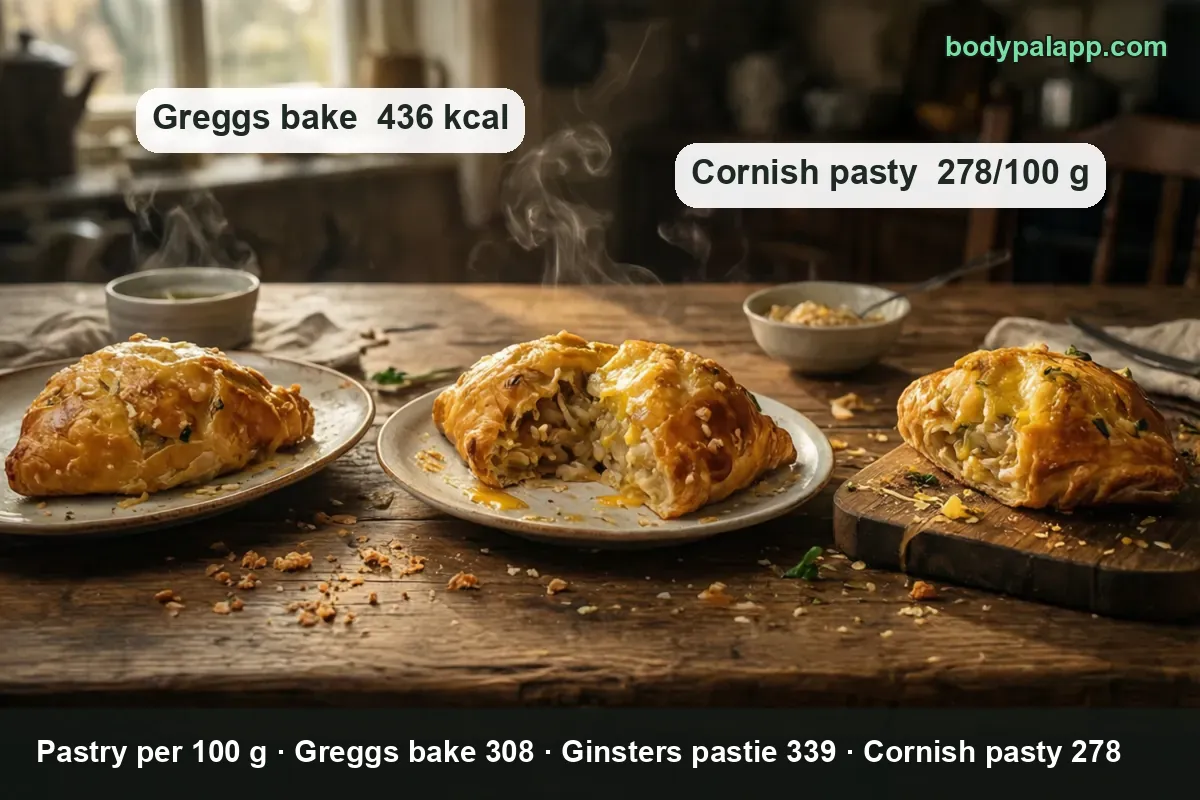
The sausage roll is the densest thing on the counter at 338 calories per 100 g and the lightest thing to buy at 348, purely because it is a third smaller than the bakes. If you want the cheapest hot item in calorie terms, that is it.
Between the three bakes there are 25 calories, which is nothing. The choice between them is not a calorie decision, it is a protein decision. Greggs publishes 15 g of protein in the Steak Bake, 15 g in the Katsu Chicken Bake, 13 g in the Chicken Bake and 8.6 g in the Cheese & Onion. Ranked per calorie the Steak Bake leads on 3.6 g per 100 kcal, the Katsu and the Chicken Bake follow on 3.4 and 3.1, and the Cheese & Onion trails on 2.0.
Our position: if you want protein for your money, take the Steak Bake, with the Chicken Bake a close second. If saturated fat is the thing you are managing, none of these four is a good pick and a homemade vegetable pasty at 7.08 g per 100 g is a meaningfully better one. If you want the cheese and onion because you want the cheese and onion, have it and eat lightly at dinner. It is 436 calories, not a catastrophe.
Salt varies more than calories
Calories across this whole category vary by under a fifth, top to bottom. Salt varies by a factor of seven.
Homemade pasties come in at 0.328 to 0.345 g of salt per 100 g, because a home kitchen seasons once. The measured retail Cornish average is 1.175 g. One specific branded product on a British shelf lists 2.3 g, which on a 180 g pasty means 4.14 g of salt in a single lunch, against the 6 g a day the NHS advises adults to stay under.
That top figure is an outlier rather than the norm, and it is exactly why the label is worth turning over. Two pasties that look identical in the chiller can differ by 3 g of salt, which is a bigger practical difference than anything on the calorie line.
The Greggs bake sits reasonably in the middle at 1.6 g per item, 27 per cent of the day. Add chips and you are past half of it before you have touched anything at home.
Most popular pasty brands in the United Kingdom
Ranked by how widely each product appears among foods sold in the United Kingdom, from the BodyPal food database of over 3.3 million products. Calories are the figures printed on each label. The cheese and onion line is the heaviest in the range, not the lightest.
| Product | Calories (per 100 g) |
|---|---|
| Ginsters Cheese & Onion Pastie | 339 kcal |
| Proper Pasty Company Traditional Cornish Pasty | 267 kcal |
| Ginsters Chicken and Bacon Pasty | 266 kcal |
| Ginsters Original Cornish Pasty | 263 kcal |
| Ginsters Cornish Pasty | 251 kcal |
| Ginsters Vegan Quorn Pasty | 242 kcal |
Brand popularity: BodyPal food database. Nutrition: manufacturer labels.
Pasty and bake FAQs
How many calories in a Greggs cheese and onion bake?
436 kcal for one 141.4 g bake, which is 308 kcal per 100 g. It also carries 30 g of fat, 16 g of saturates and 1.6 g of salt, so one bake spends 80 per cent of the daily reference intake for saturated fat. Greggs does not sell a cheese and onion pasty, only this bake.
How many calories in a cheese and onion pasty?
About 542 kcal for a 180 g pasty, based on 301 kcal per 100 g for a homemade vegetable pasty. That is more than a Greggs Cheese & Onion Bake at 436 kcal, because the pasty is nearly 40 g heavier even though the bake is denser per gram. Shelf-bought versions run from roughly 472 to 542 kcal at that size.
How many calories in a Cornish pasty?
278 kcal per 100 g for the retail average, so a 180 g pasty is about 500 kcal. Homemade comes out slightly higher per gram at 287 kcal. A Cornish pasty carries more protein than a vegetable one, 7.0 g per 100 g against 4.2 g, for a similar calorie count.
Is a pasty or a sausage roll worse?
The sausage roll is lighter to buy and heavier per gram. A Greggs sausage roll is 348 kcal at 103 g, which is 338 kcal per 100 g, while a 180 g pasty is around 500 kcal at 278 per 100 g. If you are choosing on the total, the sausage roll wins by roughly 150 calories.
Cheese and onion bake or steak bake?
Twenty-five calories apart: 436 for the Cheese & Onion Bake and 411 for the Steak Bake. Per 100 g the cheese version is actually the denser of the two at 308 against 301, which surprises people who assume a meat filling is the heavier one. Pick on protein rather than on calories.
How many calories in a large pasty?
Scale from 278 kcal per 100 g for a retail pasty. A 180 g standard is about 500 kcal, a 200 g is about 556, and a 250 g bakery pasty is about 695. Bakery pasties sold hot at the counter are usually at the larger end, so weight is the figure to establish first.
Are vegetable pasties lower in calories?
No. A homemade vegetable pasty is 301 kcal per 100 g against 287 for a homemade Cornish, and 542 against roughly 517 on a 180 g pasty. Removing the meat removes protein rather than fat, since the pastry is where most of the energy sits. It does cut the saturates a little, from 8.53 g per 100 g in the retail Cornish to 7.08 g.
How many calories in a Ginsters pasty?
Ginsters is the brand most people mean, and its Cheese & Onion Pastie is the heaviest thing in the range at 339 kcal per 100 g. Its Cornish pasties sit lower, between 251 and 263 kcal per 100 g depending on the line. As a benchmark, one branded Cornish pasty measured on the British shelf is 262 kcal per 100 g and 472 kcal for a 180 g serving. Compare the salt line as well, since branded pasties are where the widest salt figures on this page came from.
How many calories in a vegan pasty?
The Ginsters Vegan Quorn Pasty reads 242 kcal per 100 g, which makes it the lightest pasty in that range rather than the heaviest. The nearest measured reference is a homemade vegetable pasty at 301 kcal per 100 g and 542 kcal for a 180 g pasty. Since almost all of the energy is pastry rather than filling, a vegan version is unlikely to sit far from that figure.
Similar foods
- Cheese on toast — 336 kcal for two slices
- Fries — 331 kcal per medium portion
- Burger — 288 kcal per 100 g
- Bacon sandwich — 314 kcal, 388 with butter
- Greggs Chicken Bake — 420 kcal per bake
- Pizza — 340 kcal per slice
One photo, no label-reading
Point the camera at the bake, the pasty or whatever came out of the bag, and BodyPal sorts out which one it actually was.


How long does it take to burn off a cheese and onion pasty?
One Greggs Cheese & Onion Bake (141.4 g) is 436 kcal. Enter your weight and the amount you ate to see how long it takes you to burn that off:
lb
| Activity | Time to burn 436 kcal |
|---|---|
| Walking, brisk | 1 hr 27 min |
| Cycling, moderate | 54 min |
| Swimming, moderate | 1 hr 2 min |
| Jogging | 51 min |
| Weight training, moderate | 1 hr 37 min |
Times are for a 154 lb (11 st) adult at a steady pace; change the weight to see yours. The amount is set to the portion in the text (141.4 g); change it to what you actually ate. BodyPal works this out from your steps automatically.
Want the bigger picture? Calculate your daily calorie needs — your maintenance figure, a target for losing or gaining, and the date you get there.