
Calories in Cheese: 125 per Matchbox Piece, 416 per 100 g
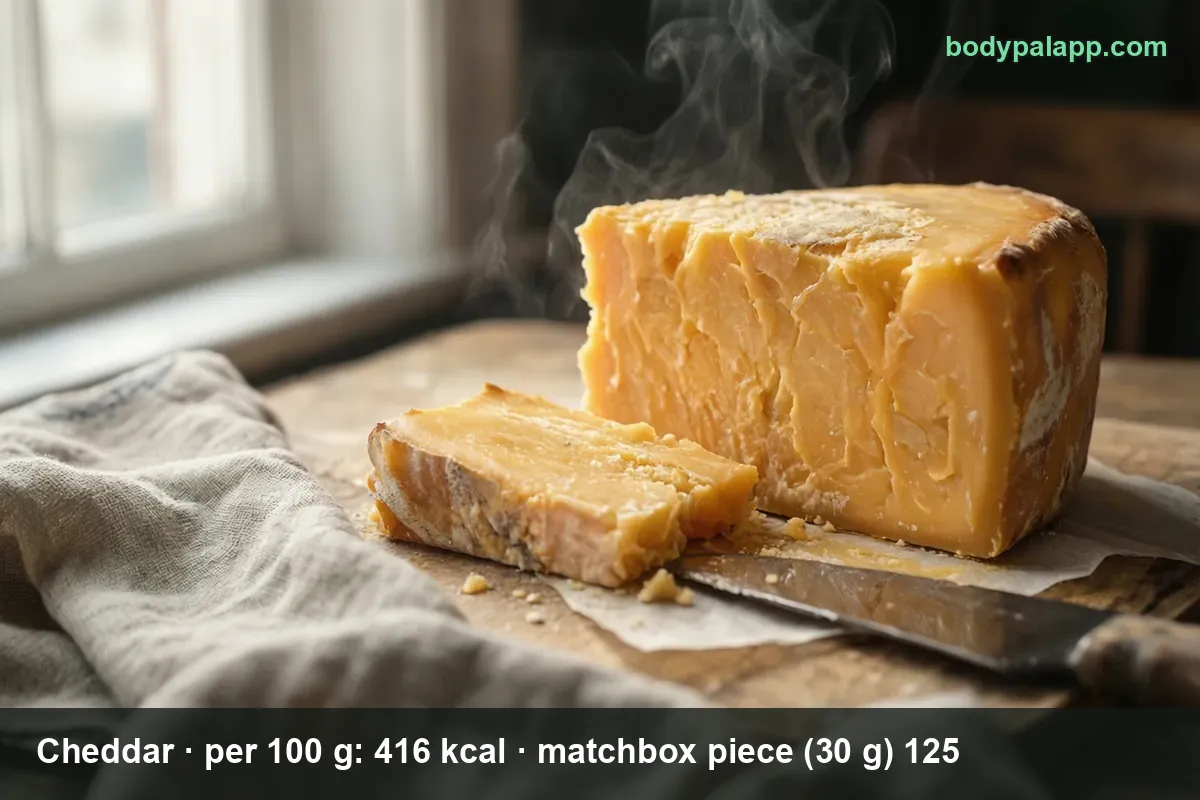
Calories in cheese deserve your full attention: a matchbox-sized piece of English Cheddar (30 g) is 125 kcal, because Cheddar runs 416 kcal per 100 g. That one piece covers 6% of a 2,000 kcal day. Cheese is not a food to guess at; it is the single most under-logged item we see on UK plates.
On this page
- Quick facts
- UK portion sizes
- Lighter Cheddars
- How does it compare?
- Is cheese just fat?
- Most popular Cheddar brands
- FAQ
Quick facts
The reference here is English Cheddar, the UK's default cheese. The right-hand column shows what the classic matchbox-sized portion of 30 g contributes to an adult's daily reference intake (RI), and unlike fruit and veg pages, these percentages actually move the needle.
Verified nutrition data
Numbers on this page come from CoFID, the UK government’s Composition of Foods Integrated Dataset, and from manufacturer labels where a branded product is named. Last verified August 2026. How we verify our data →
| Nutrient | Per 100 g | Per 30 g matchbox piece | RI% (30 g piece) |
|---|---|---|---|
| Energy | 416 kcal (1,741 kJ) | 125 kcal (523 kJ) | 6% |
| Protein | 25.4 g | 7.6 g | 15% |
| Carbohydrates | 0.1 g | 0.0 g | 0% |
| Fat | 34.9 g | 10.5 g | 15% |
| Fibre | 0.0 g | 0.0 g | — |
| Sugar | 0.1 g | 0.0 g | 0% |
| Salt | 1.808 g | 0.54 g | 9% |
Read that salt row twice. At 1.808 g per 100 g, Cheddar carries almost a third of the 6 g daily maximum in every 100 g, and even the modest matchbox piece uses up 9% of it. If you are watching salt, cheese counts towards it faster than most people realise; the NHS guidance on salt is worth a read.
UK portion sizes
Nobody weighs cheese in the moment, which is exactly why it leaks into so many calorie budgets unnoticed. Anchor these three portions and you can estimate by eye:
| Portion | Weight | Calories |
|---|---|---|
| Matchbox-size piece | 30 g | 125 kcal |
| Thick sandwich slice | ~25 g | 104 kcal |
| Grated topping | ~10 g | 42 kcal |
The matchbox comparison is the standard UK serving cue, and at 125 kcal it is a sensible ceiling for a snack. A thick slice off the block for a sandwich is around 25 g and 104 kcal; cut two and the cheese has quietly out-caloried the bread.
Grating is the calorie counter's best trick. Ten grams of grated Cheddar, 42 kcal, covers a bowl of pasta or a jacket potato with flavour that a solid 30 g chunk would deliver less evenly for three times the energy.
Lighter Cheddars: what you actually save
CoFID lists reduced-fat Cheddar types alongside the original, and the savings are real rather than cosmetic.
| Variant | kcal per 100 g | Fat | Protein | Salt |
|---|---|---|---|---|
| Cheddar, English | 416 kcal | 34.9 g | 25.4 g | 1.808 g |
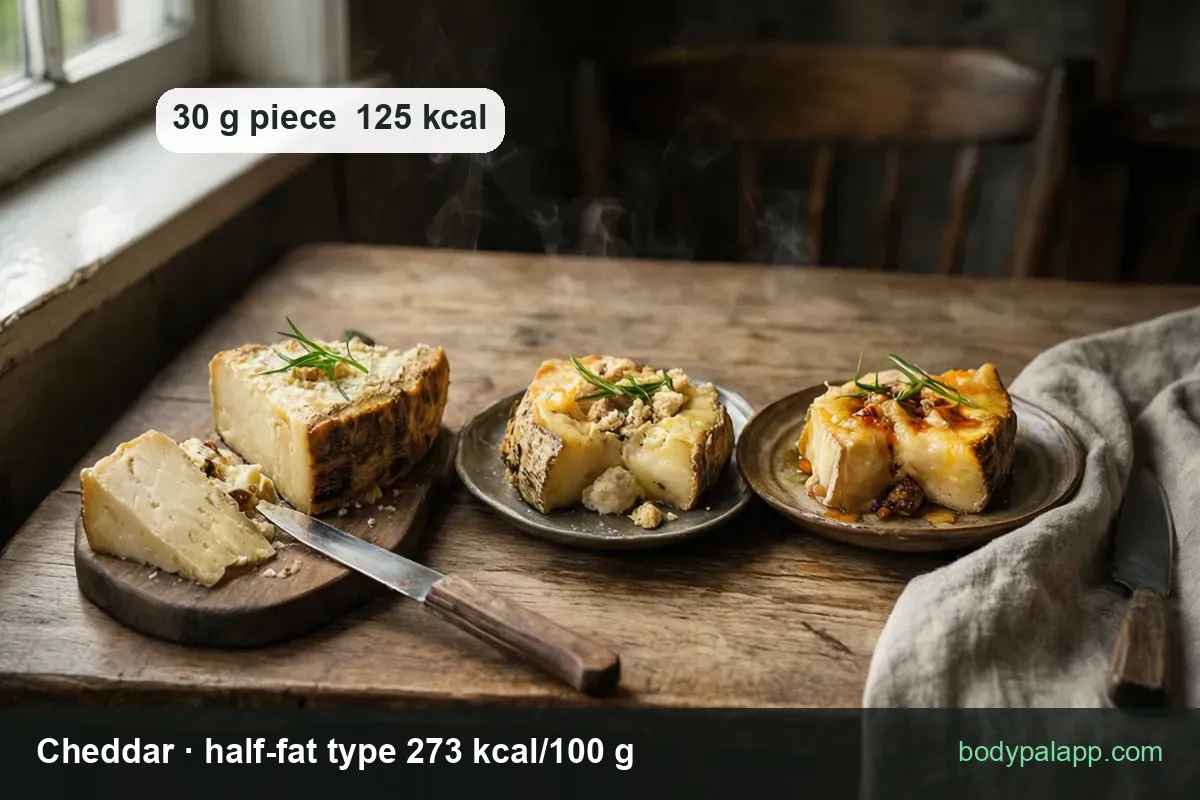
| Cheddar type, 30% less fat | 314 kcal | 22.1 g | 27.9 g | 1.8 g |
| Cheddar type, half fat | 273 kcal | 15.8 g | 32.7 g | 1.675 g |
Half-fat Cheddar saves 143 kcal per 100 g against the original and actually raises the protein, from 25.4 g to 32.7 g per 100 g, because protein fills the space the fat leaves. The trade-off is texture and a milder taste.
The catch is the salt, which barely moves: 1.8 g and 1.675 g per 100 g in the lighter versions. Swapping to reduced-fat cheese cuts calories, not salt. Our take: the "30% less fat" tier at 314 kcal is the sweet spot where the saving is meaningful and the cheese still tastes like Cheddar.
How does it compare?
| Food | kcal per 100 g |
|---|---|
| Egg | 143 kcal |
| Babybel Light | 210 kcal |
| Cheddar, English (this page) | 416 kcal |
| Butter | 744 kcal |
Cheddar looks restrained only next to butter's 744 kcal per 100 g; against everything else it is the heavyweight, nearly triple an egg. Our verdict: keep Cheddar for where its flavour is the point, and when cheese is just a habit, a Babybel Light at 210 kcal per 100 g or an egg does the same job on the plate for roughly half the energy.
Is cheese just fat?
No, and this is the fairest thing you can say for it. Cheddar delivers 25.4 g of protein per 100 g, so the matchbox piece contributes 7.6 g, a genuine 15% of the daily protein reference intake, matching its fat percentage exactly. On the Eatwell Guide cheese sits in the dairy group with a "smaller amounts, lower-fat options" note attached.
So the myth to drop is that cheese is empty calories. It is dense calories with real protein attached. The practical habit that follows: weigh it for a week, learn what 30 g looks like on your own chopping board, then trust your eye.
Most popular Cheddar brands in the United Kingdom
Ranked by how widely each product appears among foods sold in the United Kingdom, from the BodyPal food database of over 3.3 million products. Calories are the figures printed on each label.
| Product | Calories (per 100 g) |
|---|---|
| Cathedral City Cheddar | 416 kcal |
| Kerrygold Cheddar | 392 kcal |
Brand popularity: BodyPal food database. Nutrition: manufacturer labels.
FAQ
How many calories are in cheese?
English Cheddar, the UK reference cheese, has 416 kcal per 100 g. A matchbox-sized piece of 30 g is 125 kcal, a thick sandwich slice around 104 kcal, and a 10 g grated topping about 42 kcal. Reduced-fat Cheddars range from 273 to 314 kcal per 100 g.
How many calories are in a cheese slice?
A thick slice cut from a Cheddar block weighs about 25 g and carries 104 kcal. Two slices in a sandwich mean roughly 208 kcal from the cheese alone, usually more than the bread. Pre-packed processed slices differ, so check that packet's own label.
How many calories are in cheesecake?
Cheddar's 416 kcal per 100 g tells you little here, because cheesecake is built on soft cheese, cream, sugar and a biscuit base, and recipes vary enormously. No single figure would be honest. Check the label or the recipe, and treat it as a dessert, not a cheese portion.
How many calories are in a cheeseburger?
The cheese is the smaller part: a Cheddar slice adds around 104 kcal, while the bun, patty and sauces supply the bulk, varying by chain and recipe. Every major UK chain publishes calories on its menu, so use their figure for the burger and you will be close.
Is cheese healthy?
At 416 kcal and 1.808 g of salt per 100 g, Cheddar is a food the NHS Eatwell Guide says to eat in smaller amounts, while its 25.4 g of protein per 100 g gives it genuine nutritional value. The honest answer is: healthy in measured portions, costly by the wedge.
Is cheese good for you?
A 30 g portion supplies 7.6 g of protein for 125 kcal, which is a fair trade in an otherwise balanced day. The watch-outs are energy density and salt at 0.54 g per piece. If you love cheese, portion it deliberately rather than cutting it out and rebounding.
Is cheese high in protein?
Yes: Cheddar holds 25.4 g of protein per 100 g, and half-fat Cheddar even more at 32.7 g. The caveat is the company it keeps, 34.9 g of fat per 100 g in the regular version. Reduced-fat Cheddars flip that ratio further towards protein.
Is cheese a protein?
With 25.4 g of protein against 34.9 g of fat per 100 g, Cheddar is best described as a protein-and-fat food rather than a pure protein source. UK guidance groups it with dairy. It can absolutely count towards your protein target if the 416 kcal per 100 g fits your budget.
Similar foods
- Caster sugar — 16 kcal per level teaspoon
- Granulated sugar — 16 kcal per level teaspoon
- Tablespoon of sugar — 50 kcal per level tablespoon
- Chia seeds — 58 kcal a tablespoon
- Brie — 103 kcal per 30 g wedge
- Hummus — 92 kcal per 30 g
Count it without the maths
Photograph the cheeseboard with BodyPal and it sizes the wedge for you, logging the 125 kcal a matchbox piece really costs.


How long does it take to burn off cheese?
A matchbox-size piece (30 g) is 125 kcal. Enter your weight and the amount you ate to see how long it takes you to burn that off:
lb
| Activity | Time to burn 125 kcal |
|---|---|
| Walking, brisk | 25 min |
| Cycling, moderate | 16 min |
| Swimming, moderate | 18 min |
| Jogging | 15 min |
| Weight training, moderate | 28 min |
Times are for a 154 lb (11 st) adult at a steady pace; change the weight to see yours. The amount is set to the portion in the text (30 g); change it to what you actually ate. BodyPal works this out from your steps automatically.
This table assumes you know your daily total. If you do not, the daily calorie calculator works it out from five numbers.