
Calories in Caster Sugar: 16 a Teaspoon, Same as Granulated
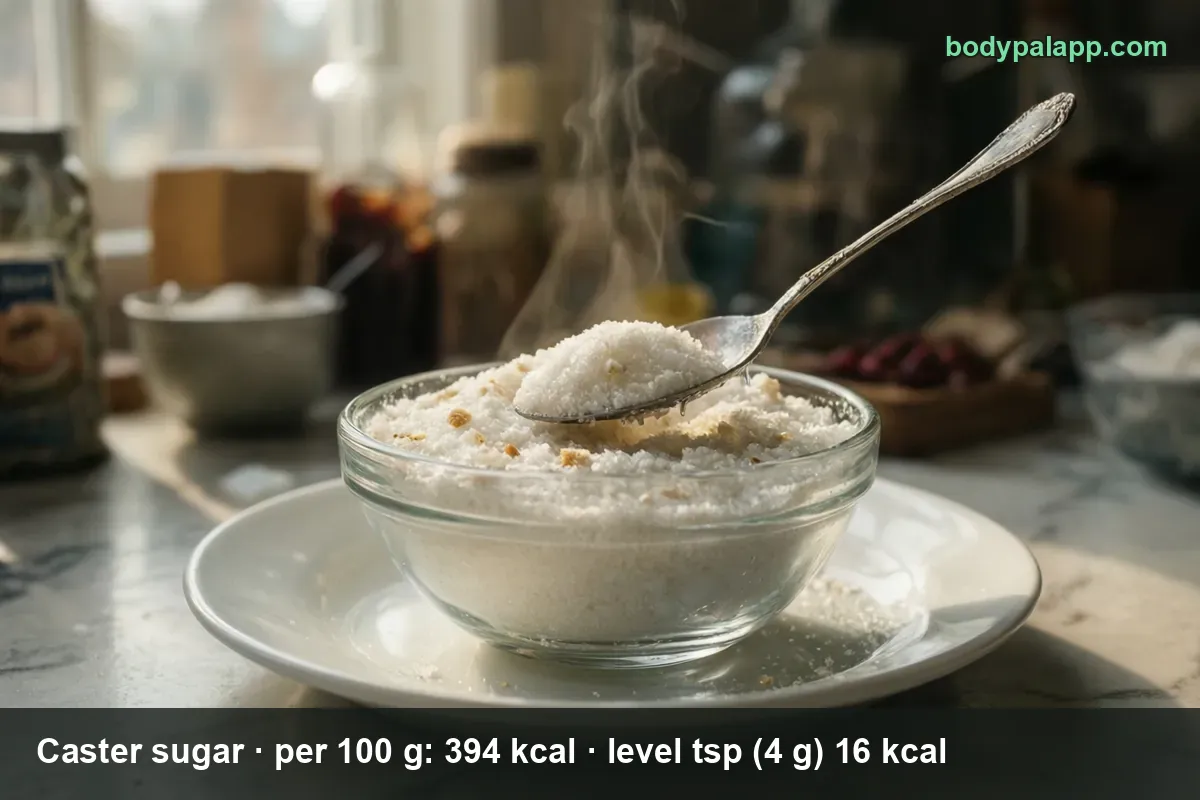
The calories in caster sugar are 16 per level teaspoon and 394 per 100 g, identical to granulated, because caster is ordinary white sugar milled to a finer crystal. Nothing is removed and nothing is added. If you reached for it hoping for a lighter bake, the saving is exactly zero.
On this page
- Caster sugar nutrition at a glance
- From a teaspoon to a sponge
- What the bag says, and why it differs
- Why bakers insist on caster anyway
- Caster against the rest of the sugar shelf
- The fine-crystal myth
- Most popular caster sugar brands
- FAQ
Caster sugar nutrition at a glance
| Nutrient | Per 100 g | Per level teaspoon (~4 g) | %RI* per teaspoon |
|---|---|---|---|
| Energy | 394 kcal / 1,648 kJ | 16 kcal / 67 kJ | 1% |
| Protein | 0 g | 0 g | – |
| Carbohydrate | 100 g | 4 g | 2% |
| of which sugars | 100 g | 4 g | 4% |
| Fat | 0 g | 0 g | – |
| Fibre | 0 g | 0 g | – |
| Salt | 0 g | 0 g | – |
*%RI = percentage of the reference intake for an average adult (2,000 kcal; 70 g fat, 260 g carbohydrate, 90 g sugars, 50 g protein, 6 g salt).
Verified nutrition data
Numbers on this page come from CoFID, the UK government’s Composition of Foods Integrated Dataset, and from manufacturer labels where a branded product is named. Last verified August 2026. How we verify our data →
Caster sugar is carbohydrate and nothing else: no fat, no protein, no fibre, no salt. Every one of its 394 calories per 100 g is sugar. That reference intake of 90 g on labels is the total-sugars line; the NHS advice on free sugars is stricter, no more than 30 g a day for adults, which caster spends at 4 g a spoon.
From a teaspoon to a sponge
| Amount | Weight | Calories |
|---|---|---|
| Level teaspoon | ~4 g | 16 kcal |
| Heaped teaspoon | ~6 g | 24 kcal |
| Tablespoon | ~12.5 g | 49 kcal |
| Meringue, per egg white | ~50 g | 197 kcal |
| Victoria sponge, whole bake | ~175 g | 690 kcal |
Baking is where caster earns its keep, and where its numbers get serious. A classic sponge takes 175 g, which is 690 calories from the sugar before the butter, flour and jam join it. Cut that cake into ten and the sugar alone puts 69 calories in every slice.
Meringues are the starkest case: the recipe is roughly 50 g of caster per egg white, so each swirl is essentially 200 calories of sugar holding its breath. There is no fat anywhere in it, which is why meringue has a lighter reputation than its numbers deserve.
What the bag says, and why it differs
Pick up a bag of Tate & Lyle caster and the label reads 400 kcal per 100 g, not 394. Nobody has changed the sugar. EU-derived labelling rules let energy be declared from rounded conversion factors, and 400 is the tidy result. The CoFID figure of 394 comes from the government's measured data; the 6 kcal gap is rounding, not recipe.
CoFID holds a stranger quirk: its white sugar entry records 105 g of carbohydrate per 100 g of sugar. That is not a typo. The database expresses carbohydrate as monosaccharide equivalents, and sucrose gains weight when it is split into its two component sugars for that accounting. Food labels use the convention you would expect, 100 g in 100 g, and that is what the table above shows.
Why bakers insist on caster anyway
Recipes specify caster for mechanical reasons. The fine crystals dissolve quickly, so meringues do not weep and syrups clear faster. In a creamed cake batter, small crystals cut more, smaller air pockets into the butter, which is what gives a sponge its even crumb.
None of that changes the energy. Swap granulated sugar in by weight and the calories are identical to the gram; the texture of the bake is what takes the risk. The full head-to-head is in our caster vs granulated comparison.
Caster against the rest of the sugar shelf
| Sugar | Per 100 g | Per level teaspoon |
|---|---|---|
| Caster | 394 kcal | 16 kcal |
| Demerara | 394 kcal | 16 kcal |
| Icing | 393 kcal | 16 kcal |
| Brown (soft) | 380 kcal | 15 kcal |
The verdict: choose by texture and flavour, because calories will not decide it; the whole shelf sits within 14 kcal per 100 g, under one calorie per spoon. Brown's tiny discount comes from the moisture in it, not from any virtue. Honey plays the same trick in liquid form, and our honey page shows why "natural" does not change the arithmetic either.
The Eatwell Guide treats every one of these as the same thing: free sugars to keep to a corner of the diet. Swapping between them is redecorating, not renovating.
The fine-crystal myth
"Caster sugar is lighter than granulated." Finer, yes; lighter, no. Both are pure sucrose at 394 kcal per 100 g. The confusion comes from volume: fine crystals pack a little differently in a spoon, but recipes and labels work in grams, and gram for gram there is no daylight between them.
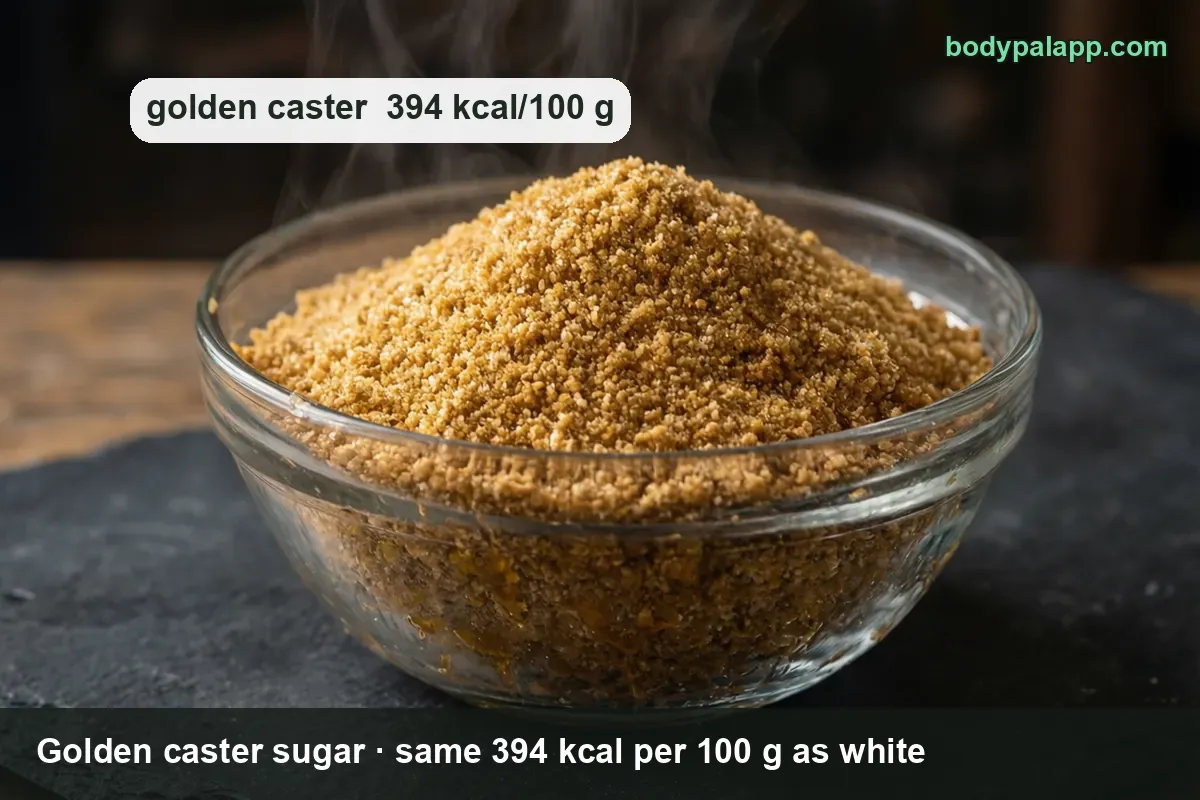
"Golden or unrefined versions are the healthy choice." The World Health Organization's guidance on free sugars draws no line between white, golden or brown. A trace of molasses changes the flavour and a rounding error's worth of calories, nothing more.
Most popular caster sugar brands in the United Kingdom
Ranked by how widely each product appears among foods sold in the United Kingdom, from the BodyPal food database of over 3.3 million products. Calories are the figures printed on each label.
| Product | Calories (per 100 g) |
|---|---|
| Tate & Lyle Golden Caster Sugar | 399 kcal |
| Billington’s Golden Caster Sugar | 399 kcal |
| Tesco Caster Sugar | 398 kcal |
Brand popularity: BodyPal food database. Nutrition: manufacturer labels.
Frequently asked questions
How many calories are in a teaspoon of caster sugar?
A level teaspoon of caster sugar is 16 kcal at about 4 g, and a heaped one is around 24 kcal. Because caster pours and packs so easily, heaped spoons happen by default; levelling against the jar's rim is the difference between logging 16 and quietly eating 24.
Is caster sugar lower in calories than granulated sugar?
No. Both are 394 kcal per 100 g, because caster is granulated sugar milled finer. The crystal size changes how fast it dissolves and how it creams into butter, which is why bakers prefer it, but the two are chemically the same sucrose with the same energy.
How many calories are in a tablespoon of caster sugar?
A tablespoon holds about 12.5 g, which is 49 kcal. Three tablespoons, the amount some flapjack and crumble recipes call "a little", already carry 148 calories. Weighing beats spooning for anything above a single teaspoon; sugar is dense, and spoons flatter it.
Why does my bag of caster sugar say 400 kcal?
Labelling rules allow energy to be calculated from rounded conversion factors, which lands brands like Tate & Lyle on a clean 400 kcal per 100 g. The UK government's measured CoFID figure is 394. The sugar is identical; the 6 kcal gap is arithmetic convention, not composition.
How much sugar does a Victoria sponge contain?
A standard sponge takes about 175 g of caster sugar, which is 690 kcal before butter, eggs and flour are counted. Sliced into ten, the sugar contributes 69 kcal per piece. It is usually the second-largest calorie source in the cake after the butter.
Does caster sugar contain fat or protein?
None of either: 0 g fat, 0 g protein, 0 g fibre and 0 g salt. Caster sugar is 100% carbohydrate, all of it sugars, delivering 394 kcal per 100 g. That purity is what makes it easy to log: grams times four, near enough, and the number is right.
Is brown sugar fewer calories than caster?
Marginally: soft brown sugar is 380 kcal per 100 g against caster's 394, a gap of about half a calorie per teaspoon. The difference is moisture, not nutrition. Choosing brown for its caramel flavour makes sense; choosing it to save calories does not.
Can I swap granulated for caster in a recipe?
By weight, yes, and the calories will match exactly at 394 kcal per 100 g. In delicate bakes the coarser crystal can leave speckling or a denser crumb, so a quick blitz in a food processor gets granulated close to caster. For syrups and stewed fruit it makes no difference at all.
How much caster sugar can I have in a day?
The NHS advises adults to keep free sugars under 30 g a day, which is about seven level teaspoons of caster sugar, 118 kcal, across everything you eat and drink. A single slice of home-made sponge can use two-thirds of that allowance on its own.
Similar foods
- Granulated sugar — 16 kcal per level teaspoon
- Tablespoon of sugar — 50 kcal per level tablespoon
- Cheddar cheese — 125 kcal per 30 g piece
- Brie — 103 kcal per 30 g wedge
- Hummus — 92 kcal per 30 g
- Chia seeds — 58 kcal a tablespoon
Logging a bake without the guesswork
BodyPal reads the slice on your plate from one photo, so the sugar that vanished into the batter still makes it into your diary.


Burning it off is one side of it. The other is knowing your number: work out how many calories you need a day, with macros and a goal date.