
Calories in Butter: 52 in a Scrape, 744 per 100 g
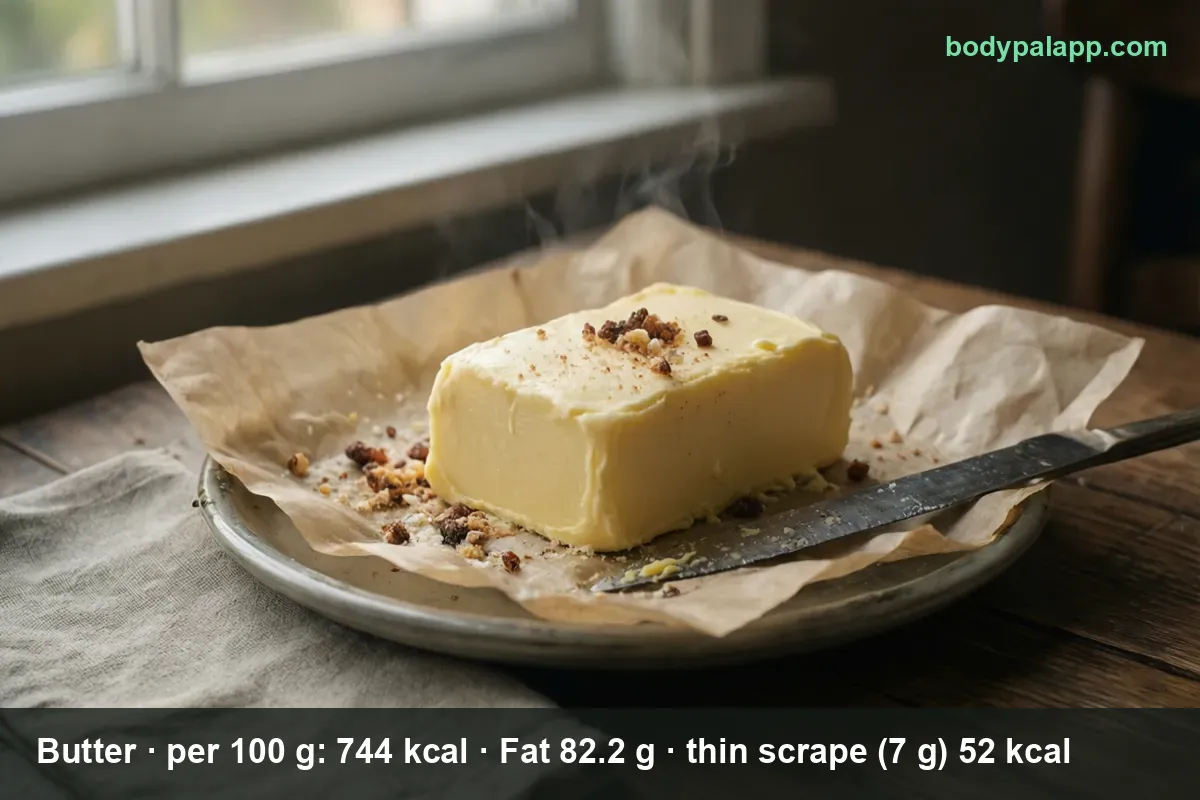
The calories in butter come to 52 for the thin scrape that covers one slice, and 744 per 100 g. That second number makes butter the most energy-dense food in most kitchens, yet almost nobody eats it by the hundred grams. They eat it seven grams at a time, and rarely write any of it down.
On this page
- Butter nutrition at a glance
- The scrape, the pat and the tablespoon
- Salted and unsalted: one number, two labels
- Butter on toast, crumpets and jacket potatoes
- How butter compares with the other spreads
- The myth worth retiring
- Most popular butter brands
- FAQ
Butter nutrition at a glance
| Nutrient | Per 100 g | Per thin scrape (~7 g) | %RI* per scrape |
|---|---|---|---|
| Energy | 744 kcal / 3,113 kJ | 52 kcal / 218 kJ | 3% |
| Protein | 0.6 g | 0 g (trace) | 0% |
| Carbohydrate | 0.6 g | 0 g (trace) | 0% |
| of which sugars | 0.6 g | 0 g (trace) | 0% |
| Fat | 82.2 g | 5.8 g | 8% |
| of which saturates | 52.1 g | 3.6 g | 18% |
| Fibre | 0 g | 0 g | – |
| Salt | 1.8 g | 0.13 g | 2% |
*%RI = percentage of the reference intake for an average adult (2,000 kcal; 70 g fat, 20 g saturates, 260 g carbohydrate, 90 g sugars, 50 g protein, 6 g salt).
Verified nutrition data
Numbers on this page come from CoFID, the UK government’s Composition of Foods Integrated Dataset, and from manufacturer labels where a branded product is named. Last verified August 2026. How we verify our data →
Butter is fat with the water left in: 82.2 g of fat per 100 g and almost nothing else. There is no protein worth counting, no carbohydrate, no fibre. Every calorie arrives the same way.
The line that deserves more attention than the calories is the saturates. One scrape carries 3.6 g, an eighth of the 20 g reference intake, and NHS guidance on fats suggests most of us are over that ceiling already. Four buttered slices across a day is 14.4 g of saturates before any cheese, meat or pastry joins in.
The scrape, the pat and the tablespoon
| Portion | Weight | Calories |
|---|---|---|
| Thin scrape for one slice | ~7 g | 52 kcal |
| Level teaspoon | ~5 g | 37 kcal |
| Café pat | ~10 g | 74 kcal |
| Level tablespoon | ~14 g | 104 kcal |
The gap between a careful scrape and a generous knife is roughly double, 37 against 74, and nobody weighs butter at breakfast. That makes it one of the quietest sources of drift in a food diary: log two slices of toast precisely, then guess the butter, and the guess can be half of the toast's own calories.
A tablespoon matters mostly in cooking. Frying eggs in a tablespoon of butter adds 104 kcal to the pan, and mash made with a couple of tablespoons carries 200-odd calories that belong to the butter, not the potato.
Salted and unsalted: one number, two labels
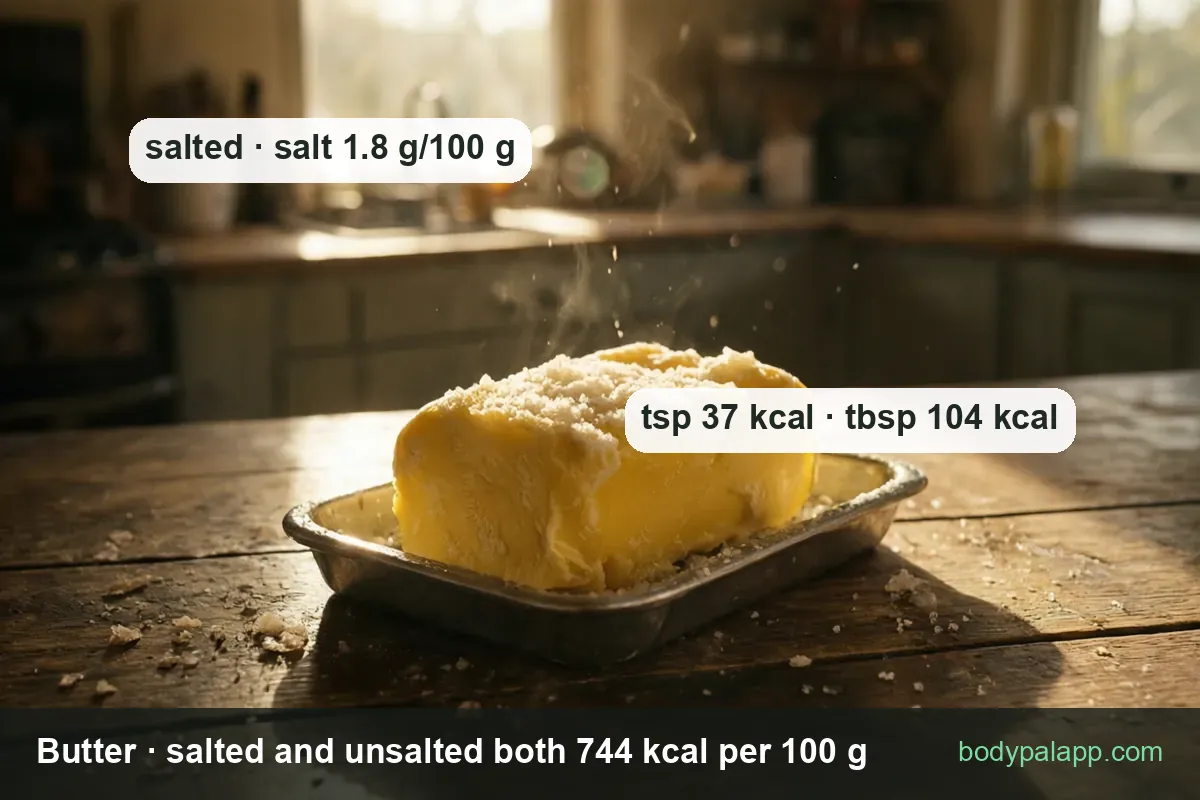
Both blocks are 744 kcal per 100 g, with the same 82.2 g of fat and the same 52.1 g of saturates. The entire difference between them is salt: 1.8 g per 100 g in salted butter, 0.02 g in unsalted, which is effectively zero.
So unsalted is not the lighter choice, and never was. It exists for control, not calories. Bakers reach for it because a recipe that calls for 250 g of butter would otherwise arrive with 4.5 g of salt already inside, most of a day's 6 g NHS limit baked into the sponge before anyone seasons anything.
On bread, the salt in salted butter is doing flavour work at a small dose: 0.13 g per scrape, about 2% of the daily reference. If you spread four slices a day it becomes half a gram, which is worth knowing and rarely worth panicking over. The full head-to-head lives in our salted vs unsalted butter comparison.
Butter on toast, crumpets and jacket potatoes
Butter's calories almost always arrive attached to something, so the honest numbers are the combined ones.
A slice of white toast at 85 kcal takes a 52 kcal scrape and becomes 137. Two rounds of buttered toast are 274, which surprises people who logged "toast" as 170. The butter was a third of the breakfast.
A crumpet is worse at hiding it, because the holes are a delivery system: butter melts in rather than sitting on top, and a generous 10 g disappears without looking like anything. A jacket potato with 10 g of butter adds 74 kcal to the plate, and the same applies to cheese on toast if the bread is buttered before the cheese goes on.
None of this is an argument against butter. It is an argument for counting it as food rather than as scenery.
How butter compares with the other spreads
| Fat | Per 100 g | Typical portion | Portion kcal |
|---|---|---|---|
| Butter | 744 kcal | thin scrape, ~7 g | 52 kcal |
| Margarine, block | 688 kcal | thin scrape, ~7 g | 48 kcal |
| Ghee | 898 kcal | tablespoon, ~13 g | 117 kcal |
| Peanut butter | 607 kcal | tablespoon, ~16 g | 97 kcal |
The verdict: on calories alone there is nothing to win between butter and block margarine, 4 kcal a scrape, so pick by taste and by saturates, where margarine's 26.4 g per 100 g is half of butter's. Peanut butter is the only spread on the table that brings protein with it, 22.8 g per 100 g, which makes it the better pick when the toast is the meal. Ghee belongs in the pan, not on the slice: it is butter with the water removed, which is how it reaches 898.
The butter-or-margarine question has its own page, butter vs margarine, and the pan question is settled in butter vs ghee.
The myth worth retiring
"Unsalted butter is the healthier, lighter version." It is the same 744 kcal and the same fat to the decimal place. The only line that moves is salt, 1.8 g down to 0.02 g per 100 g. If salt is what you are watching, that swap does real work; if calories are, it does nothing at all.
Most popular butter brands in the United Kingdom
Ranked by how widely each product appears among foods sold in the United Kingdom, from the BodyPal food database of over 3.3 million products. Calories are the figures printed on each label.
| Product | Calories (per 100 g) |
|---|---|
| Anchor Block Butter | 744 kcal |
| Country Life Salted Butter | 737 kcal |
| Kerrygold Pure Irish Butter | 714 kcal |
| Lurpak Butter | 706 kcal |
Brand popularity: BodyPal food database. Nutrition: manufacturer labels.
How long does it take to burn off butter?
A thin 7 g scrape on one slice is 52 kcal. Enter your weight and the amount you ate to see how long it takes you to burn that off:
lb
| Activity | Time to burn 52 kcal |
|---|---|
| Walking, brisk | 10 min |
| Cycling, moderate | 6 min |
| Swimming, moderate | 7 min |
| Jogging | 6 min |
| Weight training, moderate | 12 min |
Times are for a 154 lb (11 st) adult at a steady pace; change the weight to see yours. The amount is set to the portion in the text (7 g); change it to what you actually ate. BodyPal works this out from your steps automatically.
Burning it off is one side of it. The other is knowing your number: work out how many calories you need a day, with macros and a goal date.
Frequently asked questions
How many calories are in butter on toast?
About 137 kcal for one slice: 85 for a medium slice of white toast and 52 for a thin 7 g scrape of butter. A generous knife takes the butter to 74 kcal and the slice to nearly 160. Two buttered rounds are roughly 274 kcal.
How many calories are in a teaspoon of butter?
A level teaspoon of butter, about 5 g, is 37 kcal. That is the amount a careful spreader uses on warm toast, where butter goes further. A heaped knife-load is closer to the 10 g pat, which is 74 kcal, so the spread technique genuinely changes the number.
How many calories are in a tablespoon of butter?
A level tablespoon, about 14 g, is 104 kcal, with 11.5 g of fat. In cooking that is the more useful unit than the scrape: frying in a tablespoon of butter adds around 104 kcal to whatever is in the pan, before the food itself is counted.
Is unsalted butter lower in calories than salted?
No. Both are 744 kcal per 100 g with identical fat at 82.2 g. The only difference is salt: 1.8 g per 100 g in salted against 0.02 g in unsalted. Choose unsalted to control salt in baking, not to save calories, because there are none to save.
Is butter fattening?
Butter is 744 kcal per 100 g, so it is the densest everyday food in the fridge, but a measured scrape is only 52 kcal and fits most calorie budgets easily. What moves the needle is unmeasured spreading: the difference between careful and generous is roughly double per slice.
Which has fewer calories, butter or margarine?
Block margarine, narrowly: 688 kcal per 100 g against butter's 744, which is 4 kcal per scrape. The meaningful gap is saturated fat, 26.4 g against 52.1 g per 100 g. On calories alone the swap changes almost nothing on a slice of toast.
How many calories are in a pat of butter?
A café pat is about 10 g and 74 kcal, with 8.2 g of fat and 5.2 g of saturates. Two pats with a scone or a bread basket are 148 kcal, which is why restaurant bread courses cost more than the bread suggests.
Does butter contain protein or carbs?
Almost none: 0.6 g of protein and 0.6 g of carbohydrate per 100 g, which rounds to zero in any real portion. Butter is 82.2 g of fat per 100 g plus water, so effectively every calorie in butter comes from fat.
What is the lowest-calorie way to butter toast?
Spread on warm toast. Melted butter covers a slice at around 5 g, which is 37 kcal, where cold butter drags at 7 g or more, 52 kcal and up. Across two slices a day that habit alone is worth about 30 kcal a day, or a modest 210 a week.
Similar foods
- Margarine — 48 kcal per scrape
- Mayonnaise — 103 kcal a tablespoon
- Almond butter — 103 kcal per tablespoon
- Peanut butter — 97 kcal per tablespoon
- Pistachios — 180 kcal per 30 g kernels
- Ghee — 117 kcal per tablespoon
Count it without the maths
BodyPal spots the butter on the toast, not just the toast, and logs the whole slice from one photo.

