
Butter vs Ghee: Which Has Fewer Calories?
Butter has fewer calories than ghee: 744 per 100 g against 898, or 104 against 117 per tablespoon. Ghee is simply butter with the water and milk solids cooked off, and water was the only part of butter that cost nothing. Remove it, and the calories concentrate in what remains.
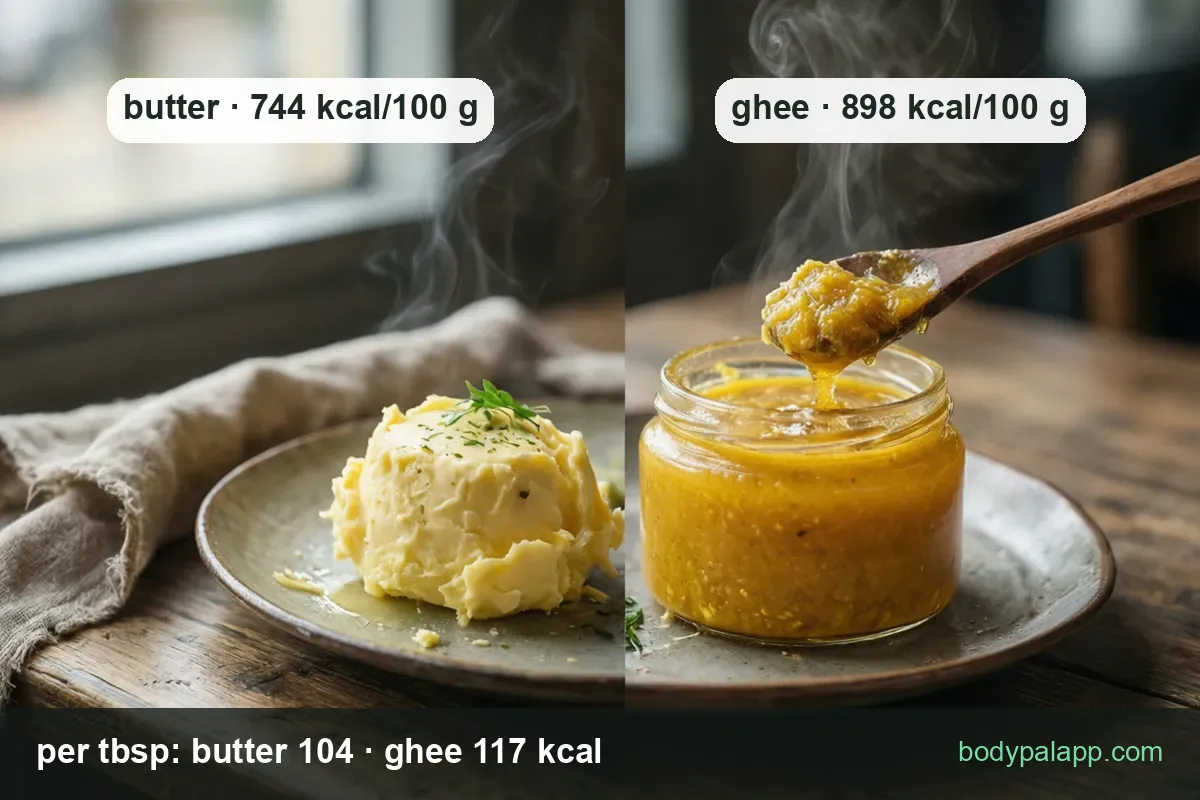
The numbers side by side
| Nutrient | Butter, per tbsp (~14 g) | Butter, per 100 g | Ghee, per tbsp (~13 g) | Ghee, per 100 g |
|---|---|---|---|---|
| Energy | 104 kcal / 435 kJ | 744 kcal / 3,113 kJ | 117 kcal / 490 kJ | 898 kcal / 3,757 kJ |
| Protein | 0.1 g | 0.6 g | 0 g | 0 g |
| Carbohydrate | 0.1 g | 0.6 g | 0 g | 0 g |
| of which sugars | 0.1 g | 0.6 g | 0 g | 0 g |
| Fat | 11.5 g | 82.2 g | 13 g | 100 g |
| Fibre | 0 g | 0 g | 0 g | 0 g |
| Salt | 0.25 g | 1.8 g | 0 g | 0 g |
Verified nutrition data
Numbers on this page come from CoFID, the UK government’s Composition of Foods Integrated Dataset, and from manufacturer labels where a branded product is named. Last verified August 2026. How we verify our data →
Butter's figures are CoFID's salted butter; ghee's come from the KTC label, the standard UK jar. Read the fat row and the whole story is there: 82.2 g against a flat 100 g. Roughly a sixth of butter is water and milk solids, and that sixth is calorie-free padding that ghee has deliberately thrown away.
The salt row is the quiet difference. Salted butter carries 1.8 g per 100 g, a real contribution against the 6 g daily limit the NHS advises, while ghee carries none at all.
On saturated fat, neither escapes: CoFID records 52.1 g per 100 g for butter and 58.4 g for its ghee entry, both several days' worth of the under-20 g daily guidance in every 100 g. Concentration rose with clarifying; the nature of the fat did not change.
When to pick butter
For anything cold or gently warm: toast, sandwiches, baking, finishing vegetables. Butter is 13 kcal cheaper per spoon, and its milk solids are precisely what gives shortbread and croissants their flavour, so in baking ghee is not an upgrade but a substitution with a cost.
If calories are the whole question, butter wins this page outright. It is the same fat diluted by a sixth of free water, which makes it the rare case where the "less pure" product is the lighter one.
When to pick ghee
For the pan. Butter's milk solids scorch at frying temperatures; with those removed, ghee stays clean at heats that would burn butter, which is why it anchors curry bases and high-heat roasting. Take the 117 kcal per tablespoon as the price of that behaviour and measure accordingly.
It is also the pick if salt is your constraint, at 0 g against butter's 1.8 g per 100 g, and its near-total lack of milk solids leaves at most a trace of lactose. Nothing in that list makes it light; 100 g of ghee still out-costs almost anything else in the kitchen.
Most popular butter and ghee brands in the United Kingdom
Ranked by how widely each product appears among foods sold in the United Kingdom, from the BodyPal food database of over 3.3 million products. Calories are the figures printed on each label. The two ghees sit together at the top for the same reason the guide gives: no water, all fat.
| Product | Calories (per 100 g) |
|---|---|
| East End Pure Butter Ghee | 900 kcal |
| KTC Pure Butter Ghee | 898 kcal |
| Anchor Block Butter | 744 kcal |
| Kerrygold Pure Irish Butter | 714 kcal |
| Lurpak Butter | 706 kcal |
Brand popularity: BodyPal food database. Nutrition: manufacturer labels.
Frequently asked questions
Is ghee healthier than butter?
Not on the numbers this page can measure. Ghee runs 154 kcal per 100 g above butter and carries a higher concentration of saturated fat, 58.4 g against 52.1 g in CoFID's entries. Its genuine advantages are zero salt and high-heat cooking behaviour, which are practical points rather than health ones.
Why does ghee have more calories than butter?
Because clarifying removes butter's water and milk solids, which are nearly calorie-free, and leaves pure fat at 9 kcal per gram. Butter is 82.2 g fat per 100 g; ghee is 100 g. Same origin, same fat, one has simply had its dilution boiled away.
How many calories in a tablespoon of ghee versus butter?
A tablespoon of ghee is 117 kcal at about 13 g; a tablespoon of butter is 104 kcal at about 14 g. The 13-calorie gap per spoon is small in one meal and real across a daily cooking habit. Whichever you use, the heaped spoon is the bigger variable.
Does ghee contain lactose or salt?
Ghee contains 0 g of salt, against 1.8 g per 100 g in salted butter. Lactose lives in the milk solids that clarifying strains out, so well-made ghee holds at most a trace; anyone avoiding dairy strictly should still check the specific jar's label.
Can I swap butter for ghee in recipes?
Usually, with two caveats. Ghee is 100% fat, so it makes doughs slightly richer and will not brown the way butter's milk solids do, which changes flavour in baking. And a salted-butter recipe loses its 1.8 g per 100 g of seasoning, so taste and adjust.
More comparisons
- Almond vs peanut butter — 103 vs 97 kcal a spoon
- Butter vs margarine — 4 kcal apart on toast
- Salted vs unsalted butter — identical calories, the salt differs
- Caster vs granulated sugar — the same 394 kcal
- Quinoa vs rice — 111 vs 131 kcal cooked
Count it without the maths
BodyPal logs what actually went into the pan from one photo of the plate, whichever side of this jar-versus-block choice you took.


This table assumes you know your daily total. If you do not, the daily calorie calculator works it out from five numbers.