
Almond Butter vs Peanut Butter: Which Has Fewer Calories?
Peanut butter wins, and it wins twice. In the almond butter vs peanut butter contest, peanut comes in at 607 kcal per 100 g against almond's 641, or 97 against 103 for a level tablespoon, and it carries more protein as well: 22.8 g per 100 g against 20.7 g. The dearer jar is the heavier one.
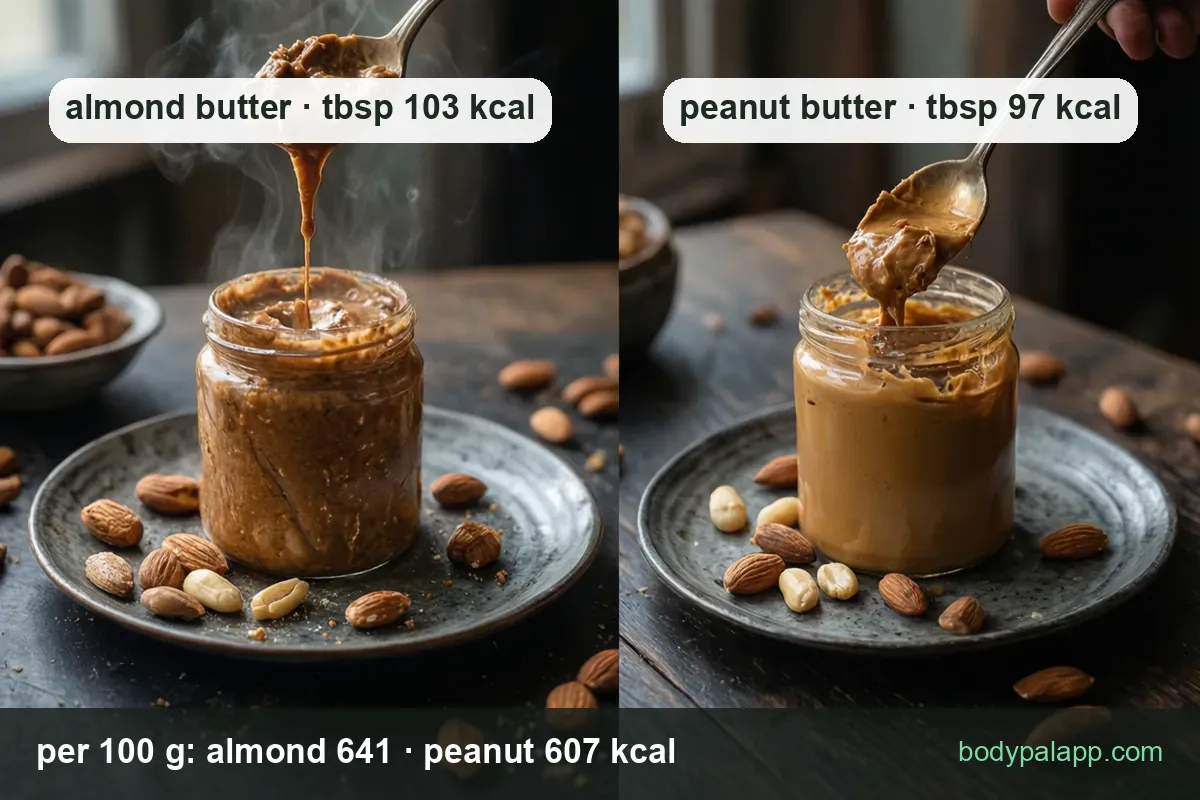
The numbers side by side
| Nutrient | Almond butter, per tbsp (~16 g) | Almond butter, per 100 g | Peanut butter, per tbsp (~16 g) | Peanut butter, per 100 g |
|---|---|---|---|---|
| Energy | 103 kcal / 431 kJ | 641 kcal / 2,682 kJ | 97 kcal / 406 kJ | 607 kcal / 2,540 kJ |
| Protein | 3.3 g | 20.7 g | 3.6 g | 22.8 g |
| Carbohydrate | 3.4 g | 21.1 g | 2.1 g | 13.1 g |
| of which sugars | 0.6 g | 4.0 g | 1.1 g | 6.7 g |
| Fat | 8.4 g | 52.7 g | 8.3 g | 51.8 g |
| Fibre | 1.6 g | 10.0 g | 1.1 g | 6.6 g |
| Salt | trace | 0.01 g | 0.14 g | 0.88 g |
Verified nutrition data
Numbers on this page come from CoFID, the UK government’s Composition of Foods Integrated Dataset, and from manufacturer labels where a branded product is named. Last verified August 2026. How we verify our data →
Six calories a spoon is not a life-changing gap, and on fat the two jars are practically twins at 52.7 g and 51.8 g per 100 g. The differences that hold up are protein, where peanut leads by 2.1 g per 100 g, and carbohydrate, where almond carries 8 g more.
What the table quietly demolishes is the health-halo pricing. Almond butter often costs twice as much and is widely assumed to be the lighter, cleaner choice. On energy it is the denser jar, and on protein per calorie it loses too. Whatever you are paying extra for, it is not the macros.
When to pick peanut butter
Pick it when the numbers are the point. If the spread is your protein top-up, peanut's 3.6 g per spoon against 3.3 g, and 22.8 g against 20.7 g per 100 g, does more work for less money. In a calorie deficit, the 34 kcal per 100 g saving compounds over a jar-a-fortnight habit.
It is also the carb-lighter jar, at 13.1 g per 100 g against 21.1 g, which occasionally matters to tight loggers. The full spoon-by-spoon breakdown lives on our peanut butter page.
When to pick almond butter
Pick it for the reason people actually buy it: the taste. Rotating jars keeps a toast habit interesting, and 103 kcal for a level tablespoon is a perfectly affordable line in a day when it is logged honestly. Our almond butter page has the portion maths.
What almond butter cannot do is act as the diet version of peanut butter. If the swap was meant to save calories, swap back; if it was meant to taste of almonds, carry on.
Most popular almond and peanut butter brands in the United Kingdom
Ranked by how widely each product appears among foods sold in the United Kingdom, from the BodyPal food database of over 3.3 million products. Calories are the figures printed on each label.
| Product | Calories (per 100 g) |
|---|---|
| Meridian Almond Butter | 650 kcal |
| Whole Earth Smooth Peanut Butter | 645 kcal |
| Meridian Smooth Peanut Butter | 596 kcal |
| Pip & Nut Smooth Peanut Butter | 593 kcal |
| Pip & Nut Smooth Almond Butter | 577 kcal |
Brand popularity: BodyPal food database. Nutrition: manufacturer labels.
Frequently asked questions
Which has fewer calories, almond butter or peanut butter?
Peanut butter: 607 kcal per 100 g against almond butter's 641, which works out at 97 versus 103 for a level 16 g tablespoon. The gap is real but small, about 5%, so the unmeasured heaped spoon matters far more than the choice of jar.
Which has more protein, almond or peanut butter?
Peanut butter, with 22.8 g per 100 g against almond butter's 20.7 g, or 3.6 g against 3.3 g per tablespoon. Neither is a true protein food, since both deliver over twice as much fat as protein, but peanut does more per calorie.
Is almond butter healthier than peanut butter?
Not on the numbers we track. Almond butter has more calories and less protein per 100 g, and the fat content is nearly identical at around 52 g. The choice is about flavour and variety rather than one jar being the virtuous option.
Can I swap almond butter for peanut butter in recipes?
Yes, weight for weight they behave the same way, and the calorie shift is about 34 kcal per 100 g or 6 per tablespoon, with almond adding roughly 8 g more carbohydrate per 100 g. Bakes, sauces and porridge stirs all survive the swap unchanged.
Which is better for weight loss?
Either works measured, neither works eyeballed. Peanut butter edges it at 97 kcal per level tablespoon with slightly more protein, but both sit above 600 kcal per 100 g, so the spoon habit decides the outcome long before the nut does.
More comparisons
- Butter vs ghee — 744 vs 898 kcal per 100 g
- Butter vs margarine — 4 kcal apart on toast
- Salted vs unsalted butter — identical calories, the salt differs
- Caster vs granulated sugar — the same 394 kcal
- Quinoa vs rice — 111 vs 131 kcal cooked
Log the jar war honestly
Snap the toast with BodyPal and it counts whichever butter is on it, at the weight that is actually there rather than the label's polite 15 g.


One food is easy to picture; a whole day is harder. See how many calories you need a day and what a deficit actually looks like.