
Butter vs Margarine: Which Has Fewer Calories?
Margarine, but not by enough to taste: 688 kcal per 100 g against butter's 744, which on a 7 g scrape of toast is 48 versus 52. Four calories is the whole prize. The fight people think they are having about calories is actually a fight about saturated fat, and that one margarine wins twice over.
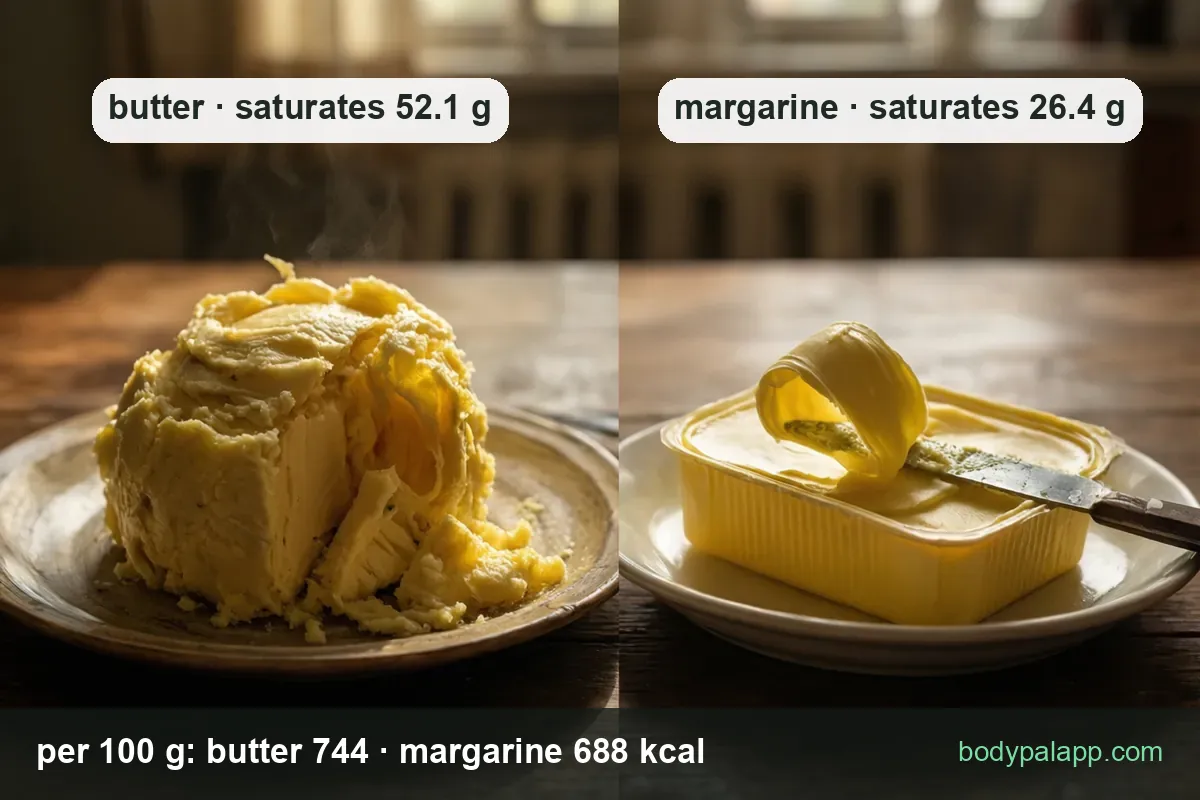
The numbers side by side
| Nutrient | Butter, per scrape (~7 g) | Butter, per 100 g | Margarine, per scrape (~7 g) | Margarine, per 100 g |
|---|---|---|---|---|
| Energy | 52 kcal / 218 kJ | 744 kcal / 3,113 kJ | 48 kcal / 201 kJ | 688 kcal / 2,879 kJ |
| Protein | 0 g (trace) | 0.6 g | 0 g | 0 g (trace) |
| Carbohydrate | 0 g (trace) | 0.6 g | 0 g | 0 g |
| of which sugars | 0 g (trace) | 0.6 g | 0 g | 0 g |
| Fat | 5.8 g | 82.2 g | 5.3 g | 76.4 g |
| of which saturates | 3.6 g | 52.1 g | 1.8 g | 26.4 g |
| Fibre | 0 g | 0 g | 0 g | 0 g |
| Salt | 0.13 g | 1.8 g | 0.11 g | 1.5 g |
Both columns describe the same kind of food: fat plus water, nothing else worth counting. No protein, no carbohydrate, no fibre on either side. The figures here are for hard block margarine; the soft tubs sold as fat spreads sit lower, from 339 to 552 kcal per 100 g, because they are diluted with water.
The row that separates the two is saturates. Butter's fat is 52.1 g saturated per 100 g; block margarine's is 26.4 g. Per scrape that reads as 3.6 g against 1.8 g, and against the 20 g daily reference intake in NHS guidance on fats, a four-slice day on butter uses nearly three quarters of it from the spread alone.
Verified nutrition data
Numbers on this page come from CoFID, the UK government’s Composition of Foods Integrated Dataset, and from manufacturer labels where a branded product is named. Last verified August 2026. How we verify our data →
When to pick butter
When taste is the point. Butter is the one of the two that people eat for its own sake, and at a 4 kcal premium per slice the calorie argument for giving it up does not exist. A measured scrape at 52 kcal fits any sensible day.
Butter also wins in the pan and under the grill, where cheese on toast or fried eggs pick up its flavour. If salt is a concern, unsalted butter drops the salt line to almost zero at identical calories; that swap is covered in salted vs unsalted butter.
When to pick margarine
When saturated fat is the number you are managing. Halving the saturates per slice is a real, repeatable saving that costs nothing in calories, and it is the reason unsaturated spreads get the nod in NHS advice rather than any slimming claim.
Block margarine is also the baker's pick on price and consistency: 96 kcal per tablespoon against butter's 104, firm enough for pastry, and it creams the same. And if the actual goal is fewer calories on toast, step past both contenders to a low-fat spread at roughly 24 kcal per scrape, half the cost of either.
Most popular butter and spread brands in the United Kingdom
Ranked by how widely each product appears among foods sold in the United Kingdom, from the BodyPal food database of over 3.3 million products. Calories are the figures printed on each label. The bottom three are tub spreads rather than hard block margarine, which is why they undercut even the 688 in the table above.
| Product | Calories (per 100 g) |
|---|---|
| Anchor Block Butter | 744 kcal |
| Lurpak Butter | 706 kcal |
| Clover Utterly Butterly | 400 kcal |
| Stork Country Spread | 362 kcal |
| Flora Light | 269 kcal |
Brand popularity: BodyPal food database. Nutrition: manufacturer labels.
Frequently asked questions
Is margarine lower in calories than butter?
Yes, by about 8%: 688 kcal per 100 g against 744, or 48 versus 52 on a 7 g scrape. Nobody notices 4 kcal on a slice. Low-fat spreads at around 339 kcal per 100 g are the only option in this aisle with a meaningful calorie saving.
Is butter or margarine better for you?
On saturated fat, margarine: 26.4 g per 100 g against butter's 52.1 g, so each scrape carries half as much. NHS guidance points towards unsaturated spreads for that reason. On calories the two are close enough that the choice makes no practical difference.
Which is better for baking, butter or margarine?
Both work, and the calories barely differ: 104 kcal per tablespoon of butter, 96 for block margarine. Block margarine holds pastry together reliably and costs less; butter brings flavour. The one to avoid in a recipe is soft tub spread, whose water content changes the texture.
Do butter and margarine have the same fat content?
Close: butter is 82.2 g of fat per 100 g, block margarine 76.4 g. The composition differs more than the amount, since butter's fat is two thirds saturated and margarine's about one third. Neither contains protein, carbohydrate or fibre in any meaningful quantity.
What has fewer calories than both?
Reduced-fat and low-fat spreads: roughly 552 kcal per 100 g at 60% fat and 339 kcal at around 35% fat, or 39 and 24 kcal per scrape. They get there by whipping water into the fat, which halves the cost of buttering toast at the price of a paler flavour.
More comparisons
- Almond vs peanut butter — 103 vs 97 kcal a spoon
- Butter vs ghee — 744 vs 898 kcal per 100 g
- Salted vs unsalted butter — identical calories, the salt differs
- Caster vs granulated sugar — the same 394 kcal
- Quinoa vs rice — 111 vs 131 kcal cooked
Count it without the maths
Whichever side of the tub you land on, BodyPal logs the spread and the slice under it from one photo.


Burning it off is one side of it. The other is knowing your number: work out how many calories you need a day, with macros and a goal date.