
Caster Sugar vs Granulated Sugar: Any Calorie Difference?
Caster sugar vs granulated sugar is a draw, and an exact one: both are 394 kcal per 100 g and 16 per level teaspoon, because they are the same refined white sucrose milled to different crystal sizes. The choice between them is about how a bake behaves. It is never about calories.
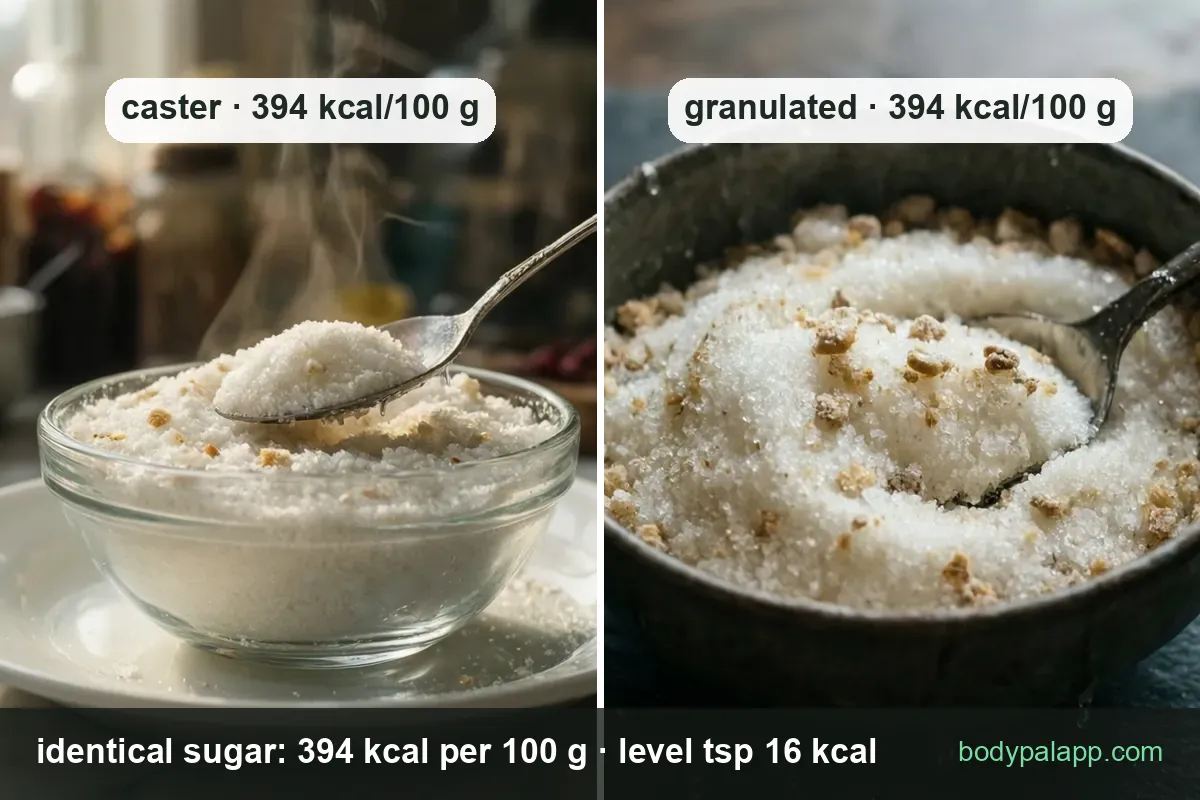
The numbers side by side
| Nutrient | Caster sugar, per level tsp (~4 g) | Caster, per 100 g | Granulated sugar, per level tsp (~4 g) | Granulated, per 100 g |
|---|---|---|---|---|
| Energy | 16 kcal / 67 kJ | 394 kcal / 1,648 kJ | 16 kcal / 67 kJ | 394 kcal / 1,648 kJ |
| Protein | 0 g | 0 g | 0 g | 0 g |
| Carbohydrate | 4 g | 100 g | 4 g | 100 g |
| of which sugars | 4 g | 100 g | 4 g | 100 g |
| Fat | 0 g | 0 g | 0 g | 0 g |
| Fibre | 0 g | 0 g | 0 g | 0 g |
| Salt | 0 g | 0 g | 0 g | 0 g |
Verified nutrition data
Numbers on this page come from CoFID, the UK government’s Composition of Foods Integrated Dataset, and from manufacturer labels where a branded product is named. Last verified August 2026. How we verify our data →
Two products, one table. Every row matches because chemically there is nothing to separate: both are essentially pure sucrose, and sucrose carries just under 4 calories per gram whatever shape the crystal takes.
Why they are the same
Granulated sugar comes out of the refinery first. Caster is that same sugar passed through a finer mill, sold at a higher price for the convenience of a crystal that dissolves in seconds rather than minutes. Milling changes surface area and nothing else. No water is added, nothing is removed, and 100 g stays 394 kcal on either side of the process.
The one place a difference can appear is the spoon, not the sugar. Fine crystals settle slightly differently from coarse ones, so a "teaspoon" of each can weigh a fraction apart. Recipes solve this by working in grams, and by weight the two are interchangeable to the calorie.
When to pick caster
Baking, and specifically baking where texture is the point. Caster creams into butter more evenly, cutting the fine air pockets that give a sponge its crumb, and it dissolves fast enough for meringues and custards not to turn grainy. If the recipe says caster, it is talking about mechanics.
Just do not let the softer texture suggest a softer number. A sponge's 175 g of caster is 690 kcal, the same as 175 g of granulated would be.
When to pick granulated
Everywhere else. In tea or coffee the crystal dissolves long before you sip, so paying the caster premium is throwing money at a solved problem. Granulated is also the sugar you want for crunchy toppings and jams, where its coarser crystal is an asset rather than a flaw.
For calorie logging, treat them as one item. A two-sugar tea habit costs 32 kcal a mug on either sugar, and the arithmetic of cutting back works identically.
Most popular caster and granulated sugar brands in the United Kingdom
Ranked by how widely each product appears among foods sold in the United Kingdom, from the BodyPal food database of over 3.3 million products. Calories are the figures printed on each label. Five labels, three kilocalories between them: the grind changes nothing.
| Product | Calories (per 100 g) |
|---|---|
| Belbake Granulated Sugar (Lidl) | 401 kcal |
| Tate & Lyle Pure Cane Granulated Sugar | 400 kcal |
| Tate & Lyle Golden Caster Sugar | 399 kcal |
| Billington’s Golden Caster Sugar | 399 kcal |
| Tesco Caster Sugar | 398 kcal |
Brand popularity: BodyPal food database. Nutrition: manufacturer labels.
Frequently asked questions
Which has fewer calories, caster or granulated sugar?
Neither. Both contain 394 kcal per 100 g and 16 kcal per level teaspoon. They are the same white sucrose at different grind sizes, so there is no lighter option to find. Any calorie saving has to come from using less sugar, not from switching between the two.
Can I substitute granulated for caster sugar?
Yes, weight for weight, and the calories match exactly. In delicate sponges and meringues the coarser crystal may dissolve unevenly, leaving speckles or a slightly denser crumb; a short blitz in a food processor closes that gap. In drinks, syrups and stewed fruit the swap is invisible.
Why is caster sugar more expensive if it's the same?
You are paying for the extra milling step and the baking convenience it buys, not for a different ingredient. Nutritionally the products are identical at 394 kcal per 100 g. If the fine crystal never matters in your cooking, granulated does the same job for less.
Is icing sugar the same calories as caster and granulated?
Effectively yes: icing sugar is 393 kcal per 100 g, one calorie below the other two, because it is the same sucrose milled to a powder with a trace of anti-caking agent. The whole white sugar family sits on one number; only the crystal size changes.
Does caster sugar dissolve into fewer calories in tea?
No. Dissolving changes where the sugar is, not what it is; a level teaspoon adds 16 kcal to the mug whether it disappears in two seconds or twenty. Speed of dissolving is the only real difference between the two sugars in a hot drink, and it has no calorie meaning.
More comparisons
- Almond vs peanut butter — 103 vs 97 kcal a spoon
- Butter vs ghee — 744 vs 898 kcal per 100 g
- Butter vs margarine — 4 kcal apart on toast
- Quinoa vs rice — 111 vs 131 kcal cooked
- Salted vs unsalted butter — identical calories, the salt differs
Count it without the maths
BodyPal logs the spoon in your tea and the sugar in your bake from one photo, whichever crystal you bought.


Burning it off is one side of it. The other is knowing your number: work out how many calories you need a day, with macros and a goal date.