
Calories in Margarine: 688 per 100 g, and Why the Tub Is a Different Food
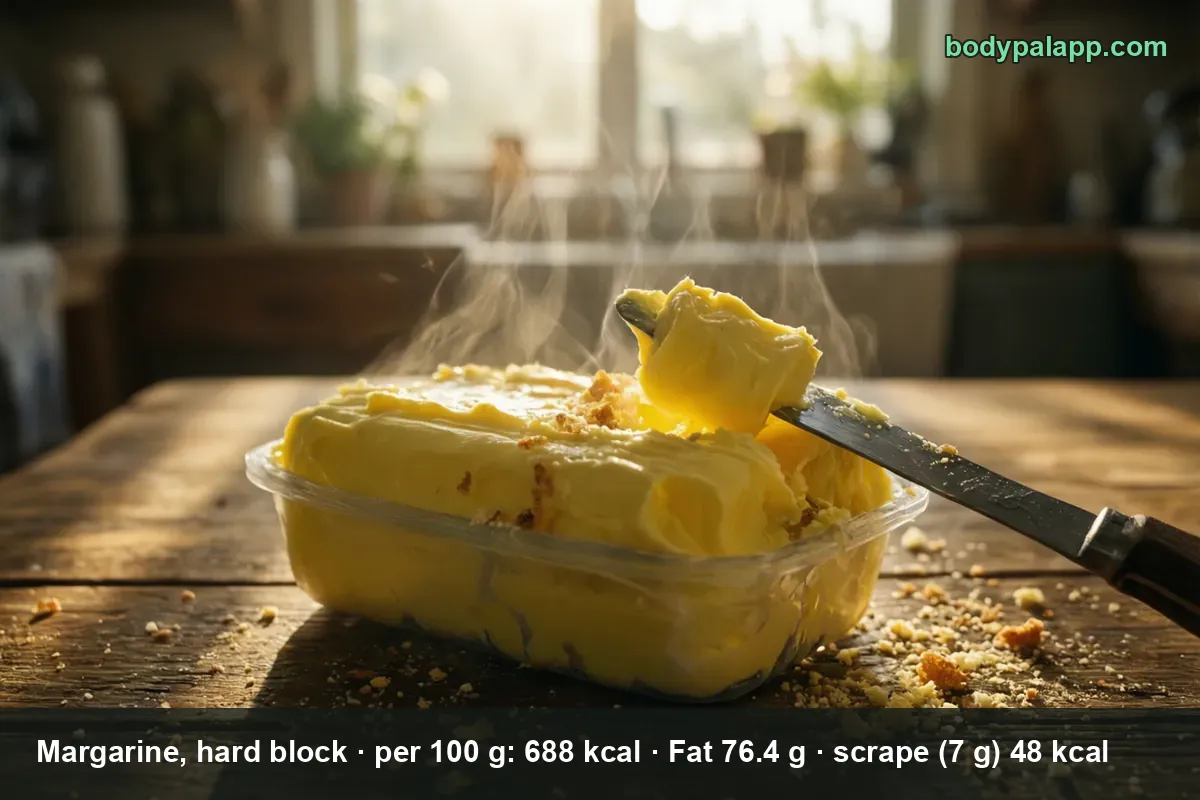
Start with a correction: the calories in margarine depend on which margarine you mean. The hard block sold for baking is 688 kcal per 100 g, 48 in a thin scrape. The soft tubs most households actually spread are not legally margarine at all. They are fat spreads, and they run anywhere from 339 to 552.
On this page
- Margarine nutrition at a glance
- Block, tub and light tub: the ladder
- Teaspoon, scrape and tablespoon
- Margarine against butter and ghee
- The diet-choice myth
- Most popular margarine and spread brands
- FAQ
Margarine nutrition at a glance
| Nutrient | Per 100 g | Per thin scrape (~7 g) | %RI* per scrape |
|---|---|---|---|
| Energy | 688 kcal / 2,879 kJ | 48 kcal / 201 kJ | 2% |
| Protein | 0 g (trace) | 0 g | 0% |
| Carbohydrate | 0 g | 0 g | 0% |
| of which sugars | 0 g | 0 g | 0% |
| Fat | 76.4 g | 5.3 g | 8% |
| of which saturates | 26.4 g | 1.8 g | 9% |
| Fibre | 0 g | 0 g | – |
| Salt | 1.5 g | 0.11 g | 2% |
*%RI = percentage of the reference intake for an average adult (2,000 kcal; 70 g fat, 20 g saturates, 260 g carbohydrate, 90 g sugars, 50 g protein, 6 g salt).
Verified nutrition data
Numbers on this page come from CoFID, the UK government’s Composition of Foods Integrated Dataset, and from manufacturer labels where a branded product is named. Last verified August 2026. How we verify our data →
These are the figures for hard block margarine, the 75–90% fat product that bakes like butter. Like butter, it is essentially pure fat: no protein, no carbohydrate, no fibre, and a salt line worth a glance at 1.5 g per 100 g.
The saturates row is where it stops behaving like butter. At 26.4 g per 100 g, block margarine carries half the saturated fat of butter's 52.1 g, which is the actual reason NHS advice on fats points towards unsaturated spreads rather than any calorie argument.
Block, tub and light tub: the ladder
UK law reserves the word margarine for the hard, high-fat product. Everything softer on the shelf is a fat spread, and the fat percentage on the front of the tub is the whole story:
| Product (CoFID category) | Fat | Per 100 g | Per scrape (~7 g) |
|---|---|---|---|
| Block margarine (75–90% fat) | 76.4 g | 688 kcal | 48 kcal |
| Reduced-fat spread (41–62%), standard | 60.6 g | 552 kcal | 39 kcal |
| Reduced-fat spread (41–62%), polyunsaturated | 59.2 g | 533 kcal | 37 kcal |
| Low-fat spread (26–39%), polyunsaturated | 36.9 g | 339 kcal | 24 kcal |
What dilutes the fat is water. A low-fat spread is roughly half water whipped into fat, which is why it cannot be baked with and why it saves a genuine 24 kcal per scrape against the block. Across a two-toast breakfast, block margarine costs 96 kcal and a light spread 48. That is the one swap in this category that actually moves a diary.
Teaspoon, scrape and tablespoon
| Portion | Weight | Calories |
|---|---|---|
| Level teaspoon | ~5 g | 34 kcal |
| Thin scrape for one slice | ~7 g | 48 kcal |
| Level tablespoon | ~14 g | 96 kcal |
On white toast at 85 kcal a slice, a scrape of block margarine makes the round 133. In baking, where block margarine earns its keep, a tablespoon into the mix is 96 kcal, eight fewer than butter's 104. A whole 250 g block creamed into a sponge is 1,720 kcal, and no cake recipe was ever rescued by that difference from butter's 1,860.
Margarine against butter and ghee
| Fat | Per 100 g | Per scrape (~7 g) | Saturates per 100 g |
|---|---|---|---|
| Low-fat spread (26–39%) | 339 kcal | 24 kcal | – |
| Block margarine | 688 kcal | 48 kcal | 26.4 g |
| Butter | 744 kcal | 52 kcal | 52.1 g |
| Ghee | 898 kcal | 63 kcal | – |
The verdict: between block margarine and butter there are 4 kcal per scrape, so choose on saturates and taste, not calories; margarine wins the first, butter usually wins the second. If the goal is fewer calories on toast, skip the debate entirely and pick a low-fat spread, which halves the cost per slice. The longer argument is in butter vs margarine.
The diet-choice myth
"Margarine is the low-calorie option." Block margarine is 92% of butter's calories: 688 against 744 per 100 g. Nobody can taste 4 kcal on a slice. The products that are genuinely lighter are the low-fat spreads at 339, and they achieve it with water, not with any virtue of margarine itself. If a tub in your fridge says 60% fat, it is closer to butter than to the light spread next to it.
Most popular margarine and spread brands in the United Kingdom
Ranked by how widely each product appears among foods sold in the United Kingdom, from the BodyPal food database of over 3.3 million products. Calories are the figures printed on each label. These are tub spreads rather than the hard baking block, which is why every figure sits far below 688.
| Product | Calories (per 100 g) |
|---|---|
| Clover Utterly Butterly | 400 kcal |
| Stork Country Spread | 362 kcal |
| Flora ProActiv | 319 kcal |
| Flora Light | 269 kcal |
Brand popularity: BodyPal food database. Nutrition: manufacturer labels.
How long does it take to burn off margarine?
100 g is 688 kcal. Enter your weight and the amount you ate to see how long it takes you to burn that off:
lb
| Activity | Time to burn 688 kcal |
|---|---|
| Walking, brisk | 2 hr 18 min |
| Cycling, moderate | 1 hr 26 min |
| Swimming, moderate | 1 hr 38 min |
| Jogging | 1 hr 21 min |
| Weight training, moderate | 2 hr 33 min |
Times are for a 154 lb (11 st) adult at a steady pace; change the weight to see yours. The amount is set to the portion in the text (100 g); change it to what you actually ate. BodyPal works this out from your steps automatically.
Burning it off is one side of it. The other is knowing your number: work out how many calories you need a day, with macros and a goal date.
Frequently asked questions
Does margarine have fewer calories than butter?
Barely. Block margarine is 688 kcal per 100 g against butter's 744, which works out at 48 versus 52 for a thin scrape on toast. The real difference is saturated fat, 26.4 g against 52.1 g per 100 g. For a genuine calorie saving, a low-fat spread at 339 kcal is the honest option.
How many calories are in margarine on toast?
About 133 kcal: 85 for a medium slice of white toast plus 48 for a 7 g scrape of block margarine. With a light spread the same slice comes to about 109. Two rounds with block margarine reach 266, so the spread is roughly a third of the total.
How many calories are in a teaspoon of margarine?
A level teaspoon, about 5 g, is 34 kcal. A tablespoon of 14 g is 96 kcal, the more useful figure for baking, where recipes measure margarine by the hundred grams. Every number scales cleanly from 688 kcal per 100 g.
What is the lowest-calorie spread?
Low-fat spreads in the 26–39% fat band, at roughly 339 kcal per 100 g, or 24 kcal per scrape. They carry about half the calories of block margarine because they are diluted with water, which is also why they spit in a frying pan and fail in pastry.
Is margarine better than butter for baking?
Block margarine was built for it: 76.4 g of fat per 100 g, firm at room temperature, and 96 kcal per tablespoon against butter's 104. Cakes rise the same. Soft tub spreads are the ones to avoid in a recipe, because their water content changes the texture.
How much salt is in margarine?
Block margarine carries 1.5 g of salt per 100 g, slightly under salted butter's 1.8 g. Per scrape that is 0.11 g, about 2% of the 6 g daily reference intake. Spread four slices a day and margarine quietly contributes just under half a gram.
Does margarine contain any protein or carbs?
No. Block margarine shows trace protein, zero carbohydrate and zero sugars per 100 g, so all 688 of its calories come from its 76.4 g of fat. In that respect it behaves exactly like butter: a pure fat with water, not a food with a mixed profile.
Why is block margarine so high in calories?
Because it is 76.4 g of fat per 100 g, and fat is the densest macronutrient at 9 kcal per gram. That arithmetic puts any high-fat spread near 700 kcal per 100 g. Only adding water brings the number down, which is precisely what the reduced-fat tubs do.
Similar foods
- Mayonnaise — 103 kcal a tablespoon
- Almond butter — 103 kcal per tablespoon
- Butter — 52 kcal per thin scrape
- Peanut butter — 97 kcal per tablespoon
- Pistachios — 180 kcal per 30 g kernels
- Almonds — 166 kcal per 30 g handful
Count it without the maths
Point BodyPal at the breakfast plate and it logs the toast and the spread in one photo, whichever tub it came from.

