
How Many Calories in Pistachios?
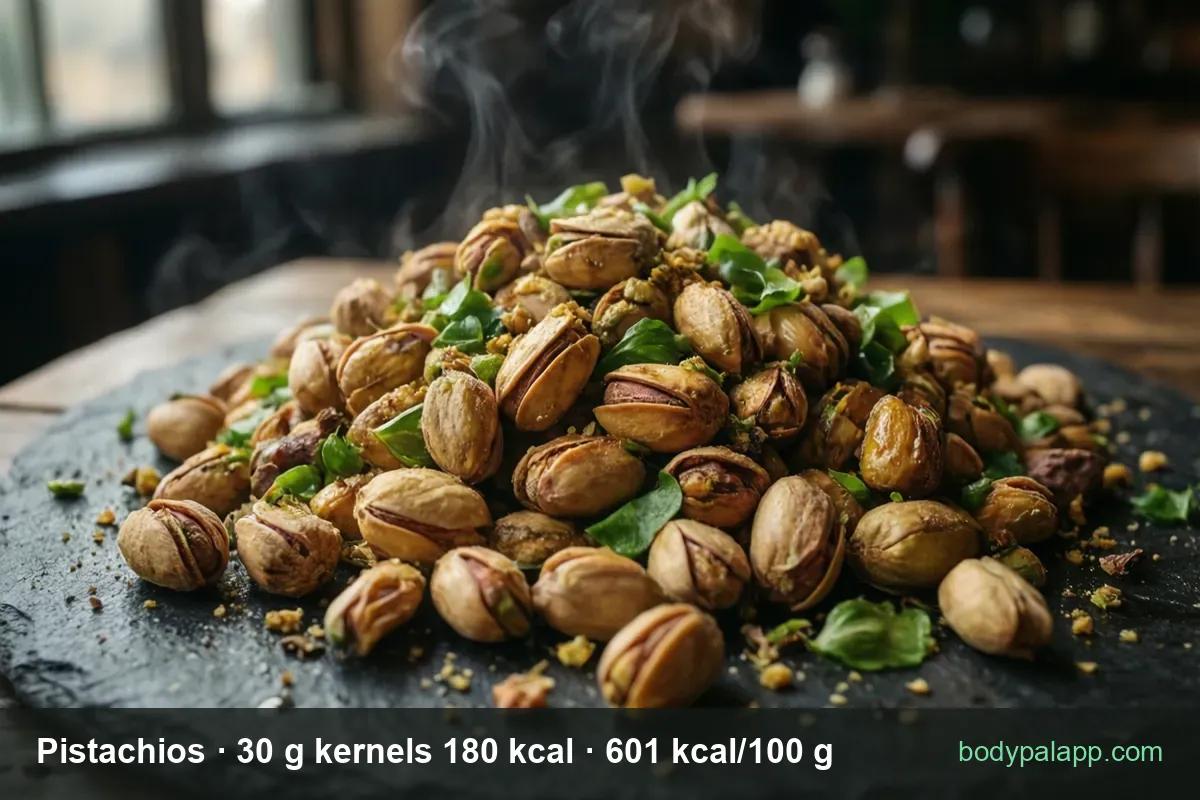
Weigh pistachios in their shells and 100 g comes to just 331 kcal; weigh the kernels alone and the same 100 g is 601. Nearly half of every bag is shell. A 30 g portion of kernels, about 30 nuts, is 180 kcal. That gap is the whole story of how many calories in pistachios you actually eat.
On this page
- Pistachio nutrition per 100 g
- Portions with and without shells
- The shell is a built-in brake
- How do pistachios compare
- Most popular pistachio brands
- FAQ
Pistachio nutrition per 100 g
Figures are for roasted, salted kernels only, shells off.
| Nutrient | Per 100 g | % RI* |
|---|---|---|
| Energy | 601 kcal / 2,515 kJ | 30% |
| Protein | 17.9 g | 36% |
| Carbohydrates | 8.2 g | 3% |
| Fat | 55.4 g | 79% |
| Saturates | 7.4 g | 37% |
| Fibre | 7.4 g | — |
| Sugar | 5.7 g | 6% |
| Salt | 1.32 g | 22% |
*Reference intake of an average adult (8,400 kJ / 2,000 kcal). No RI is set for fibre; the NHS guideline is 30 g a day.
Verified nutrition data
Numbers on this page come from CoFID, the UK government’s Composition of Foods Integrated Dataset, and from manufacturer labels where a branded product is named. Last verified August 2026. How we verify our data →
Kernel for kernel, pistachios are dense: over half fat, though mostly the unsaturated kind the NHS suggests choosing over saturated fat. Protein is a solid 17.9 g per 100 g and fibre 7.4 g.
One number here is unusual for a nut: 1.32 g of salt per 100 g. The standard roasted-and-salted pistachio is the saltiest thing in the nut aisle, worth knowing if you're keeping under the NHS 6 g daily limit.
Portions with and without shells
| Portion | Calories |
|---|---|
| 1 kernel | ~6 kcal |
| 30 g shelled kernels (~30 nuts) | 180 kcal / 753 kJ |
| 60 g bag weighed with shells | ~199 kcal |
| 100 g weighed with shells | 331 kcal |
The in-shell numbers are the useful ones, because that's how most of us buy them. A 100 g bag of in-shell pistachios holds only about 55 g of actual nut, which is why it registers 331 kcal rather than 601. Work through a whole 60 g bag, shells and all, and you've eaten roughly 199 kcal.
The 30 g kernel portion at 180 kcal is the honest benchmark for calorie counting: roughly 6 kcal per nut, so counting works if weighing doesn't.
The shell is a built-in brake
Pistachios are the one snack where the packaging does the portion control. Every nut needs opening, each one takes a moment, and the pile of empty shells sits there as a running tally of what you've eaten. Researchers call the effect the "pistachio principle": slower eating and visible leftovers nudge people to stop sooner than they would with a bowl of ready-shelled nuts.
Compare that with pre-shelled kernels, where 100 g and its 601 kcal can vanish during one episode of something. Same food, different speed limit. If pistachios are your evening habit, buying them in shells is the cheaper version of willpower.
How do pistachios compare
| Snack | Calories per 100 g |
|---|---|
| Popcorn | 470 kcal |
| Almonds | 554 kcal |
| Pistachio kernels | 601 kcal |
| Peanut butter | 607 kcal |
The verdict: on raw density pistachios sit near the top, but density isn't how snacks are eaten. In their shells, pistachios are arguably the best weight-management pick of the group, because the work slows you down; per portion that's 180 kcal against a mindless 554-plus from an open bag of anything shelled. Almonds win if you want more protein and no salt.
Most popular pistachio brands in the United Kingdom
Ranked by how widely each product appears among foods sold in the United Kingdom, from the BodyPal food database of over 3.3 million products. Calories are the figures printed on each label.
| Product | Calories (per 100 g kernels) |
|---|---|
| Alesto Californian Roasted Pistachios (Lidl) | 605 kcal |
| Morrisons Salted Pistachios | 579 kcal |
Brand popularity: BodyPal food database. Nutrition: manufacturer labels.
Pistachio FAQs
How many calories in pistachios with shells?
331 kcal per 100 g weighed with shells, against 601 kcal per 100 g for kernels alone. The shells are about 45% of the bag's weight and contribute nothing you eat. A typical 60 g in-shell bag works out around 199 kcal once you've shelled your way through it.
How many calories in 30 g of pistachios?
180 kcal for 30 g of kernels, which is roughly 30 nuts. That portion carries 5.4 g of protein, 2.2 g of fibre and 0.4 g of salt. At about 6 kcal per kernel, counting nuts is a perfectly workable substitute for weighing them.
Are pistachios good for weight loss?
A 30 g portion at 180 kcal fits easily into a calorie budget, and in-shell pistachios have a genuine advantage: shelling slows eating and the empty shells show you how much has gone. Buy them in shells and pre-portion the bag; the kernels-only tubs are far easier to overeat.
How much protein is in pistachios?
17.9 g per 100 g of kernels, so a 30 g portion delivers about 5.4 g. That's respectable, though almonds do better at 21.2 g per 100 g. Pistachios answer back with fewer calories per nut, around 6 kcal against the almond's 7.
Salted or unsalted pistachios – does it matter?
For calories, barely; for salt, a lot. Roasted salted kernels carry 1.32 g of salt per 100 g, the highest in the nut aisle, and a 30 g portion adds 0.4 g towards the NHS 6 g daily maximum. Unsalted versions remove that almost entirely while the energy stays similar.
How many calories in one pistachio?
About 6 kcal per kernel. That makes the mental arithmetic easy: 10 nuts is roughly 60 kcal, 30 nuts about 180. Few snacks price themselves so transparently, which is one more reason pistachios suit people who track what they eat.
Pistachios or almonds – which is better?
Almonds are 554 kcal per 100 g with more protein (21.2 g vs 17.9) and more fibre (12.5 g vs 7.4), and no salt. Pistachios are 601 kcal but come with the in-shell brake that slows eating. For nutrition on paper, almonds; for not finishing the bag, pistachios.
How many pistachios a day is reasonable?
The standard portion is 30 g of kernels, about 30 nuts and 180 kcal, and it's a sensible daily amount if you're counting calories. If you're watching salt too, favour unsalted kernels, since the salted kind carries 1.32 g of salt per 100 g.
Similar foods
- Peanut butter — 97 kcal per tablespoon
- Almond butter — 103 kcal per tablespoon
- Almonds — 166 kcal per 30 g handful
- Mayonnaise — 103 kcal a tablespoon
- Margarine — 48 kcal per scrape
- Chia seeds — 58 kcal a tablespoon
Count them without the maths
BodyPal logs a bowl of pistachios – shells ignored, calories and salt counted – from one photo.


How long does it take to burn off pistachios?
A 30 g portion of kernels (~30 nuts) is 180 kcal. Enter your weight and the amount you ate to see how long it takes you to burn that off:
lb
| Activity | Time to burn 180 kcal |
|---|---|
| Walking, brisk | 36 min |
| Cycling, moderate | 22 min |
| Swimming, moderate | 26 min |
| Jogging | 21 min |
| Weight training, moderate | 40 min |
Times are for a 154 lb (11 st) adult at a steady pace; change the weight to see yours. The amount is set to the portion in the text (30 g); change it to what you actually ate. BodyPal works this out from your steps automatically.
This table assumes you know your daily total. If you do not, the daily calorie calculator works it out from five numbers.