
How Many Calories in a Tablespoon of Peanut Butter?
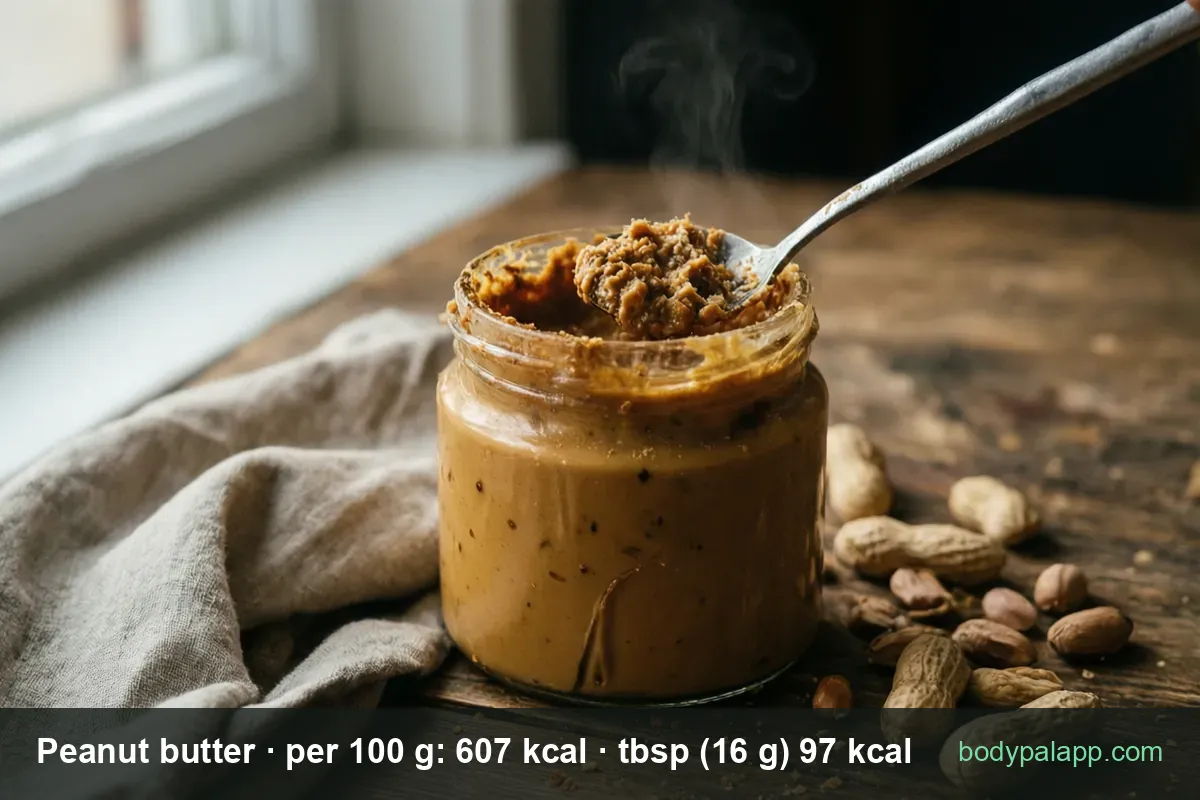
There are 97 calories in a tablespoon of peanut butter, if the spoon is level and holds 16 g. Almost no spoon that leaves a jar is level. Per 100 g the figure is 607 kcal, and the gap between the portion on the label and the portion on the knife is where diaries go wrong.
On this page
- Peanut butter nutrition at a glance
- What a spoon actually weighs
- Smooth, crunchy, toast and apples
- Peanut butter against the other jars
- The protein-food myth
- Most popular peanut butter brands
- FAQ
Peanut butter nutrition at a glance
| Nutrient | Per 100 g | Per tbsp (~16 g) | %RI* per tbsp |
|---|---|---|---|
| Energy | 607 kcal / 2,540 kJ | 97 kcal / 406 kJ | 5% |
| Protein | 22.8 g | 3.6 g | 7% |
| Carbohydrate | 13.1 g | 2.1 g | 1% |
| of which sugars | 6.7 g | 1.1 g | 1% |
| Fat | 51.8 g | 8.3 g | 12% |
| Fibre | 6.6 g | 1.1 g | – |
| Salt | 0.88 g | 0.14 g | 2% |
*%RI = percentage of the reference intake for an average adult (2,000 kcal; 70 g fat, 260 g carbohydrate, 90 g sugars, 50 g protein, 6 g salt).
Verified nutrition data
Numbers on this page come from CoFID, the UK government’s Composition of Foods Integrated Dataset, and from manufacturer labels where a branded product is named. Last verified August 2026. How we verify our data →
Half the jar is fat, at 51.8 g per 100 g, which is why the calories run so high. But the supporting cast is unusually good for something this energy-dense: 22.8 g of protein and 6.6 g of fibre per 100 g. A tablespoon contributes 1.1 g towards the 30 g of fibre a day the NHS suggests, which butter and jam cannot say.
The salt is worth one glance: 0.88 g per 100 g in a standard salted jar. Spread as most people spread, that is 0.14 g a spoonful, a modest slice of the NHS 6 g daily guideline, and no-added-salt versions exist for anyone counting harder.
What a spoon actually weighs
| Portion | Weight | Calories |
|---|---|---|
| Level teaspoon | ~8 g | 49 kcal |
| Level tablespoon | ~16 g | 97 kcal |
| Heaped tablespoon | ~25 g | 152 kcal |
| Spread for one slice of toast | ~15 g | 91 kcal |
The jar's own label usually declares a 15 g portion. Weigh what you actually drag out of a fresh jar and it is routinely 25 g or more, because peanut butter clings to the spoon in a heap. That single habit turns a 97-calorie entry into a 152-calorie reality, and it happens twice a day for a lot of people.
The honest fix costs ten seconds: put the jar on scales once, learn what your spoon looks like at 16 g, and log that. Nobody needs to do it forever. Once is enough to stop guessing low by half.
Smooth, crunchy, toast and apples
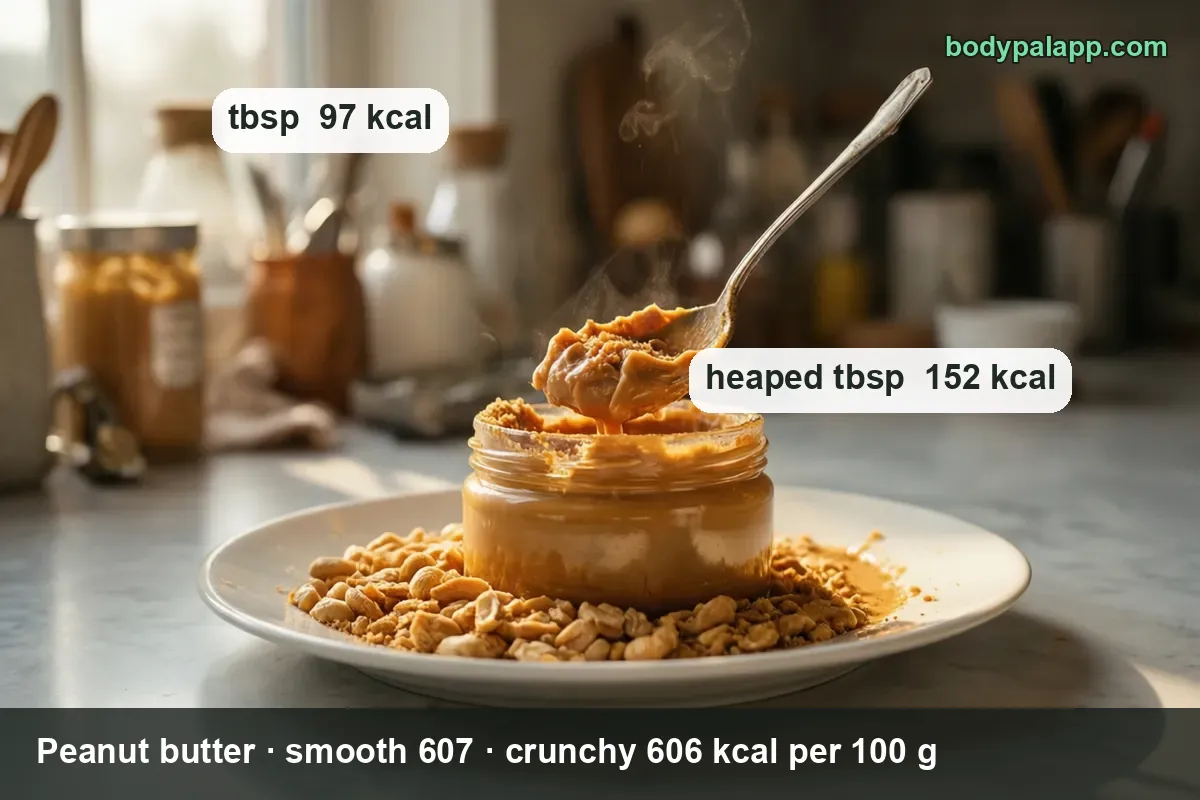
Smooth vs crunchy. The eternal debate is nutritionally empty: smooth is 607 kcal per 100 g and a typical crunchy jar comes in at 606, with the macros virtually identical. Pick the texture you like; the calories do not care.
On toast. A slice of white toast at 85 kcal plus a 15 g spread at 91 kcal lands at 176 kcal a round. Two rounds is 352, which is a proper breakfast rather than a snack, and worth logging as one.
With an apple. Sliced apple with a level tablespoon for dipping adds 97 kcal to whatever the fruit brings. As snacks go it is one of the better trades: the fibre from both sides does more for fullness than a biscuit at the same price.
In porridge. A spoon stirred into porridge melts invisible, and 97 kcal disappears into the bowl. Nice trick for hungry mornings, expensive one if it goes unlogged.
Peanut butter against the other jars
| Spread | Per 100 g | Per tbsp (~16 g) | Protein per 100 g |
|---|---|---|---|
| Peanut butter (smooth) | 607 kcal | 97 kcal | 22.8 g |
| Almond butter | 641 kcal | 103 kcal | 20.7 g |
| Whole almonds | 598 kcal | 96 kcal | 21.0 g |
| Butter | 744 kcal | 104 kcal (~14 g) | 0.6 g |
The verdict: among the nut butters, peanut is the cheaper jar and the better macro deal, with fewer calories and more protein than almond. Against dairy butter the calorie gap per spoon is small; the difference is that peanut butter's spoon carries protein and fibre while butter's carries almost nothing but fat. For a weight-loss diary, peanut butter earns its place if the spoon is measured; nothing at 600-plus kcal per 100 g survives being eyeballed.
The protein-food myth
"Peanut butter is a protein food." It is a fat food with a protein bonus. Per tablespoon you get 8.3 g of fat and 3.6 g of protein, so more than twice as much energy arrives from fat as from protein. The 22.8 g per 100 g headline is real, but you would need a third of a jar to rival a chicken breast, at around 600 calories for the privilege. Enjoy it for what it is; just let the chicken do the protein lifting.
Most popular peanut butter brands in the United Kingdom
Ranked by how widely each product appears among foods sold in the United Kingdom, from the BodyPal food database of over 3.3 million products. Calories are the figures printed on each label.
| Product | Calories (per 100 g) |
|---|---|
| Whole Earth Smooth Peanut Butter | 645 kcal |
| Whole Earth Crunchy Peanut Butter | 643 kcal |
| Meridian Smooth Peanut Butter | 596 kcal |
| Pip & Nut Smooth Peanut Butter | 593 kcal |
| Manilife Deep Roast Smooth | 613 kcal |
Brand popularity: BodyPal food database. Nutrition: manufacturer labels.
How long does it take to burn off peanut butter?
A level 16 g tablespoon is 97 kcal. Enter your weight and the amount you ate to see how long it takes you to burn that off:
lb
| Activity | Time to burn 97 kcal |
|---|---|
| Walking, brisk | 19 min |
| Cycling, moderate | 12 min |
| Swimming, moderate | 14 min |
| Jogging | 11 min |
| Weight training, moderate | 22 min |
Times are for a 154 lb (11 st) adult at a steady pace; change the weight to see yours. The amount is set to the portion in the text (16 g); change it to what you actually ate. BodyPal works this out from your steps automatically.
One food is easy to picture; a whole day is harder. See how many calories you need a day and what a deficit actually looks like.
Frequently asked questions
How many calories are in a tablespoon of peanut butter?
A level 16 g tablespoon of smooth peanut butter is 97 kcal. A heaped spoon, which is what most people actually take, weighs closer to 25 g and costs 152 kcal. Weighing the spoon once is the quickest fix a food diary can get.
How many calories are in a teaspoon of peanut butter?
A level teaspoon holding about 8 g is 49 kcal. It sounds harmless, but three teaspoons across a day of toast and snacks is 147 kcal, roughly a slice and a half of bread. Small spoons add up faster than the jar suggests.
Is crunchy peanut butter lower in calories than smooth?
No. Smooth is 607 kcal per 100 g and a typical crunchy jar is 606, with protein and fat close to identical. The peanut pieces change the texture, not the energy. Choose by preference and treat the numbers as the same.
How many calories in peanut butter on toast?
About 176 kcal a round: 85 for a slice of white toast and 91 for a 15 g spread. A two-slice round comes to roughly 352 kcal, which is breakfast territory. A thick spread pushes each slice past 200 kcal without looking any different.
Is peanut butter good for weight loss?
It can hold a place in a deficit: 97 kcal per level tablespoon buys 3.6 g of protein and 1.1 g of fibre, which is decent fullness for the money. The risk is the unmeasured spoon. At 607 kcal per 100 g, guessing low by 10 g a day is 60-odd phantom calories.
How much protein is in peanut butter?
22.8 g per 100 g, or 3.6 g in a level tablespoon. That beats almost every spread in the aisle, but it is still fat-first food: 51.8 g of fat per 100 g. For serious protein targets it is a supporting act, not the main source.
Why is peanut butter so high in calories?
Because just over half of it is fat: 51.8 g per 100 g, and fat carries 9 kcal per gram. Ground peanuts are simply a concentrated food. The 607 kcal per 100 g is not a processing trick; whole almonds and other nuts sit in the same range.
Does peanut butter have much salt?
A standard salted jar carries 0.88 g of salt per 100 g, which is 0.14 g per tablespoon, about 2% of the daily 6 g guideline. If you are watching salt, no-added-salt jars are easy to find and taste close enough after a week.
How many calories in apple slices with peanut butter?
The dip adds 97 kcal per level tablespoon on top of the apple itself. It is one of the more filling snacks at the price, since fruit fibre and nut fibre arrive together. Use a measured spoon and it stays a snack rather than a small meal.
Similar foods
- Pistachios — 180 kcal per 30 g kernels
- Almond butter — 103 kcal per tablespoon
- Almonds — 166 kcal per 30 g handful
- Mayonnaise — 103 kcal a tablespoon
- Margarine — 48 kcal per scrape
- Chia seeds — 58 kcal a tablespoon
Count the spoon without the scales
BodyPal logs the real spread from one photo of your toast, heap and all, so the jar's 15 g fantasy stops flattering your diary.

