
---
Porridge Calories: Water, Milk and Every Topping, Counted
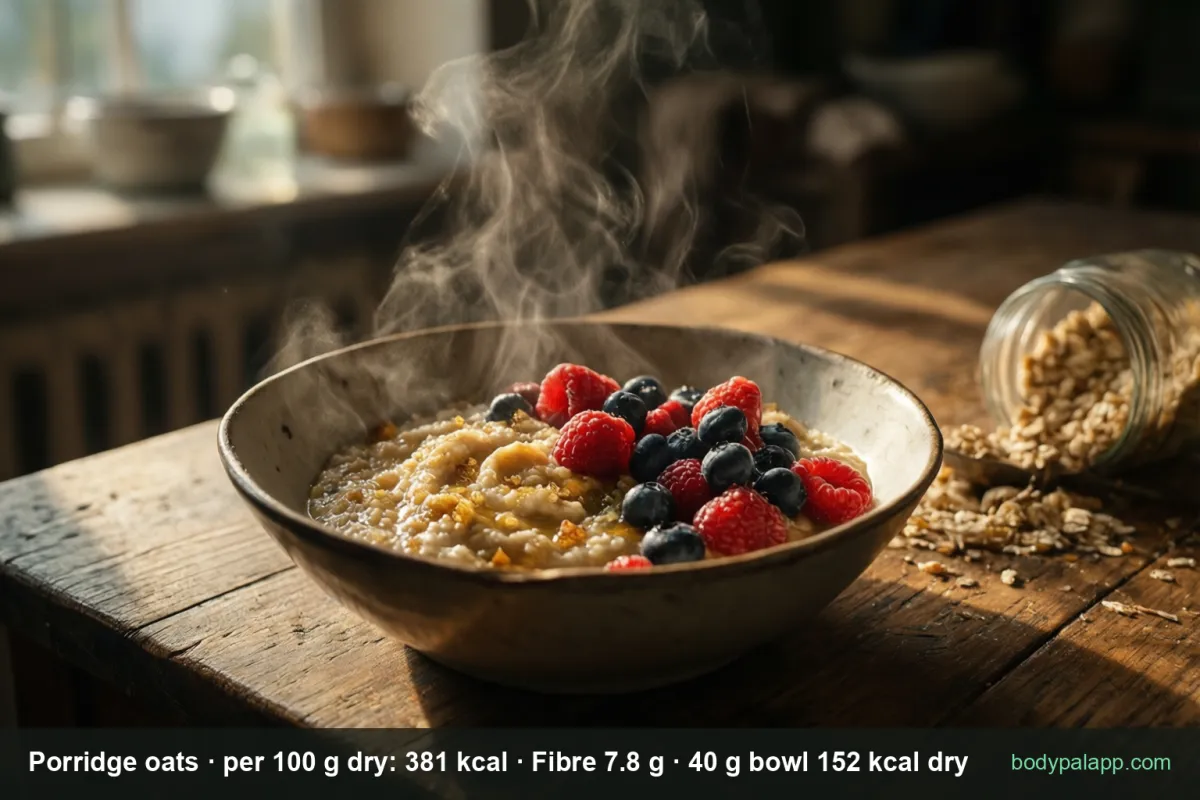
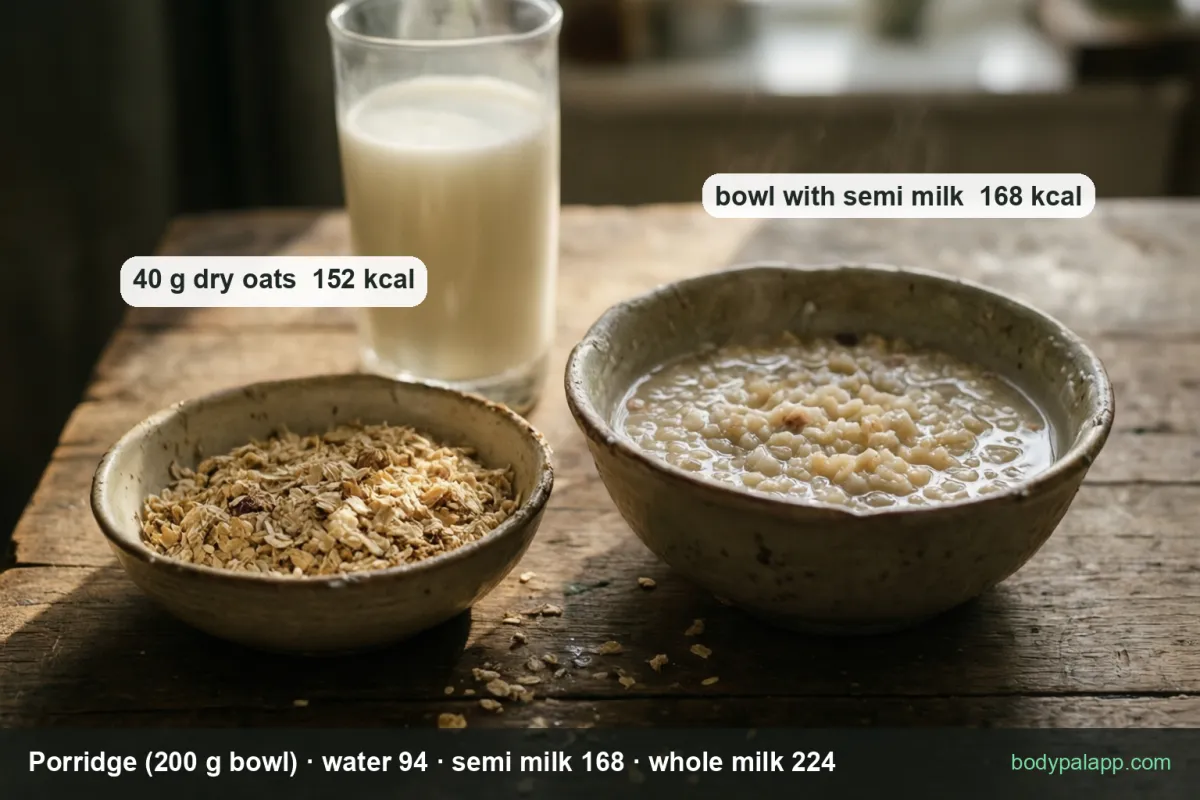
A 200 g bowl of porridge made with water is 94 kcal, or 47 kcal per 100 g. Swap the water for semi-skimmed milk and the bowl becomes 168 kcal; whole milk, 224 kcal. Dry oats are 381 kcal per 100 g and a 40 g serving is 152 kcal; the porridge calories people miss are in the liquid.
On this page
- Quick facts: porridge oats per 100 g
- What a real bowl costs: water vs milk
- UK portions
- Porridge with honey
- Porridge with banana
- Oats, beta-glucan and what the claim actually says
- How does porridge compare with other UK breakfasts?
- Three mistakes people make counting oats
- Most popular porridge oat brands
- FAQ
- Similar foods
Quick facts: porridge oats per 100 g
The honest starting point for porridge is the dry oats, because that is the only part of the bowl you can weigh before anything happens to it.
| Per | 40 g dry oats (typical serving) | %RI | 100 g dry oats | %RI |
|---|---|---|---|---|
| Energy | 152 kcal / 636 kJ | 8% | 381 kcal / 1594 kJ | 19% |
| Protein | 4.4 g | 9% | 10.9 g | 22% |
| Carbohydrate | 28.3 g | 11% | 70.7 g | 27% |
| of which sugars | 0.1 g | <1% | 0.3 g | <1% |
| Fat | 3.2 g | 5% | 8.1 g | 12% |
| Fibre | 3.1 g | — | 7.8 g | — |
| Salt | trace | 0% | trace (1 mg sodium) | 0% |
Verified nutrition data
Numbers on this page come from CoFID, the UK government’s Composition of Foods Integrated Dataset, and from manufacturer labels where a branded product is named. Last verified August 2026. How we verify our data →
%RI = percentage of an adult Reference Intake, based on 2,000 kcal a day. Fibre has no RI figure on UK labels.
Two numbers stand out. Sugar is 0.3 g per 100 g, so plain oats are effectively sugar-free before anything goes on top. And salt is a trace, which puts porridge in a different category from almost every other UK breakfast staple; the NHS guidance on salt sets 6 g a day for adults, and a plain bowl of oats spends none of it.
What a real bowl costs: water vs milk
Cooked porridge is mostly liquid, so the per-100 g figure depends entirely on what went into the pan. Here is the same finished porridge at four dilutions.
| Made with | Per 100 g cooked | 200 g bowl |
|---|---|---|
| Water | 47 kcal / 197 kJ | 94 kcal |
| Milk and water (half and half) | 72 kcal / 301 kJ | 144 kcal |
| Semi-skimmed milk | 84 kcal / 351 kJ | 168 kcal |
| Whole milk | 112 kcal / 469 kJ | 224 kcal |
The gap between the top and bottom rows is 130 kcal on an identical-looking bowl. That is the single biggest lever in porridge, bigger than any topping, and it is invisible once the pan is stirred. If you make yours with semi-skimmed milk, count it.
There is a catch with the cooked figures, and it trips people up constantly. Forty grams of dry oats is 152 kcal no matter what you do next. Spread that through enough water to hit 47 kcal per 100 g and you end up with roughly 320 g of finished porridge, which is a big bowl. Weigh a 200 g portion instead and you have not eaten 40 g of oats; you have eaten about 25 g of them.
So the cooked numbers answer "how many calories in this bowl in front of me". The dry number answers "how many calories did I put in". Pick one method and stay with it.
UK portions
| Portion | Calories |
|---|---|
| 40 g dry porridge oats (the serving on most UK packs) | 152 kcal |
| Bowl made with water, 200 g | 94 kcal |
| Bowl made with semi-skimmed milk, 200 g | 168 kcal |
| Bowl made with whole milk, 200 g | 224 kcal |
A 40 g scoop is smaller than most people picture. It is a level serving, not a heaped one, and a generous hand can easily double it before the kettle has boiled.
Porridge with honey
A teaspoon of honey adds 20 kcal, taking a water bowl from 94 to 114 kcal and a semi-skimmed bowl from 168 to 188 kcal. That is a cheap way to make plain oats taste like breakfast.
The risk is not the first spoon, it is the third. Honey drizzled straight from the squeezy bottle lands in ribbons, not teaspoons, and three of them cost more than the milk you were being careful about. Full numbers are on our honey page.
Porridge with banana
Half a banana, about 50 g of peeled fruit, adds 40 kcal and brings the water-made bowl to 134 kcal. Bananas are 81 kcal per 100 g, so a whole large one roughly doubles that addition.
Sliced fruit does something the numbers do not show: it spreads sweetness across the whole bowl, which usually means less honey goes in. A chopped apple works the same way for fewer calories again.
Oats, beta-glucan and what the claim actually says
Oats contain beta-glucan, a soluble fibre, and this is one of the few areas where a food claim is officially approved rather than marketing. The authorised claim on the GB nutrition and health claims register links oat beta-glucan to the maintenance of normal blood cholesterol, and it applies at an intake of 3 g of beta-glucan a day.
That is the whole claim. It sets a daily threshold, it does not promise anything about any individual, and a single bowl is not automatically 3 g. Our data covers energy and macros, not beta-glucan content, so treat the claim as context rather than a promise about this bowl.
What we can say from the table above is that 40 g of oats carries 3.1 g of total fibre, which is a solid contribution to the 30 g a day the NHS suggests for adults.
How does porridge compare with other UK breakfasts?
| Breakfast | Per serving | Per 100 g | P / C / F per 100 g |
|---|---|---|---|
| Porridge, made with water (200 g bowl) | 94 kcal | 47 kcal | 1.4 / 8.8 / 1.0 |
| Porridge, semi-skimmed milk (200 g bowl) | 168 kcal | 84 kcal | 4.6 / 12.1 / 2.3 |
| Crumpet | 95 kcal each | 207 kcal | 6.9 / 45.4 / 1.0 |
| Weetabix | — | 362 kcal | 12.0 / 69.0 / 2.0 |
| Full English breakfast | 1,093 kcal (full plate) | — | — |
The verdict: for weight loss, porridge made with water is the strongest breakfast on this list, because 94 kcal buys a hot bowl that takes ten minutes to eat rather than ninety seconds. For a morning that has to hold until a late lunch, make it with semi-skimmed milk at 168 kcal and take the protein; the water version is genuinely thin, and thin breakfasts get topped up at eleven.
Three mistakes people make counting oats
"Porridge is 47 calories." Only if you are counting 100 g of the finished, water-made bowl. The oats themselves are 381 kcal per 100 g, which is denser than most people expect from something marketed as diet food.
Logging the oats, then forgetting the milk. The milk is not a splash, it is the cooking liquid. It is the difference between 94 and 224 kcal.
Assuming instant sachets match the pack figures above. Flavoured sachets are a different product with added sugar, and their numbers come from the manufacturer label rather than from plain oats.
Most popular porridge oat brands in the United Kingdom
Ranked by how widely each product appears among foods sold in the United Kingdom, from the BodyPal food database of over 3.3 million products. Calories are the figures printed on each label. Dry oats are near-identical whichever bag you buy — the milk decides the bowl.
| Product | Calories (per 100 g of dry oats) |
|---|---|
| Quaker White Oats | 374 kcal |
| Mornflake Creamy Superfast Oats | 367 kcal |
| Sainsbury's Scottish Porridge Oats | 363 kcal |
Brand popularity: BodyPal food database. Nutrition: manufacturer labels.
How long does it take to burn off 94 kcal of porridge?
A 200 g bowl made with water is 94 kcal. Enter your weight and the amount you ate to see how long it takes you to burn that off:
lb
| Activity | Time to burn 94 kcal |
|---|---|
| Walking, brisk | 19 min |
| Cycling, moderate | 12 min |
| Swimming, moderate | 13 min |
| Jogging | 11 min |
| Weight training, moderate | 21 min |
Times are for a 154 lb (11 st) adult at a steady pace; change the weight to see yours. The amount is set to the portion in the text (200 g); change it to what you actually ate. BodyPal works this out from your steps automatically.
Want the bigger picture? Calculate your daily calorie needs — your maintenance figure, a target for losing or gaining, and the date you get there.
Frequently asked questions
How many calories are in porridge made with water?
Porridge made with water is 47 kcal per 100 g, so a 200 g bowl is 94 kcal. That is the finished porridge, not the oats. If you weigh your oats instead, 40 g of dry porridge oats is 152 kcal however much water you add to them.
How many calories are in porridge made with milk?
A 200 g bowl made with semi-skimmed milk is 168 kcal, and with whole milk it is 224 kcal. Half milk and half water lands between them at 144 kcal. Per 100 g those work out at 84, 112 and 72 kcal respectively.
How many calories in 40 g of oats?
40 g of dry porridge oats is 152 kcal, with 4.4 g protein, 28.3 g carbohydrate, 3.2 g fat and 3.1 g fibre. This is the serving size printed on most UK packs. Anything you cook it in, milk especially, is counted on top of that figure.
Is porridge good for weight loss?
Made with water, a 200 g bowl is 94 kcal, which is a small price for a hot breakfast. The oats bring 3.1 g of fibre per 40 g serving and almost no sugar at 0.3 g per 100 g. What changes the maths is the milk and the toppings, not the oats.
How many calories does honey add to porridge?
A teaspoon of honey adds 20 kcal, taking a water-made bowl to 114 kcal. Squeezed straight from the bottle, portions run bigger than a teaspoon, so two or three ribbons can add more than the milk does. Measure the first one to see what a teaspoon actually looks like.
Does porridge keep you full?
A 40 g serving carries 3.1 g of fibre and 4.4 g of protein, and the bowl is hot and slow to eat. Made with water at 94 kcal it is a light breakfast; made with semi-skimmed milk at 168 kcal it holds longer, mostly because there is more of everything in it.
Is porridge a good breakfast before the gym?
A 40 g serving of oats is 152 kcal with 28.3 g of carbohydrate, which is the part that matters before training. Made with semi-skimmed milk, a 200 g bowl comes to 168 kcal. Timing and quantity are personal; the numbers here are the fixed part.
How many calories in porridge with banana?
Half a banana adds 40 kcal, so a 200 g water-made bowl with banana is 134 kcal and a semi-skimmed bowl is 208 kcal. Bananas are 81 kcal per 100 g, so using the whole fruit instead of half roughly doubles that 40 kcal.
Is there much sugar in porridge?
Plain porridge oats contain 0.3 g of sugar per 100 g, which is under 1% of the daily Reference Intake. Everything sweet in a bowl of porridge is something you added: honey, fruit, syrup or the natural sugars in the milk you cooked it with.
How much salt is in porridge?
Porridge oats contain only a trace of salt, around 1 mg of sodium per 100 g. That is effectively zero against the 6 g daily maximum the NHS advises for adults. Salt added in the pan, and any salted topping, is what shows up on the total.
Similar foods
- Weetabix — 136 kcal for two biscuits
- Bacon roll — 250 kcal per roll
- Pancake — 187 kcal each
- Hash brown — 127 kcal each at McDonald’s
- Duck eggs — ~106 kcal each
- Eggs — 72 kcal per boiled medium egg
Count it without the maths
BodyPal logs a bowl of porridge, the milk it was made with and the honey on top from one photo, so the oats and the extras land on the same total.

