Duck Egg Calories: the Bigger Egg, Counted
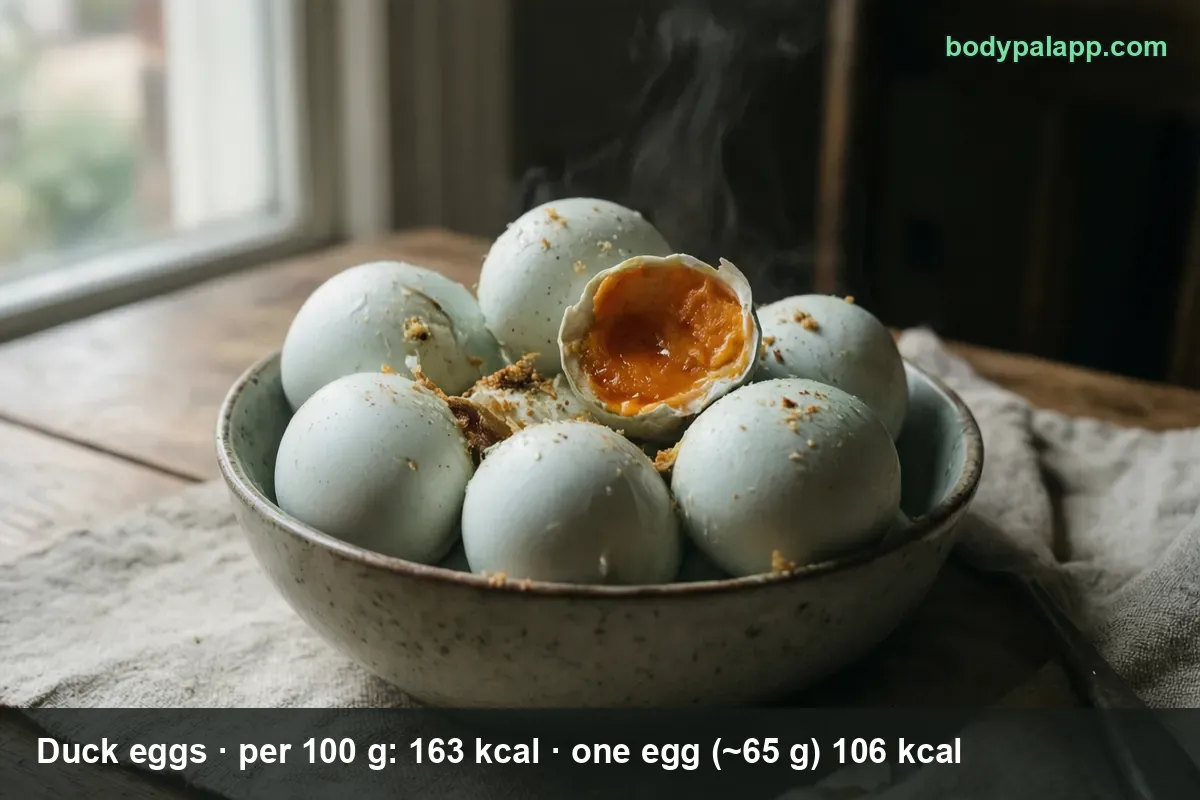
One duck egg is about 106 calories, and duck egg calories run 163 per 100 g. Put a medium chicken egg beside it on the same raw basis and you get 66, so the duck egg costs roughly 60% more per egg. Most of that gap is simply size, and the rest is a bigger, richer yolk.
On this page
- Duck egg nutrition at a glance
- One egg, two eggs, and the pan
- Where the extra calories come from
- What bakers know about duck eggs
- The salted duck egg is a different food
- Duck egg against chicken egg
- Most popular duck egg brands
- FAQ
Duck egg nutrition at a glance
Figures are for whole raw duck egg, which is how CoFID publishes it.
| Nutrient | Per 100 g | Per egg (~65 g edible) | %RI* per egg |
|---|---|---|---|
| Energy | 163 kcal / 682 kJ | 106 kcal / 443 kJ | 5% |
| Protein | 14.3 g | 9.3 g | 19% |
| Carbohydrate | 0 g (trace) | 0 g (trace) | – |
| of which sugars | 0 g (trace) | 0 g (trace) | – |
| Fat | 11.8 g | 7.7 g | 11% |
| Fibre | 0 g | 0 g | – |
| Salt | 0.30 g | 0.20 g | 3% |
*%RI = percentage of the reference intake for an average adult (2,000 kcal; 70 g fat, 260 g carbohydrate, 90 g sugars, 50 g protein, 6 g salt).
Verified nutrition data
Numbers on this page come from CoFID, the UK government’s Composition of Foods Integrated Dataset, and from manufacturer labels where a branded product is named. Last verified August 2026. How we verify our data →
Nearly a fifth of a day's protein reference intake in one egg is the line that matters. A duck egg is not a light food, but it is a serious one: 9.3 g of protein for 106 kcal, with no carbohydrate worth recording.
One egg, two eggs, and the pan
| Portion | Calories |
|---|---|
| One duck egg (~65 g edible) | 106 kcal |
| Two duck eggs | 212 kcal |
| One medium chicken egg, same raw basis | 66 kcal |
Two duck eggs at 212 kcal and 18.6 g of protein make a breakfast on their own. The same protein from chicken eggs takes three of them, which is the practical difference: duck eggs are counted in smaller numbers.
Cooking follows the same rules as any egg. Boiling and poaching add nothing. Frying adds whatever fat clings from the pan, and a teaspoon of butter under a duck egg is another 37 kcal before the toast enters the picture.
Where the extra calories come from
A duck egg weighs around 65 g edible against roughly 50 g for a medium chicken egg, so a third of the difference is pure size. The rest is composition. Duck egg carries 11.8 g of fat per 100 g against 9.0 g in raw chicken egg, because the yolk takes up a larger share of the egg.
That bigger yolk is why duck eggs taste richer and why the whites feel almost translucent and firm. It is a proper culinary difference, not marketing. Per gram, though, the two foods are more alike than the folklore suggests: 163 against 131 kcal per 100 g is a gap of about a quarter, not a doubling.
What bakers know about duck eggs
Bakers reach for duck eggs because the larger yolk share means more fat and more emulsifying power in the mix, which reads as richer sponges and silkier custards. One duck egg stands in comfortably for one large chicken egg with a little extra to spare.
For an ordinary fry-up the swap works in the other direction too. One duck egg instead of two chicken eggs saves you nothing, at 106 against 143 boiled, but one for one it costs about 34 kcal more. If the rest of the plate looks like a full English breakfast, the egg choice is a rounding error.
The salted duck egg is a different food
The salted duck egg sold in Asian grocers is brined for weeks, and the label reads accordingly: 198 kcal per 100 g and 4.2 g of salt. One egg on that basis gets you close to half of the 6 g daily salt limit the NHS advises, which is why it is eaten as a condiment with rice, not as breakfast.
Fresh duck eggs from a British farm shop carry 0.30 g of salt per 100 g. The two products share a bird and nothing else.
Duck egg against chicken egg
| Food | Per egg | Per 100 g | Protein | Fat |
|---|---|---|---|---|
| Duck egg (raw) | 106 kcal | 163 kcal | 14.3 g | 11.8 g |
| Chicken egg, medium (raw) | 66 kcal | 131 kcal | 12.6 g | 9.0 g |
| Chicken egg, medium (boiled) | 72 kcal | 143 kcal | 14.1 g | 9.6 g |
The verdict: for everyday counting, the chicken egg is the easier unit, cheaper per egg and available in sizes. Pick the duck egg when richness is the point, in baking or as the single showpiece egg on the plate, and count it as one and a half chicken eggs. The full side-by-side lives in our chicken eggs vs duck eggs comparison.
The NHS guidance on eggs treats all eggs as part of the protein group in a balanced diet, and duck eggs count the same way, just in bigger units.
Most popular duck egg brands in the United Kingdom
Ranked by how widely each product appears among foods sold in the United Kingdom, from the BodyPal food database of over 3.3 million products. Calories are the figures printed on each label. One brand dominates the supermarket shelf, and its label lands exactly on the CoFID figure of 163.
| Product | Calories (per 100 g) |
|---|---|
| St Ewe Dabbling Duck Eggs | 163 kcal |
Brand popularity: BodyPal food database. Nutrition: manufacturer labels.
How long does it take to burn off 106 kcal of duck egg?
One duck egg (~65 g edible) is 106 kcal. Enter your weight and the amount you ate to see how long it takes you to burn that off:
lb
| Activity | Time to burn 106 kcal |
|---|---|
| Walking, brisk | 21 min |
| Cycling, moderate | 13 min |
| Swimming, moderate | 15 min |
| Jogging | 12 min |
| Weight training, moderate | 24 min |
Times are for a 154 lb (11 st) adult at a steady pace; change the weight to see yours. The amount is set to the portion in the text (65 g); change it to what you actually ate. BodyPal works this out from your steps automatically.
Burning it off is one side of it. The other is knowing your number: work out how many calories you need a day, with macros and a goal date.
Frequently asked questions
How many calories are in a duck egg?
One duck egg is about 106 kcal for a typical ~65 g of edible egg, on the raw whole-egg basis CoFID publishes. Per 100 g duck eggs are 163 kcal. Boiling or poaching adds nothing; frying adds whatever fat the pan contributes.
Do duck eggs have more calories than chicken eggs?
Yes. Per 100 g it is 163 against 131 raw, about a quarter more, and per egg it is roughly 106 against 66 because a duck egg is also bigger. Size does most of the work; the richer yolk does the rest.
Are duck eggs healthier than chicken eggs?
They are richer rather than healthier: 14.3 g of protein and 11.8 g of fat per 100 g against 12.6 g and 9.0 g in raw chicken egg. Both are high-protein, zero-carb foods. The choice is about portion size and taste, not about one being the virtuous option.
How many calories in 2 duck eggs?
Two duck eggs come to about 212 kcal with 18.6 g of protein, over a third of an adult's daily reference intake. That is a complete protein breakfast by itself. Matching that protein with chicken eggs takes three, at a similar total energy cost.
Can I use duck eggs instead of chicken eggs in baking?
Yes, one for one in place of a large chicken egg, with a slightly richer result. A duck egg carries around 106 kcal against 82 for a large boiled chicken egg, and its bigger yolk share adds fat that sponges and custards visibly benefit from.
What is a salted duck egg?
A brined, preserved duck egg from Asian cuisine, at 198 kcal and a striking 4.2 g of salt per 100 g. One egg approaches half the NHS daily salt limit of 6 g, so it works as a strong seasoning for rice or congee rather than as an everyday egg.
How much protein is in a duck egg?
About 9.3 g per egg, from 14.3 g per 100 g. That is 19% of an adult's daily reference intake in a single egg, and the reason two duck eggs make a legitimate high-protein meal at 212 kcal with no carbohydrate attached.
Are duck eggs good for weight loss?
They can fit: 106 kcal buys 9.3 g of protein, a strong ratio. The practical risk is unit size, since swapping a 66 kcal chicken egg for a 106 kcal duck egg one-for-one adds 40 kcal without changing the meal. Count them as the bigger egg they are.
Similar foods
- Eggs — 72 kcal per boiled medium egg
- Greek yogurt — 226 kcal per 170 g pot
- Hash brown — 127 kcal each at McDonald’s
- Pancake — 187 kcal each
- Bacon roll — 250 kcal per roll
- Weetabix — 136 kcal for two biscuits
Count the bigger egg without the maths
Snap the plate and BodyPal logs a duck egg as a duck egg, not as a guess at a chicken one.