
Calories in Greek Yogurt: 226 kcal [45 Minutes of Walking]
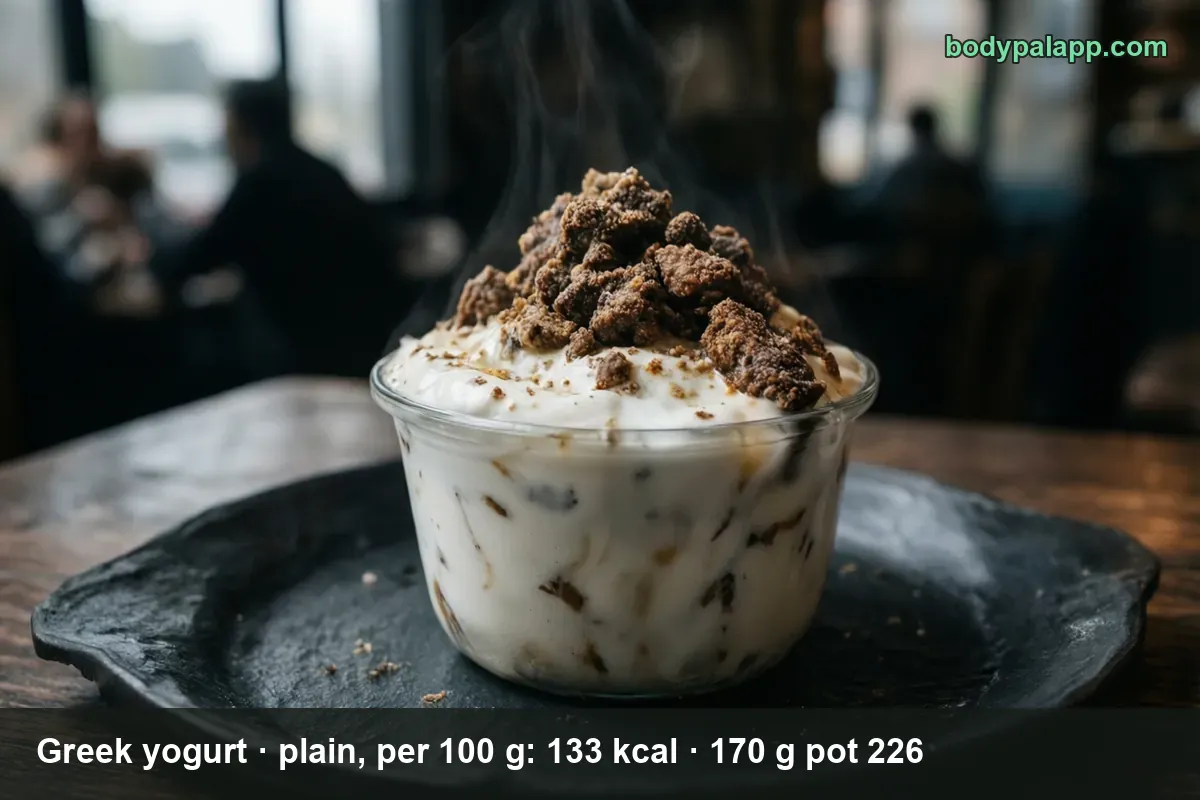
Plain Greek-style yogurt has 133 calories per 100 g (556 kJ), so a typical 170 g pot serving comes to 226 calories. Here is the part most people get backwards: the calories in Greek yogurt come mainly from fat — 10.2 g per 100 g — not from sugar, which sits at a modest 4.5 g.
On this page
- Quick facts
- Pots and spoonfuls
- Plain vs fruit: where the sugar hides
- How does it compare?
- The "Greek means diet food" mix-up
- Most popular Greek yogurt brands
- FAQ
Quick facts
| Nutrient | Per 100 g | Per pot serving (170 g) | % RI (170 g)* |
|---|---|---|---|
| Energy | 133 kcal (556 kJ) | 226 kcal (946 kJ) | 11% |
| Protein | 5.7 g | 9.7 g | 19% |
| Carbohydrates | 4.8 g | 8.2 g | 3% |
| Fat | 10.2 g | 17.3 g | 25% |
| Fibre | 0.0 g | 0.0 g | — |
| Sugar | 4.5 g | 7.7 g | 9% |
| Salt | 0.165 g | 0.28 g | 5% |
*Reference intake for an average adult, calculated for the 170 g pot serving.
Verified nutrition data
Numbers on this page come from CoFID, the UK government’s Composition of Foods Integrated Dataset, and from manufacturer labels where a branded product is named. Last verified August 2026. How we verify our data →
The shape of that table is unusual for something sold as a health food. A pot spends 11% of a day's energy but a full 25% of the day's fat reference intake, while sugar stays down at 9%. Greek-style yogurt is, calorically speaking, closer to a creamy food than a sweet one.
The protein is real — 9.7 g in a pot, 19% of the reference intake — which is a large part of why a yogurt breakfast holds hunger better than its 226 calories suggest.
Pots and spoonfuls
| Portion | Weight | Calories |
|---|---|---|
| Typical pot serving | 170 g | 226 kcal |
| Heaped tablespoon | ~40 g | 53 kcal |
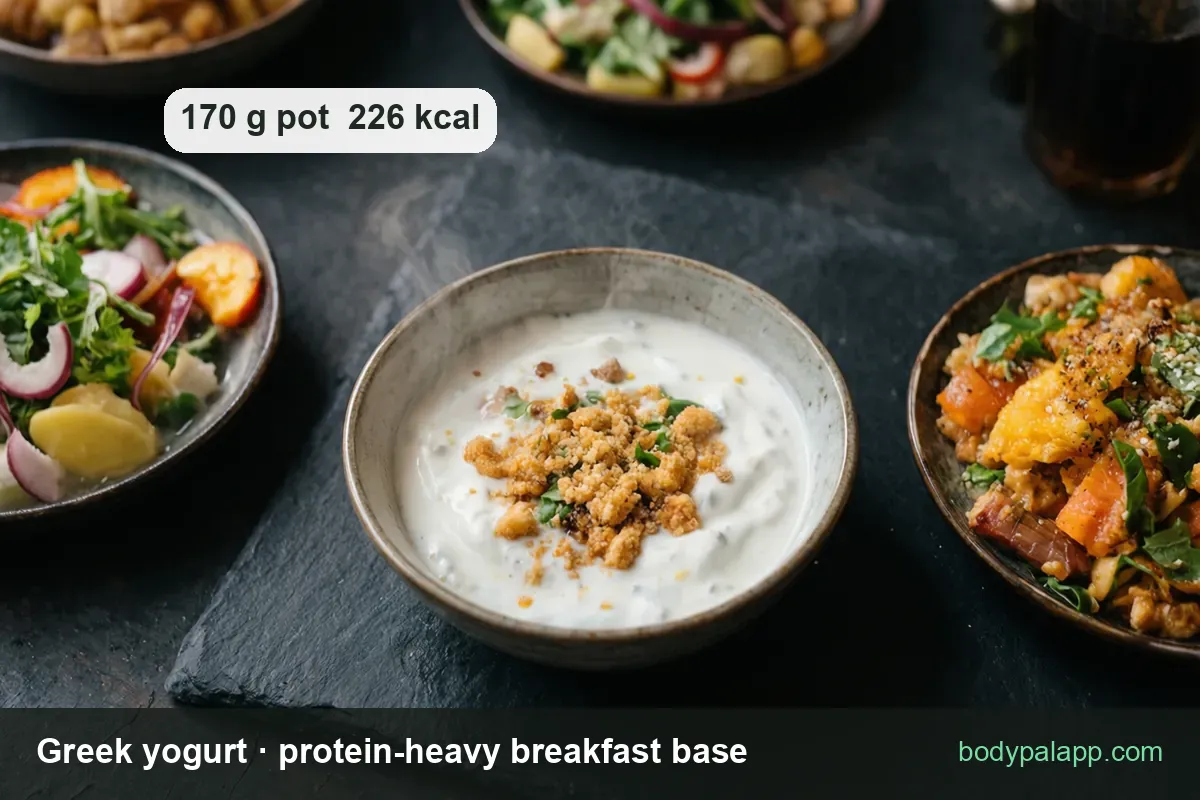
The 170 g pot is the breakfast-sized serving: yogurt as the main event, usually under fruit or granola. The heaped tablespoon at 53 calories is the supporting-role portion — a dollop on curry, chilli or a baked potato in place of soured cream.
The tablespoon figure is worth memorising, because dollops are where untracked calories breed. Three casual spoonfuls across a day is around 159 kcal that rarely makes it into anyone's log. If the tub lives in your fridge door, that habit is worth counting honestly.
Buying big tubs rather than individual pots? Weigh your usual bowlful once. Most people's "one serving" from a large tub is heavier than 170 g, and at 133 kcal per 100 g every extra 50 g of generosity adds roughly a tablespoon-and-a-bit's worth of calories without anyone noticing.
Plain vs fruit: where the sugar hides
| Greek-style yogurt (per 100 g) | kcal | Protein | Carbs | Fat | Sugar | Salt |
|---|---|---|---|---|---|---|
| Plain | 133 | 5.7 g | 4.8 g | 10.2 g | 4.5 g | 0.165 g |
| Fruit | 137 | 4.8 g | 11.2 g | 8.4 g | 10.5 g | 0.16 g |
At first glance the fruit version looks like a free upgrade: 137 kcal against 133, a difference of 4 calories per 100 g. Look one column further and the trade appears. Sugar more than doubles, from 4.5 g to 10.5 g per 100 g, while protein drops from 5.7 g to 4.8 g.
In other words, fruit yogurts swap some of the cream for sugar and keep the calorie total almost identical. If you are tracking energy alone, it barely matters. If you are watching free sugars the way the NHS suggests, the plain pot with your own berries stirred in is the stronger play — same creaminess, and you decide the sweetness.
How does it compare?
Per 100 g, against other breakfast staples:
The verdict: Greek-style yogurt sits almost level with egg per 100 g and roughly double milk, which is fair for something that eats like a cross between the two. Judge it per serving rather than per 100 g, though — a 226-calorie pot is a substantial but honest breakfast base, and the protein does more work than the same calories from toast.
The "Greek means diet food" mix-up
"Greek yogurt" has become shorthand for "the healthy one", and the halo hides a fact worth knowing: plain Greek-style yogurt is the full-fat option in the chiller. At 10.2 g of fat per 100 g, a pot delivers a quarter of the day's fat reference intake — perfectly reasonable in a balanced day under Eatwell Guide principles, but not a low-calorie choice by default.
The other trap is assuming every tub matches every other. Fat and protein vary noticeably between products and styles, so the pot in your hand may not match the average figures on this page. Glance at your label once; the 133 kcal per 100 g here is the benchmark to compare it against.
None of this is an argument against the pot. It is an argument for logging it as what it is: a 226-calorie, protein-forward, genuinely creamy breakfast — rather than as a token "light" entry that quietly under-reports a quarter of the day's fat.
Most popular Greek yogurt brands in the United Kingdom
Ranked by how widely each product appears among foods sold in the United Kingdom, from the BodyPal food database of over 3.3 million products. Calories are the figures printed on each label.
| Product | Calories (per 100 g) |
|---|---|
| Fage Total 5% | 93 kcal |
| Fage Total 2% | 70 kcal |
| Fage Total 0% | 54 kcal |
Brand popularity: BodyPal food database. Nutrition: manufacturer labels.
Greek yogurt questions, answered
How many calories are in Greek yogurt?
Plain Greek-style yogurt contains 133 calories per 100 g, which puts a typical 170 g pot serving at 226 kcal and a heaped tablespoon at 53. The fruit version is nearly identical in energy at 137 kcal per 100 g, but carries more than twice the sugar.
How many calories in Greek yogurt per 100g?
Per 100 g, plain Greek-style yogurt provides 133 calories (556 kJ), with 5.7 g protein, 10.2 g fat and 4.5 g sugar. Fruit Greek-style yogurt is 137 kcal per 100 g. Individual brands differ with their fat content, so treat these as the benchmark and check your pot.
How many calories in plain Greek yogurt?
Plain Greek-style yogurt is 133 kcal per 100 g and 226 kcal for a 170 g pot serving. Most of that energy comes from its 10.2 g of fat per 100 g rather than sugar, which sits at just 4.5 g — the reverse of what many people assume about yogurt.
How much protein is in Greek yogurt?
This Greek-style average carries 5.7 g of protein per 100 g, so a 170 g pot delivers 9.7 g — 19% of the daily reference intake. Strained and high-protein products can differ from the average considerably, so the label on your specific tub is worth a look if protein is the goal.
Is Greek yogurt good for you?
A 226-calorie pot brings 9.7 g of protein and only 7.7 g of sugar, which makes plain Greek-style yogurt one of the more filling breakfasts per calorie. The fat is substantial at 17.3 g per pot, so it earns its place best in a day that isn't already fat-heavy.
Is Greek yogurt good for dogs?
Plain Greek-style yogurt at 133 kcal per 100 g is generally tolerated by many dogs in small spoonfuls, but skip anything sweetened or flavoured, and avoid it entirely for dogs that react badly to dairy. A tablespoon is 53 calories — a lot in a small dog's day — so keep amounts token and ask your vet.
Is Greek yogurt dairy?
Yes — with 10.2 g of fat and 5.7 g of protein per 100 g, Greek-style yogurt is a concentrated milk product and firmly part of the dairy group. Anyone avoiding dairy for allergy or intolerance reasons should treat it exactly as they would milk or cream.
Is Greek yogurt healthy?
At 133 kcal per 100 g with strong protein and low sugar, plain Greek-style yogurt fits comfortably into the dairy segment of the NHS Eatwell Guide. The main watch-out is the fruit version: almost the same calories at 137 per 100 g, but with sugar rising to 10.5 g.
Similar foods
- Eggs — 72 kcal per boiled medium egg
- Duck eggs — ~106 kcal each
- Hash brown — 127 kcal each at McDonald’s
- Pancake — 187 kcal each
- Bacon roll — 250 kcal per roll
- Weetabix — 136 kcal for two biscuits
Count it without the maths
BodyPal reads the pot for you — one photo logs the 226 calories with protein and fat already broken out.


How long does it take to burn off Greek yogurt?
A 170 g pot is 226 kcal. Enter your weight and the amount you ate to see how long it takes you to burn that off:
lb
| Activity | Time to burn 226 kcal |
|---|---|
| Walking, brisk | 45 min |
| Cycling, moderate | 28 min |
| Swimming, moderate | 32 min |
| Jogging | 27 min |
| Weight training, moderate | 50 min |
Times are for a 154 lb (11 st) adult at a steady pace; change the weight to see yours. The amount is set to the portion in the text (170 g); change it to what you actually ate. BodyPal works this out from your steps automatically.
This table assumes you know your daily total. If you do not, the daily calorie calculator works it out from five numbers.