How Many Calories in a Glass of Milk?
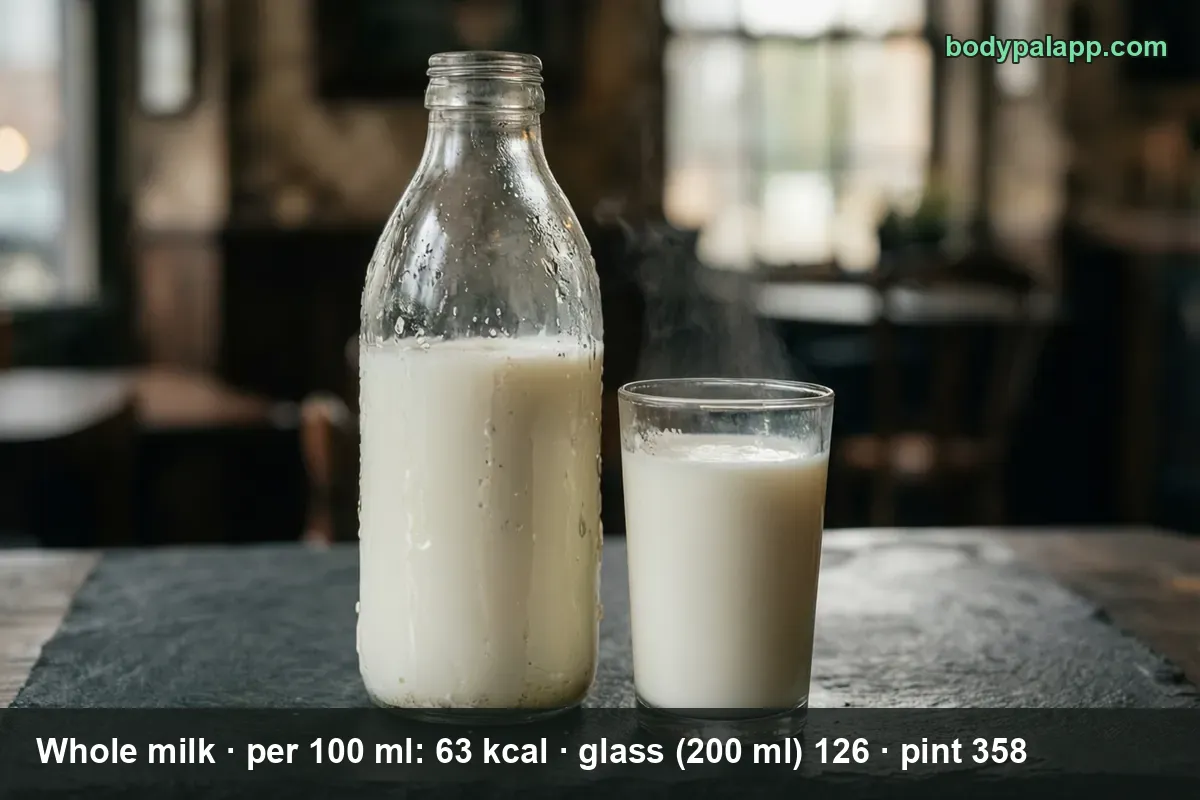
The cap colour answers before the label does. How many calories in a glass of milk depends on the top of the bottle: a 200 ml glass of whole milk, the blue cap, is 126 calories at 63 kcal per 100 ml. Green-cap semi-skimmed is 92, red-cap skimmed is 68.
On this page
- Whole milk nutrition at a glance
- From a splash to a pint
- Blue, green, red: what the cap changes
- Milk against the plant drinks
- The full-fat myth
- Most popular whole milk brands
- FAQ
Whole milk nutrition at a glance
| Nutrient | Per 100 ml | Per 200 ml glass | %RI* per glass |
|---|---|---|---|
| Energy | 63 kcal / 264 kJ | 126 kcal / 527 kJ | 6% |
| Protein | 3.4 g | 6.8 g | 14% |
| Carbohydrate | 4.6 g | 9.2 g | 4% |
| of which sugars | 4.6 g | 9.2 g | 10% |
| Fat | 3.6 g | 7.2 g | 10% |
| Fibre | 0 g | 0 g | – |
| Salt | 0.11 g | 0.22 g | 4% |
*%RI = percentage of the reference intake for an average adult (2,000 kcal; 70 g fat, 260 g carbohydrate, 90 g sugars, 50 g protein, 6 g salt).
Verified nutrition data
Numbers on this page come from CoFID, the UK government’s Composition of Foods Integrated Dataset, and from manufacturer labels where a branded product is named. Last verified August 2026. How we verify our data →
Two lines carry the story. A glass gives you 6.8 g of protein, an eighth of the daily reference intake, and 4.6 g of saturated fat, which is nearly a quarter of it. Milk is generous and costly at the same time, and which side matters more depends on what the rest of your day looks like.
The 9.2 g of sugars in a glass is lactose, naturally present rather than added, and the NHS milk and dairy guidance treats plain milk as a food group of its own rather than a sugary drink.
From a splash to a pint
| Portion | Volume | Calories (whole milk) |
|---|---|---|
| Splash in tea or coffee | ~25 ml | 16 kcal |
| Cereal pour | ~125 ml | 79 kcal |
| Glass | 200 ml | 126 kcal |
| Half pint | 284 ml | 179 kcal |
| Pint | 568 ml | 358 kcal |
The splash deserves more respect than it gets. One mug of tea costs 16 calories in whole milk; five mugs across a working day is 80, which is most of a biscuit that never appears in anyone's diary. The same habit tracked in full sits in our cup of tea breakdown, and a milk-heavy latte plays by different rules again, because there the milk is the drink.
A pint of whole milk is 358 calories, and it buys a lot: 19.3 g of protein, 26.1 g of carbohydrate and 20.4 g of fat. Nothing else in the fridge door delivers that much protein for that little effort. The salt across a pint is 0.62 g, about a tenth of the 6 g daily limit the NHS advises, all of it naturally occurring.
Cereal is the quiet one. A 125 ml pour adds 79 calories to the bowl before the oats arrive, which is why a modest-looking porridge can outweigh its own ingredients list.
Blue, green, red: what the cap changes
British fridges sort themselves by cap colour, and the colour is really a fat setting. Skimming removes fat and only fat; the protein and the lactose stay put.
| Milk | Per 100 ml | Per 200 ml glass | Per pint (568 ml) |
|---|---|---|---|
| Whole (blue cap) | 63 kcal | 126 kcal | 358 kcal |
| Semi-skimmed (green cap) | 46 kcal | 92 kcal | 261 kcal |
| Skimmed (red cap) | 34 kcal | 68 kcal | 193 kcal |
Moving from blue to green saves 34 calories a glass and 97 a pint; going all the way to red roughly halves the whole-milk number. What you give up is fat, at 3.6 g, 1.7 g and 0.3 g per 100 ml respectively, and with it some of the fat-soluble vitamins the fat carries. Protein barely moves: 3.4 g against 3.5 g per 100 ml across all three.
Semi-skimmed is the UK's default for a reason, and it has a full page of its own covering the glass, the pint and the lactose question. This page keeps to the whole-milk numbers, because blue-cap drinkers are the ones the calorie tables usually ignore.
Milk against the plant drinks
| Drink | Per 100 ml | Per 200 ml glass | Protein per 100 ml |
|---|---|---|---|
| Whole milk | 63 kcal | 126 kcal | 3.4 g |
| Skimmed milk | 34 kcal | 68 kcal | 3.5 g |
| Oat drink (Oatly) | 48 kcal | 96 kcal | 1.1 g |
| Unsweetened almond drink (Alpro) | 14 kcal | 28 kcal | 0.4 g |
The verdict: if the goal is fewer calories with the protein intact, skimmed milk beats every plant drink on this table, at 68 a glass with 7 g of protein. If the goal is simply the lightest thing to whiten a coffee, unsweetened almond at 28 a glass wins and nothing comes close. Oat sits in the middle at 96 per glass with a third of milk's protein, which makes it the least efficient trade of the four.
The NHS Eatwell Guide places dairy and its alternatives in the same slice of the plate, so the swap is legitimate either way. Just swap with your eyes open: plant does not automatically mean lighter, and lighter does not automatically mean better fed.
The full-fat myth
"Whole milk is full of fat." It is 3.6% fat. A food that is 96% not-fat would never earn the label "full fat" anywhere else in the supermarket; butter is 82% fat, cheddar around a third. Whole milk's 126 calories a glass is real, but it comes with protein and calcium attached, and the gap to semi-skimmed is 34 calories, not a scandal.
"Hot milk has more calories." Heat changes nothing. A 200 ml mug of warm whole milk is the same 126 kcal it was cold; what changes the number is what gets stirred in, which is how a mug of hot chocolate leaves plain milk far behind.
Most popular whole milk brands in the United Kingdom
Ranked by how widely each product appears among foods sold in the United Kingdom, from the BodyPal food database of over 3.3 million products. Calories are the figures printed on each label. The spread from 64 to 68 kcal is real: whole milk is standardised to a minimum fat level, not an exact one.
| Product | Calories (per 100 ml) |
|---|---|
| Tesco Whole Milk | 66 kcal |
| Sainsbury’s British Whole Milk | 66 kcal |
| Arla Cravendale Whole Milk | 65 kcal |
| Essential Waitrose Whole Milk | 64 kcal |
| Yeo Valley Whole Milk | 68 kcal |
Brand popularity: BodyPal food database. Nutrition: manufacturer labels.
How long does it take to burn off a glass of milk?
A 200 ml glass of whole milk is 126 kcal. Enter your weight and the amount you ate to see how long it takes you to burn that off:
lb ml
| Activity | Time to burn 126 kcal |
|---|---|
| Walking, brisk | 25 min |
| Cycling, moderate | 16 min |
| Swimming, moderate | 18 min |
| Jogging | 15 min |
| Weight training, moderate | 28 min |
Times are for a 154 lb (11 st) adult at a steady pace; change the weight to see yours. The amount is set to the portion in the text (200 ml); change it to what you actually drank. BodyPal works this out from your steps automatically.
One food is easy to picture; a whole day is harder. See how many calories you need a day and what a deficit actually looks like.
Frequently asked questions
How many calories are in a glass of whole milk?
A 200 ml glass of whole milk is 126 kcal, with 6.8 g of protein and 7.2 g of fat. The same glass of semi-skimmed is 92 kcal and skimmed is 68. Whole milk runs at 63 kcal per 100 ml, so any glass size is quick to work out.
How many calories are in a pint of milk?
A pint of whole milk is 358 kcal at 568 ml, alongside 19.3 g of protein. Semi-skimmed brings a pint down to 261 kcal and skimmed to 193. The protein hardly changes between them, because skimming takes out fat, not protein.
How many calories does milk add to a cup of tea?
A 25 ml splash of whole milk adds 16 kcal; semi-skimmed adds 12. It sounds like nothing, but five mugs a day on whole milk is 80 kcal that rarely gets logged. Builders' tea drinkers should count the day, not the mug.
What do the milk bottle cap colours mean?
Blue is whole milk at 63 kcal per 100 ml, green is semi-skimmed at 46, and red is skimmed at 34. The colour tracks the fat: 3.6 g, 1.7 g and 0.3 g per 100 ml respectively. Protein stays around 3.4 to 3.5 g whichever cap you pick.
Is whole milk fattening?
A glass is 126 kcal with 7.2 g of fat, of which 4.6 g is saturated, close to a quarter of the daily reference intake. That fits comfortably in most days, but if you drink milk by the pint, the switch to semi-skimmed saves 97 kcal per pint for very little loss.
How many calories are in skimmed milk?
Skimmed milk is 34 kcal per 100 ml: 68 in a 200 ml glass and 193 in a pint. It keeps 3.5 g of protein per 100 ml, slightly more than whole milk, because removing fat concentrates everything else a little.
Does milk contain added sugar?
No. The 4.6 g of sugars per 100 ml in whole milk is lactose, which occurs naturally, and UK guidance leaves it out of the free sugars count. A glass shows 9.2 g of sugars on that basis. Flavoured milks and milkshakes are a different story, with added sugar on top.
Is whole milk better than oat milk for calories?
Oat drink is lower: 48 kcal per 100 ml against whole milk's 63, so 96 against 126 per glass. But whole milk carries 3.4 g of protein per 100 ml to oat's 1.1 g. On calories alone oat wins; on nutrition per calorie, milk does.
How much protein is in a pint of milk?
A pint of whole milk delivers 19.3 g of protein, nearly 40% of the 50 g daily reference intake. Semi-skimmed and skimmed pints give slightly more, around 19.9 g, since protein survives skimming untouched. Milk is the cheapest protein most kitchens hold.
Similar foods
- Protein shake — ~215 kcal per RTD bottle
- Hot chocolate — 185 kcal a mug
- Monster — 235 kcal per 500 ml can
- Semi skimmed milk — 46 kcal per 100 ml
- Can of Coke — 139 kcal a 330 ml can
- Cappuccino — 68 kcal per regular cup
Count it without the maths
BodyPal reads the glass, the cereal pour and the tea round from one photo, so the blue cap stops being a blind spot in your day.