
How Many Calories in a Can of Coke?
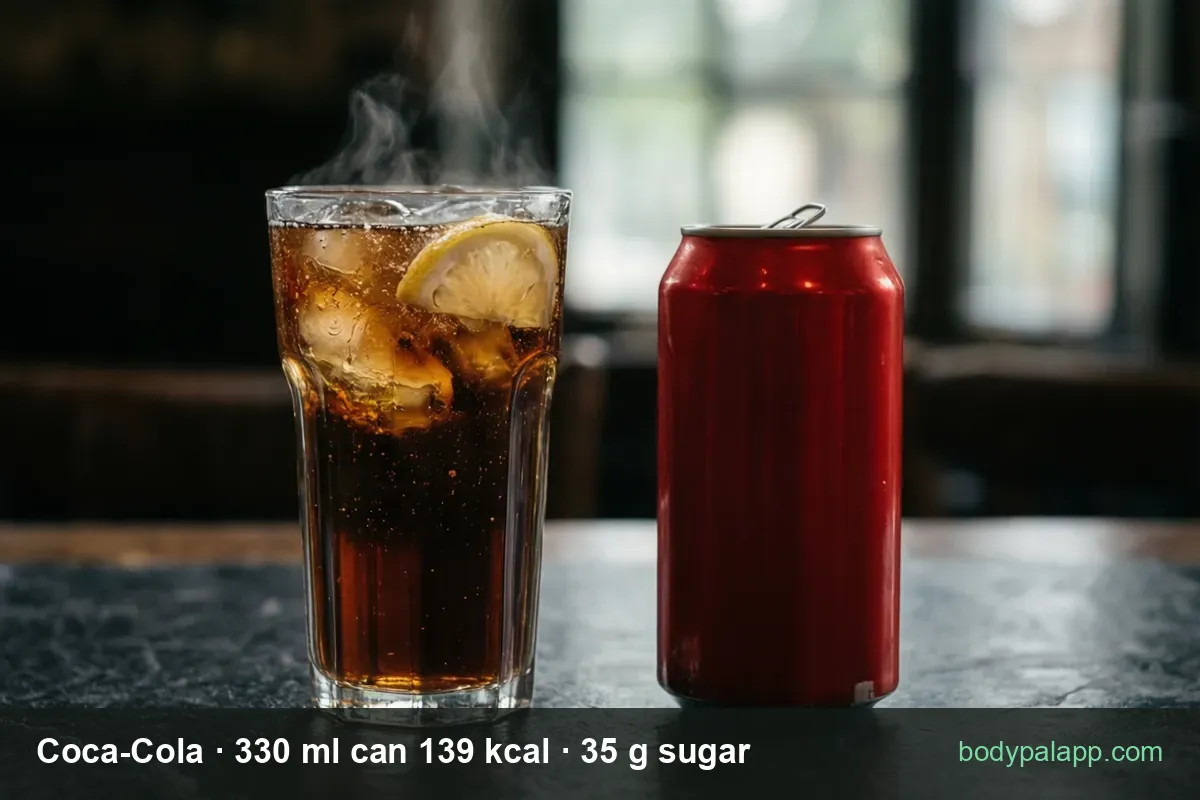
Nine sugar cubes, dissolved and chilled: that is the whole answer to how many calories in a can of Coke, 139 kcal per 330 ml, every one of them from sugar. Per 100 ml the label reads 42 kcal and 10.6 g of sugar. There is no fat, no protein and no fibre in the drink at all.
On this page
- Quick facts
- Where the 139 calories come from
- Can, bottle or glass
- Diet Coke, Coke Zero and Cherry Coke
- How does a can of Coke compare?
- Most popular Coca-Cola products
- FAQ
Quick facts
Figures are for one 330 ml can of Coca-Cola Original Taste.
| Nutrient | Per 330 ml can | RI% |
|---|---|---|
| Energy | 139 kcal / 582 kJ | 7% |
| Protein | 0 g | 0% |
| Carbohydrates | 35 g | 13% |
| Fat | 0 g | 0% |
| Fibre | 0 g | – |
| Sugar | 35 g | 39% |
| Salt | 0.03 g | <1% |
Per 100 ml: 42 kcal (176 kJ) and 10.6 g of sugar. RI = reference intake for an average adult (2,000 kcal a day).
Verified nutrition data
Numbers on this page come from CoFID, the UK government’s Composition of Foods Integrated Dataset, and from manufacturer labels where a branded product is named. Last verified August 2026. How we verify our data →
Where the 139 calories come from
Sugar, and nothing else. The 35 g in a can works out at roughly nine standard 4 g cubes, and because the drink carries no fat, protein or fibre, there is nothing in it to slow digestion or fill you up. It is the textbook example of drinking your calories.
That single can also overshoots the NHS limit for free sugars, which is 30 g a day for adults. One can, and the day's allowance is spent with 5 g borrowed on top.
At 10.6 g of sugar per 100 ml, the original recipe sits in the top band of the UK's Soft Drinks Industry Levy, the sugar tax that nudged much of the soft-drink aisle to reformulate below the thresholds. Coca-Cola kept the classic recipe and pays the levy instead, so the red can still carries its full sugar load.
Can, bottle or glass
| Serving | kcal | Sugar |
|---|---|---|
| 250 ml glass | 105 | ~26 g |
| 330 ml can | 139 | 35 g |
| 500 ml bottle | 210 | ~53 g |
The 500 ml bottle is the quiet trap. It reads as one drink but holds a can and a half: 210 kcal and around thirteen sugar cubes, usually finished in one sitting.
Going the other way works just as well. Swapping the bottle for a can saves 71 kcal per serving, and the 250 ml glass keeps the real-sugar taste for 105. If Coke is a daily habit rather than a treat, the serving size is the single easiest lever to pull.
The habit maths is where these numbers earn attention. A can a day is 973 kcal a week from one drink; the same ritual with Diet Coke or Zero Sugar costs about 7. Few swaps in the whole of calorie counting save so much while changing so little about the day.
Diet Coke, Coke Zero and Cherry Coke
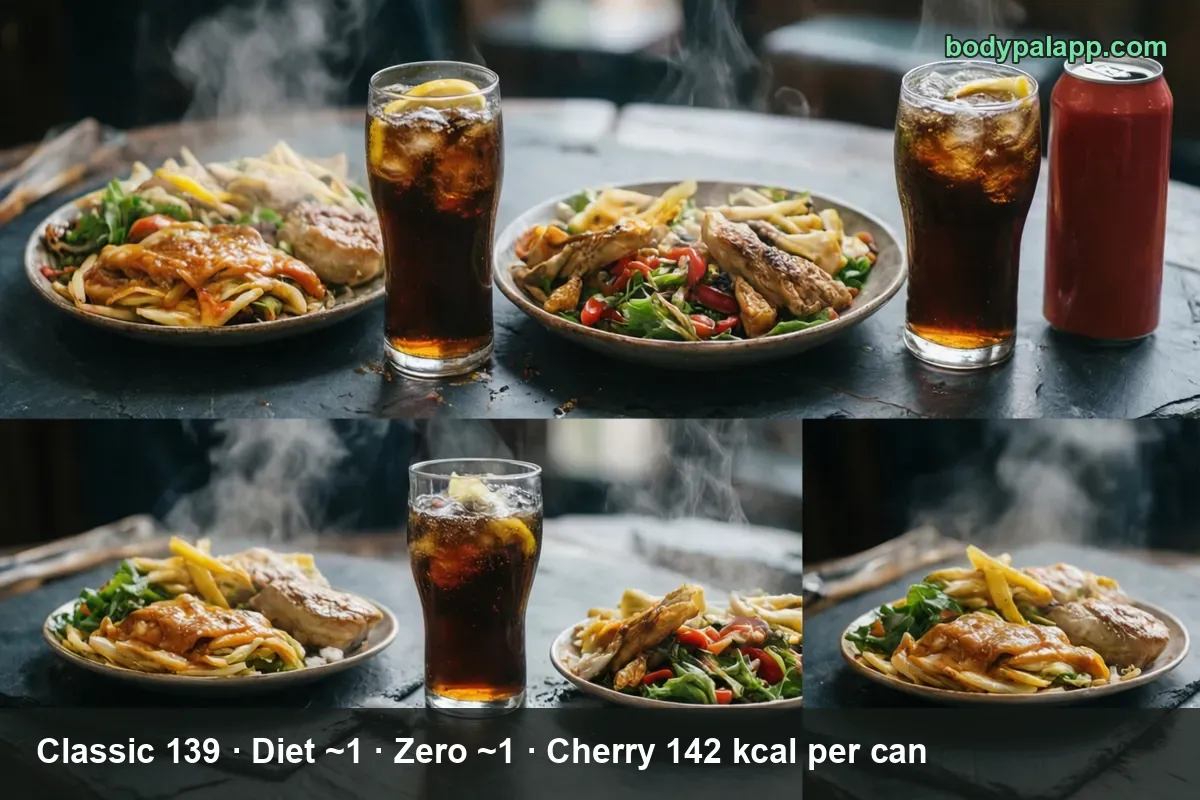
| Variant | Per 330 ml can |
|---|---|
| Coca-Cola Original Taste | 139 kcal |
| Cherry Coke | 142 kcal |
| Diet Coke | ~1 kcal |
| Coca-Cola Zero Sugar | ~1 kcal |
Diet Coke and Coca-Cola Zero Sugar swap the sugar for sweeteners, and the calories vanish with it: about 1 kcal a can for either. The difference between those two is flavour, not numbers. Zero Sugar is built to taste like the original; Diet Coke has its own sharper profile.
Cherry Coke is the original plus flavouring, at 43 kcal per 100 ml, which lands the can at 142 kcal. Choosing it over classic changes the taste, not the total.
How does a can of Coke compare?
| Drink | Serving | kcal |
|---|---|---|
| Coca-Cola | 330 ml can | 139 |
| Beer | pint | 170 |
| Milk | glass | 126 |
| Latte | mug | 68 |
| Cup of tea | with milk | 13 |
The numbers look close, but what rides along with them is not. The glass of milk at 126 kcal brings protein; the can's 139 kcal arrive alone, as sugar.
The verdict: tea wins by a street at 13 kcal, and it is the only genuinely free habit on the table. If it has to be sweet, cold and fizzy, pour the 250 ml glass at 105 kcal, which undercuts both the can and the pint.
Most popular Coca-Cola products in the United Kingdom
Ranked by how widely each product appears among foods sold in the United Kingdom, from the BodyPal food database of over 3.3 million products. Calories are the figures printed on each label.
| Product | Calories (per 100 ml) |
|---|---|
| Coca-Cola Original Taste | 42 kcal |
| Cherry Coke | 43 kcal |
| Diet Coke | 0.4 kcal |
| Coca-Cola Zero Sugar | 0.2 kcal |
Brand popularity: BodyPal food database. Nutrition: manufacturer labels.
FAQ
How many calories are in a can of Coke in the UK?
139 kcal per 330 ml can of Coca-Cola Original Taste, all of it from 35 g of sugar; there is no fat and no protein. The UK label reads 42 kcal per 100 ml, and the government's generic cola figure agrees within a single calorie.
How many calories in a 500 ml bottle of Coke?
210 calories. The 500 ml bottle holds a can and a half of drink, and the sugar scales with it: around 53 g, or thirteen cubes. If you want the full-sugar taste with a smaller bill, a 250 ml glass is 105 kcal, half the bottle's total.
Does Coke Zero have calories?
Barely: about 1 calorie per 330 ml can. Coca-Cola Zero Sugar replaces the sugar with sweeteners, so the energy all but disappears, and the same is true of Diet Coke. Neither touches your free-sugar allowance, which is where the original's 35 g per can does its damage.
What is the difference between Diet Coke and Coke Zero?
Not calories: both sit at roughly 1 kcal per can. The difference is the recipe and the taste. Coke Zero is flavoured to imitate the original as closely as possible, while Diet Coke has its own lighter, sharper profile. Chosen on numbers alone, it is a dead heat.
How much sugar is in a can of Coke?
35 g per 330 ml can, which is about nine 4 g sugar cubes and more than the NHS daily maximum of 30 g of free sugars for adults. Per 100 ml the drink carries 10.6 g, placing it in the top band of the UK sugar levy.
How many calories in a glass of Coke?
105 calories for a 250 ml serving, carrying about 26 g of sugar. Poured from a 500 ml bottle, half the bottle comes to the same 105 kcal. It is the simplest way to have the real thing for less than the can's 139.
How many calories in Cherry Coke?
142 kcal per 330 ml can. Cherry Coke runs 43 kcal per 100 ml, one calorie above the original's 42, so the flavoured version changes the taste rather than the total. It remains a full-sugar soft drink, with the same free-sugar arithmetic as the classic.
Is a can of Coke a lot of calories?
139 kcal is modest as snacks go; the problem is the form. The whole amount is sugar, exceeding the NHS 30 g daily free-sugar limit in one drink, and liquid calories do little for fullness. As an occasional treat it is easily absorbed into a day; as a daily default it adds up fast.
Similar foods
- Semi skimmed milk — 46 kcal per 100 ml
- Monster — 235 kcal per 500 ml can
- Cappuccino — 68 kcal per regular cup
- Latte — 68 kcal a mug at home
- Lucozade Sport — 135 kcal a 500 ml bottle
- Whole milk — 126 kcal a glass
Count the can without the maths
One scan of the barcode, or a photo of the glass, and BodyPal logs the calories and sugar for whichever size of Coke is in your hand.


How long does it take to burn off a can of Coke?
A 330 ml can is 139 kcal. Enter your weight and the amount you ate to see how long it takes you to burn that off:
lb ml
| Activity | Time to burn 139 kcal |
|---|---|
| Walking, brisk | 28 min |
| Cycling, moderate | 17 min |
| Swimming, moderate | 20 min |
| Jogging | 16 min |
| Weight training, moderate | 31 min |
Times are for a 154 lb (11 st) adult at a steady pace; change the weight to see yours. The amount is set to the portion in the text (330 ml); change it to what you actually drank. BodyPal works this out from your steps automatically.
Burning it off is one side of it. The other is knowing your number: work out how many calories you need a day, with macros and a goal date.