
How Many Calories in a Lucozade Sport?
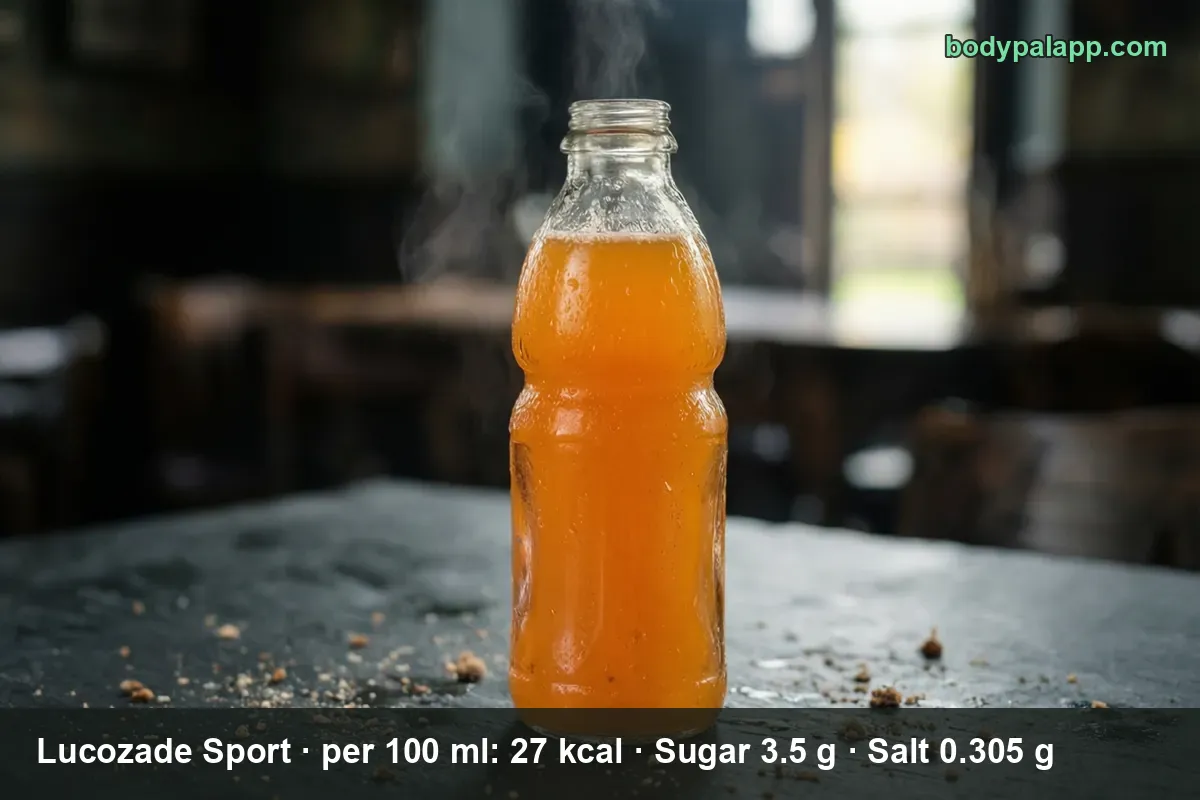
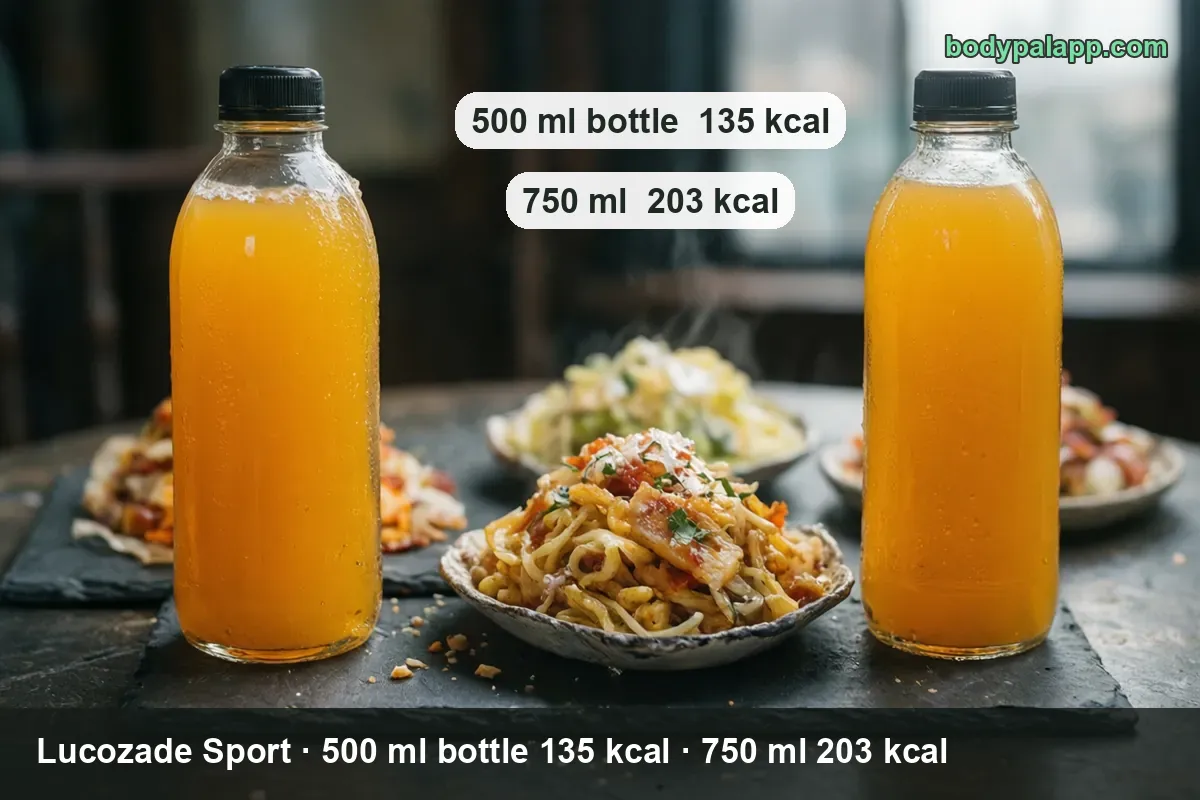
A 500 ml bottle of Lucozade Sport is 135 calories, from 27 kcal per 100 ml. The 750 ml bottle is 203. Those are small numbers for a sweet drink, and they are not the ones worth knowing. The line to read on this label is the salt.
On this page
- Lucozade Sport quick facts
- The 500 ml bottle and the 750 ml one
- The salt is the point
- Ice Kick and the lighter option
- Under an hour, over an hour
- Lucozade Sport against other drinks
- Most popular Lucozade products in the United Kingdom
- Lucozade Sport FAQs
Lucozade Sport quick facts
Figures below are Lucozade Sport Orange, the reference flavour. The bottle column is the 500 ml one, since that is what most people pick up.
| Nutrient | Per 100 ml | Per 500 ml bottle | RI%* per bottle |
|---|---|---|---|
| Energy | 27 kcal / 113 kJ | 135 kcal / 565 kJ | 7% |
| Protein | 0 g | 0 g | 0% |
| Carbohydrates | 6.3 g | 31.5 g | 12% |
| – of which sugars | 3.5 g | 17.5 g | 19% |
| Fat | 0 g | 0 g | 0% |
| – of which saturates | 0 g | 0 g | 0% |
| Fibre | 0 g | 0 g | – |
| Salt | 0.305 g | 1.5 g | 25% |
*RI% = one bottle's share of an adult's daily reference intake, based on 2,000 kcal.
Verified nutrition data
Numbers on this page come from CoFID, the UK government’s Composition of Foods Integrated Dataset, and from manufacturer labels where a branded product is named. Last verified September 2026. How we verify our data →
Look down the right-hand column and one figure is four times the size of the rest. Energy is 7% of a day. Salt is 25%. No other soft drink on a UK shelf produces that shape of panel, and it is the whole design of the product rather than an accident.
The 500 ml bottle and the 750 ml one
- 100 ml: 27 kcal
- 250 ml (half a small bottle): 68 kcal
- 500 ml bottle: 135 kcal, 17.5 g sugar, 1.5 g salt
- 750 ml bottle: 203 kcal, 26.3 g sugar, 2.3 g salt
The 750 ml sports cap bottle is the one that catches people out. It is only 68 calories more than the 500, which sounds harmless, but it also carries 2.3 g of salt, and a person drinking one of those on a mild afternoon walk has taken in more than a third of a day's salt before lunch.
Half a bottle is a genuinely useful serving here. Sports drinks are designed to be sipped across a session, not drained in one go, and 250 ml at 68 calories with 0.76 g of salt is a reasonable dose for most of what people actually do at the gym.
The salt is the point
Lucozade Sport is an isotonic drink, and isotonic means salted. The label reads 0.305 g of salt per 100 ml, which works out at 1.5 g in a 500 ml bottle. The NHS puts the adult daily maximum at 6 g, so one bottle is a quarter of it.
That is not a manufacturing flaw. Sodium is one of the things lost in sweat, and replacing some of it is the entire premise of an isotonic drink. If you have just finished a long run in July, the salt in the bottle is doing a job.
If you have not, it is a quarter of your daily salt in a drink you chose because it looked like a healthier cola. That is the case worth stating plainly: the salt only makes sense in the context that the salt was designed for.
There is a second design decision hiding in the energy line. At 27 kcal per 100 ml, Lucozade Sport is about two thirds the calorie density of Coca-Cola's 42.1. A sports drink is deliberately diluted, because a weaker sugar solution empties the stomach faster than a strong one. The lower calorie count is a side effect of that dilution, not a health feature.
Sugar lands at 17.5 g a bottle, 19% of the daily reference for sugars. Set against a can of full-sugar cola at 35 g, that is genuinely half, and half in a bottle 170 ml larger. As sweet drinks go, this is a moderate one.
Ice Kick and the lighter option
| Per 100 ml | Calories | Carbs | Sugar | Salt |
|---|---|---|---|---|
| Lucozade Sport Orange | 27 kcal | 6.3 g | 3.5 g | 0.305 g |
| Lucozade Sport Ice Kick | 13.6 kcal | 3.14 g | 1.76 g | 0.067 g |
Ice Kick halves the calories: a 500 ml bottle is 68 rather than 135, with 8.8 g of sugar instead of 17.5. It also drops the salt to 0.067 g per 100 ml, which is 0.34 g a bottle against 1.5 g.
That last number changes what the drink is for. Cutting the salt by nearly 78% removes most of the reason to choose an isotonic drink over squash in the first place. Ice Kick is a light, mildly sweet drink; it is not really a sports drink with fewer calories, it is a different product wearing the same badge.
Which is the better buy depends on what you are doing. For general thirst on a hot day, Ice Kick at 68 calories a bottle is the sensible one. For a long, sweaty session where the salt is the reason you bought it, the standard version is the one that does the job it advertises.
Lucozade Energy is a separate line with a separate label, and the two get confused constantly. Energy Original is 37 kcal per 100 ml with 8.9 g of carbohydrate, 4.5 g of sugar and 0.0875 g of salt. That makes a 500 ml bottle of Energy 185 calories against 135 for the same size of Sport, and it carries barely a third of the salt.
Under an hour, over an hour
Most gym sessions do not need a sports drink at all. Water has no calories, no sugar and no salt, and for an hour of ordinary training it does everything a drink needs to do. The NHS guidance on drinks puts water and lower-fat milk at the top of the list for a reason.
Past an hour, and particularly in heat, the calculation shifts. Carbohydrate and salt both start to matter when a session runs long, and that is the window where 135 calories and 1.5 g of salt in a bottle stop being decoration and start being the point.
The habit that costs people most is the third case: drinking it at a desk. A bottle a day, five days a week, is 675 calories and 7.5 g of salt across a working week, taken on for no reason at all. If it is the taste you want rather than the function, squash or a diet soft drink gives you the same flavour without either number.
For recovery after training, a drink with protein does more than a drink with sugar. A ready-to-drink protein shake runs around 65 kcal per 100 ml, roughly 2.4 times the density of Lucozade Sport, but it brings protein, which this bottle does not have a single gram of.
Lucozade Sport against other drinks
| Drink | Per 100 ml | Typical serving |
|---|---|---|
| Lucozade Sport Orange | 27 kcal | 135 kcal a 500 ml bottle |
| Lucozade Sport Ice Kick | 13.6 kcal | 68 kcal a 500 ml bottle |
| Coca-Cola | 42.1 kcal | 139 kcal a 330 ml can |
| Pepsi Max | ~0.4 kcal | about 1 kcal a can |
| Monster Original | ~47 kcal | about 235 kcal a 500 ml can |
| Protein shake, ready to drink | 65 kcal | – |
| Water | 0 kcal | 0 |
The comparison that reframes the whole page: a 500 ml bottle of Lucozade Sport is 135 calories and a 330 ml can of Coke is 139. Practically identical, from a bottle half again as large. On calories alone the sports drink is the better swap, and it carries half the sugar.
Then look one column across. The can of cola contains almost no salt. The bottle of Lucozade Sport contains 1.5 g. If you swapped cola for a sports drink to be sensible, you traded 17.5 g of sugar for a quarter of your daily salt.
Against a 500 ml can of Monster at roughly 235 calories, Lucozade Sport wins comfortably on energy. Against a cup of tea or a glass of semi-skimmed milk it is a different kind of drink entirely, and the milk at least brings protein with its calories.
Our take: for training under an hour, water and the 135 calories stay in the bank. For anything long or genuinely sweaty, standard Lucozade Sport earns its label and the salt is the feature you are paying for. For sitting still, Ice Kick or something with no calories at all makes far more sense than either.
Most popular Lucozade products in the United Kingdom
Ranked by how widely each product appears among foods sold in the United Kingdom, from the BodyPal food database of over 3.3 million products. Calories are the figures printed on each label.
| Product | Calories (per 100 ml) |
|---|---|
| Lucozade Sport Orange | 27 kcal |
| Lucozade Sport Raspberry | 27 kcal |
| Lucozade Sport Ice Kick | 13.6 kcal |
| Lucozade Energy Orange | 37 kcal |
| Lucozade Zero Pink Lemonade | 1.7 kcal |
Brand popularity: BodyPal food database. Nutrition: manufacturer labels.
Lucozade Sport FAQs
How many calories in a 500ml Lucozade Sport?
135 calories, from 27 kcal per 100 ml. The same bottle carries 31.5 g of carbohydrate, 17.5 g of sugar and 1.5 g of salt. The larger 750 ml bottle comes to 203 calories.
How much sugar is in Lucozade Sport?
3.5 g per 100 ml, so 17.5 g in a 500 ml bottle and 26.3 g in a 750 ml one. A bottle is 19% of the daily reference intake for sugars. For scale, a 330 ml can of full-sugar cola holds 35 g, twice as much in a smaller container.
How much salt is in Lucozade Sport?
0.305 g per 100 ml, which is 1.5 g in a 500 ml bottle and 2.3 g in a 750 ml one. The NHS daily maximum for adults is 6 g, so one standard bottle is a quarter of it. The salt is deliberate, since isotonic drinks are built to replace some of what is lost in sweat.
Is Lucozade Sport better than water?
Not for ordinary training. Water is 0 calories and 0 salt and covers a session under an hour. Lucozade Sport adds 135 calories and 1.5 g of salt per bottle, which is useful when a session runs long or you are sweating heavily, and pointless when it does not.
Is there a zero calorie Lucozade Sport?
Ice Kick is the light version rather than a zero one: 13.6 kcal per 100 ml, so 68 calories in a 500 ml bottle. It halves the sugar to 8.8 g a bottle and cuts the salt to 0.34 g, which also removes most of what makes an isotonic drink isotonic.
Lucozade Energy or Lucozade Sport?
They are different products with different labels. Lucozade Sport Orange is 27 kcal per 100 ml with 3.5 g of sugar and 0.305 g of salt. Lucozade Energy Original is 37 kcal per 100 ml with 4.5 g of sugar and only 0.0875 g of salt. Energy is the sweeter drink; Sport is the salty one, and the salt is the point of it.
How many calories in a bottle of Lucozade Sport?
135 calories for the 500 ml bottle and 203 for the 750 ml. Half a small bottle is 68. If you are sipping across a session rather than drinking it in one, 250 ml is the serving most people actually need.
Is Lucozade Sport a good drink for weight loss?
It is 135 calories a bottle that do not fill you up, since there is no protein, fat or fibre in it at all. As a training drink for long sessions it has a role. As a daily desk drink it adds about 675 calories and 7.5 g of salt over a working week, and a no-calorie drink does the same job for the taste.
Similar foods
- Cappuccino — 68 kcal per regular cup
- Latte — 68 kcal a mug at home
- Can of Coke — 139 kcal a 330 ml can
- Semi skimmed milk — 46 kcal per 100 ml
- Monster — 235 kcal per 500 ml can
- Cup of tea — 13 kcal with milk
Count the bottle as well as the plate
BodyPal logs drinks from a photo of the label, so the 135 calories in the bottle stop being the ones you forget.


How long does it take to burn off a Lucozade sport?
A 500 ml bottle is 135 kcal. Enter your weight and the amount you ate to see how long it takes you to burn that off:
lb ml
| Activity | Time to burn 135 kcal |
|---|---|
| Walking, brisk | 27 min |
| Cycling, moderate | 17 min |
| Swimming, moderate | 19 min |
| Jogging | 16 min |
| Weight training, moderate | 30 min |
Times are for a 154 lb (11 st) adult at a steady pace; change the weight to see yours. The amount is set to the portion in the text (500 ml); change it to what you actually drank. BodyPal works this out from your steps automatically.
Want the bigger picture? Calculate your daily calorie needs — your maintenance figure, a target for losing or gaining, and the date you get there.