
---
Latte Calories: How Many in a Mug, a Costa and a Skinny?
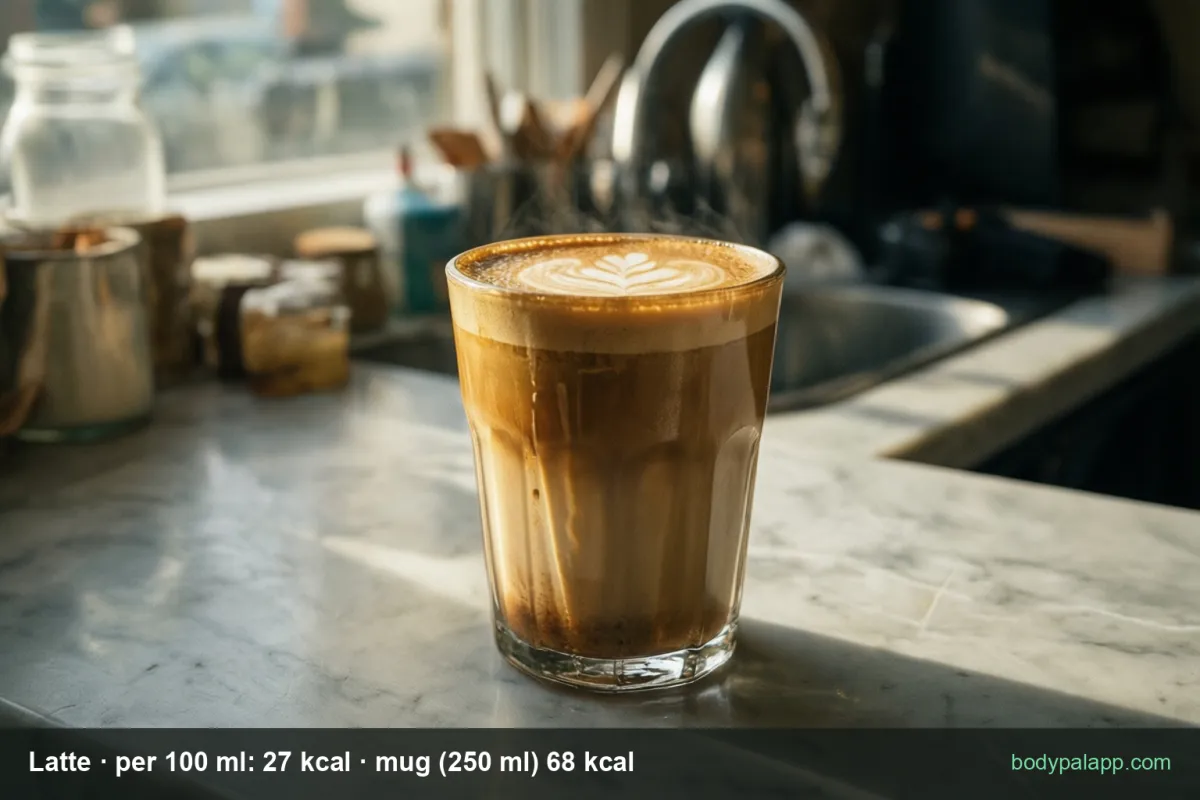
A 250 ml latte made at home with semi-skimmed milk is 68 calories, or 27 kcal per 100 ml. Buy one out and the number climbs: a Greggs regular is around 120 kcal, a Costa medio around 197. Same drink, three very different entries in your day. The gap is milk volume, not the coffee.
On this page
- Quick facts: latte nutrition
- UK portions and what each one costs
- Costa, Greggs and the high street gap
- Skinny latte
- Oat and soya lattes
- Latte vs cappuccino
- Syrup lattes
- How does a latte compare?
- The milk sugar myth
- Most popular ready-to-drink latte brands
- Latte FAQ
- Similar foods
Quick facts: latte nutrition
Figures below are for a latte made with semi-skimmed milk, the standard pour in most UK kitchens and most high street chains.
| Per | 100 ml | 250 ml mug | %RI (mug) |
|---|---|---|---|
| Energy | 27 kcal / 113 kJ | 68 kcal / 285 kJ | 3% |
| Protein | 2.0 g | 5.0 g | 10% |
| Carbohydrate | 3.2 g | 8.0 g | 3% |
| Fat | 0.8 g | 2.0 g | 3% |
| Fibre | 0 g | 0 g | — |
| Sugars | 2.4 g | 6.0 g | 7% |
| Salt | 0.06 g | 0.15 g | 3% |
%RI is the reference intake for an average adult on 2,000 kcal a day.
Verified nutrition data
Numbers on this page come from CoFID, the UK government’s Composition of Foods Integrated Dataset, and from manufacturer labels where a branded product is named. Last verified August 2026. How we verify our data →
UK portions and what each one costs
Nobody drinks 100 ml of coffee. Here is what the real glassware does to the total.
| Serving | Volume | Calories |
|---|---|---|
| Home mug, semi-skimmed | 250 ml | 68 kcal |
| Greggs regular | 350 ml | 120 kcal |
| Costa medio | 340 ml | 197 kcal |
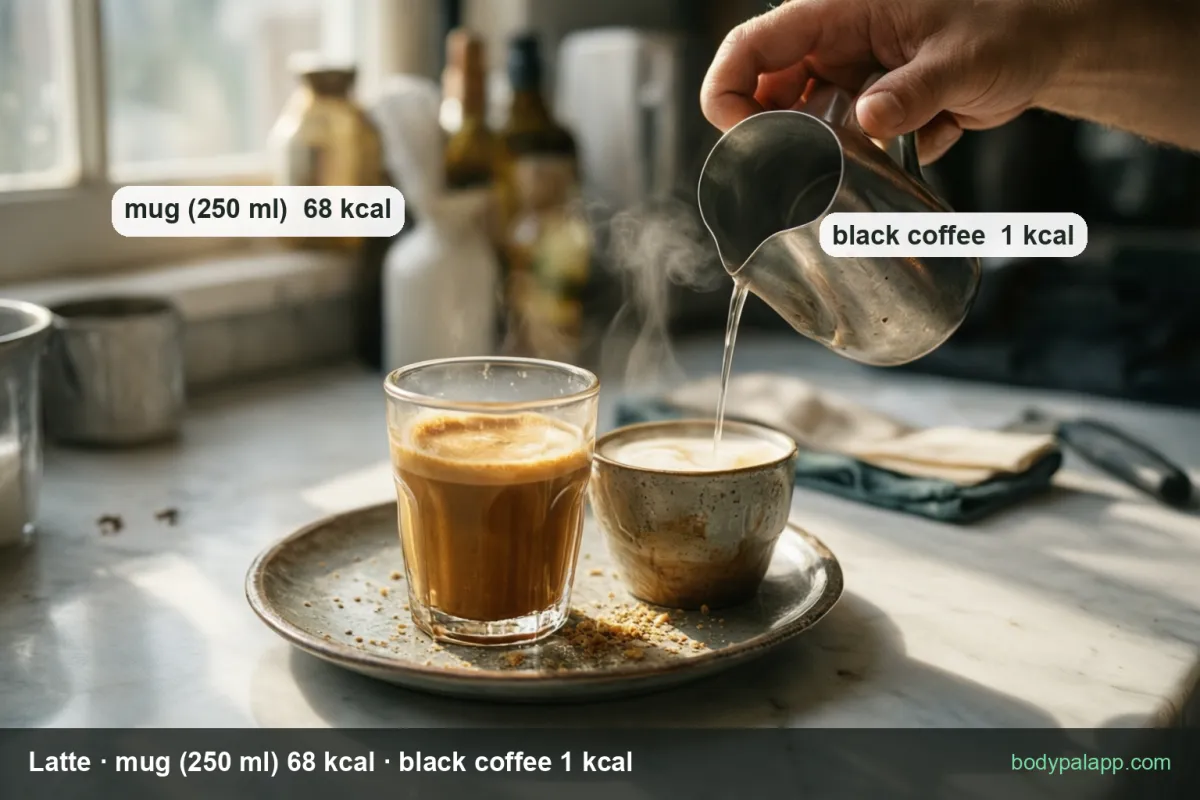
| Black coffee, for contrast | 1 cup | 1 kcal |
That last row is the one worth staring at. Coffee itself is essentially free. Everything you are counting in a latte arrived in the steaming jug.
Two milky coffees a day at Costa prices is roughly 400 kcal before you have eaten anything, which is a small meal's worth of your day gone into a cup. Two home mugs is 136. If you have a daily habit, the cheapest fix is not a smaller size or a skinny option, it is making one of them yourself.
Costa, Greggs and the high street gap
Per 100 ml, a Costa latte lands at 58 kcal against 27 for the home version. That is more than double, and it is not a rounding artefact. Chains pull a bigger milk volume into a bigger cup, and the house milk is often whole rather than semi-skimmed. Greggs sits between the two at 35 kcal per 100 ml.
So the same word on three menus describes three different drinks. If you log "latte" as a generic entry, you can be 130 kcal out on a single order. Log the chain and the size, not the drink name.
Skinny latte
Skinny means skimmed milk instead of semi-skimmed, and it is the single most effective swap on this list because it targets the only ingredient carrying real energy. Fat is the component being removed, so the protein stays put and the drink still counts towards your dairy for the day.
We do not have a verified figure for the skinny version, so we are not going to invent one. What we can say is the direction. Going skimmed cuts fat from the milk without touching the sugar, which is lactose and stays roughly where it was.
Order it skinny and you get most of the saving with none of the taste compromise people expect. It is a better lever than dropping a cup size, because a smaller cup takes the protein with it.
Oat and soya lattes
Oat and soya lattes vary enormously by brand, and barista editions are formulated differently from the cartons on the shelf at home, so a single number would be misleading.
The rule of thumb that actually holds: check the carton, not the menu. Barista oat milks are built to foam, and foaming usually means added fat. Unsweetened soya is generally the leaner of the two and carries meaningful protein; oat tends to bring more carbohydrate. The NHS guidance on milk and dairy alternatives is worth a read if plant milk is your default rather than an occasional swap.
Latte vs cappuccino
They come out the same. A cappuccino sits on the identical nutrition line as a latte, because the difference between the two is how the milk is textured, not how much of it goes in. More foam, less liquid, same jug.
That surprises people who order cappuccinos as the lighter choice. Foam is milk with air whipped through it, and air has no calories, but it also has no mass, so the drink weighs and counts the same once you account for the full serve. Where a genuine difference appears is cup size: if the cappuccino comes in a smaller cup, the smaller cup is doing the work, not the foam.
Syrup lattes
Vanilla, hazelnut, caramel: syrups are sugar and water, and they sit outside every figure on this page. Chains vary the pump size and some now offer sugar-free ranges that behave completely differently, so check the syrup label at the till rather than guessing.
One thing worth knowing before you order. The sugar in a plain latte is lactose from the milk and does not count as free sugar. Syrup is free sugar, the kind the NHS advises cutting back on. A syrup latte is a different drink nutritionally, not a flavoured version of the same one.
How does a latte compare?
| Drink | Per serving | Per 100 ml | Protein | Carbs | Fat |
|---|---|---|---|---|---|
| Latte (250 ml mug) | 68 kcal | 27 kcal | 2.0 g | 3.2 g | 0.8 g |
| Hot chocolate (mug) | 185 kcal | — | — | — | — |
| Cup of tea | 13 kcal | — | — | — | — |
| Semi-skimmed milk | 92 kcal (200 ml glass) | 46 kcal | 3.5 / 4.7 / 1.7 | — | — |
Per 100 ml figures for the comparison drinks are shown where verified.
The verdict. If you are cutting calories, tea wins outright at 13 kcal a cup and it is not close: a latte costs you five tea breaks. But if the coffee is standing in for breakfast or bridging a long gap before lunch, the latte earns its 68 because 5 g of protein and the milk behind it actually hold you, and hot chocolate at 185 kcal a mug gives you the sugar without the same return.
The milk sugar myth
"There's 6 g of sugar in that" gets said about lattes a lot, usually with alarm. The 6 g in a plain 250 ml mug is lactose, which arrives with the milk and comes packaged with protein, calcium and the rest of it. No sugar has been added to a plain latte.
Free sugars are the ones health guidance targets, and in a coffee those come from the syrup pump or the sachet you stir in, not from the milk. Worth keeping straight before you swap a latte for something that genuinely does carry added sugar.
The salt line surprises people too. A mug carries 0.15 g, a fortieth of the 6 g daily maximum the NHS advises for adults. Coffee is not where your salt problem lives.
Most popular ready-to-drink latte brands in the United Kingdom
Ranked by how widely each product appears among foods sold in the United Kingdom, from the BodyPal food database of over 3.3 million products. Calories are the figures printed on each label. These are chilled bottled lattes; a fresh one from a machine depends on the milk you pick, as the sections above show.
| Product | Calories (per 100 ml) |
|---|---|
| Emmi Caffè Latte Macchiato | 80 kcal |
| Emmi Caffè Latte Double Zero | 68 kcal |
| Starbucks Caffe Latte (chilled) | 54 kcal |
| Emmi Caffè Latte Balance | 34 kcal |
Brand popularity: BodyPal food database. Nutrition: manufacturer labels.
Latte FAQ
How many calories are in a latte?
A 250 ml latte made with semi-skimmed milk is 68 calories, which works out at 27 kcal per 100 ml. Shop-bought versions run higher because the cups are bigger and the milk is often whole: a Greggs regular is around 120 kcal and a Costa medio around 197.
How many calories in a Costa latte?
A Costa medio latte is around 197 calories, based on 58 kcal per 100 ml across a 340 ml serve. That is close to three times a home-made mug of the same drink. Size and milk choice move the number more than anything else on the order, so specify both when you log it.
How many calories in a skinny latte?
A skinny latte swaps semi-skimmed for skimmed milk, so the saving comes entirely out of the fat, which is 0.8 g per 100 ml in the standard version. Protein and lactose stay effectively unchanged, which is why skinny is a better lever than dropping a cup size.
Is a latte or a cappuccino fewer calories?
Neither. A latte and a cappuccino sit on the same nutrition line, because the difference is foam texture rather than how much milk goes in. Air adds volume, not calories. If one of them genuinely counts less on your day, it is because it came in a smaller cup.
Does a latte break a fast?
Yes, on a strict fast. A 250 ml latte carries 68 calories, 5 g of protein and 8 g of carbohydrate, which is real food by any definition of fasting. Black coffee is the drink that survives the rule at roughly 1 kcal a cup, and it is the standard swap during a fasting window.
How many calories in an oat milk latte?
Oat lattes vary too widely between brands to quote one figure, and barista formulations differ from the standard carton on the shelf. Barista oat milks are built to foam, which usually means more fat. Check the carton your cafe uses, or the one in your fridge.
How much sugar is in a latte?
A 250 ml latte contains 6.0 g of sugar, or 2.4 g per 100 ml. All of it is lactose from the milk, so a plain latte contains no added sugar at all. Syrups are the exception: they are free sugar and sit outside every figure on this page.
Is a latte a good source of protein?
A 250 ml mug gives you 5.0 g of protein, which is 10% of the daily reference intake and the reason a latte holds you better than tea or black coffee. It is a useful contribution rather than a protein drink, and it comes with the calcium in the milk.
How many calories in a large latte?
It depends on the chain, not the word. Costa runs at 58 kcal per 100 ml and Greggs at 35, so the same size cup can differ by 80 calories between two shops on the same high street. Multiply the chain figure by the millilitres rather than trusting a generic "large latte" entry.
What is the lowest calorie coffee?
Black coffee, at about 1 calorie a cup. Nothing else is close, because the beans contribute almost no energy and everything you count in a milky coffee came from the jug. An americano with a dash of milk is the realistic middle ground if plain black is too austere.
Similar foods
- Cappuccino — 68 kcal per regular cup
- Lucozade Sport — 135 kcal a 500 ml bottle
- Can of Coke — 139 kcal a 330 ml can
- Semi skimmed milk — 46 kcal per 100 ml
- Monster — 235 kcal per 500 ml can
- Cup of tea — 13 kcal with milk
Count it without the maths
BodyPal logs a latte, the mug it came in and the milk you used from one photo, so a daily coffee habit stops being a guess.


How long does it take to burn off 68 kcal of latte?
A 250 ml home mug is 68 kcal. Enter your weight and the amount you ate to see how long it takes you to burn that off:
lb ml
| Activity | Time to burn 68 kcal |
|---|---|
| Walking, brisk | 14 min |
| Cycling, moderate | 8 min |
| Swimming, moderate | 10 min |
| Jogging | 8 min |
| Weight training, moderate | 15 min |
Times are for a 154 lb (11 st) adult at a steady pace; change the weight to see yours. The amount is set to the portion in the text (250 ml); change it to what you actually drank. BodyPal works this out from your steps automatically.
Burning it off is one side of it. The other is knowing your number: work out how many calories you need a day, with macros and a goal date.