
Calories in a Hot Chocolate: The Dessert That Comes in a Mug
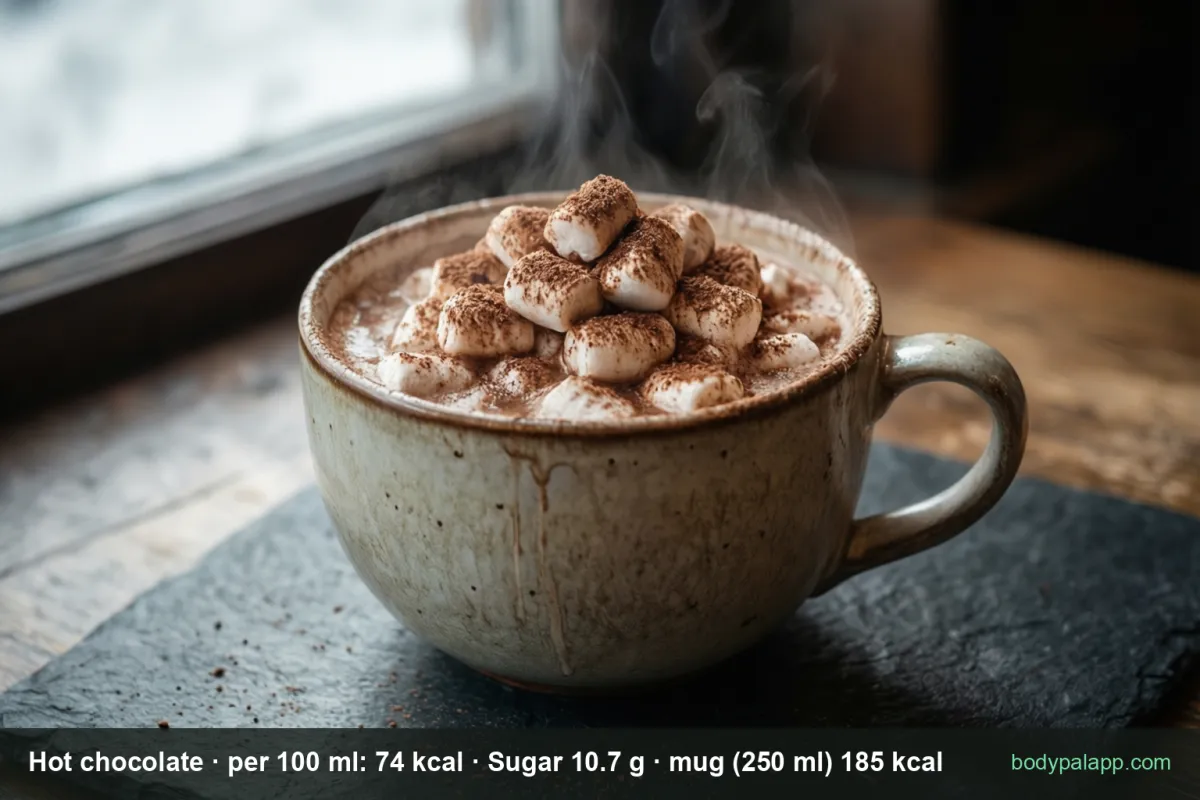
The calories in a hot chocolate come to 185 for a 250 ml mug made up with semi-skimmed milk, or 74 kcal per 100 ml. Order the large café size and you are at 259. Nothing has gone on top yet, and already this is the heaviest thing on the hot drinks menu.
On this page
- Hot chocolate nutrition at a glance
- Mug, café cup, and made with water
- The sugar is the whole story
- What cream and marshmallows do to it
- How does hot chocolate compare?
- Two things people get wrong
- Most popular hot chocolate brands
- FAQ
- Similar foods
Hot chocolate nutrition at a glance
| Nutrient | Per 100 ml | Per mug (250 ml) | %RI* per mug |
|---|---|---|---|
| Energy | 74 kcal / 310 kJ | 185 kcal / 774 kJ | 9% |
| Protein | 3.7 g | 9.3 g | 19% |
| Carbohydrate | 10.9 g | 27.3 g | 10% |
| of which sugars | 10.7 g | 26.8 g | 30% |
| Fat | 2.0 g | 5.0 g | 7% |
| Salt | 0.15 g | 0.38 g | 6% |
*%RI = percentage of the reference intake for an average adult (2,000 kcal; 70 g fat, 260 g carbohydrate, 90 g sugars, 50 g protein, 6 g salt). Figures are for drinking chocolate powder made up with semi-skimmed milk, the standard British way of making it.
Verified nutrition data
Numbers on this page come from CoFID, the UK government’s Composition of Foods Integrated Dataset, and from manufacturer labels where a branded product is named. Last verified August 2026. How we verify our data →
Look down the column and one number is doing all the work. Fat is mild, at 7% of a day. Sugars are 30%, and almost every carbohydrate gram in the mug is a sugar gram.
Mug, café cup, and made with water
| Portion | Calories |
|---|---|
| 1 mug (250 ml) | 185 kcal |
| Large café size (350 ml) | 259 kcal |
| Two mugs across an evening | 370 kcal |
The jump from a home mug to the café cup is 74 calories, which is the same as pouring yourself another third of a mug, because that is exactly what it is. Café hot chocolate is usually built on whole milk and syrup rather than a spoon of powder, so treat 259 as the floor for the shop-bought version, not the ceiling.
Most of what is in the mug arrives with the milk, not the tub. If you make it with semi-skimmed milk, that 9.3 g of protein per mug is milk protein, and it is the one genuinely useful thing here.
The sugar is the whole story
A mug carries 26.8 g of sugars, 30% of an adult's reference intake for a whole day, in a drink most people do not log at all. That is the information gain on this page: nobody worries about the fat in hot chocolate, and the fat is not the problem.
Some of that total is lactose that comes with the milk rather than sugar added by anyone. The rest is out of the tub, where sugar is usually the first ingredient. The NHS advises adults to keep free sugars under 30 g a day, and a nightly mug takes a serious bite out of that on its own.
Here is the anchor that makes it concrete. One mug is 185 kcal. Two crumpets are 190. You would notice eating two crumpets at ten o'clock at night. You would not notice drinking this.
What cream and marshmallows do to it
The rule of thumb that survives without a label: if it went on top, it costs more than the spoon of powder did. Powder is a few grams. A swirl of cream is not.
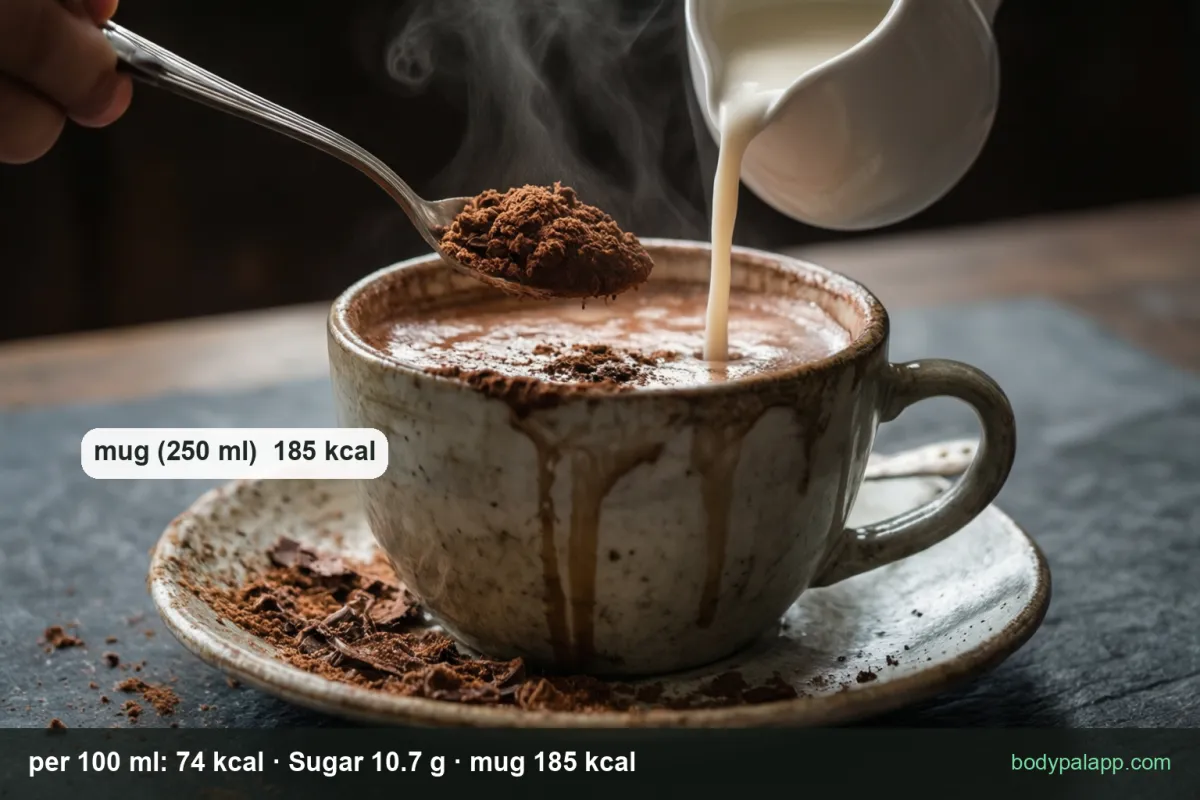
Against the rest of the hot drinks menu, the gap is wider than the queue at the counter suggests.
How does hot chocolate compare?
| Drink | Typical serving | Calories |
|---|---|---|
| Hot chocolate, semi-skimmed | 250 ml mug | 185 kcal |
| Latte | 250 ml | 108 kcal |
| Tea with milk | 1 cup | 13 kcal |
| Black coffee | 1 cup | ~1 kcal |
Per 100 ml the shape is the same: hot chocolate is 74 kcal against 43 for a latte. Both are mostly milk, so the difference is the chocolate powder and the sugar riding with it.
The verdict: if you are counting, the latte wins on calories and the hot chocolate wins on nothing except pleasure, which is a fair reason to order one anyway. For a drink you have several times a day, tea with milk at 13 kcal is the only one on this list that is genuinely free, and swapping one daily hot chocolate for one is a 172-calorie change without touching a meal.
Two things people get wrong
"It's a drink, so it doesn't really count." Liquid calories count exactly the same as chewed ones. A mug is 185 kcal, which is a biscuit-tin-sized number, and it lands in a diary far less often than a biscuit does.
"Hot chocolate is fatty." It is not, particularly. Five grams of fat per mug is 7% of a day. The sugars are 30%. If you are cutting something out of this drink, cut the second spoon of powder, not the milk, because the milk is where the protein is.
Most popular hot chocolate brands in the United Kingdom
Ranked by how widely each product appears among foods sold in the United Kingdom, from the BodyPal food database of over 3.3 million products. Calories are the figures printed on each label. A made-up mug uses far less than 100 g of powder, so check the per-serving figure on the tin.
| Product | Calories (per 100 g of powder) |
|---|---|
| Cadbury Drinking Chocolate | 400 kcal |
| Galaxy Instant Hot Chocolate | 417 kcal |
| Options Belgian Choc | 365 kcal |
| Cadbury Highlights | 345 kcal |
Brand popularity: BodyPal food database. Nutrition: manufacturer labels.
How long does it take to burn off a hot chocolate?
A 250 ml mug is 185 kcal. Enter your weight and the amount you ate to see how long it takes you to burn that off:
lb ml
| Activity | Time to burn 185 kcal |
|---|---|
| Walking, brisk | 37 min |
| Cycling, moderate | 23 min |
| Swimming, moderate | 26 min |
| Jogging | 22 min |
| Weight training, moderate | 41 min |
Times are for a 154 lb (11 st) adult at a steady pace; change the weight to see yours. The amount is set to the portion in the text (250 ml); change it to what you actually drank. BodyPal works this out from your steps automatically.
Burning it off is one side of it. The other is knowing your number: work out how many calories you need a day, with macros and a goal date.
Frequently asked questions
How many calories are in a hot chocolate?
A 250 ml mug made up with semi-skimmed milk is 185 kcal, or 74 kcal per 100 ml. The large café size, around 350 ml, comes to about 259 kcal. Cream or marshmallows on top push both figures higher again.
How many calories are in a hot chocolate made with milk?
Made with semi-skimmed milk, a mug is 185 kcal and 26.8 g of sugars. The milk is not the villain: it supplies the 9.3 g of protein in the mug and only 5 g of the fat. Whole milk lifts the total, skimmed lowers it.
How many calories are in a Cadbury's hot chocolate?
Check the tub, because branded powders vary and the same brand sells several strengths. What does not vary much is the milk you make it with, which is most of the 185 kcal in a standard mug. The powder's own figure is printed per serving on the back of the pack.
Hot chocolate or latte: which has more calories?
Hot chocolate, by some distance: 185 kcal for a 250 ml mug against 108 kcal for the same volume of latte. Per 100 ml that is 74 against 43. Both are built on milk, so the gap is the chocolate powder and its sugar.
Is hot chocolate fattening?
A mug is 185 kcal, roughly 9% of a 2,000-calorie day, so it only adds weight the way any food does, by pushing your total past what you burn. What makes it easy to overshoot is that it is a drink, and drinks get logged less often than the equivalent snack.
How much sugar is in a hot chocolate?
About 26.8 g in a 250 ml mug, or 10.7 g per 100 ml, which is 30% of the daily reference intake for sugars. Part of that is lactose from the milk and the rest comes from the powder, where sugar is usually the leading ingredient.
How many calories are in a large hot chocolate from a café?
A 350 ml café size works out at about 259 kcal on the same semi-skimmed basis. Treat that as the minimum. Shops typically use whole milk and a chocolate syrup, and the cream is offered by default rather than asked for.
Do cream and marshmallows add a lot of calories?
Yes, and they add to the two lines that are already highest: cream is mostly fat, marshmallows are mostly sugar. The plain 185 kcal mug is the floor before either of them lands.
Similar foods
- Protein shake — ~215 kcal per RTD bottle
- Whole milk — 126 kcal a glass
- Monster — 235 kcal per 500 ml can
- Semi skimmed milk — 46 kcal per 100 ml
- Can of Coke — 139 kcal a 330 ml can
- Cappuccino — 68 kcal per regular cup
Count it without the maths
BodyPal logs the mug and whatever is floating on top of it from one photo, so the drink stops being the invisible line in your day.

