
Calories in Semi Skimmed Milk: 46 per 100 ml, 261 a Pint
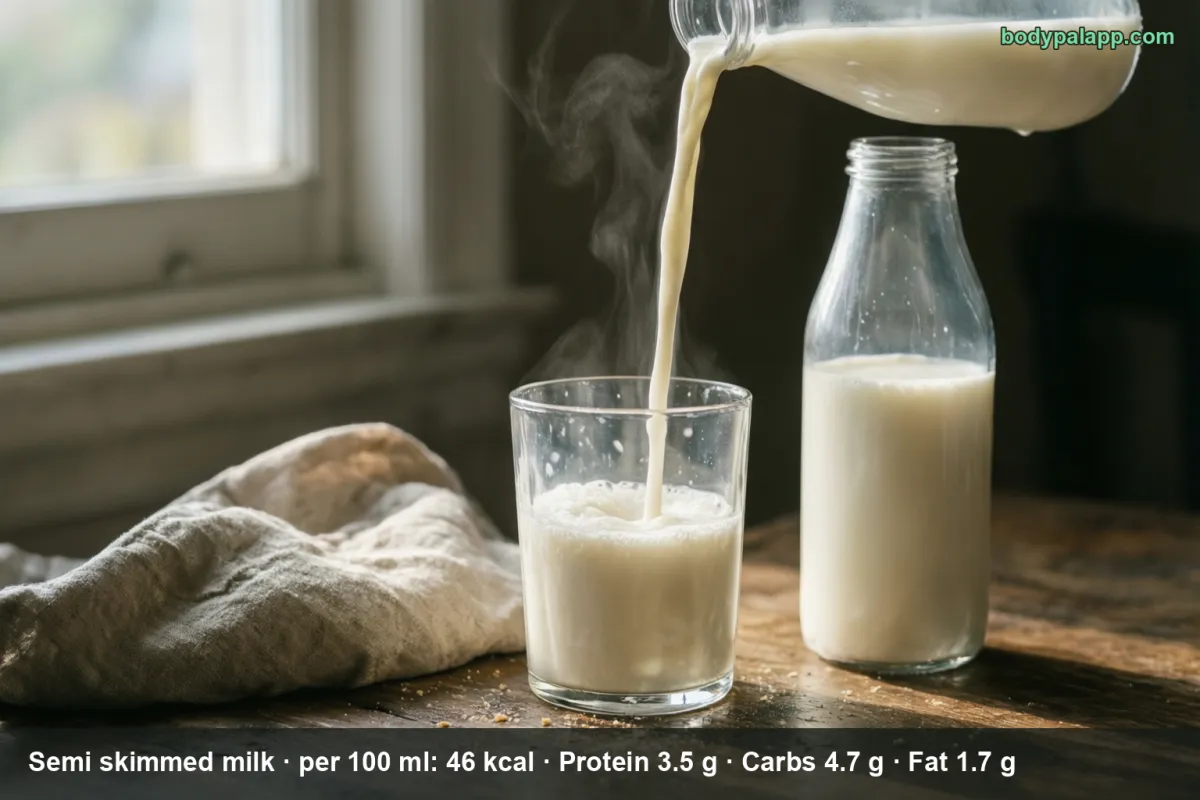
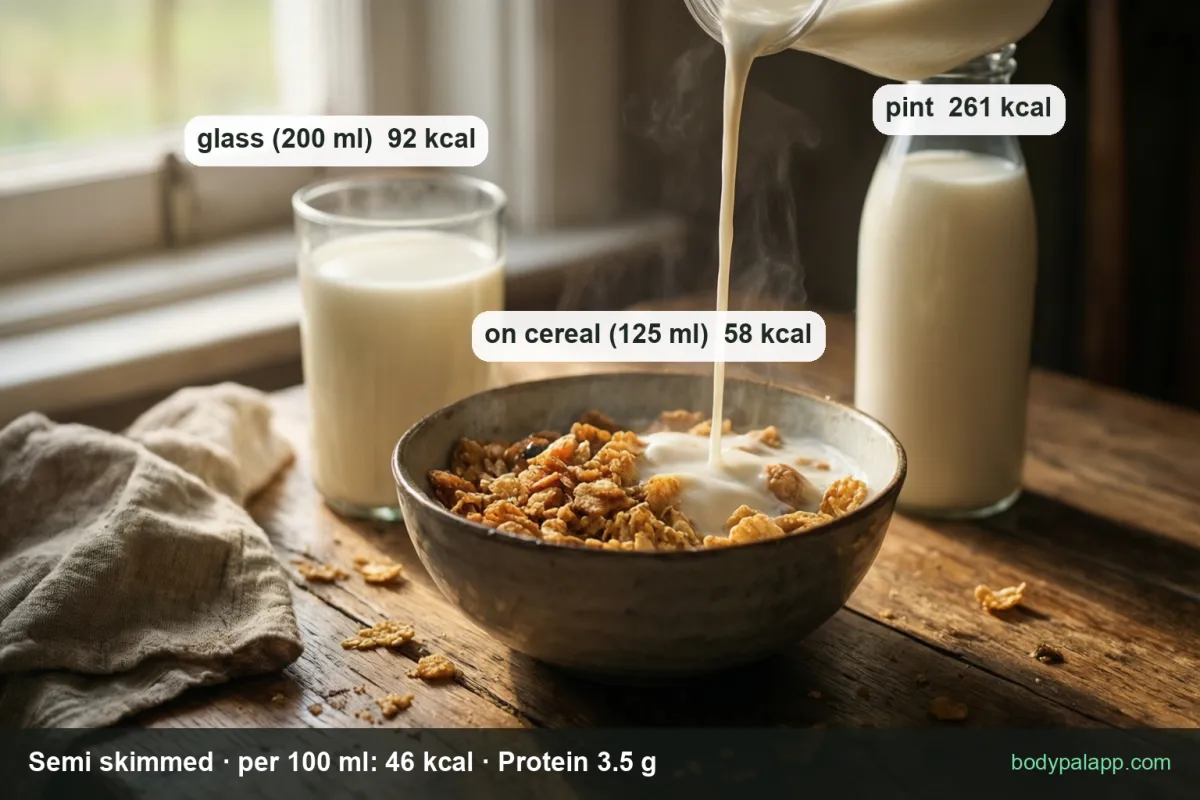
The calories in semi skimmed milk come to 46 per 100 ml, which is 92 in a 200 ml glass and 261 in a full pint. A splash in a mug of tea costs 12. It is the food most people pour every day and log the least, because it never feels like eating.
On this page
- Semi-skimmed milk nutrition at a glance
- UK portions, from a splash to a pint
- That 4.7 g of sugar is lactose
- Semi-skimmed against whole, skimmed and plant drinks
- Two things people get wrong
- Most popular semi-skimmed milk brands
- FAQ
Semi-skimmed milk nutrition at a glance
| Nutrient | Per 100 ml | Per 200 ml glass | %RI* per glass |
|---|---|---|---|
| Energy | 46 kcal / 192 kJ | 92 kcal / 385 kJ | 5% |
| Protein | 3.5 g | 7.0 g | 14% |
| Carbohydrate | 4.7 g | 9.4 g | 4% |
| of which sugars | 4.7 g | 9.4 g | 10% |
| Fat | 1.7 g | 3.4 g | 5% |
| Fibre | 0 g | 0 g | – |
| Salt | 0.11 g | 0.22 g | 4% |
*%RI = percentage of the reference intake for an average adult (2,000 kcal; 70 g fat, 260 g carbohydrate, 90 g sugars, 50 g protein, 6 g salt).
Verified nutrition data
Numbers on this page come from CoFID, the UK government’s Composition of Foods Integrated Dataset, and from manufacturer labels where a branded product is named. Last verified August 2026. How we verify our data →
Protein is the line worth staring at. One glass carries 7 g, a seventh of an adult's daily reference intake, for 92 calories. Nothing else you drink from a bottle does that.
The salt figure surprises people who spot it on the label: 0.11 g per 100 ml, so 0.62 g in a whole pint. That is a tenth of the 6 g a day the NHS advises adults to stay under, and none of it is added. Milk simply contains sodium.
UK portions, from a splash to a pint
| Portion | Volume | Calories |
|---|---|---|
| Splash in tea or coffee | 25 ml | 12 kcal |
| On cereal | 125 ml | 58 kcal |
| Glass | 200 ml | 92 kcal |
| Half pint | 284 ml | 131 kcal |
| Pint | 568 ml | 261 kcal |
Six mugs of tea in a working day is 150 ml of milk, or 72 calories, which is the number nobody writes down. It is small enough to ignore once and large enough to matter across a week. If tea is your main route to dairy, the arithmetic sits in our cup of tea breakdown.
A pint is the honest unit for anyone who gets through a bottle every couple of days. At 261 kcal it also delivers 19.9 g of protein, roughly 40% of the daily reference intake, alongside 26.7 g of carbohydrate and 9.7 g of fat. Milk is the rare calorie that brings a serious macro with it.
Cereal is where the milk hides best: a typical 125 ml pour is 58 calories before a single flake goes into the bowl. People weigh the cereal and pour the milk by eye, the same blind spot as buttering a crumpet without looking at the knife.
That 4.7 g of sugar is lactose
The label says 4.7 g of sugars per 100 ml. In a glass that reads as 9.4 g, in a pint 26.7 g, and it looks like something has been sweetened. Nothing has.
Every gram of it is lactose, the sugar that occurs naturally in milk from the cow. There is no unsweetened semi-skimmed milk on the shelf, because there is no sweetened version to distinguish it from. UK guidance keeps sugars in plain milk out of the free sugars count for exactly that reason, and the NHS milk and dairy pages treat dairy as a food group rather than a sugar source.
That stops applying the moment milk becomes a drink with a recipe. Flavoured milkshakes and a mug of hot chocolate carry added sugar on top of the lactose, and the label will not separate the two for you.
The bottle in the door has two neighbours on the shelf, and three more that are not milk at all.
Semi-skimmed against whole, skimmed and plant drinks
| Drink | Per 100 ml | Per 200 ml glass |
|---|---|---|
| Whole milk | 63 kcal | 126 kcal |
| Semi-skimmed milk | 46 kcal | 92 kcal |
| Skimmed milk | 34 kcal | 68 kcal |
| Oat drink (Oatly) | 48 kcal | 96 kcal |
| Unsweetened almond drink (Alpro) | 14 kcal | 28 kcal |
The verdict: for a calorie deficit that you barely feel, semi-skimmed over whole saves 17 kcal per 100 ml, which is about 97 calories across a pint, and going down to skimmed saves another 68 per pint. For everything else, whole milk's fat is what carries the fat-soluble vitamins, so the saving is not free. Semi-skimmed sits where most people want to sit: 1.7 g of fat per 100 ml, 17 calories under whole, and the 3.5 g of protein left alone.
The plant drinks split cleanly. Unsweetened almond at 14 kcal per 100 ml is by far the lightest thing on the table, but its protein is a fraction of milk's 3.5 g, so it thins a coffee rather than replacing a glass. Oat lands at 48, above semi-skimmed, which catches out anyone who assumed plant automatically meant lighter. The NHS Eatwell Guide puts dairy and its alternatives in one slice of the plate, and on these numbers the choice between them is about protein, not calories.
Two things people get wrong
"Semi-skimmed is half the calories of whole." It is not. Whole is 63 kcal per 100 ml and semi-skimmed is 46, a cut of 27%, not 50%. The word semi describes the fat that was taken out, never the energy, and the protein and lactose stay exactly where they were.
"Any plant drink is the lighter choice." Oat drink is 48 kcal per 100 ml, two above semi-skimmed and 14 above skimmed. Almond is genuinely light at 14, and that is because it is mostly water.
Most popular semi-skimmed milk brands in the United Kingdom
Ranked by how widely each product appears among foods sold in the United Kingdom, from the BodyPal food database of over 3.3 million products. Calories are the figures printed on each label. Whichever chiller you buy from, the number barely moves.
| Product | Calories (per 100 ml) |
|---|---|
| Tesco British Semi Skimmed Milk | 50 kcal |
| Waitrose Semi Skimmed Milk | 49 kcal |
| Milbona Semi Skimmed Milk (Lidl) | 47 kcal |
| Cowbelle Semi-Skimmed Milk (Aldi) | 49 kcal |
Brand popularity: BodyPal food database. Nutrition: manufacturer labels.
How long does it take to burn off semi skimmed milk?
100 ml is 46 kcal. Enter your weight and the amount you ate to see how long it takes you to burn that off:
lb ml
| Activity | Time to burn 46 kcal |
|---|---|
| Walking, brisk | 9 min |
| Cycling, moderate | 6 min |
| Swimming, moderate | 7 min |
| Jogging | 5 min |
| Weight training, moderate | 10 min |
Times are for a 154 lb (11 st) adult at a steady pace; change the weight to see yours. The amount is set to the portion in the text (100 ml); change it to what you actually drank. BodyPal works this out from your steps automatically.
This table assumes you know your daily total. If you do not, the daily calorie calculator works it out from five numbers.
Frequently asked questions
How many calories are in a pint of semi-skimmed milk?
A pint of semi-skimmed milk is 261 kcal at 568 ml, and a half pint is 131 kcal. It also brings 19.9 g of protein, around 40% of an adult's daily reference intake. Per 100 ml the figure is 46 kcal, so any volume is easy to work out from there.
How many calories are in a glass of semi-skimmed milk?
A 200 ml glass is 92 kcal, with 7 g of protein and 3.4 g of fat. A smaller 125 ml pour, the amount most people use on cereal, is 58 kcal. Glass sizes vary more than anyone admits, so check yours once with a measuring jug.
How many calories does a splash of milk in tea add?
A 25 ml splash adds 12 kcal to a mug. Six mugs across a day is 150 ml, or 72 kcal, which is the amount that quietly escapes most food diaries. Coffee with a generous pour lands closer to 25 kcal, since the volume roughly doubles.
What is the difference between semi-skimmed and whole milk?
Whole milk is 63 kcal per 100 ml against 46 for semi-skimmed, a difference of 17 kcal per 100 ml or about 97 across a pint. The gap is fat. Whole milk's extra fat is also what carries its fat-soluble vitamins, so the two are not simply better and worse versions of each other.
Is semi-skimmed milk good for weight loss?
A glass is 92 kcal for 7 g of protein, which is a strong ratio for a drink and fits a deficit without much thought. Skimmed saves a further 12 kcal per 100 ml if you drink it by the pint. The bigger win for most people is measuring the pour rather than changing the bottle.
Why does semi-skimmed milk have sugar in it?
The 4.7 g of sugars per 100 ml is lactose, the sugar naturally present in milk, and none of it is added. A glass shows 9.4 g and a pint 26.7 g on that basis. UK guidance keeps sugars in plain milk outside the free sugars count, unlike flavoured or sweetened milk drinks.
How much protein is in semi-skimmed milk?
Semi-skimmed milk has 3.5 g of protein per 100 ml: 7 g in a 200 ml glass and 19.9 g in a pint. Skimming takes out fat, not protein, which is why milk keeps this line whatever the colour of the cap. An unsweetened almond drink carries only a fraction of it.
Is semi-skimmed milk lower in calories than oat milk?
Yes, narrowly. Semi-skimmed is 46 kcal per 100 ml and a standard oat drink is 48, so a 200 ml glass is 92 against 96. The meaningful difference is protein rather than energy: milk holds 3.5 g per 100 ml, and oat drinks are built from a grain rather than a bean.
Similar foods
- Monster — 235 kcal per 500 ml can
- Can of Coke — 139 kcal a 330 ml can
- Whole milk — 126 kcal a glass
- Cappuccino — 68 kcal per regular cup
- Latte — 68 kcal a mug at home
- Lucozade Sport — 135 kcal a 500 ml bottle
Count it without the maths
BodyPal logs the glass, the cereal pour and the splash in your tea from one photo, so the milk stops disappearing from your day.

