
How Many Calories in a Roll and Bacon?
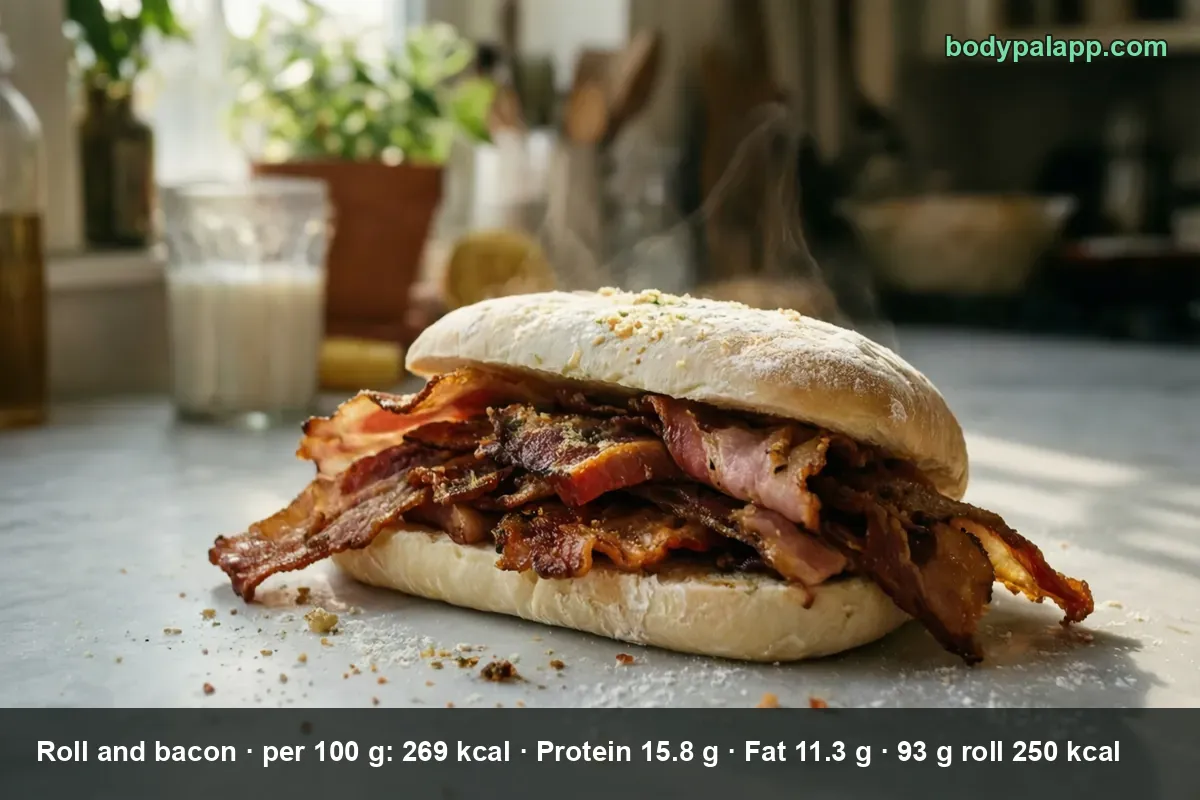
A roll and bacon — one 50 g morning roll, two rashers of back bacon, nothing spread on it — is 250 calories, which works out at 269 kcal per 100 g. Butter takes it to 324. A third rasher takes it to 311. The salt in the plain one is 1.98 g, a third of an adult's day.
On this page
- Roll and bacon quick facts
- A 50 g roll and two rashers
- Butter, sauce and the third rasher
- Which bacon you buy moves the number
- Where the salt comes from
- Roll and bacon against the breakfast counter
- Popular bacon roll products
- Roll and bacon FAQs
Roll and bacon quick facts
The build below is the Scottish standard: a soft white morning roll of 50 g, two grilled back rashers, no butter. Assembled, it weighs 93 g.
| Nutrient | Per 100 g | 93 g roll | RI%* |
|---|---|---|---|
| Energy | 269 kcal / 1,126 kJ | 250 kcal / 1,046 kJ | 13% |
| Protein | 15.8 g | 14.6 g | 29% |
| Carbohydrates | 27.8 g | 25.8 g | 10% |
| – of which sugars | 1.4 g | 1.3 g | 1% |
| Fat | 11.3 g | 10.5 g | 15% |
| – of which saturates | 4.1 g | 3.8 g | 19% |
| Fibre | 1.4 g | 1.3 g | – |
| Salt | 2.14 g | 1.98 g | 33% |
Verified nutrition data
Numbers on this page come from CoFID, the UK government’s Composition of Foods Integrated Dataset, and from manufacturer labels where a branded product is named. Last verified September 2026. How we verify our data →
*RI% = one roll's share of an adult's daily reference intake, based on 2,000 kcal.
Read that table across and the roll comes out well. Thirteen per cent of the day's calories for 29% of the day's protein is a good trade at eight in the morning, and 250 kcal is a light breakfast by any measure. The salt line is the one that spoils it, and it gets a section of its own further down.
A 50 g roll and two rashers
Almost every calorie figure published for a bacon roll makes the same mistake, which is to use the weight of the bacon in the packet rather than the weight of the bacon on the roll.
Bacon loses water on the grill. How much can be worked out rather than guessed, because protein does not disappear during cooking: raw back bacon holds 16.5 g of protein per 100 g and grilled back bacon holds 23.2 g. Divide one by the other and the yield is 0.711. A 30 g raw rasher — the standard slice in a British pack — lands on the roll at 21 g, carrying 61 kcal.
That gives the assembly:
| Component | Weight on the roll | Calories |
|---|---|---|
| Morning roll, white, soft | 50 g | 127 kcal |
| First rasher, grilled | 21 g | 61 kcal |
| Second rasher, grilled | 21 g | 61 kcal |
| Total | 93 g | 250 kcal |
The split is the surprise. The bread supplies 127 calories and the meat supplies 123. People order a bacon roll thinking about the bacon and it is the flour that costs them slightly more.
There is a neat check on all of this. Greggs sells a bacon roll without butter and lists it at 269 kcal per 100 g, with 16.0 g protein, 28.0 g carbohydrate and 10.0 g fat. Our assembly says 269 kcal per 100 g, with 15.8 g protein, 27.8 g carbohydrate and 11.3 g fat. The two agree to the calorie, and 250 kcal divided by 269 puts the Greggs roll at 93 g — the same weight we built.
Butter, sauce and the third rasher
| Build | Weight | Calories | Salt |
|---|---|---|---|
| Roll on its own | 50 g | 127 kcal | 0.50 g |
| Roll and one rasher | 71 g | 188 kcal | 1.24 g |
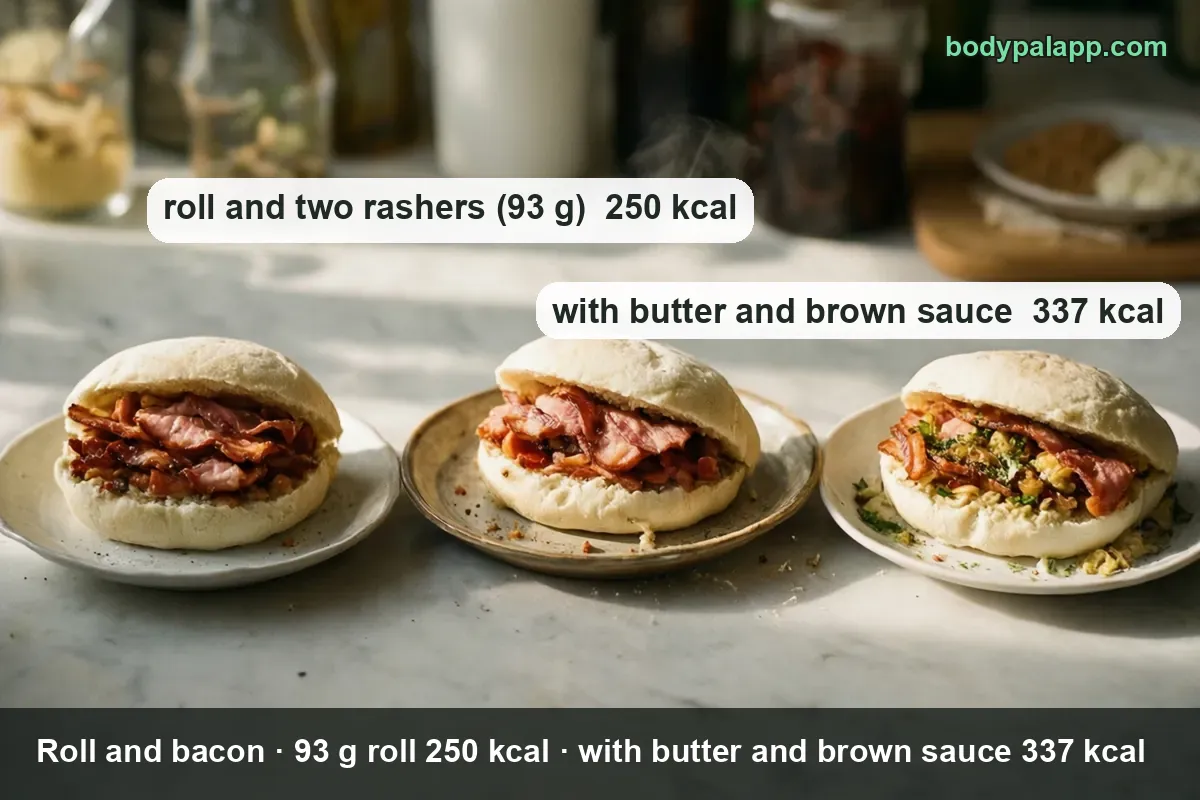
| Roll and two rashers | 93 g | 250 kcal | 1.98 g |
| Plus brown sauce, 15 g | 108 g | 263 kcal | 2.13 g |
| Plus tomato ketchup, 15 g | 108 g | 267 kcal | 2.28 g |
| Three rashers instead of two | 114 g | 311 kcal | 2.72 g |
| Plus butter, 10 g | 103 g | 324 kcal | 2.17 g |
| Butter and brown sauce | 118 g | 337 kcal | 2.32 g |
Sauce is free, near enough. A spoonful of brown sauce costs 13 calories and ketchup 17 — less than a third of a rasher either way, though ketchup brings 4 g of sugar with it and brown sauce a gram less salt.
Butter is not free. Ten grams of it is 74 calories, more than a whole rasher of bacon at 61. Spreading the roll adds 30% to a breakfast in a step most people would not think to log at all, and it is the single reason a café roll and a home-made one can be a hundred calories apart.
The third rasher costs 61 calories and 0.74 g of salt. Compared with butter, it is a much better use of the same energy: it buys 4.9 g of protein, where the butter buys none.
Which bacon you buy moves the number
Every rasher below is 30 g raw, 21 g grilled — the same slice from a different packet.
| Rasher, 21 g grilled | Calories | Salt |
|---|---|---|
| Back, fat trimmed | 46 kcal | 0.76 g |
| Back, dry cured | 55 kcal | 0.92 g |
| Back, reduced salt | 60 kcal | 0.60 g |
| Back, standard | 61 kcal | 0.74 g |
| Back, smoked | 62 kcal | 0.74 g |
| Middle | 65 kcal | 0.74 g |
| Streaky | 72 kcal | 0.89 g |
The spread from trimmed back to streaky is 26 calories per rasher. Build the same roll with two streaky rashers instead of two trimmed ones and you have added 52 calories without changing anything you would notice on the plate. Smoked or unsmoked makes a difference of one calorie, so buy whichever you prefer.
Reduced-salt bacon is the row that earns its price. It costs the same 60 calories as ordinary back and takes 0.14 g of salt off each rasher, which is 0.28 g across the roll.
Where the salt comes from
A roll and bacon carries 1.98 g of salt before any sauce touches it. The adult limit is 6 g a day, so one breakfast has spent a third of it.
The blame splits three ways to one. Two rashers contribute 1.48 g and the roll contributes 0.50 g, so bacon is 75% of the total. Add brown sauce and it reaches 2.13 g; go to three rashers and it reaches 2.72 g, which is 45% of the day in one hand.
Bacon is cured in salt, and the NHS notes that processed meats carry more salt and saturated fat than fresh cuts. The saturated fat side of that is real but modest here: 3.8 g in the roll, 19% of the daily reference intake, most of it from the fat strip along the back rasher. Trimming it takes the roll to about 220 kcal and cuts the saturates further, which the NHS guidance on fats would call the better swap of the two.
If salt is the number you watch, the useful move is not skipping the bread. It is buying reduced-salt bacon and leaving the sauce bottle where it is.
Roll and bacon against the breakfast counter
| Item | Per 100 g | Typical serving | Calories |
|---|---|---|---|
| Roll and bacon | 269 kcal | 93 g | 250 kcal |
| Bacon sandwich | 287 kcal | one round | 314 kcal |
| Sausage roll | 352 kcal | one | 348 kcal |
| Burger bun | 254 kcal | one bun | 152 kcal |
| White bread | 236 kcal | 36 g slice | 85 kcal |
| Full English breakfast | 160 kcal | full plate | 1,093 kcal |
The pairing to look at is the first two rows. A bacon sandwich made with two slices of white bread is 314 kcal, against 250 for the roll — 64 calories more, from bread alone. Two slices weigh 72 g and a morning roll weighs 50 g. Same bacon, same grill, smaller bread.
On the high street the range is wider than any of that. The Greggs roll without butter is the lightest thing on the list at 250 kcal; a buttered bap at Costa is 274; Asda's brioche version is 319; a Co-op bacon bap is 365 and a Starbucks smoked bacon roll reaches 400. The gap between the best and worst is a second breakfast, and it is mostly butter and bap size.
Our take: for a breakfast under 300 calories with real protein in it, a plain roll and bacon is one of the best things a British counter sells — 250 kcal and 14.6 g of protein beats almost anything in the pastry cabinet. If you want it lighter, drop the butter before you drop the bacon; if you want it to hold you until lunch, add the third rasher rather than the spread. And treat the salt as the ceiling, not the calories: two of these in a day is two thirds of your daily allowance before dinner.
Popular bacon roll products in the BodyPal food database
Ranked by how widely each product appears among foods sold in the United Kingdom, from the BodyPal food database of over 3.3 million products. Calories are the figures printed on each label.
| Product | Calories (per 100 g) |
|---|---|
| Greggs Bacon Roll (no butter) | 269 kcal |
| Costa Bacon Bap | 324 kcal |
| Costa Smoked Bacon Bap | 277 kcal |
| Sainsbury's Bacon Bap | 286 kcal |
| Sainsbury's Bacon Sandwich | 270 kcal |
Brand popularity: BodyPal food database. Nutrition: manufacturer labels.
Roll and bacon FAQs
How many calories in a roll and bacon?
250 calories for a 50 g morning roll with two rashers of grilled back bacon and no butter, which is 269 kcal per 100 g. With butter it is 324 kcal, and with a third rasher instead of butter it is 311 kcal.
How many calories in a bacon roll with butter?
324 calories, using 10 g of butter on a roll with two rashers. The butter alone is 74 calories, which is more than a whole rasher of bacon at 61. Add brown sauce as well and the roll reaches 337 calories.
How many calories in a Greggs bacon roll?
250 calories for the version without butter, listed at 269 kcal per 100 g on a roll of about 93 g. Its macros are 16.0 g of protein, 28.0 g of carbohydrate and 10.0 g of fat, which is within a rounding error of a home-made roll.
How many calories in 2 rashers of bacon?
123 calories for two standard back rashers, grilled. Each one starts at 30 g raw and finishes at 21 g on the plate, at 61 calories. Streaky rashers come to 144 calories for the pair; fat-trimmed back comes to 92.
How many calories in a Scottish morning roll?
127 calories for a standard 50 g roll on its own. Supermarket labels for morning rolls run from 260 to 328 kcal per 100 g, so a single roll is 130 to 164 calories depending on the bakery. It carries 0.50 g of salt.
Bacon roll or bacon sandwich — which has fewer calories?
The roll, by 64 calories: 250 against 314. The bacon is identical in both. Two slices of white bread weigh 72 g and a morning roll weighs 50 g, and that 22 g of extra bread is the entire difference.
How much salt is in a bacon roll?
1.98 g, which is 33% of the 6 g adult daily limit. The bacon supplies 1.48 g of that and the roll 0.50 g. Brown sauce takes it to 2.13 g and a third rasher to 2.72 g, or 45% of the day.
Is a bacon roll a good breakfast?
On calories and protein it holds up: 250 kcal and 14.6 g of protein, with 3.8 g of saturates. Salt is the weak point at 1.98 g a roll, and cured meat is the source of most of it. Reduced-salt rashers take 0.28 g off without changing the calories.
Similar foods
- Pancake — 187 kcal each
- Hash brown — 127 kcal each at McDonald’s
- Weetabix — 136 kcal for two biscuits
- Duck eggs — ~106 kcal each
- Porridge — 168 kcal a bowl with semi milk
- Eggs — 72 kcal per boiled medium egg
One photo, both numbers
Point the camera at the plate before the first bite and BodyPal puts the calories and the salt in the same log entry.


How long does it take to burn off a roll and bacon?
A 50 g roll with two rashers is 250 kcal. Enter your weight and the amount you ate to see how long it takes you to burn that off:
lb
| Activity | Time to burn 250 kcal |
|---|---|
| Walking, brisk | 50 min |
| Cycling, moderate | 31 min |
| Swimming, moderate | 36 min |
| Jogging | 29 min |
| Weight training, moderate | 56 min |
Times are for a 154 lb (11 st) adult at a steady pace; change the weight to see yours. The amount is set to the portion in the text (50 g); change it to what you actually ate. BodyPal works this out from your steps automatically.
Burning it off is one side of it. The other is knowing your number: work out how many calories you need a day, with macros and a goal date.