
How Many Calories Are in Eggs? From 72 a Boiled Egg Upwards
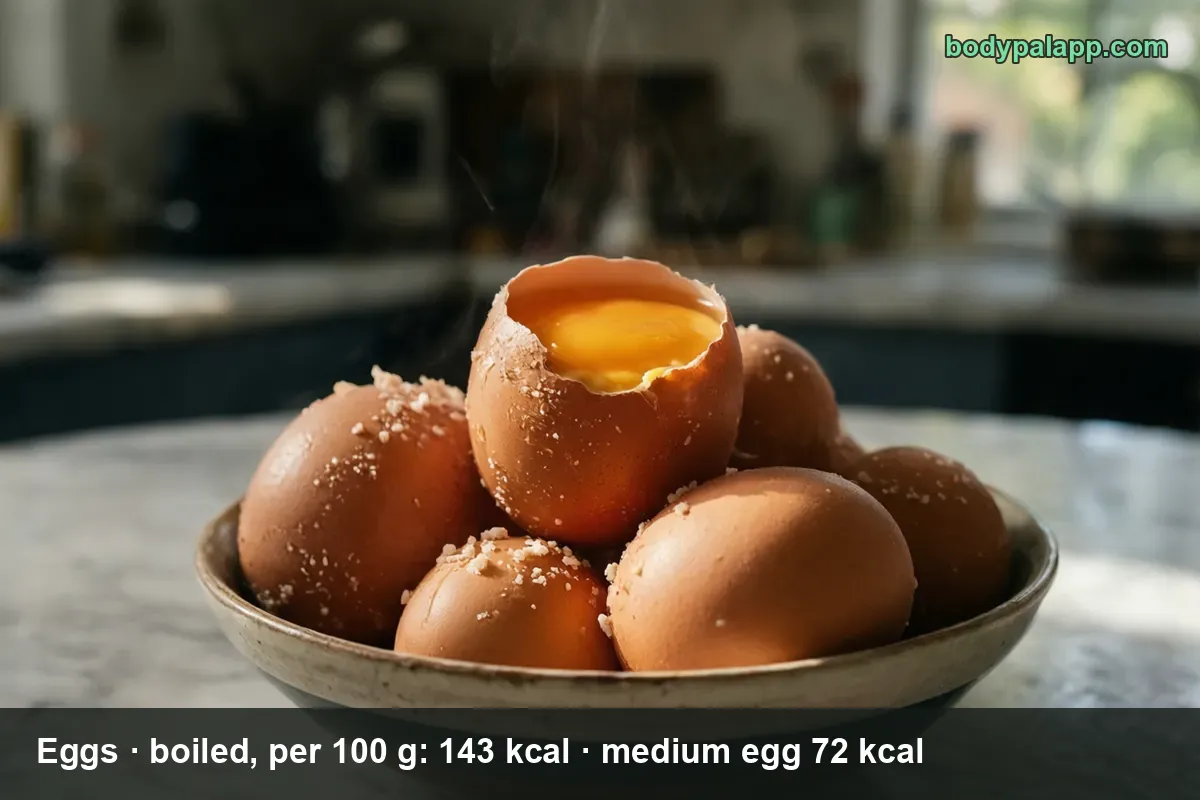
A medium boiled egg is 72 calories. Per 100 g, eggs come to 143 kcal, and that modest number carries 14.1 g of protein, which is why nothing else at breakfast earns its calories quite so well. That is the short answer to how many calories are in eggs. The pan writes the rest: 75 poached, about 100 fried, 284 for a two-egg scramble.
On this page
- Egg nutrition at a glance
- Calories by egg size and count
- The pan changes the number
- White and yolk are two different foods
- The weekly egg budget
- How do eggs compare with other proteins?
- The cholesterol question
- Most popular egg brands
- FAQ
Egg nutrition at a glance
Figures are for boiled eggs, the plainest way to eat one.
| Nutrient | Per 100 g | Per medium egg (~50 g) | %RI* per egg |
|---|---|---|---|
| Energy | 143 kcal / 598 kJ | 72 kcal / 301 kJ | 4% |
| Protein | 14.1 g | 7.1 g | 14% |
| Carbohydrate | 0 g (trace) | 0 g (trace) | – |
| of which sugars | 0 g (trace) | 0 g (trace) | – |
| Fat | 9.6 g | 4.8 g | 7% |
| Fibre | 0 g | 0 g | – |
| Salt | 0.38 g | 0.19 g | 3% |
*%RI = percentage of the reference intake for an average adult (2,000 kcal; 70 g fat, 260 g carbohydrate, 90 g sugars, 50 g protein, 6 g salt).
Verified nutrition data
Numbers on this page come from CoFID, the UK government’s Composition of Foods Integrated Dataset, and from manufacturer labels where a branded product is named. Last verified August 2026. How we verify our data →
Read the protein line against the energy line. One egg gives you 14% of a day's protein reference intake for less than 4% of the calories. A food that trades at that rate is rare, and it is the whole case for eggs in a diet that counts anything.
There is effectively no carbohydrate in an egg, and no fibre. What an egg is, in macro terms, is protein and fat in a shell.
Calories by egg size and count
Egg boxes sell size, so the counting is really about size and multiplication.
| Portion | Calories |
|---|---|
| Medium boiled egg (~50 g edible) | 72 kcal |
| Large boiled egg (~57 g edible) | 82 kcal |
| Two medium boiled eggs | 143 kcal |
| Four medium boiled eggs | 286 kcal |
| Poached egg, medium | 75 kcal |
| Fried egg, medium | ~100 kcal |
| Scrambled eggs, two-egg serving (~120 g, made with milk) | 284 kcal |
Four eggs at 286 kcal is worth pausing on, because it also delivers around 28 g of protein. A gym breakfast built on four boiled eggs costs less energy than many single pastries, which is the kind of arithmetic that makes a full English breakfast look expensive by comparison: on that plate, the eggs are the cheap part.
Large versus medium matters less than people think. Ten calories per egg, roughly, and the protein scales with it.
The pan changes the number
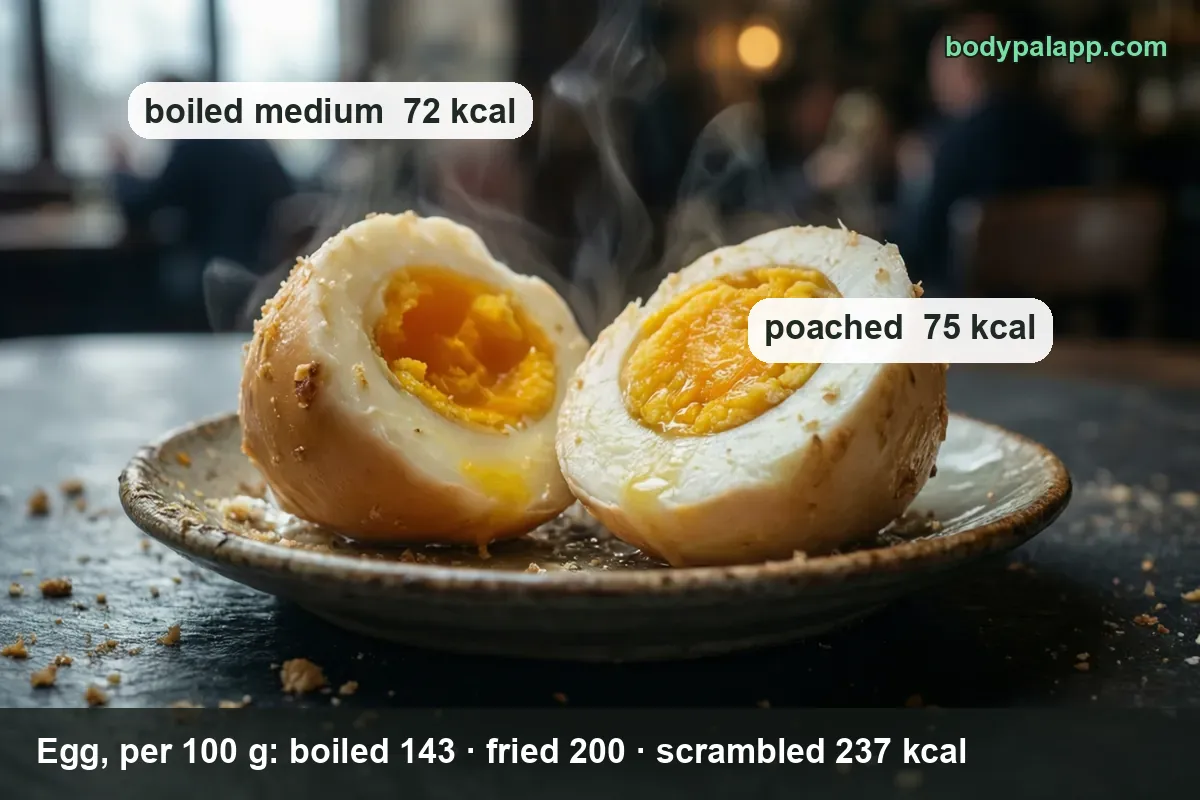
Boiling and poaching add nothing, because water is free. A poached egg reads 149 kcal per 100 g, or about 75 for a medium egg, and the small rise over raw comes from what cooking does to the water content, not from anything added.
Frying is a different story. A fried egg comes to 200 kcal per 100 g, around 100 for a medium egg, and the extra is the sunflower oil that clings to it. Call it 28 calories for the privilege of crispy edges.
Scrambled sits highest of all: 237 kcal per 100 g made with milk and butter in the pan, so a two-egg serving lands near 284. It is still a strong breakfast, but the milk and fat quietly double the cost of the eggs themselves. If your scramble goes on toast, the bread starts from its own number; our white bread page has the per-slice figures.
White and yolk are two different foods
Split an egg and the calories do not split evenly. Egg white runs 52 kcal per 100 g with 10.9 g of protein and almost no fat at 0.2 g. Egg yolk runs 322 kcal per 100 g, with 15.9 g of protein and 26.5 g of fat.
So the white is nearly pure protein, and the yolk holds nearly all the energy, all the fat, and most of the flavour. An egg-white omelette is a legitimate cut if you want volume for very little energy. Just be honest about what you are giving up: the yolk is also where the egg's vitamins and richness live, which is why whites alone taste like the compromise they are.
The weekly egg budget
Eggs are one of the most-logged breakfasts in BodyPal, and the diaries show a pattern worth copying: the egg is rarely the problem, the vehicle is. Two poached eggs are 150 kcal; the buttered toast underneath them can cost more than both eggs together.
Run the week and the shapes are clear. Five weekday breakfasts of two boiled eggs come to 715 kcal for the working week, with about 71 g of protein attached. One weekend fry-up swaps those eggs into a pan next to bacon and sausage, where the same two eggs, fried, are 200 kcal, and everything around them does the real damage. A bacon sandwich with an egg added is carrying the bread and the bacon, not an egg problem.
The practical rule: budget the egg by how it is cooked, then watch what it sits on. Boiled and poached eggs are as close to a fixed price as cooked food gets, which makes them the easiest protein in the kitchen to log accurately.
How do eggs compare with other proteins?
| Food | Per portion | Per 100 g | Protein | Carbs | Fat |
|---|---|---|---|---|---|
| Boiled egg (medium) | 72 kcal | 143 kcal | 14.1 g | 0 g | 9.6 g |
| Duck egg (one, raw basis) | 106 kcal | 163 kcal | 14.3 g | 0 g | 11.8 g |
| Grilled chicken breast (~130 g) | 191 kcal | 147 kcal | 29.8 g | 0 g | 3.1 g |
| Whole milk (200 ml glass) | 126 kcal | 63 kcal | 3.4 g | 4.6 g | 3.6 g |
The verdict: for the cheapest possible protein start to the day, the boiled egg wins on convenience and cost per calorie. For sheer protein, chicken breast is the stronger tool, carrying twice the protein of egg per 100 g with a third of the fat. The duck egg is simply a bigger, richer version of the same idea.
The cholesterol question
For decades people binned eggs over cholesterol, and the advice has moved on. The NHS eggs guidance notes there is no recommended limit on how many eggs people should eat, and that for most people dietary cholesterol has much less effect on blood cholesterol than saturated fat does.
On that front an egg is mild: 1.4 g of saturated fat in a medium egg, 7% of the 20 g daily reference intake. The saturated fat in an egg breakfast usually arrives with the butter, the bacon and the sausage, not the egg. The NHS Eatwell Guide counts eggs in the beans, pulses, fish, eggs and meat group, which is polite official language for: eat them.
Most popular egg brands in the United Kingdom
Ranked by how widely each product appears among foods sold in the United Kingdom, from the BodyPal food database of over 3.3 million products. Calories are the figures printed on each label. All three sit within a whisker of the CoFID raw-egg figure of 131, which is exactly what you would hope: an egg is an egg.
| Product | Calories (per 100 g) |
|---|---|
| Lodge Farms Free Range Eggs (Aldi) | 143 kcal |
| The Happy Egg Co. Large Eggs | 139 kcal |
| Clarence Court Burford Browns | 131 kcal |
Brand popularity: BodyPal food database. Nutrition: manufacturer labels.
How long does it take to burn off eggs?
A medium boiled egg is 72 kcal. Enter your weight to see how long it takes you to burn that off:
lb
| Activity | Time to burn 72 kcal |
|---|---|
| Walking, brisk | 14 min |
| Cycling, moderate | 9 min |
| Swimming, moderate | 10 min |
| Jogging | 8 min |
| Weight training, moderate | 16 min |
Times are for a 154 lb (11 st) adult at a steady pace; change the weight to see yours. BodyPal works this out from your steps automatically.
This table assumes you know your daily total. If you do not, the daily calorie calculator works it out from five numbers.
Frequently asked questions
How many calories are in 4 eggs?
Four medium boiled eggs come to 286 kcal, with roughly 28 g of protein between them. Fried, the same four eggs land near 400 kcal because of the oil. Boiled or poached is the way to eat eggs in numbers without the calories climbing with them.
How many calories are in a hard boiled egg?
A hard boiled medium egg is 72 kcal, the same as a soft boiled one. Cooking time changes the texture of the yolk, not the energy. Per 100 g boiled eggs are 143 kcal, so a large egg works out around 82.
How many calories are in an egg white?
Egg white is 52 kcal per 100 g, with 10.9 g of protein and just 0.2 g of fat. The white from a single egg therefore contributes only a small share of the egg's 72 kcal. Almost all the energy sits in the yolk.
How many calories are in an egg yolk?
Egg yolk is 322 kcal per 100 g, with 26.5 g of fat and 15.9 g of protein. That is six times the calorie density of the white. It is also where the fat-soluble vitamins and the flavour are, so a yolk is expensive but not empty.
How many calories are in a 3 egg omelette?
Three medium raw eggs come to about 197 kcal, and a teaspoon of butter in the pan adds 37, so a plain three-egg omelette lands around 234 kcal. Cheese changes that quickly: a generous grating can add more than the third egg did.
How many calories in scrambled egg on toast?
A two-egg scramble made with milk is about 284 kcal before the bread. Add a slice of toast and whatever you spread on it, and most versions pass 400 kcal. The scramble itself is the biggest single item on the plate.
How much protein and how many calories in an egg?
A medium boiled egg carries 72 kcal and 7.1 g of protein, which is 14% of an adult's daily reference intake for under 4% of the energy. Per 100 g the figures are 143 kcal and 14.1 g. Few everyday foods trade protein for calories at that rate.
Are eggs good for weight loss?
At 72 kcal for a boiled medium egg with 7.1 g of protein, eggs fit a calorie deficit better than almost any other cooked breakfast item. The catch is the cooking: frying adds around 28 kcal per egg and a buttery scramble roughly doubles the cost.
How many eggs a day can I eat?
The NHS sets no recommended limit on eggs, so the practical ceiling is your overall balance rather than a fixed count. Three boiled eggs is 215 kcal, which fits most days easily. If you are watching saturated fat, the butter and bacon beside the eggs matter more.
Do fried eggs have many more calories than boiled?
A fried medium egg is about 100 kcal against 72 boiled, so the pan costs you roughly 28 kcal per egg in clinging oil. Over a two-egg breakfast every day, that is a difference of about 390 kcal a week for the same eggs.
Similar foods
- Greek yogurt — 226 kcal per 170 g pot
- Duck eggs — ~106 kcal each
- Hash brown — 127 kcal each at McDonald’s
- Pancake — 187 kcal each
- Bacon roll — 250 kcal per roll
- Weetabix — 136 kcal for two biscuits
Count it without the maths
Point BodyPal at the plate and it logs the eggs, the toast and the butter in one photo, however you cooked them.

